

The Palestinian Environmental Quality Authority estimates, on 6 November 2026, that Israeli destruction produced between 61 and 68 million tons of rubble in Gaza. It also reports massive losses in agriculture and water systems. Under the ruins, unexploded ordnance, hazardous materials and remains delay the clearance. The rehabilitation of land and pipelines is a condition for the return of residents as well as the reconstruction of housing.
The alert takes place on the occasion of the International Day for the Prevention of Environmental Exploitation in Time of War. The Palestinian Authority claims that Israeli operations destroyed or levelled 82 per cent of agricultural land. It is also advancing the destruction of 97% of fruit trees and olive trees and 84% of water and sanitation infrastructure.
International assessments document a devastation of comparable magnitude, with different categories. They measure damaged crop areas, out-of-service facilities or land that has become inaccessible. Several international assessments are based on 2025 observations. The latest available surveys also show that loss of access may prevent production on undamaged plots.
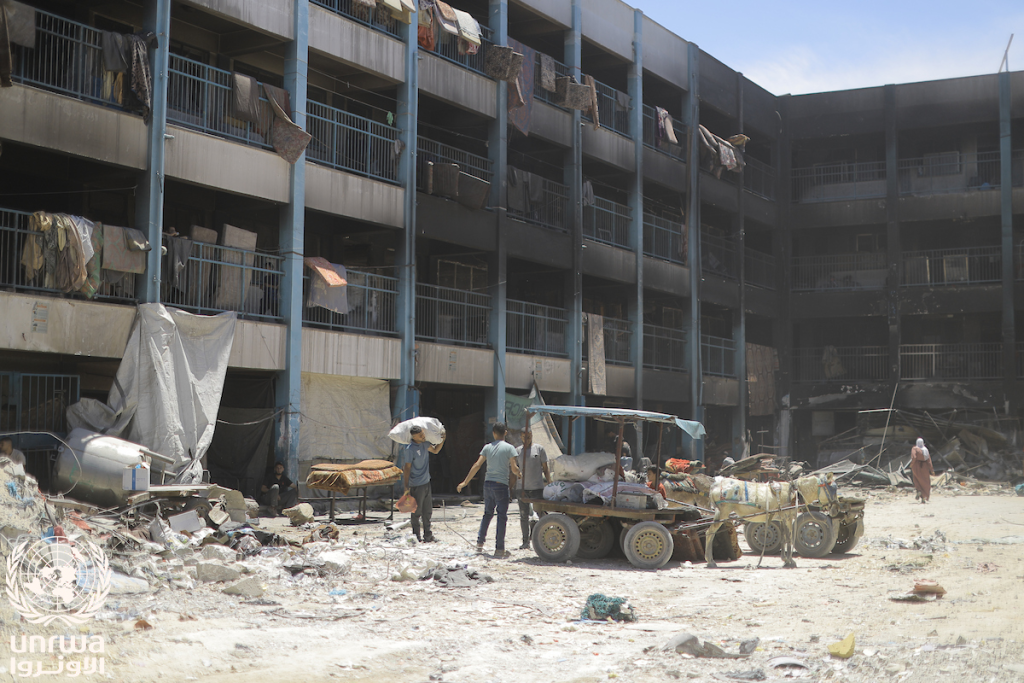
Gravats in Gaza: tens of millions of tons to be processed
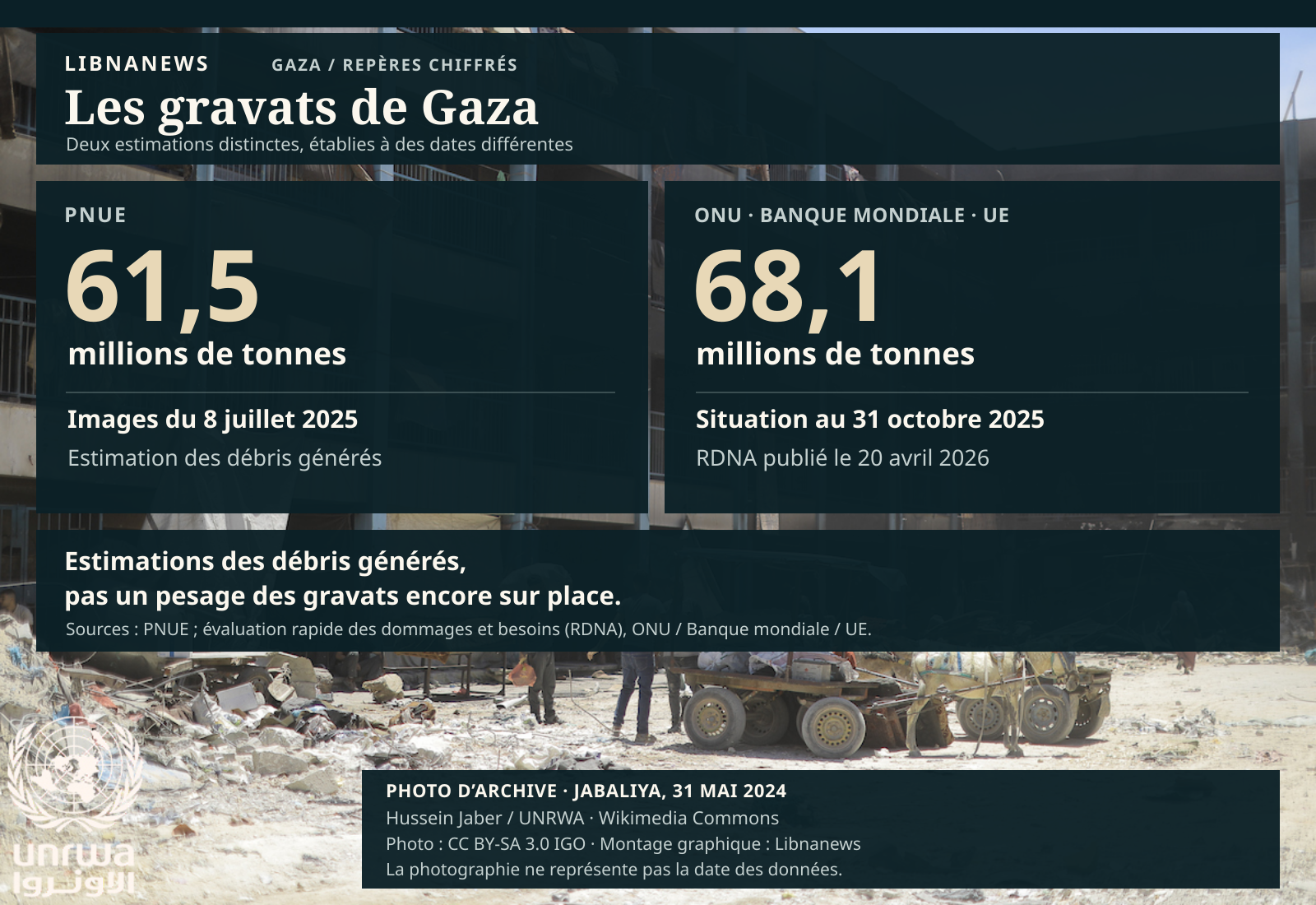
The volume of 68 million tonnes was already in an assessment prior to the November alert. The joint assessment of the United Nations, the World Bank and the European Union, published on 20 April 2026, already contained 68.1 million tonnes of debris generated by 31 October 2025. The environmental report published in September 2025 previously estimated this volume at over 61 million tonnes.
These estimates are mainly based on satellite imagery. Analysts identify the affected buildings, then cross their right-of-way to the ground with their height and degree of destruction. The scenario for 8 July 2025 used the UNOSAT damage analysis and an updated building base until May 2023. The result is approaching a mass of materials to be managed. It does not correspond to the weighing of each load or to a daily inventory of the remaining rubble.
Their distribution counts as much as their weight. A building collapsed on a main line blocks network repair. Debris accumulated in front of a health facility prevents ambulances from approaching. On the contrary, a clear road can restore a number of services: emergency relief, water supply and access to shops.
The first works therefore favour roads and essential equipment. In its report of 23 July 2026, the United Nations humanitarian coordination reported nearly 630 000 tonnes released. These included roads and public service sites. Much of the rubble remained inaccessible.
Explosives under buildings and roads
Worksite teams are involved in areas contaminated with unexploded ordnance. The threat concerns the workers, but also the families who seek property in their homes. It also exposes children and people who recover materials to build shelter or earn income.
UNMAS carries out risk assessments prior to some clearance operations. Its records cover accessible locations and missions actually requested. They therefore do not constitute an exhaustive mapping of explosives throughout the Gaza Strip.
In its 2025 review, the organization recorded 130 explosive device-related accidents, with 52 deaths and 267 injuries reported. He felt that statements probably underestimated the actual number of victims. These data describe recorded accidents, without calculating the total amount of ammunition buried.
The clearing also requires checking the stability of buildings still standing. Fragile walls and slabs can collapse during construction. The mechanical removal of debris must therefore be linked with inspections, the security of the premises and the intervention of explosives specialists. The arrival of more trucks is not enough to speed up all these steps.
Asbestos requires sorting before recycling
The Palestinian Environmental Quality Authority reports about four million tonnes of hazardous waste. It also mentions at least 50,000 tonnes of asbestos. The UN environmental report of September 2025 presents this last figure as an order of magnitude of materials that may contain asbestos in the rubble of refugee camps. Their composition has yet to be confirmed by sampling.
This estimate is for asbestos-based materials, not a measured mass of pure fibres. Their uncausing crushing can release carcinogen fibres. Debris from workshops and industrial areas may also contain chemicals. Mixing these wastes with recoverable concrete would complicate their treatment.
The recirculation of materials therefore requires separate channels. Concrete removed from hazardous elements may be used for certain purposes. Contaminated waste requires appropriate storage and disposal. Their use in new work depends on environmental controls and the technical characteristics sought.
A UNOPS report published in June 2026 highlights the economic value of reemployment. Sorting and recycling can cost more initially than landfilling. They then reduce purchases of new materials and transport. In Gaza, these opportunities remain dependent on available machinery, energy and access to safe sites.
Destroyed fields, others out of reach
Agricultural damage combines several losses: uprooted trees, razed crops, damaged greenhouses, interrupted irrigation and prohibited or dangerous access. A holding may combine these difficulties. A parcel spared by destruction may also remain unusable due to lack of access, water or seeds.
In the September 2025 environmental report, the rates of 97.1% and 82.4% refer, respectively, to areas of trees and damaged annual crops. Tree crops include orchards and olive groves. These surveys cover hectares, not an individual count of all dead trees.
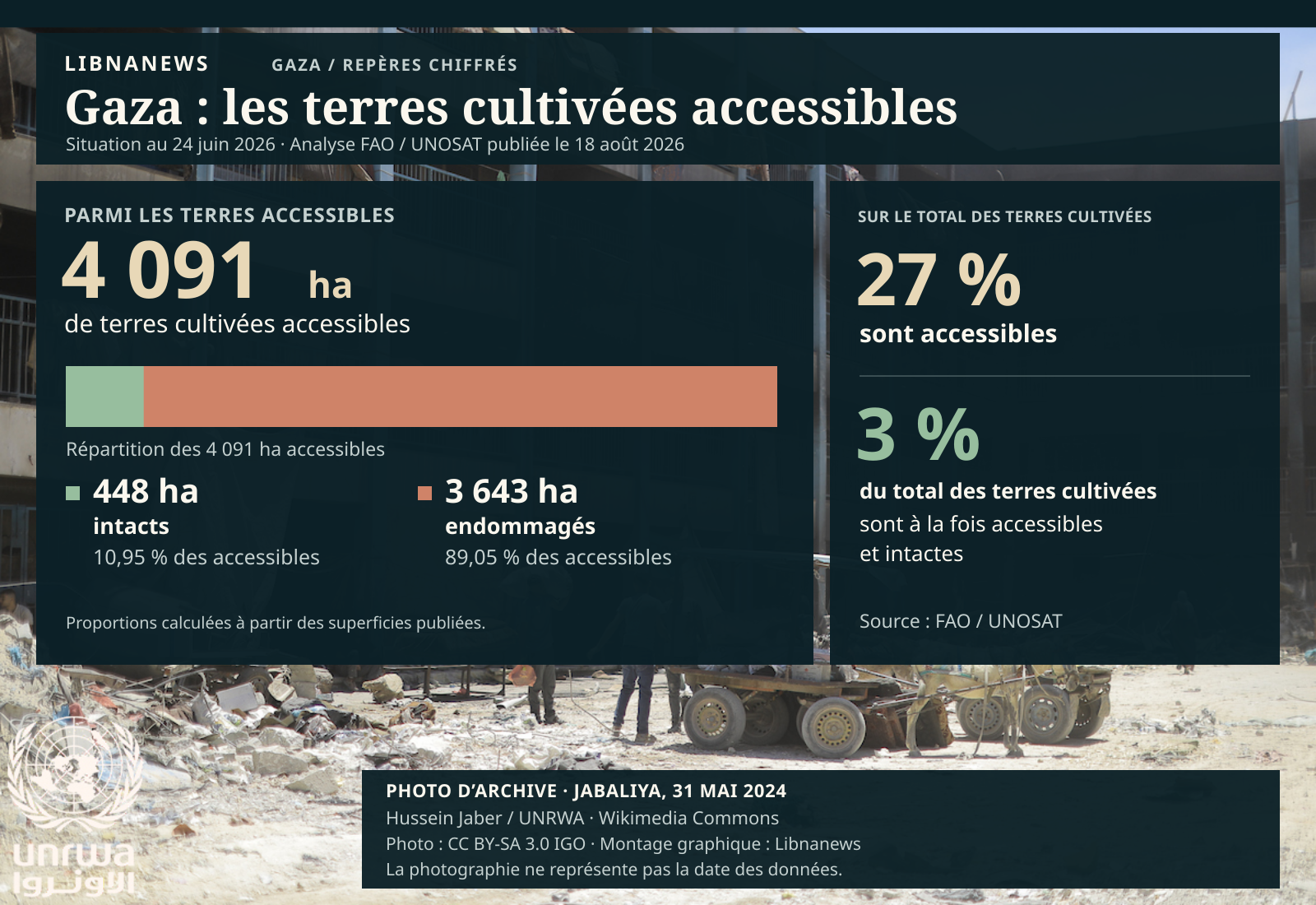
A FAO-UNOSAT assessment published on 18 August 2026 describes the situation as at 24 June. It identifies 4,091 hectares accessible, representing 27% of the cultivated land. Of these, only 448 hectares are both accessible and undamaged. The other 3,643 hectares accessible require rehabilitation.
Accessible and intact plots account for about 3% of all cultivated land. Their area increased from 601 hectares in October 2025 to 448 hectares in June 2026. The FAO mainly attributes this decline to the reduction in access, associated with the westward extension of the « yellow line ». This line separates the ceasefire zone from the militarily controlled space.
Recovery requires different means depending on the damage. Annual crops can be restarted after restoration of the land and irrigation. A ripped orchard requires replanting, and then several years before replanting. In both cases, farmers must be able to work without risking their lives.
Alert figures and available assessments
| Indicator | Palestinian announcement of 6 November 2026 | International assessment |
|---|---|---|
| Gravats | 61 to 68 million tonnes | RDNA published in April 2026: 68.1 million tonnes generated at October 31, 2025. |
| Agricultural land | 82% destroyed or levelled | FAO-UNOSAT: 3 per cent of cultivated land, both accessible and intact, as at 24 June 2026. |
| Olives and fruit trees | 97% destroyed | UNEP, September 2025 report: 97.1 per cent of damaged forested area. |
| Water and sanitation | 84% of infrastructure destroyed | RDNA published in April 2026, damage until October 2025: 88% of surface equipment and 76% of underground networks partially or completely damaged. |
The agricultural percentages do not all describe the same set of land. Network assessments also distinguish physical damage from the ability to provide service. An installation may remain out of operation due to an electrical failure or inability to access it.
A water system dependent on roads, current and parts
The figure of 84 per cent advanced by the Palestinian Authority is water and sanitation. Sectoral evaluations detail different situations depending on the equipment. The joint report published in April 2026, covering mainly damage from October 2023 to October 2025, identified six non-functional wastewater treatment plants. He estimated the damage to the area at $1.7 billion.
On 5 November 2026, UNICEF issued a new report on attacks on water systems. Its balance sheet, covering a period up to June 2026, mentions more than 130 kilometres of sewage pipes damaged in Gaza since October 2023. Untreated wastewater is discharged to the Mediterranean or to temporary retention areas.
The commissioning of the networks depends on several simultaneous supplies. Pumps need electricity or fuel. The teams must have pipelines, replacement parts and processing products. Roads must allow them to reach the facilities and carry the equipment.
Distribution interruptions force residents to search for water out of their homes. Health facilities also rely on this resource to clean their premises, sterilize equipment and treat malnourished children. Unsanitary water promotes diarrhea and worsens nutritional difficulties. Sewer repair also reduces exposure to discharges in inhabited neighbourhoods.
Finally, pollution concerns land and the coastal table. Their extent requires sampling, while access and means of analysis remain limited. The re-watering of a pipe alone does not guarantee the quality of all the resources used around this pipe.
Over $1.7 billion for debris
The summary of the joint assessment of April 2026 amounts to more than $1.7 billion in debris removal and management. It estimates the overall need for rehabilitation and reconstruction at $71.4 billion. Financing must cover housing and infrastructure, but also the restoration of services and economic activity.
| Estimated need | Amount | Perimeter |
|---|---|---|
| Debris removal and management | Over $1.7 billion | Estimation presented in the RDNA synthesis of April 2026. |
| Recovery and reconstruction | $71.4 billion | All sectors covered by the joint assessment. |
| First 18 months | $26.3 billion | Share of global needs for essential services and restart. |
These amounts represent estimated needs, not acquired funding. Costs can change with access conditions, materials prices and field inspections. Sector envelopes do not automatically add up to the overall needs, some of which they cover.
The duration of the work depends on the same constraints. On 20 November 2025, the United Nations Development Programme considered it possible to clear most of the debris in seven years. It required unhindered access, the entry of heavy equipment, regular deliveries of fuel and a stable environment.
This projection did not set a deadline for rebuilding the entire Gaza Strip. The restoration of neighbourhoods also requires functional networks, enterprises capable of working and a housing solution during construction sites. Repairs can begin at some sites while clearing continues elsewhere.
The remains and rights of families
The ruins still contain human remains. Their recovery requires specialized teams, the identification of victims and the preservation of information useful to families. The treatment of these sites requires a different pace than that of an ordinary site.
In September 2026, the Office of the United Nations High Commissioner for Human Rights reported on a review of Palestinian Civil Defence. It reported more than 630 bodies and other human remains found under the buildings between November 2025 and September 2026. Research continues in a territory where many places remain out of reach.
The transactions also raise ownership issues. The disappearance of buildings and physical landmarks complicates the identification of plots. Documents, testimonies and records must enable residents to assert their rights. The movement of the rubble must be linked with this documentation, before installation of equipment or reconstruction.
In Jabaliya, a basin threatens shelters before winter
Immediate needs remain visible around the rainwater basin of Abu Rashid in Jabaliya, near the yellow line. In its report of 29 October 2026, UN humanitarian coordination described a facility paralyzed by lack of electricity and insecurity of access. Without intervention, its overflow could affect neighbouring displacement sites during the winter.
In Khan Yunes, the teams also evaluated shelter sites exposed to flooding and erosion. UNDP uses recycled crushed concrete to raise and level some sheltered land. The treated debris is thus used for protection work, while its removal remains far from complete.
For Abu Rashid, a further assessment should specify possible measures. The intervention always depends on the access of technicians, the supply of pumps and the means necessary to stabilize the basin before heavy rains.





Comments