

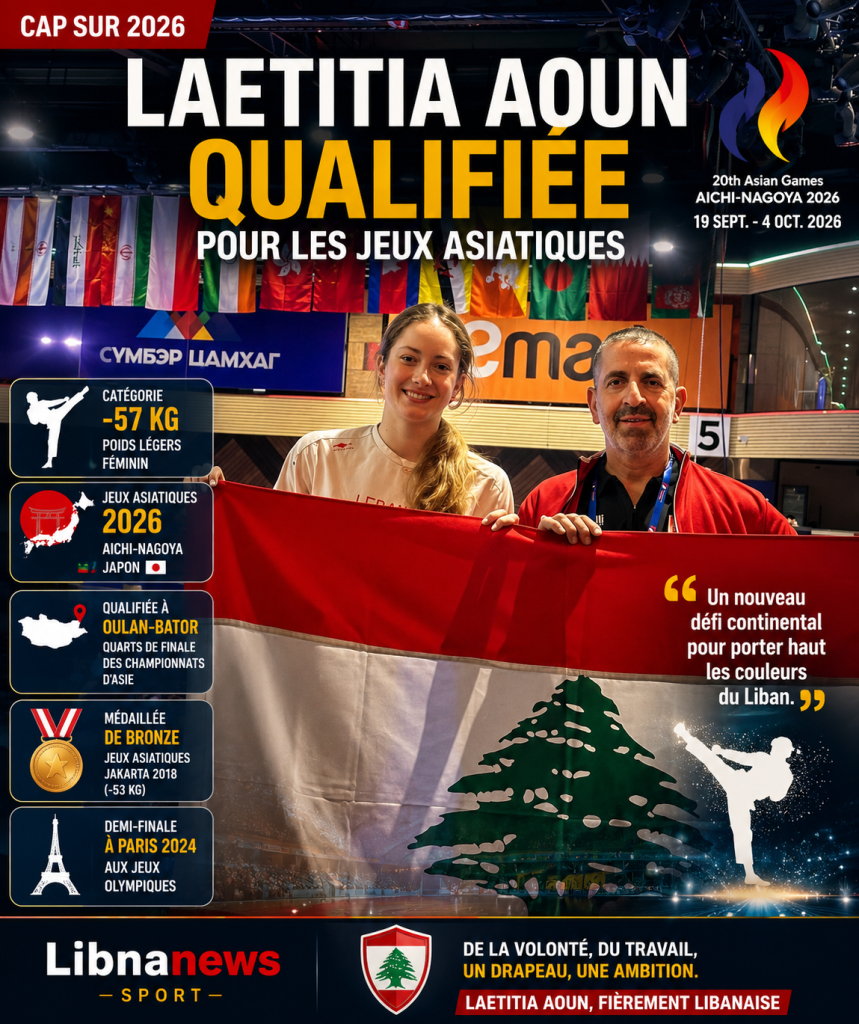
The Lebanese Taekwondo holds its first major landmark towards the Asian Games 2026. Laetitia Aoun obtained her qualification for the twentieth edition of the Games, scheduled in Aichi Prefecture and Nagoya, Japan, from September 19 to October 4. The Lebanese fighter validated her ticket in the category of less than 57 kg after reaching the quarter finals of the Asian Championships held in Ulaanbaatar, Mongolia. In a national sport landscape weakened by the economic crisis, displacement and weak public resources, this qualification confirms the special place Aoun occupies in Lebanese sport.
The announcement was welcomed as a new step in an already dense trajectory. Laetitia Aoun does not arrive at this appointment as an isolated revelation. She took Lebanon to the Olympic Games in Paris 2024, where she reached the semifinals of the women’s under 57 kg tournament before missing the bronze medal. She had also already won a bronze medal at the Asian Games in Jakarta in 2018, in the category of less than 53 kg. His qualification for Aichi-Nagoya 2026 thus extends a continental and Olympic journey built over several seasons, with a rare regularity in Lebanese sport.
Mongolia’s performance was conducted under the supervision of Grand Master Elie Elia, a national coach who accompanied the delegation in the Asian competition. The Lebanese Taekwondo Federation reported that the champion had previously followed a training camp in Turkey to prepare for this continental event. After the qualification, the president of the federation, Dr. Habib Zarifeh, contacted Aoun and his coach to congratulate them on behalf of the administrative committee and the family of the Lebanese Taekwondo. The federation must now draw up a specific preparation plan for the Asian Games.
Laetitia Aoun returns to the Asian Games route
Laetitia Aoun’s qualifying for the Asian Games 2026 is based on a specific result: his access to the quarterfinals of the Asian Championships in Ulaanbaatar. In a discipline where weight categories, world rankings and continental tables determine the major events, reaching this stage is not a simple step result. This means that the Lebanese woman has crossed the threshold required to integrate the expected athlete quota in Japan. Its competitive weight, less than 57 kg, also corresponds to the category in which it built its recent references.
The place of this qualification is not insignificant. Ulaanbaatar hosts an elevated Asian competition, in a continent where Taekwondo concentrates several major nations of discipline. South Korea, Iran, China, China Taipei, Thailand, Uzbekistan, Kazakhstan, the Philippines and Japan have large reservoirs, structured technical schools and athletes used to world podiums. For a Lebanese fighter, every trick won in this context incurs a high physical, tactical and mental expense.
The taekwondo works by short, intense duels, often decided on small differences. A victory can be built on a kick to the head, a penalty avoided, a time management or a faster reading of the opposing links. Laetitia Aoun now knows these margins. His Olympic experience, Grand Prix passes, Asian competitions and international tournaments give him a base that few Lebanese athletes have. The qualification obtained in Mongolia confirms that this foundation remains active after Paris.
An athlete already installed among Lebanese references
Laetitia Aoun belongs to a generation that has given international visibility to the Lebanese taekwondo. Born in 2001, it grew very early in the young categories, before imposing on seniors. His bronze medal at the Asian Games in Jakarta in 2018 had already marked a turning point. Lebanon does not accumulate podiums in major continental multisport events. A medal in this context therefore gives a career a special density, especially in a combat discipline dominated by highly structured countries.
The next cycle confirmed this promise. Aoun continued in the category of less than 57 kg, with regional and international results. She participated in World Championships, classified tournaments and Asian competitions. In 2024, she obtained her Olympic qualification at the Asian tournament in Taisan, China, after decisive victories in a table where only one mistake could close the road to Paris. This qualification had already been hailed as an important moment for Lebanese sport.
At the Paris Olympics, she crossed a new threshold. In the Grand Palais, transformed into a battlefield, she beat Taiwanese Lo Chia-Ling, an Olympic medallist in Tokyo, and then Miljana Reljikj of North Macedonia in the quarter-finals. She then turned to the semifinal against Iranian Nahid Kiyani, before losing the bronze fight against Canadian Skylar Park. The medal has eluded Lebanon, but the course has placed Aoun among the most recent Lebanese athletes.
This experience counts today. A return to the Asian Games after an Olympic semifinal has nothing to do with administrative continuity. It obliges the athlete to confirm, absorb expectations and recover in a demanding schedule. Aoun is no longer just a competitor who tries to surprise. She enters tournaments with a status. His opponents are studying. Coaches make plans against her. Mongolia’s qualification shows that it remains capable of responding to this new exhibition.
Technical guidance around Elijah Elia
The presence of Grand Master Elijah with Laetitia Aoun in Mongolia underscores the importance of technical guidance in this phase. The high-level taekwondo is no longer based solely on explosiveness or courage. It requires video analysis, weight management, mental preparation, recovery work and permanent adaptation to opposing styles. The role of the coach is to read the fight in real time, choose the instructions between the resumes and adjust the pace according to the arbitration.
The preparation camp in Turkey must be read along this lines. Internships outside Lebanon often offer higher adversary density, more regular working conditions and equipment less affected by local constraints. For an athlete to fight against the best Asians, exposure to a variety of partners is essential. It allows to repeat combat sequences, test tactical options and work the passage between attack, counter-attack and defensive management.
However, the Lebanese leadership must deal with limited means. High-level sport in Lebanon largely depends on federation, clubs, families, private supporters and sometimes universities. Travel, airline tickets, internships, nutrition, care and equipment are high costs. In this context, each international qualification also reflects an organizational effort. She engages an entire network around the athlete, not just an individual performance on the carpet.
The Federation wants to convert the exploit into a programme
The reaction of Dr. Habib Zarifeh is part of this collective logic. The President of the Lebanese Taekwondo Federation congratulated Aoun and Elia after the announcement of the qualification. He pointed out that the discipline continued to shine abroad despite the difficult conditions facing the country. This formula summarizes a shared feeling in several Lebanese federations: the international results serve to maintain an image of sporting continuity while local structures are experiencing the crisis.
The federation now has to develop a preparation plan for Aoun before Aichi-Nagoya. This plan will probably have to integrate several dimensions: adjustment competitions, external internships, medical follow-up, weight control, recovery, video work and mental preparation. The calendar will be tight. The Asian Games will be held in the fall, but the Taekwondo events are planned on a short window. An athlete must arrive in Japan with a precise form peak, not only with a good general condition.
The question of adversaries will be central. The category of less than 57 kg remains one of the highest. It combines speed, amplitude, power and tactical reading. Asian women fighters are often very experienced. Aoun will therefore have to fine-tune his responses against left-wingers, long-term fighters, defensive profiles and more aggressive opponents. His experience in Paris gave him benchmarks, but the Asian Games have their own logic. The picture may be less publicized than at the Olympic Games, but it is no less difficult.
A return to an appointment that has already succeeded him
The Asian Games have a special place in Laetitia Aoun’s career. In 2018, in Jakarta, she won a bronze medal among the under 53 kg. This medal had installed its name in Lebanese sport long before its Olympic exhibition. Returning to the Games, eight years later, in another category and with a more assertive status, gives Aichi-Nagoya 2026 a dimension of continuity. Aoun will not only seek participation. She will find there an event where she has already proved that she can climb on a podium.
Comparison with 2018 also shows its evolution. In Jakarta, she was a young rising athlete. In 2026, she arrived with an Olympic experience, a demanding academic career and a much stronger national visibility. This maturity can become an asset if it results in better management of tense moments. It can also increase pressure. Lebanon’s sport, which lacks a lot of regular results in world competitions, places a lot of expectations on a few names. Aoun is now one of those few athletes whose every fight is followed as a national rendezvous.
The Asian Games of Japan will also have symbolic significance. Japan will host the twentieth edition of the event in Aichi and Nagoya. The competition will bring together the continent’s delegations in a dense programme, where combat sports will have an important place. For Lebanon, each qualification counts. National delegations are often limited and the chances of medals are concentrated on a few disciplines. The Taekwondo, thanks to its federal work and recent results, is one of the sports capable of providing positive exposure to the country.
A discipline that resists the Lebanese crisis
Laetitia Aoun’s qualification comes in a context where Lebanese sport continues to suffer. The economic crisis has reduced budgets, complicated travel and weakened many clubs. War and insecurity in some areas add other constraints. Athletes often have to train in irregular conditions, seek ad hoc funding and reconcile studies, work and preparation. In these circumstances, a ticket to the Asian Games takes a value that exceeds the sporting result.
However, the Lebanese Taekwondo maintained an external presence. The discipline has a tradition of clubs, coaches and competitions that allows it to produce competitive athletes. The results of Aoun are part of this continuity. They show that technical work can resist, provided that it is supported by realistic planning. They also show that Lebanese talent needs a regular international calendar. Without exits, internships and high-level combat, the progression ends up blocking.
The dual identity of Aoun further reinforces this image. She is both a high-level sports student and a medical student, according to institutional information published after the Paris Games. This combination speaks to a Lebanese youth who seek to hold several fronts at once: training, career, family, possible migration and personal commitment. His career is therefore not reduced to a list. It embodies a form of daily discipline, very visible in a country where sporting success is rarely built in comfort.
Aichi-Nagoya as a new test
The next challenge will be to transform qualification into a competitive ambition. The ticket to the Asian Games opens the door, but does not guarantee anything. Preparation should avoid two traps. The first would be to consider the Olympic experience sufficient. It gives a mental advance, but the opponents will also have made progress. The second would be to overload the athlete before the Japanese appointment. A season too dense can use the body, especially in a category where weight control is permanent.
The federation will therefore have to choose the relevant competitions, not just the available ones. Preparation tournaments will have to offer a high level, but also allow adjustments. Medical work will be crucial. The taekwondo imposes repeated impacts, rapid rotations and strong strain on the hips, knees and ankles. Injury prevention will count as much as technical progress. An athlete aiming for a continental podium must arrive with freshness, a clear reading of the table and a combat strategy ready for several profiles.
For Lebanon, the challenge will also be institutional. An athlete like Laetitia Aoun needs a stable environment during the months leading up to the Games. The Federation has announced its intention to set up a preparation. The next few weeks will tell how this plan will be funded, where the internships will take place, which competitions will be selected and which partners will accompany the champion. After Ulaanbaatar, the Lebanese flag has already found a place in the Asian calendar. The road that will lead Aoun to the Japanese carpet now remains to be built.




