

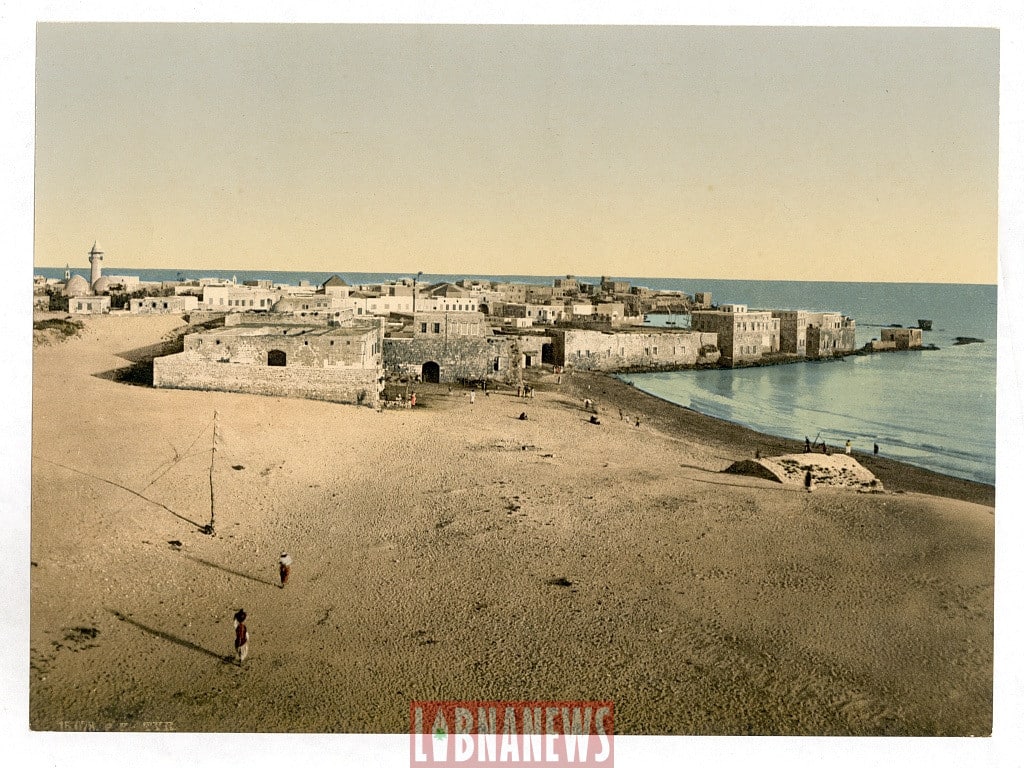
In Tyre, an ancient legend tells that purple was discovered by chance, when a dog bit a shell on the shore and returned the purple tinted snout. Behind this almost simple scene lies one of the most prestigious industries of the ancient world, the one that made Tyrian color the symbol of kings, priests and empires.
In Tyre, even the sea has produced power. Before being an imperial colour, before covering the clothes of kings, priests, magistrates and emperors, purple would have started with a beach scene: a god, a dog, a nymph and a shell crushed between the teeth.
Legend is famous. Melqart, the great protective god of Tyre, later identified by the Greeks in Heracles and by the Romans in Hercules, would have walked by the sea with his dog and Tyros nymph. The dog would have bit a seashell. His mouth would then have tinted with a strange color, between dark red, purple and purple. Struck by this colour, Tyros would have asked for a garment of the same brightness. Melqart then collected the shell substance and dyed the first purple tissue. This version is reported in the ancient tradition attributed to Julius Pollux, Greek author of the 2nd century C.E.
The scene seems almost childish. Yet it tells something very serious: the symbolic birth of an industry that would make Tyre one of the great economic, political and cultural names of the ancient Mediterranean.
Melqart, the god of the city
Melqart is not a secondary character in this story. Its name usually means the king of the city or the master of the city. He was the tutelary god of Tyre, linked to royalty, sea, commerce, colonial foundations and Phoenician expansion. The Greeks and Romans have gradually assimilated it to Heracles-Hercules, which explains that some sources speak of the dog of Hercules when they actually tell a Tyrian tradition associated with Melqart. The British Museum presents him as a Phoenician god particularly associated with Tyre, equivalent to Heracles in the Greek world and Hercules in the Roman world.
This identification is not just a mythological detail. It shows how the Phoenician narratives were translated into Greek and then Roman cultural language. Melqart became Heracles to be understood by the Greeks. Heracles became Hercules for the Romans. But behind these successive names, the center of the story remains Tyrian: the god of Tyre, the shore of Tyre, the nymph Tyros and the color that will bear the name of the city.
UNESCO also recalls that Tyre was, according to legend, the place of discovery of purple. The city, a great Phoenician city in the south of today’s Lebanon, dominated the seas and founded prosperous settlements like Cadiz and Carthage. Its association with purple is therefore not limited to an isolated narrative: it is part of its historical identity.
The dog, the first purple discoverer
In this legend, the true discoverer is neither a king, nor a priest, nor a scientist. He’s a dog. As in Nahr al-Kalb, where local tradition evokes a guardian dog charged with warning the inhabitants of the arrival of invaders, Tyre also retains a canine memory. But here, the dog doesn’t give the alarm. He reveals wealth.
His gesture is accidental. He bites a shell. He’s coming back with the stained muzzle. The nymph sees the color. The god understands that there is something extraordinary there. Chance becomes technical. Curiosity becomes industry. The stain on the mouth of the animal becomes one of the most expensive colors of antiquity.
This is what gives the legend its strength. It does not claim to explain a conquest, a war or the foundation of an empire. It tells the discovery of a matter. A detail of nature, seen on a beach, becomes a marker of power for centuries.
Murex, luxury shell
The reality behind the myth is well known: Tyrus purple was extracted from marine molluscs of the Muricidae family, often grouped under the name of murex. Several Mediterranean species could produce these colouring substances, includingHexaplex trunculus,Bolinus brandarisandStramonita haemastoma. The dye compounds did not appear in their final form in the living animal: they developed by chemical reaction, in contact with the air, light and work of the dyer.
Production was slow, dirty, expensive and smelly. The molluscs were to be collected in large numbers. The glands containing the colouring substance were extracted and then treated in tanks or containers with brine. Some modern descriptions, based on ancient sources, evoke slow cooking for several days. The process had such a strong smell that the purple workshops were often located away or under the wind of cities.
What this meant must be measured. Purple was not a simple pigment that was quickly mixed in a clean workshop. It was a heavy industry based on fishing, collection, decomposition, chemical processing and textile work. It involved fishermen, workers, dyers, merchants, ships, markets and elites capable of paying considerable prices.
A color more expensive than the fabric
Tyrian purple was precious because it was difficult to produce. Thousands of shells were needed to obtain a small amount of usable dye. The numbers vary according to the sources and methods of calculation, but all say the same thing: this color required a huge mass of animal material for a tiny yield. The University of Chicago recalls that Tyrian purple was one of the most expensive dyes in the ancient world and was reserved for kings, priests and nobles.
The value also came from his outfit. Unlike other tinctures that quickly faded, purple was known for its resistance. It could even seem to gain in depth over time, according to ancient descriptions and modern analyses. This solidity contributed to its prestige: a rare, expensive, difficult to imitate and lasting color could not remain neutral. She immediately became political.
Wearing purple was not only a beautiful color. It was to show a row. That was to say that it belonged to those who could pay the effort of thousands of shells, the knowledge of the dyers and the commercial network of Tyre.
The colour of kings and empires
Tyre’s purple finally surpassed Tyre itself. It has become the color of Mediterranean power. The Greeks knew her. The Romans admired, regulated, and then associated with imperial prestige. Later, the Byzantine world made it a marker of sovereignty. The expression « born in purple » refers to this logic: to be born in the space of imperial power, in the colour reserved for those who govern.
UNESCO points out that Tyre is directly associated with several stages of human history, including the production of purple pigment reserved for royalty and nobility. This mention says the essential: purple is not a craft anecdote, but a major contribution by Tyre to the social and political history of colour.
This is a remarkable paradox. A substance extracted from a shell, under probably repulsive conditions, ends up dressing the most refined power. Behind the noble fabrics, there were piles of broken shells, pestilential vats, stained hands, workshops apart and a sea exploited until local exhaustion.
The dog’s legend erases this hardness. It turns a dirty industry into an elegant scene. But it is precisely the role of the myth: giving a noble origin to what in reality required a much less poetic production chain.
Tyre, city of colour and commerce
Tyre had everything to make this discovery an economic power. It was a maritime city, a city of navigators, merchants and shopkeepers. Its position on the Phoenician coast, its ports, its commercial networks and its colonial influence allowed it to spread its products far beyond the Levant.
Purple is part of this logic. It is not just a local invention. It becomes a prestige commodity, exportable, desirable, almost diplomatic. It circulates with fabrics, artisans, elites and stories. It accompanies the Phoenician expansion in the Mediterranean, then enters Greek, Roman and Byzantine cultures.
Modern research, however, has the effect of a strictly Tyrian invention. Old traces of purple production from shells also exist in other parts of the Mediterranean, especially in the Aegean, sometimes prior to the evidence available for Tyre. But this does not remove anything from the Tyrian role. The question is not just who produced the first dye. It is to understand who made it a global symbol. On this point, Tyre won the battle of memory.
A legend more true than it looks
The story of Melqart’s dog is obviously not a report. No identified dog n But the myth rests on a plausible observation: a crushed murex can release a substance that changes color in contact with air and light. A visible spot on the mouth of an animal or on a stone could perfectly intrigue those living by the sea.
That’s where the story becomes interesting. He staged an accident discovery. However, many old techniques may have been born of repeated practical observations: a broken shell, a persistent spot, a colour that does not leave, a smell, a reaction to the sun, and then try to reproduce the phenomenon.
The myth simplifies. He’s focused. He gives a name, a god, a nymph and a dog to a process that has probably required generations of experimentation. But it retains a deep truth: purple comes from the sea, and Tyre has been able to turn this marine resource into power.
The Spot Becomes Empire
There is a lesson in civilization in this history. Empires are not only born of weapons. They are also born of materials, colors, techniques and desires. A city can dominate by its ships, alliances, colonies, but also by its ability to produce what others do not know how to manufacture or can’t pay.
Tyre understood that very early. Purple was a luxury product, but also a form of language. She said rank, authority, social distance. She was turning a garment into a political declaration. She made the body dressed a sign of domination.
That’s why Melqart’s dog is not just a charming detail. It is the symbolic starting point for a much larger story: that of a shell that has become industrial, of a color that has become a privilege, of a city that has become synonymous with wealth, and of a Lebanese myth that has entered the Mediterranean imagination.
A memory to resume
Today, Tyre is often watched through its Roman ruins, its racetrack, its columns, its maritime remains and its inscription to the world heritage. But its oldest identity is not limited to visible stones. She also goes through this color story.
The purple of Tyre reminds us that ancient Lebanon was not only a territory crossed by empires. He was also a producer of symbols. He gave the Mediterranean ports, alphabets, myths, travelling gods and a color that became the one of power.
In this memory, Melqart still walks on the shore. His dog still bites the shell. Tyros nymph still shows an impossible colour on the snout of the animal. And Tyre, by this stain that has become a legend, continues to recall that a detail of nature can sometimes change the history of luxury, commerce and sovereignty.
References used:UNESCO, leaflet on Tyre; Kelsey Museum, file on the creation of purple; University of Chicago Library, Tyrian purple dossier; Scientific study on the archaeological chemistry of shell purple; British Museum, notice on Melqart.




