

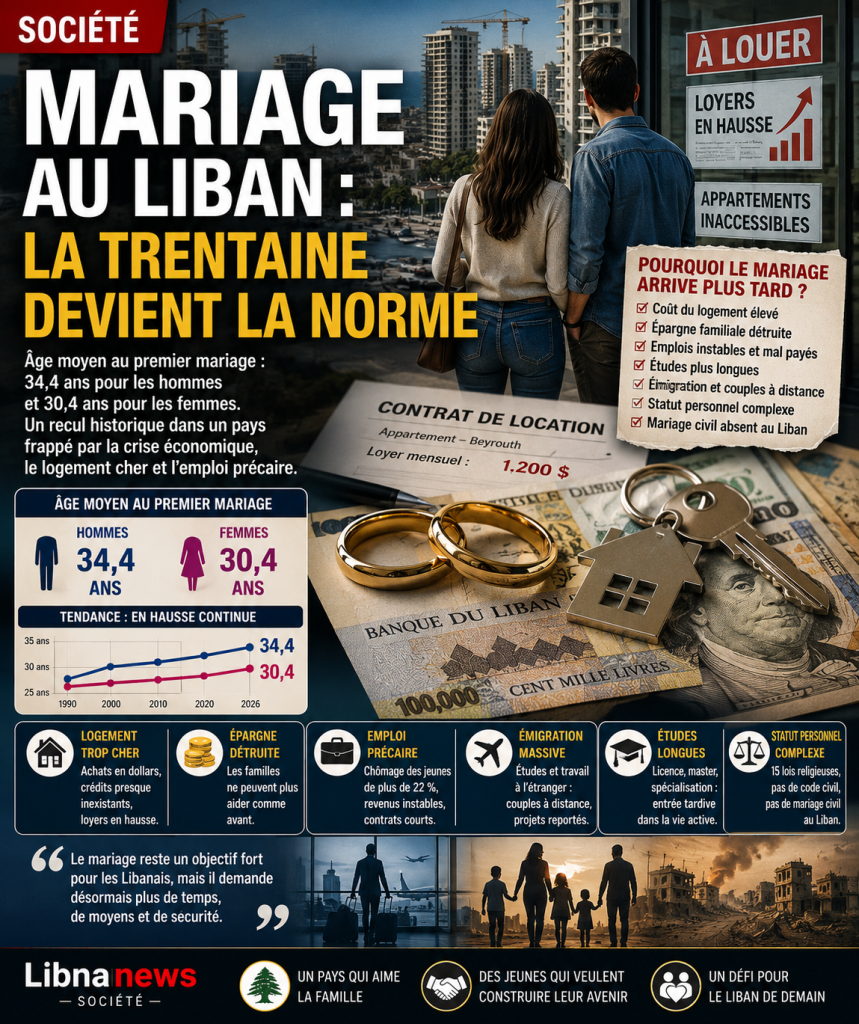
Marriage in Lebanon now ends at an age rarely reached in its regional environment. Comparable international demographic data place the average age at first marriage at 34.4 for men and 30.4 for women. The country thus reaches levels close to those observed in Western Europe, while remaining marked by its own social, economic and legal constraints. This decline not only reflects changes in individual choices. In particular, it reveals the exhaustion of a family settlement model based on housing, savings, parental help and the promise of stable employment.
Since the financial collapse of 2019, marriage has become a difficult project to finance for part of the Lebanese youth. Buying or renting an apartment, furnishing a home, paying a ceremony, guaranteeing a regular income and preparing a family life require resources that many young adults no longer have. Wages have lost value. Real estate loans are almost gone. Much of the expenditure is settled in dollars. Families, long able to support new couples, have themselves suffered the loss of part of their savings.
This shift from age to marriage therefore does not mean that Lebanese young people turn away from the institution. Marriage retains a strong religious, social and family weight. There is still a searchable horizon in most circles. But later, after longer studies, a first job experience, an attempt to emigrate or several years of engagement. In today’s Lebanon, getting married means less respecting a natural stage than overcoming a series of material obstacles.
Marriage in Lebanon: Numbers to read with method
The average age at first marriage must be read methodically. The figures of 34.4 years for men and 30.4 years for women are based on an international demographic indicator called the synthetic average age at marriage. It measures the average single life expectancy among persons who marry before 50 years, based on the categories of marital status observed in censuses or surveys. It does not always correspond to a simple administrative average calculated on the marriage certificates of a given year.
This statistical shade does not change the trend. Marriage in Lebanon is moving sharply towards the thirties. Older national data, based on other methods, already placed the average age of marriage above 32 years for men, with a significant increase for women. The differences between series reflect the differences in calculation, but the trajectory remains clear: the first marriage occurs later than before, and later than in much of the Arab world.
Comparison with Western Europe sheds light on the phenomenon, but it can also be misleading. In several European countries, the decline in marriage goes hand in hand with free union, social protection, access to credit, housing subsidies or non-marital parenting. In Lebanon, these shock absorbers remain weak or socially limited. Unmarried couples remain unacceptably accepted in many families. Children out of wedlock are strongly stigmatized. The social state does not compensate for the cost of housing, health or education. The country therefore reached high ages, but without the same protection mechanisms.
The economic crisis turns marriage into a bet
The economic crisis remains the central factor. Since 2019, devaluation of the pound, banking restrictions, inflation and dollarization have changed the concrete conditions of adult life. Income poverty reached 44 per cent of the population in the international assessment published in 2024, compared with about 12 per cent ten years earlier. This increase has affected the popular classes, but also some of the middle classes that had the classic model: diploma, employment, apartment, marriage, children.
In this context, housing is the first barrier. Prior to the crisis, some young households could hope to buy an apartment through bank credit, family support or payment in instalments. This path has been largely closed. Real estate loans are rare. Transactions are often made in fresh dollars. Rents have increased in urban areas, in areas near Beirut and in areas hosting internally displaced persons. For a young employee paid in pounds, or with partially dollarized but irregular income, installation becomes difficult.
The apartment is not only a cost. There is still a social condition of marriage. In many families, the young man still has to prove that he can offer housing. This expectation is changing, as women work more and contribute more often to the couple’s expenses. But the norm did not disappear. It weighs on men, who delay engagement because of lack of resources. It also weighs on women, who see marriage plans suspended from the financial capacity of the partner, family or couple.
Furniture, appliances, reception fees, jewellery and gifts add pressure. Some couples reduce expenses, give up a big party or opt for a more intimate ceremony. Others reject marriage in order not to face family expectations. The symbolic cost remains high. In a country where marriage involves two families, sometimes two villages or two denominational backgrounds, the simplicity chosen can be experienced as a downgrading. So the crisis is not just about the budget. It affects the social image of marriage.
Families less able to help
Family support, long decisive, was weakened. Parents who helped purchase an apartment or finance the ceremony often lost access to their bank deposits. Many now have to finance medicines, school fees, generator bills, rents or help relatives. Diaspora transfers help some families, but they are not enough to compensate for the magnitude of the shock. When a family has to choose between medical care, housing and a child’s marriage, union is often rejected.
The labour market adds a second constraint. Youth unemployment remains high, around 22 per cent in the latest international estimates available for the 15-24 age group. That figure doesn’t say everything. Many young people work informally, have temporary jobs, are paid late or have no social protection. Income sometimes exists, but it does not allow planning. Marriage, however, requires predictability: monthly rent, bills, insurance, health care, and sometimes school fees.
Graduates are not spared. Doctors, engineers, teachers, architects, computer scientists, bank employees and young executives saw the value of their income change abruptly after the crisis. Some have found opportunities in dollar-paid sectors. Others are looking for a way out abroad. The marriage then becomes dependent on a visa, a contract in the Gulf, an installation in Europe, Canada, Africa or Australia. A relationship may last, but the decision to formalize the union awaits the stabilization of the migration project.
Emigration is also transforming the matrimonial market. Men and women leave the country to study or work. Couples live at a distance. The engagement is getting longer. Ceremonies must adapt to leave, plane tickets, residence papers and family calendars. Some couples choose to marry abroad before registering their union in Lebanon. Others are waiting to have a stable legal status outside the country. Lebanese marriage thus becomes a transnational phenomenon.
Long education, rare employment and later choices
Education explains another part of the decline. Lebanon has a long tradition of secondary and higher education, with a strong presence of women in universities. Young adults often want to complete a bachelor’s, master’s, specialization or vocational training before starting a home. This choice is not only cultural. It responds to competition in the labour market. The more unstable employment, the more the diploma appears as a protection, even imperfect.
For women, this is a major development. Education and employment offer more autonomy. They allow us to delay an unwanted marriage, to better negotiate the terms of the union or to refuse a relationship deemed fragile. But this autonomy is still governed by powerful family norms. A qualified woman can be encouraged to succeed, while under pressure on her age, future motherhood, religious choice or place of life. The postponement of marriage is therefore between emancipation and coercion.
Personal status adds difficulty
The legal question reinforces these hesitations. Lebanon does not have a unified civil code for marriage, divorce, custody of children or marital rights. Personal status cases fall under fifteen separate religious regimes administered by confessional courts. This plurality reflects the country’s history, but it complicates the decision for mixed couples, non-practice couples, people who want a civil marriage or women concerned about the consequences of separation.
Local civil marriage remains absent from the ordinary framework. Couples who want a civil union often marry abroad, especially in Cyprus, Turkey or other countries, before having their act recognized in Lebanon. This option involves money, documents, travel and sometimes difficult negotiations with families. It is therefore not accessible to all. Legal complexity does not alone create the postponement of marriage, but adds an administrative, emotional and financial cost.
Divorce, custody and pension rules vary among communities. This diversity can discourage certain couples, especially women, when they anticipate the risks of an unprotected union. Rights associations have long denounced the inequalities produced by religious courts. Marriage thus remains both a desired institution and a legal framework that many consider uncertain. The time before the union can be used to better assess these risks.
Silent Family Transformation
The decline in age at marriage changes demographics. A later union often delays the birth of the first child. It can reduce the number of children per couple, especially in a country where non-marital parenting remains very rare. Lebanon was already experiencing a decline in fertility before the crisis. Economic pressure can accelerate this development. Having a child involves financing pregnancy, care, a nursery, a school, sometimes private insurance and expensive domestic energy.
Households also change shape. Many young adults stay longer with their parents. Some live alone in cities when they have sufficient income. Others share housing or alternate between Lebanon and abroad. Families become areas of prolonged solidarity, but also of tension. Parents support adult children. Children contribute to the expenses of the parental home. The marriage, which was to open a new family unit, waits for the old one to hold.
The effects vary from one social setting to another. Affluent families can still finance an apartment, a ceremony and a facility abroad. The impoverished middle classes suffer the most visible shock, as they maintain high social expectations without the corresponding means. Poor people sometimes adopt simpler unions, but they also suffer the greatest insecurity. In some vulnerable contexts, poverty can even promote early marriage, especially among refugee and marginalized populations. Lebanon therefore has several marital temporalities at the same time.
A generation waiting for guarantees
The current crisis adds a security dimension. War in the South, displacement, destruction and regional uncertainties reinforce the postponement of family projects. The Minister of Finance recently warned that the economy could contract by at least 7% in 2026 due to the conflict, with direct and indirect damages of up to $20 billion. This perspective weighs on young people. It reduces confidence, affects diaspora transfers and delays decisions that involve several years.
Late marriage thus becomes a social indicator. It measures the housing crisis, the labour crisis, the banking crisis, the confidence crisis and the transformation of expectations. He also says the resilience of a generation that sometimes refuses to reproduce a model that has become unrealistic. Many young people still want to marry, but not under any conditions. They want a minimum of security, sustainable housing, a chosen relationship and a capacity to raise children without dependent entirely on parents or foreigners.
For public authorities, the subject goes beyond the private sphere. It covers housing policy, social protection, youth employment, banking reform, legal equality and the recognition of civil marriage. Without an answer on these grounds, the decline in age at first marriage may continue. Lebanon could continue to look statistically like Western Europe, while remaining deprived of the social nets that accompany this transition. The next indicators to follow will be the number of registered marriages, age at the first child, civil unions contracted abroad, departures of young graduates and the ability of households to rebuild savings.




