

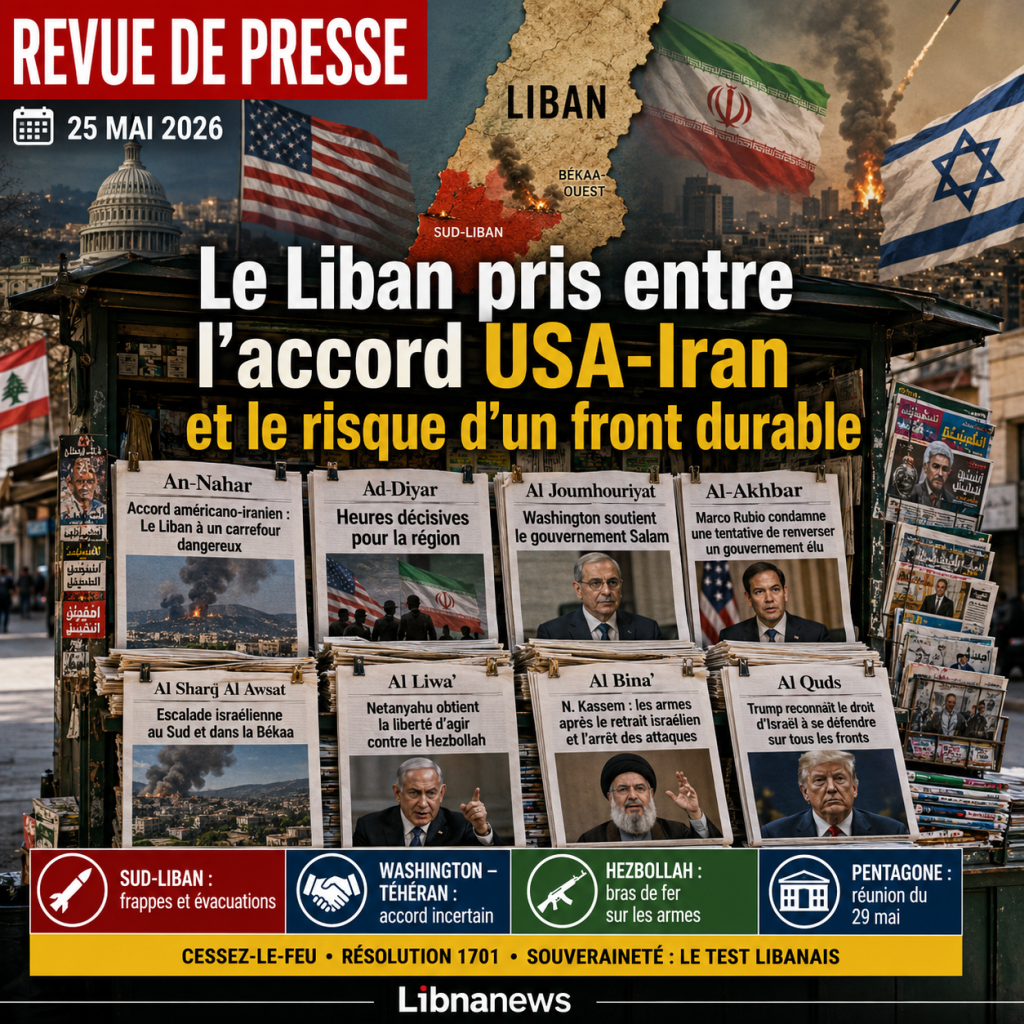
A regional sequence that places Lebanon at the centre of the balance of power
Lebanon appears, in the press of 25 May 2026, as one of the most sensitive areas of the phase opened by the discussions between Washington and Tehran.Naharon 25 May 2026, describes a country in front of a « crossroad » at several levels, with an increase in Israeli strikes in the South and in the West Bekaa, at a time when information is circulating on a framework agreement between the United States and Iran. The newspaper believes that this sequence may aggravate the Lebanese situation, as Israel is wary of any agreement that might include the Lebanese front, while Hezbollah might see it as a validation of Iran’s role in the region. This reading joins that ofAd Diyaron 25 May 2026, which speaks of decisive hours for the region, after almost three months of war, and notes that US President Donald Trump asked his representatives not to rush, saying that time was playing in favor of Washington. In this atmosphere, Lebanon follows the discussions while under direct military pressure.Al Sharq Al AwsatOn 25 May 2026, he noted that Israel had raised the level of its escalation in the South and the Bekaa, with deadly strikes and evacuation notices, before the security meeting scheduled for 29 May in Washington.
Israel seeks to preserve its military margin
The central question is the policy space that Israel intends to retain in Lebanon, even if an American-Iranian agreement eventually covers several fronts.Al Liwaon 25 May 2026, reports that Israeli Prime Minister Benjamin Netanyahu insisted with Donald Trump on the freedom to act against threats against Israel, particularly in Lebanon. The newspaper also cites reports that Washington would allow Israel to act if Hezbollah tried to rearm itself.Al Qudson 25 May 2026, reports the same line, stating that Netanyahu claimed that Trump had recognized Israel’s right to defend himself on all fronts, including in Lebanon. This position is in tension with Iranian demands, which seek to include a cessation of hostilities in Lebanon in the agreement in preparation.Al Joumhouriyaton 25 May 2026, goes further by presenting the Lebanese scene as a space still governed by direct security arrangements between Washington and Tel Aviv, more than by negotiations with Tehran. The newspaper notes that the United States has been working for several weeks on a parallel path for Lebanon, linked to the post-war arrangements in the South. This approach gives the Pentagon meeting a central place because it could open a technical and military process, distinct from a broad political settlement.
Hezbollah gets tougher in the face of arms pressure
The press also insists on the rise of Hezbollah’s tone.Al Binaon 25 May 2026, reports that Naim Kassem claimed that any debate on arms should come after the Israeli attacks had stopped, Israel ‘ s complete withdrawal, the release of prisoners and the return of the inhabitants. Hezbollah’s Secretary General said he hoped that the agreement between Tehran and Washington would include Lebanon by a complete stop to the fire. But he also presented disarmament as a loss of defensive capacity for Lebanon and as a step towards what he calls elimination.Ad DiyarOn 25 May 2026, a similar formulation was repeated, stating that Naim Kassem considered that the withdrawal of weapons from the resistance would be tantamount to withdrawing part of his defence from Lebanon. He therefore asked to discuss the defence strategy only after the attacks had stopped, the Israeli withdrawal, the release of prisoners and the return of the inhabitants.Al Liwaon 25 May 2026, stresses that Kassem links the maintenance of weapons with the inability of the State to assume sole protection of the territory, while affirming that the people would have the right to go down the street against a project which he describes as American-Israeli.
Washington responds by supporting the Salam government
The American reaction is presented as fast and direct.Al Joumhouriyaton 25 May 2026, reports that US Secretary of State Marco Rubio accused Hezbollah of seeking to bring Lebanon back to chaos and destruction. He called Naim Kassem’s appeal to bring down the government as a dangerous step and insisted that Washington supports the legitimate Lebanese government.Al Akhbaron 25 May 2026, also notes that Rubio condemned what he called an attempt to overthrow an elected government. According to the newspaper, the US official claimed that Hezbollah was unaware of the Lebanese government’s repeated demands to stop the attacks and to respect the ceasefire.Al Sharqon 25 May 2026, put this position on the headline, with a clear formula on Washington’s support for the Lebanese government and its efforts to restore state authority. The American message therefore goes beyond Hezbollah’s only criticism. It also aims to present the Government of Nawaf Salam as the main interlocutor of the forthcoming diplomatic phase, at a time when Lebanon must seek assistance, prepare for reconstruction and define its role in security discussions.
The Pentagon meeting becomes the Lebanese test
The meeting scheduled for 29 May in the Pentagon occupies a central place in several newspapers.NaharOn 25 May 2026, Lebanon states that it is preparing for a military negotiation with Israel under American sponsorship, while stressing that the disarmament issue and the application of the State monopoly on arms are weighing the whole process. The newspaper stated that the Lebanese delegation should carry a priority message: to set a ceasefire and put an end to Israeli violations, without accepting commitments that would exceed resolution 1701 or the traditional role of the army.Al Sharq25 May 2026, writes that contacts between Baabda, Yarzé and Washington are continuing to prepare for the discussions, while recent American sanctions against Lebanese military and security officials have made the climate heavier.Al Binaon 25 May 2026, adopted a more critical reading, seeing in the Pentagon discussions the risk of a new security structure in the South, with mechanisms for coordination, surveillance and exchange of information that could go beyond mere border control. This contrast shows that the meeting is seen either as a necessity to stop the war or as a gateway to a profound redefinition of the relationship between the state, the army and Hezbollah.
The agreement with Iran remains uncertain and burdened with contradictions
At the regional level, the newspapers describe a still unclear agreement.Naharon 25 May 2026, indicates that the information available on the U.S.-Iranian memorandum is based on leaks and contradictory readings. However, the newspaper believes that Washington and Tehran do not want to resume the war and seek to exploit an alleged 60-day truce to prepare a final agreement.Al Sharqon 25 May 2026, reports that the formula discussed provides for the opening of the Strait of Hormuz, the cessation of fire on several fronts, including Lebanon, and the postponement of the nuclear dossier to a later stage. The same newspaper notes that Iran would not have agreed to hand over its highly enriched uranium and that the nuclear dossier would not be part of the first phase.Al 3arabi Al Jadidon May 25, 2026, also presents Donald Trump as not in a hurry to conclude, while saying that discussions with Iran are progressing towards a more professional cadre. This American prudence complicates the Lebanese situation. As long as the agreement is not fixed, Israel retains a space for military manoeuvre, Hezbollah hardens its discourse, and the Lebanese government is placed between international pressure, security emergency and internal fragility.
Local policy: the Lebanese state under pressure between sovereignty, arms and negotiation
The Salam government faced internal and external pressure
The local political scene is dominated by a clear tension between the government of Nawaf Salam, Joseph Aoun’s presidency, Hezbollah and the American arms-related pressures.Al Sharqon 25 May 2026, reports that official Lebanon did not receive any specific information on what the American-Iranian agreement could produce for the Lebanese front, but that it welcomes any agreement that could completely stop the war and military operations in the South. The newspaper adds that the Lebanese State is in contact with Washington to set a complete stop to operations, while claiming that it wants to negotiate for itself and not become a map in the hands of another party. This formula summarizes the official line: keep the Lebanese file in the hands of the State and separate as far as possible the national negotiation of the Iranian agenda. In this context, the Salam government becomes a central political target. He must speak with the Americans, prepare the Pentagon security meeting, contain Israeli pressure and respond to Hezbollah’s accusations.Al Akhbaron 25 May 2026, presents this phase as a push towards a security agreement where disarmament would be placed at the heart of the negotiations. The newspaper states that the text discussed with Washington would include an Israeli withdrawal linked to guarantees on the monopoly of arms by government forces. This very critical reading reflects the distrust of a part of the Hezbollah camp against an executive authority accused of accepting American logic.
Naim Kassem puts weapons at the heart of the arm
Naim Kassem’s speech is the mainstay of the internal controversy.Al BinaOn 25 May 2026, he reported that he had declared that the people had the right to go down the street and bring down the government, while setting a red line around disarmament. According to the newspaper, Naim Kassem presents the withdrawal of weapons as a form of political and security elimination that Hezbollah cannot accept. The sentence had an immediate effect. It transforms the debate on the defence strategy into an open crisis with the government. It also moves the conflict from military ground to the street, with the risk of a confrontation between institutional legitimacy and legitimacy of resistance.Al LiwaOn 25 May 2026, for its part, reports the response of the US State Department, which accuses Hezbollah of seeking to shoot Lebanon towards chaos and threatening a legitimate government. This hardening shows that Lebanese local policy is now being read from Washington as part of the regional settlement. Thus, the arms debate is no longer an internal issue. It becomes the test of the Salam government’s ability to impose state authority, but also the point by which Hezbollah wants to prevent the results of the war being translated into political concessions.
Joseph Aoun seeks a line of state between peace and denial of guardianship
Joseph Aoun’s position is presented by several newspapers as an effort to clarify.Al AkhbarOn 25 May 2026, the President stated that he wanted to leave an ambiguous area on the relationship to resistance, Iran and reconstruction. The newspaper attributed him a line that he sought peace, refused Iran to manage reconstruction and did not close the door to normalization with Israel if a state agreement were to be reached. This presentation is part of a very critical reading by the Presidency. It shows above all that Joseph Aoun becomes, for the Hezbollah camp, one of the central actors of the new balance of power. In the opposite direction,Al Sharqon 25 May 2026, gives a more institutional picture of Baabda’s position. According to this reading, official Lebanon wants to stabilize the ceasefire, refuse to be annexed to the Iran-U.S. negotiation and maintain its decision-making capacity. The gap between these two treatments is revealing. For part of the press, Joseph Aoun is trying to restore state authority. For another, it accompanies American and Israeli pressure on weapons. In both cases, the Presidency has a strong place in the local equation. It is no longer just arbitrariness. It became one of the places where the state’s response to the post-war era was decided.
Nabih Berri expects execution more than promises
The role of Nabih Berri seems more cautious.NaharOn 25 May 2026, the President of the Chamber said that he expected reassuring news about the inclusion of the South in the agreement under discussion, as Hezbollah would be placed in a difficult situation if the war did not stop on the Lebanese front. The same newspaper points out that the messages sent to the President of the Chamber and Hizbullah say that Iranian officials have not abandoned the request to include Lebanon in the agreement.Al Bina, 25 May 2026, reports that Nabih Berri summarized his position with a precautionary formula: the essential remains the execution. This sentence reflects an ancient political reflex. Berri knows that regional texts are only valid for implementation on the ground. He also knows that the slightest vagueness can allow Israel to continue its operations, while exposing Lebanon to increased pressure on the weapons issue.Ad DiyarOn May 25, 2026, reported a headline position attributed to MP Kassem Hashem, according to which Berri will not change despite pressure. The same newspaper talks about US pressure before negotiations to pass the Israeli agenda. Thus, the Speaker of the House tries to keep a buffer role. He follows the negotiation, protects Hezbollah’s place in the balance of power, but avoids appearing as the actor that would bring down the government.
The street, the memory of May 25 and the crisis of meaning
May 25th gives this tension a symbolic reach.Al Qudson 25 May 2026, reports that Nawaf Salam published a note making the day an official holiday for resistance and liberation. Public administrations, institutions, municipalities, schools and universities are closing their doors. The note refers to solidarity with the families of the dead, wounded, prisoners, displaced persons and inhabitants of the South. But the newspaper also notes criticism of the continuation of this celebration, while the Israeli army still occupies part of the territory and villages in the South have been destroyed.Al Akhbar, May 25, 2026, gives another reading. The newspaper insists on the strength of the link of the inhabitants of the South to their land, despite the destruction, exile and the feeling of abandonment. The same date therefore becomes a narrative issue. For the government, it makes it possible to display national solidarity. For Hezbollah and its supporters, it remains a symbol of resistance. For critics, it becomes a party difficult to understand as long as Lebanon lives under military pressure. This battle around memory shows that local politics is not limited to the meetings of Baabda, Ain al-Tinah or Serail. It also involves words that give meaning to war, sacrifice and the role of the State.
Beirut, coexistence and fear of an internal fracture
Beyond the weapons issue, several signals show a wider concern for internal balance.Ad Diyar, May 25, 2026, highlights a declaration of the Maronite Patriarch Bechara Boutros Rai that Beirut was not built on exclusion, but on coexistence. This sentence aims at a climate of fear. It recalls that the capital remains a sensitive space, where any security crisis can awaken old fractures.Al 3arabi Al Jadid, 25 May 2026, also returns to the old debate around Beirut without weapons, recalling the tensions in the capital and the clashes of 2010 in Bourj Abi Haidar. This historical reminder weighs on the present. He states that the threat of a descent into the street, launched by Naim Kassem, is not received as a mere figure of style. It reactivates the memory of internal armed tensions. In this climate, the state seeks to assert its authority without causing a break. Hezbollah seeks to prevent the arms file from being slit under external pressure. The political forces are monitoring Berri, Joseph Aoun and Nawaf Salam. Thus, Lebanese local policy is suspended from a double constraint: to avoid the security collapse in the South and to avoid the political explosion inside.
Quote and speech by political figures: the words of the Lebanese crisis between threat, sovereignty and regional calculus
Naim Kassem turns the issue of weapons into a red line
The most commented speech is that of Naim Kassem.Al Binaon 25 May 2026, reports that he claimed that the people had the right to go down the street and to bring down the government. The newspaper adds that it has presented disarmament as a form of « elimination » that Hezbollah cannot accept. This formula sets out the political framework of the arm of arms. It not only deals with a military calendar. It is intended to prevent the arms file from being placed in a negotiation dictated by Washington, Tel Aviv or the expected security meeting in the Pentagon. Thus, Kassem’s speech gives Hezbollah a line of refusal in the face of any formula that would link the Israeli withdrawal, the return of the displaced and the reconstruction to a questioning of its arsenal.Al Joumhouriyat, May 25, 2026, reports a more institutional version of the same message. The newspaper reports that Kassem links weapons with the national defence strategy, Lebanon’s ability to protect its territory and the need for internal dialogue. In this reading, the Hizbullah leader tries to present the issue of weapons as a Lebanese issue and not as a condition imposed from outside.
The same speech also includes a social and financial dimension.Al Akhbaron 25 May 2026, stresses that Naim Kassem warned against any infringement of the financial institution related to Hezbollah, stating that the subject affects a wide network of beneficiaries. The newspaper thus gives the subject a wider scope than the military debate alone. The message targets sanctions, pressure on the party’s social networks, reconstruction efforts and parallel economic structures that ensure part of its popular anchoring. Kassem therefore seeks to move the debate by taking the floor. He’s not just talking about weapons. He spoke of social protection, the dignity of the inhabitants of the South and the refusal of a political order which he considered imposed after the war. This rhetorical strategy is clear. It combines disarmament, social weakening, Israeli threat and American pressure in a single story. It makes any negotiations that isolate the military issue from the rest of the files more difficult.
Marco Rubio answers by state vocabulary
The American response is direct.Al Sharq Al Awsat25 May 2026, reports that Marco Rubio warned Hezbollah after Naim Kassem’s call to the street. The US Secretary of State reaffirmed that the United States was standing alongside the legitimate Lebanese government, while it was trying to restore its authority and build a better future for the Lebanese. The choice of words is important. Rubio is not just responding to Hezbollah. He recognizes Nawaf Salam as the central political interlocutor and places the crisis in the register of institutional legitimacy. He also describes Hezbollah as a threat to the state, not as an ordinary political actor. This response turns internal strife into a test of sovereignty. It means that Washington considers the call to bring down the government as a threat to the political framework it supports.
Al Joumhouriyat, May 25, 2026, gives more details on the tone of the American message. The newspaper reports that Rubio accuses Hezbollah of wanting to shoot Lebanon again towards chaos and destruction. He described Kassem’s appeal as dangerous and said that threats of violence would not succeed.Al Akhbaron 25 May 2026, also takes up the formula that the time when an organization could hold a whole country hostage would come to an end. These words come from a language of confrontation. They aim to provide international political coverage to the Salam government as it prepares for security talks with Washington and Israel. But they also reinforce the perception among Hezbollah and its allies that the arms issue is not treated as a Lebanese dialogue. It is set as an external requirement, carried by the United States and linked to Israel’s security.
Joseph Aoun between peace, reconstruction and suspicion of change
The word given to Joseph Aoun occupies a sensitive place.Al Akhbaron 25 May 2026, a title on a position according to which the Lebanese President would like peace and refuse Iran to lead the reconstruction. The newspaper also gives it an opening to normalization with Israel, within a framework that the publication presents as a meeting with the adversary’s requests. This presentation is politically loaded. It shows how part of the press near the resistance camp reads the presidency: not as a mere arbitration authority, but as an actor likely to move the centre of gravity of power towards a security agreement supported by Washington. Even if the tone of the newspaper is critical, the stake remains real. Joseph Aoun must assert the state monopoly without causing a major internal breakdown. It must also prevent reconstruction from becoming a regional umbrella.
In a more institutional reading,Al Sharqon 25 May 2026, reports that Lebanese official sources say they want to negotiate on behalf of Lebanon and not as a map in Iran’s hand. This sentence is the counterpart of Joseph Aoun’s speech. It lays down the principle of a State which refuses to be annexed to the American-Iranian file. It also states that the regional agreement is not sufficient if Israel does not respect the ceasefire. Thus, the presidential word and the governmental word converge towards a simple idea: Lebanon wants to stop operations on its territory, but it wants to do so through its own channels. This line is difficult to maintain. It places the state between the urgency of stopping the strikes, American demands on weapons, Hezbollah’s refusals and Israel’s reserves.
Nabih Berri chooses prudence of execution
The sentence of Nabih Berri summarizes another political culture.Al Sharqon 25 May 2026, reports that the Speaker of the Chamber answered a question on the American-Iranian agreement and its possible inclusion of Lebanon by a brief formula: the essential remains in execution.Naharon 25 May 2026, reports the same idea, stressing that Berri is waiting to see whether regional promises will have a real effect on the Lebanese ground. This sentence avoids the sudden. She said that the agreements were not valid for their titles, but for withdrawals, stoppages, guarantees and the end of violations. It also reflects an old mistrust of blurred arrangements. The Speaker of the Chamber knows that a text can announce a ceasefire while leaving Israel a wide margin for action.
This caution serves several purposes. First, it avoids Berri’s position in frontal opposition to Hezbollah, of which he shares part of the political base. Then it allows him to remain in a position of contact with the State and mediators. Finally, it protects its role in the continuation of the discussions, as Parliament and Ain al-Tiné remain places of contact when the government and the Presidency are under pressure.Ad DiyarOn 25 May 2026, moreover, put forward a position that Berri would not change despite the pressures. This line gives the Speaker of the House a cautious stabilizer function. It does not celebrate the agreement before its implementation. Nor does it break with negotiation dynamics. He keeps the most useful word in a crisis where each party speaks a lot, but where the land remains the only judge.
Béchara Rai recalls the fear of Beirut
The words of the Maronite Patriarch Béchara Boutros Rai are on another plane.Ad Diyaron 25 May 2026, reports that he claimed that Beirut was not built on exclusion, but on living together. The sentence targets the heart of internal fear. In a time when the call to the street returns to the debate, when the weapons file reactivates the memories of violence, and when external pressures mix with internal fractures, the patriarch brings the discourse back to coexistence. He’s not just talking to politicians. He also speaks to the people of the capital, communities and parties who know that Beirut remains a very sensitive place. The city still bears traces of past crises. Any confrontation around power, weapons or sovereignty can produce rapid effects.
This religious word complements political discourse without confusing it. Where Rubio talks about legitimacy, where Kassem talks about resistance, where Berri talks about execution, Rai talks about social bond. His reminder of living together expresses a deeper concern: the current crisis does not only threaten the South or the Pentagon negotiations. It also threatens the ability of Lebanese to remain within a common framework. This dimension is essential to understand the press climate of 25 May 2026. Political quotations are not mere sentences. They draw lines of fear, defense, pressure and survival. They show a country where every word can be received as a signal of war, a promise of peace or a threat of rupture.
Diplomacy: Lebanon in the shadow of a still unstable regional agreement
American-Iranian negotiations beyond the nuclear framework
The regional diplomacy described by the press on 25 May 2026 focuses on a central question: can the agreement in preparation between the United States and Iran stop the war without opening a new crisis in Lebanon?Naharon 25 May 2026, indicates that the known information on the compromise note is mainly based on leaks and contradictory readings. However, the newspaper points out a stable point: neither Donald Trump’s administration nor Tehran want a resumption of the war. This will explains the idea of a 60-day, renewable truce, which would serve to prepare a final agreement. In this context, the nuclear issue would be postponed to another phase, following an initial agreement on urgent matters. This reading gives diplomacy a function of freezing the conflict more than a definitive settlement function. It reduces the risk of regional war, but leaves many grey areas. Lebanon lies at the heart of these areas, as the end of hostilities on its territory depends on Iran, Israel, the United States and the ability of the Lebanese government to secure recognition of its own role.
The Strait of Hormuz as a key to compromise
The Darmuz Strait appears as one of the keys to the compromise.Al Qudson 25 May 2026, reports that Donald Trump claimed to have asked his representatives not to rush, while maintaining the American blockade on Iranian ports and ships in the Strait until the official signing of an agreement. The newspaper states that the US President spoke about progress in the negotiations, but also stressed the need to avoid any mistakes. This caution reflects a calculation. The Strait focuses on energy, military and political issues. Its reopening gives Iran an immediate gain, but it also gives the United States a lever to demand guarantees.Al SharqOn 25 May 2026, for its part, reports that the proposed compromise note would allow the reopening of the Strait and the over-the-counter sale of Iranian oil for a period of sixty days. In exchange, discussions on the nuclear programme would be referred to a later negotiation. Diplomacy therefore operates in stages. It seeks first a reduction in tension, then a heavier debate on nuclear power. This choice can calm the Gulf. It can also feed Israeli critics, as Tel Aviv refuses to separate the nuclear issue from the rest of regional safeguards.
Regional mediators seek to prevent the resumption of war
Diplomatic mobilization is not limited to the two major capitals.Al QudsOn May 25, 2026, reports that several regional leaders participated in a contact with Donald Trump to discuss the evolution of the war. The newspaper quotes Qatar, Bahrain, Jordan, Egypt, Saudi Arabia, Turkey, Pakistan and the United Arab Emirates. This list shows that the American-Iranian file is no longer just a face-to-face. It becomes a regional matter, as each state fears the effects of a renewed conflict on energy, military bases, navigation, air routes, markets and armed fronts.Ad Diyaron 25 May 2026, goes further by stating that the compromise could be announced by Pakistan as the » Declaration of Islamabad », without the mandatory presence of delegations at the ceremony. The same newspaper said that a new phase of discussions could take place in early June. This staging gives Pakistan a useful mediator role. It also allows the United States and Iran to maintain a political margin, avoiding a direct concession image. In this architecture, the Arab States do not conduct negotiations alone, but they try to limit their dangerous effects. Their aim is simple: to prevent the failure of a still fragile text from relaunching strikes and responses.
Israel tries to separate Lebanese file from Tehran compromise
Israeli diplomacy seeks to reduce the impact of the agreement on its freedom of action.Al QudsOn 25 May 2026, Benjamin Netanyahu reported that he had agreed with Donald Trump on the need to eliminate the Iranian nuclear threat altogether. He also said Trump had confirmed Israel’s right to defend itself on all fronts, including in Lebanon. This sentence is central. It means that Israel does not want a compromise between the United States and Iran to become an automatic constraint on its operations in southern Lebanon.NaharOn 25 May 2026, a more direct reading was put forward: to convince Netanyahu to accept the agreement with Tehran, the United States could give him a military margin in Lebanon. According to the newspaper, this margin would include the maintenance of an occupied area and the continuation of strikes until Israeli conditions were obtained around the disarmament of Hezbollah. This perspective creates two-speed diplomacy. On one side, the American-Iranian agreement seeks to calm the region. On the other hand, Israel is trying to get a Lebanese exception. The risk is therefore that Lebanon will be included in the ceasefire by Iran, but excluded from the actual protection by Israel.
The Lebanese government tries to preserve its own voice
In the face of these games, the Lebanese government seeks to avoid being treated as a mere annex to the regional negotiations.Al Sharq25 May 2026, reports that the Lebanese authorities want to know whether the American-Iranian agreement really includes Lebanon and under what conditions. The newspaper mentions a position attributed to Nabih Berri, according to which the essential remains in execution. This sentence summarizes Lebanese prudence. An agreement announced from outside is not enough if the strikes continue, if the Israeli army remains on the ground and if the inhabitants cannot return.Al Sharq Al Awsaton 25 May 2026, reports that the Israeli escalation to the south and in the Bekaa is taking place before the Lebanese-American-Israeli security meeting in Washington on 29 May. This date gives Lebanon another diplomatic channel, more direct, but also more risky. The Salam government must defend a complete cessation of operations, an end to violations, the release of prisoners and the return of the inhabitants. It must also prevent the meeting from becoming a pressure table on Hezbollah’s weapons without a clear counterpart to the Israeli withdrawal.
The United States supports the Lebanese state, but sets priorities
The American position towards Lebanon combines diplomatic support with political pressure.Al Liwaon 25 May 2026, reports that the US State Department claims to support the Lebanese government in its efforts to recover, rebuild, obtain international aid and restore state authority. The same source indicates that Washington accuses Hezbollah of seeking to drag Lebanon towards chaos and destruction. This message gives the Salam government international coverage. It also reinforces the idea that the United States wants to make the government the legitimate interlocutor of the post-war period. But this diplomatic assistance is not neutral. It is part of a clear American priority: reducing the military role of Hezbollah, stabilizing the front with Israel and integrating Lebanon into a state-controlled security order. For Beirut, the challenge is to take advantage of American support without appearing to be simply executing a policy dictated from outside. The paradox is strong. Lebanon needs the United States to get pressure on Israel, but any American pressure on Hezbollah can also exacerbate the internal divide.
Crisis diplomacy remains fragile for lack of confidence
The main obstacle remains the lack of confidence between actors.Al Joumhouriyat, May 25, 2026, writes that it is still too early to know what Donald Trump and Iran really decided. The newspaper reports that US officials say Iran would have accepted the principle of abandoning its highly enriched uranium stock, while Iranian officials do not confirm this version.Naharon 25 May 2026, also underlines this contradiction, stating that Iranian sources deny that the nuclear dossier is part of the first phase of the compromise note. This diplomatic blur feeds Israel’s concern, the caution of the Gulf countries and the expectation in Lebanon. It also allows each party to speak to its public opinion. The United States can say that it is forcing Iran to make heavy decisions. Iran can say that it does not give in to nuclear. Israel can say that it retains its military freedom. Lebanon, on the other hand, cannot live long in this ambiguity, because every day of blurring results in strikes, displacement and greater pressure on the state. Current diplomacy can therefore suspend the war. It has not yet produced the guarantees that would effectively stop it in Lebanon.
International policy: open wars, humanitarian crises and recompositions of power
Ukraine faced with new Russian ballistic demonstration
The war in Ukraine returns to the forefront with a large-scale Russian attack on Kiev and its region.Al 3arabi Al JadidOn 25 May 2026, Russian forces reported that during the night of Saturday to Sunday, they carried out a massive offensive which killed four people and injured dozens of others. The newspaper notes that Volodymyr Zelensky accused Moscow of using an Oreshnik-type hypersonic ballistic missile, an weapon that has been used twice since 2024. According to the same source, Moscow confirmed the use of several types of missiles, including Oreshnik, Iskander, Kinjal and Zircon, presenting the attack as a response to Ukrainian strikes against Russian civilian infrastructure. The Russian account and the Ukrainian account therefore remain opposed. Kiev claims to have targeted military objectives, while Moscow speaks of terrorist acts. This divergence allows both sides to justify the escalation, at a time when Ukrainian air defences are showing their limits.
Al Sharq Al Awsaton 25 May 2026, stresses the military and political scope of this attack. The newspaper notes that Zelensky recognized the failure of intercepting all ballistic missiles. This admission reveals Ukraine’s chronic lack of air defence missiles. Kiev still depends heavily on US Patriot systems to intercept this type of weapon. However, stocks remain limited. The Russian attack thus became a message to Ukraine, but also to Western allies. Moscow tests Kiev’s ability to hold under combined strikes and pushes Europeans to measure the cost of sustained support. The European response remains firm.Al Sharq Al Awsaton 25 May 2026, reports on the convictions of Emmanuel Macron and German Chancellor Friedrich Merz, as well as the announcement of a meeting of EU Foreign Ministers to look for new ways of increasing pressure on Russia.
Gaza between bombing, hunger and prison crisis
The Palestinian issue remains dominated by the war in Gaza and the humanitarian crisis.Al Qudson 25 May 2026, reports that an Israeli strike killed a man, his wife and their child in the camp of Nousseirat in the central Gaza Strip. The newspaper also mentions another attack on a police centre in northern Gaza, with six dead. The war therefore continues with strikes targeting civilian areas or local structures, in a context where basic institutions are already very weakened. The same newspaper reports that the Palestinian Government has alerted to the rapid deterioration of living conditions due to the voluntary reduction in the entry of aid, fuel and medical supplies. The request to the international community concerns the full and lasting opening of the crossing points. This requirement is intended to respond to a situation where hunger becomes an instrument of pressure as well as a consequence of war.
The food question is described with heavy figures.Al Qudson 25 May 2026, reports a mobilization in central Gaza against the siege and deteriorating living conditions. The newspaper quotes a World Food Programme report that 1.6 million people, or 77 per cent of Gaza’s population, face high levels of acute food insecurity. These include more than 100,000 children and 37,000 pregnant and nursing women. This data shows that the crisis is no longer a matter of urgency. It affects the social structure itself. Displaced families depend on assistance to survive. Restrictions on food and medication pose the lowest risks to sustainability. In parallel,Al Qudson 25 May 2026, reports the accusations of the Palestinian Prisoners ‘ Club on the spread of scabies in Israeli prisons. According to this source, illness and lack of care are said to be used as a slow death policy, with at least three inmates in some cells of eight prisoners.
Syria prepares its first Parliament in a fragile balance
Syria appears in the press as another area of institutional restructuring.Al Sharq Al Awsaton 25 May 2026, reports that 8 June was set as the preliminary date for the first sitting of the Syrian Parliament, after the announcement of the part reserved for President Ahmad Al Sharaaa and the validation of the members elected by the regional authorities. The newspaper states that the list of the presidential third party has 70 seats, with possible adjustments before the final announcement. According to the sources cited, the composition aims to fill the gaps resulting from the elections, to strengthen the representation of the major cities and to correct the low presence of women. The same treatment also refers to the integration of Syrian elements and confessions into political life. The process therefore seeks to give an institutional form to a still fragile transition. But it remains marked by presidential arbitration and negotiations with the Syrian Democratic Forces on the representation of the Syrian East.
This Syrian case illustrates a wider trend. States emerging from a long phase of conflict attempt to rebuild institutions without a full consensus. Syria seeks to produce an image of political normalization. But the weight of regions, armed groups, minorities, cities and old front lines continues to work. The forthcoming first sitting of Parliament will therefore not only be a formal step. It will be used to measure the ability of the Syrian power to integrate several forces without opening a new battle of legitimacy. The emphasis on women and peripheral regions will be observed. Negotiations with the Syrian Democratic Forces will be equally decisive. It conditions the degree of inclusion of the eastern areas and the possibility of a lasting compromise between Damascus and the actors who still control local areas of power.
Iraq tries to frame tensions with Iran and Kurdistan
In Iraq, the Kurdish issue and relations with Iran are at the forefront.Al Qudson 25 May 2026, reports that Masrour Barzani ‘ s visit to Baghdad allowed the reopening of channels with several Iraqi political forces, following the tensions caused by attacks on Kurdistan. The newspaper states that an Iraqi joint committee or delegation must go to Tehran to discuss the attacks on the area. Iraqi officials are trying to prevent the recurrence of these attacks on internal security. The newspaper’s account shows that the crisis is beyond the only relationship between Baghdad and Erbil. It also affects Iraqi sovereignty in the face of the effects of the American, Israeli and Iranian war in the region.
Barzani’s visit also has an internal scope.Al Qudson 25 May 2026, notes that it helped break a form of freezing between the Kurdistan Democratic Party and the Taqaddum party of Mohammad Al Halboussi. He announced that he would soon go to Erbil and spoke about the necessary cooperation at all levels. This detail shows that regional crises can produce internal reconciliations in Iraq. Political actors understand that attacks on Kurdistan or other regions threaten the national fabric. They therefore seek to display a minimum unit around the new Iraqi government and the defence of the country’s components. However, this unity remains fragile. It will depend on Baghdad’s ability to speak with Tehran without appearing weak, and to protect Kurdistan without reopening the old budgetary and institutional conflicts between the centre and the region.
Tunisia faces social anger without a solid political framework
The Tunisian situation is addressed in the light of diffuse anger.Al 3arabi Al Jadidon 25 May 2026, describes a rise in protests against the effects of Kais Said’s power on the freedoms, economy, standard of living and exclusion of opponents. The newspaper speaks of an unorganized anger, without parties able to structure it and without unions able to give it a national framework. This formula is important. It shows that the Tunisian crisis is not only a social crisis. It is also a crisis of political mediation. Citizens protest, but channels that should turn discontent into a public project seem weak or paralyzed. The newspaper also mentions the worsening of political and economic choking, as well as restrictions on activists.
This situation creates a paradox. Tunisia is experiencing signs of power wear and tear, but organized opposition struggles to embody an alternative. Social discontent is increasing, but it still does not produce a coherent national dynamic. The risk is double. On one side, anger can disperse and exhaust. On the other hand, it can radicalize outside civilian cadres. The press thus gives the image of a country where the social question becomes inseparable from the democratic question. Prices, labour, freedoms, arrests and the place of parties combine in a single crisis. Power can still benefit from the fragmentation of its opponents. But this fragmentation does not solve anything. It only repels the test of a wider conflict between social demand and political closure.
Health, security and social tensions beyond the Middle East
International news also extends to Africa and Asia.Naharon 25 May 2026, reports that the Ebola epidemic killed 204 people in the Democratic Republic of the Congo out of 867 suspected cases, while the African health authorities warn of a risk of spread to 10 other countries.Al Sharq Al Awsaton 25 May 2026, states that the epidemic spread from Ituri to North Kivu and South Kivu, in areas where displacement and insecurity favour transmission. The newspaper adds that World Health Organization equipment and teams have been sent, but that the response remains delayed in a region with more than eight million inhabitants, including one million internally displaced persons living in overcrowded camps. The health crisis is therefore becoming a crisis of security and governance. It shows how a disease can progress when the state, health services and local stability are weakened at the same time.
Other signals confirm the density of global tensions.Al Sharq Al Awsaton 25 May 2026, reports the expulsion of the leader of the People ‘ s Republican Party by the Turkish police from his party headquarters, a murderous attack on a train in Pakistan, the influx of pilgrims to Mina and the African warnings around Ebola. This information draws an international landscape marked by simultaneous crises. Open wars coincide with internal political tensions, health threats and large religious gatherings under surveillance.NaharOn 25 May 2026, it was noted that more than one million Muslims visited Mecca for the pilgrimage, in a regional climate marked by the fear of a resumption of war between the United States, Israel and Iran. Today’s international policy is therefore not a single crisis. It shows a tense global system where military conflicts, health emergencies and internal fragility respond from one region to another.
Economy: bank liquidity, vital imports and regional war costs
Bank circulars remain the core of financial survival
The press of 25 May 2026 places the Lebanese economy under the sign of a fragile maintenance of liquidity mechanisms.NaharOn 25 May 2026, it was reported that the debate on the Bank of Lebanon Circulars 158 and 166 had intensified in the run-up to the end of June, which was due to expire. The newspaper reports that the available data is going to an extension of one year, without increasing the amounts paid to depositors. Thus, the recipient who receives $1000 per month under Circular 158 would continue to receive the same amount between July 2026 and July 2027. This decision, if confirmed, does not resolve the deposit crisis. Instead, it maintains a minimal withdrawal channel, which has become one of the few sources of regular liquidity for many households. In a country where the banking crisis remains without a comprehensive restructuring law, this choice reflects time management. It avoids the shock of a brutal stop, but it also prolongs a waiting situation for applicants.
Naharon 25 May 2026, gives figures showing the scale of the device. Both circulars provide more than $2.5 billion in cash per year. The number of beneficiaries reached 578,770 by the end of March 2026, while 266,166 depositors had recovered all their assets from the accounts concerned, representing 46% of the beneficiaries. The total number of applications filed was 610,624. The cumulative payments since the inception of the scheme amounted to $6.109 billion at the end of March 2026. The Bank of Lebanon contributed $4.183 billion, or 68.46 per cent, while banks contributed $1.926 billion, or 31.54 per cent. These figures indicate that the Bank of Lebanon remains the main carrier of the burden. They also show that the banking system has not yet recovered a normal repayment capacity.
Karim Souaid between crisis management and financial rights of families
The Bank of Lebanon also appears on a less macroeconomic basis, but important for financial rights.Naharon 25 May 2026, reports that Governor Karim Souaid sent a notification to the banks requesting the application of an old rule allowing the married woman to open accounts for her minor children. This measure responds to a request from the National Forum for Lebanese Women’s Affairs, chaired by First Lady Neemat Aoun, with Sahr Baassiri Salam as Vice-President. The subject is not about the big financial balances. Yet it affects the daily lives of families. In an economy where accounts, withdrawals and payments have become survival issues, facilitating mothers’ access to their children’s banking is a practical gesture. It also strengthens the position of women in household financial decisions.
Al Sharqon 25 May 2026, takes up the same measure and stresses that the National Forum for Women ‘ s Affairs welcomed it as a step forward for the rights of women and mothers. The publication emphasises the direct effect of this application on the lives of families, especially at a time when banking has an impact on day-to-day management. This decision comes at a time when banks remain a place of tension between depositors and institutions. It does not respond to the heart of the crisis. It does not return the losses. But it corrects a practice that limited the ability of mothers to act for their children. It also shows that the Bank of Lebanon is attempting to combine the management of withdrawal circulars with more social measures. This mix is not a banking reform. However, it helps to reduce some concrete blockages.
Drugs, Resilience Test for Imports
The health sector provides another indicator of economic resilience.Al Sharqon 25 May 2026, reports that the importation of medicines into Lebanon continues by sea and air, despite measures taken by several airlines and war-related tensions. The newspaper quotes Jo Gharib, who states that stocks of imported drugs are sufficient for several months. Breaks may occur for certain chronic or heavy treatments, but they would be mainly related to transport, agents, foreign production lines or manufacturers’ deadlines. The newspaper also states that imports go through legal ports, including Beirut and Tripoli, as well as Rafic Hariri Airport, in coordination with the Ministry of Health and the importers’ union. This organization is essential. In a Lebanese economy heavily dependent on import, the continuity of ports and airport conditions health security.
The same source indicates that drug use increased by 15% during this period. This increase reflects several effects. First, it may reflect the precautionary behaviour of households, who buy out of fear of a breakup. Second, it can reflect an increase in the need for stress, displacement, injury and aging of the population. Finally, it imposes pressure on prices.Al Sharqon 25 May 2026, reports the existence of a serious dialogue with the Ministry of Health to redraw the price-fixing card if the war continues. This sentence is central. It shows that the cost of war is not limited to destruction. It also affects stocks, logistics, margins and purchasing capacities. The drug sector thus becomes a barometer of the country’s vulnerability to external shocks.
Meat and Adha festival: seasonal demand, price and purchasing power
The food market shows another tension.Al Sharqon 25 May 2026, quotes Majed Eid, secretary of the Chamber of Trade Union of Butchers and Live Cattle Traders, according to which meat stocks in Lebanon are available and do not pose an immediate problem. He pointed out that cattle prices were not affected by the Adha season, as demand was concentrated mainly on sheep. It notes, however, that beef prices had risen sharply in recent months from foreign import sources. This distinction is important. It means that the Lebanese market can be apparently stable in some segments, while already experiencing increases from its external suppliers. Import dependence therefore remains a weak point.
The same official claims that sheep prices rise significantly, as every year before the Adha, as a result of demand for sacrifices.Al Sharq, 25 May 2026, also notes that a large number of foreign associations are organizing slaughters of sheep and cattle in Lebanon this year, which increases overall demand, while individual demand for sacrifices declines. This reflects social and economic change. Households have less room to buy themselves. Associations take a more visible place in demand. The market therefore remains fueled, but the purchasing power of the families is contracting. This gives a clear picture of the Lebanese economy: goods exist, not all circuits are cut, but access increasingly depends on income, aid and collective networks.
Electric transport: a local project in a constrained economy
In this heavy landscape, transport offers a sign of local investment.Al Sharq, 25 May 2026, reports the launch by the municipality of Jbeil-Byblos of an electric bus service between Jbeil and Beirut, under the patronage and in the presence of the Minister of Public Works and Transport, Fayez Rasamny. The project is supported by the Global Environment Facility and implemented by the United Nations Development Programme. It includes four electric buses on the Jbeil-Beirut axis. These vehicles are equipped with safety, surveillance, positioning and wheelchair-friendly access systems. This initiative remains limited by its size. But it affects a sector that is decisive for the competitiveness of households and workers. Private transport absorbs a high share of revenues, especially with fuel volatility. A clean collective service can therefore reduce the daily bill, even on a small scale.
The project also has political and economic value. It shows that local authorities can still mobilize external funding for concrete public services. In a country where the state is struggling to finance large infrastructure, municipalities, donors and international agencies are becoming alternative actors. This does not replace a national transport policy. But this creates a useful precedent. The Jbeil-Beirut link concerns an area where travel to the capital remains frequent, for work, studies and services. The choice of electric buses reduces dependence on imported fuel. It is also part of a more sober economy, even if the national electricity grid remains fragile. Thus, the initiative combines transition, mobility and social economy. It gives an example of a modest but directly useful project in a phase where major economic plans remain blocked.
Hormuz, oil and imported inflation
The Lebanese economy cannot be separated from the regional shock.Al Qudson 25 May 2026, reports that the future US-Iranian agreement could open the Strait of Hormuz for sixty days, lift the US blockade on Iranian ports and allow Iran to sell its oil more freely. But the newspaper also stresses that an agreement would not immediately calm the global energy crisis. According to the evidence cited, oil flows would not return to normal levels until the first or second quarter of 2027, even if the crisis ended. Prior to the war, an average of 140 vessels crossed the Strait every day. The number quoted for the last 24 hours falls to 33 vessels. This difference gives the measure of the logistical and commercial disruption.
For Lebanon, this situation is very important. The country imports most of its fuel, many food products and a large part of its essential goods. A sustainable increase in oil, transport costs or fertilizers is passed on to domestic prices.Al Qudson 25 may 2026, writes that energy, fertilizers and food are directly affected by strait bottlenecks.Al Akhbar, on 25 May 2026, also reports that European markets are under heavy pressure because of the closure of Hormuz, where a major part of world trade in oil, gas and fertilizers occurred before the crisis. Lebanon therefore receives the shock through several channels: energy bills, freight costs, food prices and import capacities. This external pressure aggravates a local crisis already marked by blocked deposits, low bank confidence and high reliance on dollar flows.
Regional signals weigh on Lebanese margins
The newspapers of 25 May 2026 also give indices of the regional economy.Al Sharq Al Awsaton 25 May 2026, reports that Moodys maintains a stable outlook for Saudi Arabia despite the war. This data shows that large Gulf producers retain a resilience that Lebanon has not. Countries with deep reserves, oil revenues and financial markets can absorb some of the shock. Lebanon, for its part, is facing rising costs without having an equivalent mattress.Al 3arabi Al JadidOn 25 May 2026, for its part, notes that the war prompted India to increase its imports of U.S. gas by 90% after the unrest around Hormuz, and that US debt costs were affected by higher yields. These global indicators show that war is already changing trade routes, energy prices and the decisions of large buyers.
Lebanon therefore faces a war economy without a war budget. Banks extend withdrawals to avoid social breakdown. Drug importers seek to maintain stocks. Meat markets adjust to Adha demand and external prices. Municipalities are launching targeted transportation projects. Households remain exposed to dollar, fuel, food and care costs. The press does not describe a recovery economy. It describes an economy that continues to operate in pockets through partial circuits, temporary measurements and external flows. In this context, the American-Iranian agreement is not just a matter of diplomacy. It conditions part of the cost of living in Lebanon, because any relaxation on Hormuz can reduce some of the tensions, without cancelling the internal fragility inherited from the banking crisis.
Society: war, displacement and social fragility in a country under stress
The people of the South between memory of the occupation and fear of return
The social section is dominated by the human effects of the war in the South.Al Akhbaron 25 May 2026, describes the weight of the « passes of humiliation » in the memory of the inhabitants who lived the occupation. The newspaper recalls that the entrance and exit of the villages of the former occupied band used to be through permits, humiliating excavations and long expectations. He points out that a close logic comes back today with targeting maps and isolation of border villages in an area called « yellow ». This description is not just about security. It highlights the social breakdown caused by the closure of roads, the impossibility of returning home and dependence on military decisions. For families, therefore, war is not only measured by the number of strikes. It is measured by time lost outside the village, empty houses, inaccessible fields and missed family holidays. The date of May 25, linked to liberation, then takes a paradoxical form. It recalls the return of the displaced inhabitants from their villages, but it takes place at a time when many inhabitants still cannot return.
Al Akhbar, May 25, 2026, also insists on the strength of the bond at the place. The log notes that the keys stored after moving are not just an object. They become a sign of continuity with the village, even when return is prevented. This image reflects a broader social reality. The displacement does not immediately cut the link to the earth, but it transforms it. Displaced families live elsewhere, sometimes in precarious conditions, while continuing to organize their lives around a expected return. This link can help to hold. It can also prolong pain, as each delay becomes a new loss. The newspaper also cites the idea that displacement not only distributes people in space, but reorganizes them socially. Forced contact between groups from different regions may reduce some clichés. It can also produce frictions around housing, help, work and hospitality.
Children facing a war entering the house
War also weighs on children.Al Akhbaron May 25, 2026, published an overview of the questions that the younger ones ask their parents during the war. The paper quotes the psychologist Rana Fadllallah, who distinguishes several types of conflict-related symptoms: sleep and eating disorders, enuresia, nervousness, anger, anxiety, but also retreats into already controlled achievements, such as speech or autonomy. These signs show that the war does not stay outside. It enters into rooms, meals, games and simple gestures. Parents must then answer difficult, sometimes direct, questions about the death, abandonment or loss of relatives. The newspaper reports that emotional support is not always enough for children over six years of age. They also need clear answers to maintain confidence in adults.
The same articleAl Akhbaron 25 May 2026, stresses that the child’s fears should not be denied when he asks what would happen to him if his parents died. The recommended answer is to reassure him of the current presence of the parents, then tell him that there is also an extended family and relatives able to take care of him. This approach avoids two pitfalls. On one side, she does not lie to the child. On the other hand, it does not lock it in a loss scenario. This type of advice reveals deeper social fatigue. Families no longer ask only how to protect children from bombs. They also ask how to protect their relationship with the world. In a context of displacement, aircraft noise, rumours and strike announcements, parental speech becomes a protective tool. But this word remains fragile if stability does not return.
Beirut between fear, coexistence and state demand
The capital appears to be another place of fragility.Nahar, 25 May 2026, reports a sentence of Maronite Patriarch Béchara Boutros Rai according to which fear and disorder in Beirut impose a responsible pause, because the city was built on living together and should not be left alone without a plan or present state. This position highlights a central social issue. Beirut is not just a political space. It is a place of mixing, memory and tension. Any crisis around weapons, displacement or poverty can produce rapid effects. The reminder of living together therefore aims to contain community fears and discourses of exclusion. It also expresses an expectation towards the state. The people are not just asking for statements. They demand presence, services, public order and prevention capacity.
Ad DiyarOn 25 May 2026, this alert of Patriarch Rai was also repeated, and it was part of a climate of political tension. The newspaper points out that Beirut was not built on exclusion, but on coexistence. This reminder comes at a time when the debate on the street, weapons and stability of the government revives old reflexes of fear. Lebanese society is experiencing double pressure here. It suffers the direct effects of the war in the South. It also fears an internal tension that would affect the capital’s neighbourhoods, schools, shops and families. In this context, religious discourse takes on a social function. He tries to recall that the city cannot be transformed into a field of force between political camps. It calls for a logic of civil protection and shared responsibility.
Public health, drugs and fear of ruptures
Health remains a major social issue.Al Sharqon 25 May 2026, reports that imports of medicines continue by sea and air, despite tensions and measures taken by several airlines. The newspaper quotes Jo Gharib, who states that the available stocks are sufficient for several months, even if one-off ruptures may affect certain chronic or heavy treatments. This is important for families. Patients with long-term illnesses have been living in constant concern since the economic and banking crisis. War adds a layer of fear, because a break in transport can make treatment scarce. The newspaper also notes that imports go through legal ports, including Beirut and Tripoli, as well as Rafic Hariri Airport, in coordination with the Ministry of Health and the importers’ union.
The 15% increase in drug use, reported byAl Sharqmay 25, 2026, reveals a precautionary social behavior. Families buy more when they fear breakups. Some do it for real diseases. Others do it for fear of not finding a drug later. This reflex can protect short-term households, but it can also create tensions over stocks. The debate with the Ministry of Health on a possible tariff review shows that the war is affecting prices, deadlines and distribution channels. Thus, public health becomes an indicator of confidence. When citizens still believe in stocks, ports and the ministry, panic remains limited. When this confidence declines, purchases increase and inequalities increase between those who can store and those who cannot.
Pilgrimage in the shadow of regional war
The pilgrimage to Mecca occupies an important social and religious place in today’s sources.Naharon 25 May 2026, reports that more than one million Muslims visited Mecca to complete the pilgrimage, in a climate marked by regional tensions and the fear of a resumption of war between the United States, Israel and Iran. The newspaper notes that the Saudi authorities announced the arrival of more than 1.2 million pilgrims, up from 1.6 million in 2025. It also recalls the ban on raising political or denominational flags and launching slogans in holy places. This rule reflects the desire to maintain the event within a strict religious framework, despite the tension that is going through the region.
Ad Diyaron 25 May 2026, describes the organizational measures implemented by Saudi Arabia. The newspaper reports that the number of pilgrims arriving at the various entry points is about 1.5 million according to the General Passport Directorate. It also refers to the use of digital platforms and artificial intelligence tools to coordinate arrivals, flights, buses and movements between holy places. The newspaper states that the train of the holy places is reinforced to carry up to two million pilgrims, while the Saudi authorities would spend about $16 billion a year on the organization of the pilgrimage. These data show that pilgrimage is both a religious ritual, a logistical operation and a moment of social surveillance. In the current context, it also becomes a test of crowd, border and political tensions.
Ebola recalls the health vulnerability of societies
The newspapers also devote a place to the health threat from Africa.Naharon 25 May 2026, reports that the Ebola epidemic caused 204 deaths in the Democratic Republic of the Congo out of 867 suspected cases. The newspaper reports that African health authorities are warning about a risk of spread to ten other countries on the continent. He said that the outbreak had been reported on 15 May and that it concerned the Bundibugyo variant, whose mortality rate could reach 50 per cent in the absence of vaccine or available treatment. This information goes beyond the medical framework. It recalls that societies weakened by war, poverty or displacement are more vulnerable to epidemics.
Al Sharq Al Awsaton 25 May 2026, reports that the United States has strengthened border health surveillance for air travellers from affected African countries. The newspaper also states that this new episode is the seventeenth in the Democratic Republic of the Congo and comes as non-governmental organizations suffer from a decline in international aid. Finally, he refers to tensions in the eastern part of the country, where residents attacked a health centre and burned a tent for the treatment of patients, causing patients suspected of being infected to flee.Ad Diyaron 25 May 2026, gives a Lebanese perspective by quoting a doctor according to whom prevention remains essential and Lebanon has medical preparation for epidemics. This combination of global fear and local reading shows that public health is now seen as a total social subject. It affects trust, borders, hospitals, rumours and the ability of states to act quickly.
Culture: Lebanese heritage, living theatre and cinema under debate
Beatification of Patriarch Elias Howayek as a national memory event
The Lebanese culture of 25 May 2026 is first read through a religious fact that goes beyond the only spiritual framework.NaharOn May 25, 2026, reports that the Association of Sisters of the Holy Maronite Family announced the signing by Pope Leo XIV of the Beatification Decree of Patriarch Elias Howayek, presented as the seventy-second Maronite Patriarch and as one of the figures related to the birth of Greater Lebanon. The newspaper points out that this announcement is addressed to the Lebanese of the country and the diaspora. He also quotes Joseph Aoun, for whom this announcement forms a sign of divine attention at a time heavy for the country. In this reading, beatification is not only a fact of the Church. It becomes a moment of national narrative, as it brings back to the foreground the figure of a man associated with the construction of a unified Lebanon, in a context where the country again lives under the pressure of war, threatened borders and debates on sovereignty.
Al JoumhouriyatOn May 25, 2026, Elias Howayek was also given an important place. The publication believes that the Vatican does not make such a decision without political and historical meaning. It recalls that the patriarch, who died in 1931, is presented as the godfather of Greater Lebanon and as one of the figures who accompanied the emergence of the state after the end of the Ottoman Empire. The same source places this beatification in the current debate on the Lebanese formula, the pluralism and repeated failure of the political class to build a rule of law. Thus, culture here becomes an active memory space. It is not limited to the preservation of the past. It is used to reread the foundations of the country as these foundations are weakened. Howayek’s figure opens up the question of the link between faith, politics, identity and state. It places religious heritage at the heart of a civil debate about what Lebanon still wants to be.
Lebanese theatre maintains presence despite war
Today’s press also shows signs of theatrical activity.Al Liwaon 25 May 2026, reports that Lebanese artist Jihad Al Andari won two awards at an international short-story festival in Dubai, with the participation of approximately 90 performances from several countries. The newspaper presents this success as a new achievement in its artistic journey. The information is brief, but it counts in the Lebanese context. It shows that Lebanese artists continue to circulate, compete and obtain recognition outside the country, despite local instability. In a time when cultural production is often hampered by lack of resources, cuts, travel costs and security fear, this type of price gives a visibility to creators. It also recalls that Lebanese theatre remains a tool for regional presence, even when local theatres operate in fragile conditions.
The same numberAl Liwaon 25 may 2026, reports the opening of a special performance of the roomThe Monsterat the Monnot Theatre in Beirut. The show is signed by Jacques Maroun, with Carole Abboud and Dory Samarani, from a text by John Patrick Shanley translated and adapted by Arza Khodr. This announcement gives an element of Lebanese cultural agenda, even if the sources of the corpus remain poor in detailed cultural events. The choice of the Monnot theatre is important. This hall retains a symbolic place in Beirut’s cultural life. The maintenance of programming in the capital, while the country is being hit in the south, debates on war and political tensions, shows a form of civil resistance by art. The theatre continues to offer a place of speech, play and meeting. It does not solve the crisis, but it keeps a space where society can look at itself differently than by fear or by politics alone.
Cannes, a global showcase and debate on cinema ethics
The Cannes Festival occupies another part of the cultural coverage.Nahar, 25 May 2026, reports that the festival awarded its prizes in an edition marked by the place of very political films and by attention to the relationship between the intimate and power systems. The newspaper evokes the filmMinotaurrussian Andrei Zviaguintsev, awarded by the Grand Prix, presents it as one of the finest texts on contemporary Russia, from an intimate space, the marital bed. It also highlights how some films transform personal stories into confrontations with public institutions, norms and values. Cannes then appears as a place where privacy, war, religion, family and politics intersect. Movies don’t just tell stories anymore. It is becoming a means of raising the question of protection, freedom and violence contained in modern societies.
Nahar, 25 May 2026, also notes the sharing of the performance awards between several actors and actresses, including Emmanuel Makia and Valentin Campan forDrop, and Virginie Efira and Tao Okamoto forSuddenly. The newspaper describes this last film as a work that starts from an intimate story in a retirement home before becoming a reflection on capitalism and modern medical systems. This reading shows that the film critic treats the festival as a laboratory of social issues. Old age, care, body, faith, family and war are all themes that come back in award-winning or commented films. For the Lebanese reader, this international look resonates with local subjects. The country is also experiencing a crisis of social protection, difficulties in caring for older people, fragile institutions and a constant link between private drama and public failure.
Palestine case 36 reopens the issue of sources and copyright
Arab cinema is also marked by controversy.Al Quds25 May 2026, deals with the conflict between Ibrahim Nasrallah and Annemarie Jacir around the filmPalestine 36. The newspaper reports that the film, produced with a budget of about six million dollars, is a historical fresco about the great Palestinian revolt from 1936 to 1939. Several countries participated in its production, including Palestine, France, Denmark, Qatar, Saudi Arabia, Jordan and the United Kingdom. The controversy relates to the alleged similarities with the novelHorse Times. Palestinian intellectuals quoted in the newspaper believe that the misunderstanding could be solved by at least recognizing the novel as one of the sources that fed the film. The issue is therefore not just a judicial one. It concerns the recognition of works, collective memory and the place of literature in film production.
Al Quds, May 25, 2026, details several elements of resemblance evoked between the novel and the film. He cites village scenes, a British military operation, the gathering of the inhabitants, the appearance of a Palestinian indicator, the execution of a resident, then the burning of the village and the expulsion of the inhabitants. The publication indicates that the two works also feature fates close to characters engaged in resistance. This dossier highlights a recurring problem in historical cinema. When a work deals with a national trauma, it often draws on a common memory. But this common memory does not erase the rights of writers or the need to recognize narrative sources. The debate onPalestine 36shows that palestinian culture, like lebanese culture, must simultaneously manage the transmission of the cause, respect for the authors and entry into international production channels.
Popular music and circulation of Arab artists
Music finds a more limited but visible place.Al Quds, 25 may 2026, announces in one the release ofRose morning, new work by Palestinian singer San Levant, with the surprise participation of Yasmina Zaytoun. This is a matter of both culture and artistic news. It shows the circulation of young figures between music, image, social networks and Arabic identities. The fact that Yasmina Zaytoun is highlighted also gives the subject Lebanese interest. The corpus does not provide enough elements to develop a people section, but this information can enter the culture section, as it concerns a musical work and artistic collaboration. It points to the growing position of artists who mix Palestinian, Lebanese and international references in short formats, strongly relayed by the young audience.
This is part of an Arab cultural landscape where national borders are less important than before in the dissemination of songs, clips and collaborations. Artists no longer rely solely on radios, television sets or conventional production houses. They use more direct channels and build dispersed audiences between Beirut, Amman, Ramallah, Paris, Dubai and diaspora capitals. In this context, a piece worn by a Palestinian artist and marked by a Lebanese presence becomes a transnational cultural object. He speaks of style as well as identity. It also helps maintain artistic news in a climate dominated by war, famine in Gaza, pressure in southern Lebanon and diplomatic uncertainty.
Culinary heritage, nature and memory of gestures
Culture is not limited to theatres, festivals and films.Nahar, 25 May 2026, devotes a subject to l’akkoub, a wild plant associated with Lebanese recipes and a rural memory. The newspaper points out that the recent popularity of this plant on social networks also threatens its existence, as unsustainable harvesting has led to its decline in some areas. The article evokes the preparation of the kakkoub with qawarma, onion and wild garlic on a fire, in a scene that awakens the memory of grandmothers’ kitchens. This subject is cultural in the full sense. It links cuisine, season, terroir, feminine gesture, mountain and ecology. He recalls that Lebanese memory also passes through plants, dishes and knowledge transmitted outside books.
This case also shows the risk of transforming a living heritage into a simple consumption trend. When a dish returns to fashion, it can help save a memory. But it can also endanger the resource that makes it possible. In this way, it becomes an example of tension between cultural valorisation and nature conservation. The press puts forward a simple question: how to celebrate a tradition without destroying it? In a country where land is already weakened by urbanization, fires, the agricultural crisis and the effects of war, this issue goes beyond cooking. It concerns how Lebanese live in their environment. It shows that daily culture can open up a very concrete debate on sustainability, transmission and responsibility.
World literature and political reading of the present
Finally,Al Sharq Al Awsaton May 25, 2026, expanded the cultural field with a literary dossier dedicated to Jack London. The paper quotes an American academic publication of January 2026 that re-reads the figure of London as that of a rebel writer, crossed by a contradiction between the revolutionary engagement by the pen and a more easy way of life. The publication recalls that London died in 1916 at the age of forty, after leaving more than fifty books and a legend greater than his work. This portrait gives a useful subject to read the relationship between literature and politics. It shows that writers often remain powerful because they are not reduced to a single image.
At a time when the Arab press mainly deals with war, diplomacy and social crisis, this detour by Jack London reminds us that culture continues to offer forms of distance. Reading a foreign author who has been dead for more than a century is not a luxury. It allows us to reflect on poverty, violence, work, revolt and moral contradictions of intellectuals.Al QudsOn May 25, 2026, he also published a cultural page on Moroccan poet Ahmed Lamsih and his use of darija as a language of poetic vision, recalling that he had published more than twenty collections of zajal. These non-Lebanese subjects complete the picture. They show an Arab cultural life that remains active, plural and traversed by debates of language, form and memory.
Sport: Lebanese football seeks to breathe, marathon keeps street open
The local ball between war, forced arrest and emergency recovery
Lebanese sport appears, in the press of 25 May 2026, as a fragile recovery space more than a return to normal.Naharon 25 May 2026, describes a Lebanese football force forced to « take its breath » in a daily life measured by the war. The publication goes back to theCup of national solidaritywon byAl AnsaragainstAl Nejmehshooting on target. The newspaper insists that this competition should not be read as a mere recovery tournament. It served as a rescue station for a sports structure almost paralyzed by almost three months of arrest, as a result of Israeli aggression, security blur, financial difficulties of clubs and loss of rhythm of players. In this context, the sporting result counts, but it counts less than the function of competition. The aim was to prevent Lebanese football from falling into a complete freeze, with players without matches, clubs without regular income, unmarked coaches and a national selection without rhythm before a major deadline.
Nahar, on 25 May 2026, links this recovery to the preparation of the Lebanese selection, expected against Yemen in a decisive qualifying match for the Asia 2027 Cup in Saudi Arabia. The newspaper writes that Lebanon cannot present itself at this meeting with a « cold body » and a spirit emerging from the competition. The image is strong. It shows that the shutdown of the championship not only creates a physical loss. It also breaks automatism, sports aggressiveness, speed of decision and confidence. On his arrival in Lebanon, Algerian coachMadjid Bougherraaccording to the same source, there is an almost frozen landscape: players without matches for about 90 days, financially and morally weakened clubs, and a championship suspended by war and fear. The use of re-launch competitions was therefore not a luxury. He was responding to a sports and psychological emergency. The major risk was not just losing a game. It was to let a whole system lose its pulse.
Crisis tournaments as a return to an old Lebanese memory
The use ofCup of national solidarityalso refers to an older sports memory.Naharon 25 may 2026, compares this formula with the expected return of theAdha Cup, after 36 years of absence, to models known by Lebanese football during the years of civil war. At that time, friendly tournaments and short competitions often replaced normal sports life that became impossible. The parallel is heavy with meaning. It means that Lebanese sport can survive by temporary forms, when the regular calendar becomes too difficult to maintain. But it also indicates that the country finds itself once again in a logic of adapting to the crisis, rather than in a dynamic of development. The recovery does not come from a stable framework. It comes from a ability to tinker with useful competitions, keep players active and give supporters a reason to follow the teams again.
This situation raises several substantive questions. The first concerns the economic health of clubs. Without a regular championship, revenues are falling, contracts become more fragile and teams struggle to retain their players. The second concerns training. Young players need follow-up matches, open stadiums and a real competitive environment. War and instability reduce these spaces. The third concerns national selection. A country may have talented players, but it cannot build a competitive team if players arrive at rallies without pace.Nahar, May 25, 2026, shows that Madjid Bougherra therefore had to observe the players in a short competition, not to judge a full season, but to measure a state of form, a capacity for reaction and mental availability. The National Solidarity Cup then becomes a kind of medical test for Lebanese football. She says if the body still breathes, even weak.
Beirut marathon keeps city in motion
Next to football, the running gives a different picture of Lebanese sport.Al Liwaon 25 may 2026, reports the organisation of the raceBeirut Marathon Global Run, with a departure and arrival in the area of BielSeaside Arena. The newspaper describes a race marked by the presence of Lebanese flags, a car opening and an organization structured around several distances. The event shows that Beirut maintains a capacity to occupy public space through sport, despite the security tension, social fear and the weight of the war in the South. In a country where the street is often associated with protest, blocking or danger, a popular race produces another image. It gives the city a civil, collective and open use. This does not mean that the crisis disappears. But this shows that sport can still create a common framework, where men, women, young people and families find themselves around a shared effort.
Al Liwaon 25 May 2026 also gives the results of the main categories. In the 21.1 kilometre semi-marathon,Romario Ibrahimcomes first in men, aheadSmerdipandMalek Dagher, whileNancy ChalhoubwomenMay SassinandOlga Trad. Ten kilometers,Elie Farhatwins in men, aheadAhmad FarroukhandHassan Ali Fahs, whileLama Berjwomen, aheadSona ArakelianandNafia Ghawi. These names give flesh to the event. They show that sport practice is not limited to big teams, TV championships or debates about federations. It also passes through riders who train, take the start and maintain a form of discipline in an unstable environment. The marathon and its associated races thus become an urban resistance marker. They say the city can still move differently than under duress.
Horse racing keeps an active sports niche
Lebanese sport is also read in more discreet disciplines.Ad Diyar, May 25, 2026, publishes the results of the hippo meeting on Sunday, May 24, 2026. The newspaper mentions several events over 1,000 metres and 1,500 metres. In the first race over 1,000 meters,Saaeqcome in frontZahra AdnanandShaha Essam. In another race,Bent Al QamaraheadIbn Al Malik. ThenBachayeris requiredEsperanza. Over 1,500 meters,Moughamerwins aheadWael Al Kheir, whileRokncome in frontHayain another trial. These results may appear to be secondary to major football issues or international events. Yet they show continuity. Horse racing keeps an audience, economy, owners, coaches and habits.
This continuity is important to understand the diversity of Lebanese sport. Not all practices depend on the same model. Running is a popular urban sport. Football depends on clubs, supporters, federations and national selection. Horse racing is based on a more specific circuit, combining horses, bets, owners, stables and meeting schedules. In a country in crisis, these niches can survive when large systems suffer. They do not replace a true national sport plan. But they maintain a clean activity, jobs, rituals and sports culture.Ad Diyar, May 25, 2026, shows that sport does not disappear from a single block. It resists in fragments. Some disciplines slow down, others find survival formats, others keep their appointments because they rely on smaller but faithful communities.
European football occupies the international space
Today’s sports press is not limited to Lebanon.Al Quds25 may 2026, reports thatHarry Kaneled theBayern Munichgermany Cup title, thanks to three goals againstStuttgart, winner of the previous edition. The Bavarian club won its first cup since 2020 and achieved the national double after having already won the championship. The newspaper points out that Kane brings his total to 61 goals all over the season, less than 20 days from the World Cup. This data illustrates the central place of the English goaltender in the Bayern project. It also shows that the German club regained strong internal domination after several less linear seasons in the cup.
Al 3arabi Al Jadid, May 25, 2026, insists on the statistical dimension of Harry Kane’s season. The publication notes that he scored 36 goals in the championship, 14 in the European Champions League, one in Germany’s Super Cup and 10 in Germany’s Cup, for a total of 61 goals in 51 official matches. The newspaper adds that the Bayern scored 122 goals in the championship, which gives the measure of its offensive strength. At this level, international sport contrasts with the Lebanese scene. On one side, Lebanon struggles to preserve the rhythm of its players and organize rescue tournaments. On the other hand, major European clubs produce seasons of exceptional statistical intensity. The contrast does not prevent the interest of Lebanese readers. On the contrary, it feeds their relationship to world football, often more regular and stable than local football.
London and the sporting cost of a failed season
The English championship gives another example of sports dramaturgy.Al Joumhouriyat25 may 2026, reports thatTottenhamretained his place in the english first division championship after his victory againstEverton, whileWest Hamwas relegated to second division despite his three-to-zero victory againstLeeds. The newspaper explains that Tottenham entered the last day with two points ahead and a better goal difference. West Ham was to win and hope for a defeat of Tottenham. The first condition has been met. The second one wasn’t. The newspaper quotes the aims ofCastellanos,BowenandCallum Wilsonwho gave West Ham too short hope.
This case shows that high-performance sport is also a matter of management, responsibility and long season. A relegation is never just about the last day. It punishes repeated mistakes, earlier lost matches, recruitment choices, injuries, coaching decisions and leadership flaws.Al JoumhouriyatOn 25 May 2026, moreover, the question of liability was raised. In a Lebanese context, this type of narrative has a particular resonance. Local clubs also have difficult management choices, but without the resources of the major championships. The West Ham case recalls that the identity of a club, its audience and its history is not always enough to avoid the fall. It takes a solid structure, a sporty vision and a capacity to correct errors before the last day.
Global sport as a result of health and economic crises
International sport is also affected by external factors.Al 3arabi Al Jadidon 25 May 2026, reports that the selection of the Democratic Republic of the Congo cancelled a preparation camp because of the Ebola virus. The same source recalls that this participation in the World Cup would be historic for the Congolese selection, whose only previous presence dates back to 1974 as Zaire. This information shows that major competitions do not live outside the world. Health crises, travel restrictions and epidemic risks can disrupt the preparation of national teams, even in a World Cup year.
Al 3arabi Al JadidOn May 25, 2026, also referred to the broader economic impact of the war on travel, with high fuel prices and more expensive airline tickets, while the World Cup was to attract supporters to the United States, Mexico and Canada. This information links sport to the cost of mobility. Major competitions are based on the travel of players, teams, supporters, journalists and organizers. When energy prices rise, access to sport becomes more expensive. The world show remains, but it can become less accessible. For fragile countries, these costs are even heavier. The sport of 25 May 2026 thus gives a double picture: in Lebanon, he tries to stand up despite the war; In the world, it remains powerful, but it does not escape viruses, energy crises or economic imbalances.
Technology: artificial intelligence between information, health, pilgrimage and infrastructure
Artificial intelligence tools change access to information
The press of 25 May 2026 presents artificial intelligence as a direct break in the way the public accesses information.Al Sharq Al Awsaton 25 May 2026, reports that the use of these tools as a direct source of answers is increasing, while the use of information sites and conventional search engines is declining. The paper quotes the analysis of Mohammad Al Sawi, a specialist in media monitoring and analysis, that these systems attract users because they provide short, fast and synthetic responses. The change is therefore profound. The Internet user doesn’t necessarily go through the page of a media, doesn’t necessarily read an entire article anymore, and doesn’t always see the original source. It receives an answer that is already recomposed by a machine. This is at the heart of the press economy. The media were already losing part of their direct link with the public in favour of social platforms. They now risk losing part of their traffic to tools that read, summarize and reorganise content in their place.Al 3arabi Al JadidOn 25 May 2026, the same observation is made in a more critical way: artificial intelligence becomes an intermediary between the public and the media, to the point that the « reader » of the sites could be a robot rather than a human being. This formula highlights a concrete threat to advertising revenues, as the public no longer sees ads on original sites.
Press in the face of the risk of sources being erased
The technological debate is also becoming a debate on rights.Al Sharq Al AwsatOn 25 May 2026, it was pointed out that one of the main problems with these tools is the attribution of sources and copyright. The newspaper reports that many artificial intelligence systems use publisher content without ensuring a clear reference to original articles. This practice undermines the media on two fronts. First, it deprives the editors of visits, therefore income. Second, it can blur editorial responsibility, as a machine-generated response can capture elements of an article without giving context. The same newspaper also notes that some information can be distorted by errors or hallucinations produced by systems. This issue is decisive for the editorial rooms. Technology does not only threaten a revenue line. It also threatens the relationship of trust between the media, its text and its reader. In this context, the challenge is to produce original, verifiable and robust content that is not easily replaced by automatic summaries.
Al 3arabi Al Jadid, 25 May 2026, describes the sector’s possible responses. Some media have prosecuted artificial intelligence companies. The newspaper cites a case forwarded to the Court of Justice of the European Union, where a Hungarian media institution accuses a Google model of using its articles without authorisation. Other actors are seeking to negotiate or build collective frameworks. The newspaper mentions the creation in the United Kingdom of a coalition to defend standards for the use of publishers’ rights. He also referred to a German initiative aimed at giving the media full control over their content and rights. These approaches show that the battle is not limited to technical innovation. It deals with the value of journalistic work. If the articles become a free raw material for private systems, the production of information becomes weakened. By contrast, if rules of use, licensing and attribution are in place, editorial staff can find a new model of coexistence with automatic tools.
Response engines change the player’s place
The examples cited by the newspapers show that the transformation extends to everyday uses.Al 3arabi Al Jadid, 25 May 2026, evokes several services that condense messages, agendas, interests and news in personalized formats. The newspaper also mentions Google’s artificial intelligence search mode, which responds with abstracts rather than merely presenting links. This evolution changes the place of the reader. It receives an already ordered synthesis, but it often loses the ability to compare angles, identify omissions and verify sources. The saving of time is obvious. The risk of addiction is equally high. A media can publish a long and precise work, but its content can reach the public in the form of a short paragraph, without a nuance, without a visible author and without a strong link to the original context.Al Sharq Al Awsaton 25 May 2026, notes that this change obliges publishers to review their publishing strategies, reinforcing the original content and seeking to appear in the responses produced by artificial intelligence systems. The stake is therefore double. We must remain visible in an environment dominated by the response engines, while keeping a direct link with the readers so as not to depend entirely on intermediaries.
Medicine between surgical robot and human responsibility
The technological issue is not just about the media.Al Sharq Al AwsatOn May 25, 2026, a subject was also dedicated to the evolution of artificial intelligence-assisted surgery. The newspaper explains that the classical surgical robot functioned as an extension of the surgeon’s hand, improving accuracy and reducing human tremors. The new systems go further. They tend to what the publication calls a form of cooperative intelligence, capable of analyzing the operating scene, predicting complications and alerting the team before an error. The machine is no longer just a tool. It begins to act as a decision partner in a space where every gesture can have serious consequences. This transformation can improve patient safety. It can also reduce risks by giving the surgeon a more complete reading of images, vital signs and possible scenarios. But it opens up a delicate question: what place does human judgment have when a machine offers a different option than the doctor?
Al Sharq Al AwsatOn May 25, 2026, this ethical difficulty was highlighted. The newspaper asks who bears responsibility if the surgeon refuses the algorithm recommendation and that a complication occurs. He also asks the opposite question: if the doctor follows the machine’s recommendation and the procedure fails, does the algorithm become part of the medical decision? This debate is no longer theoretical. He enters medical institutions and scientific discussions. Technology can help read invisible data for the human eye, but it cannot yet replace professional responsibility, clinical experience and patient relationship. The subject also affects the expectations created by images generated by artificial intelligence. The same newspaper notes that, in cosmetic surgery, patients sometimes arrive with unrealistic representations, shaped by digital images. Technology therefore acts even before the medical act. It influences desire, demand and perception of the possible outcome.
Pilgrimage becomes a digital crowd management laboratory
The pilgrimage to Mecca is another field of application of technology.Al Sharq Al Awsaton 25 May 2026, reports that modern technical systems and digital services have helped to facilitate pilgrims ‘ travel, direct them to sites and services, and support field teams. The publication also highlights the existence of orientation points capable of helping visitors in several languages. In an event that brings together more than one million people on limited spaces and on specific schedules, technology is primarily used to reduce the risk of disorder. It guides, distributes, informs and allows teams to better track flows.Ad Diyaron 25 may 2026, the theme of artificial intelligence in the service of pilgrims was also placed in one, indicating that the management of the pilgrimage was now read as a major technical operation as well as a religious ritual.
Transport illustrates this logic.Al Sharq Al Awsat, 25 May 2026, indicates that the train of the holy places has a capacity of approximately three thousand passengers per train and a capacity of seventy-two thousand passengers per hour. The season plan targets more than two million passengers on approximately two thousand trips. The newspaper adds that the train avoids more than fifty thousand bus trips during the pilgrimage season. These figures show that innovation is not limited to mobile applications or guidance systems. It also includes heavy infrastructure, rail, coordination with safety services and reduction of road pressure. In this type of event, data, transport and human organization must work together. Technology becomes useful when it reduces wait times, fluidizes travel and reduces risks for the most vulnerable. It also shows how large religious gatherings become experimental grounds for smart cities, crowd management and digital public services.
Connected sport and game monitoring
Sport offers another example of technological integration.Al 3arabi Al JadidOn May 25, 2026, devoted a topic to the World Cup ball and the debates it generated. The newspaper reports that this balloon incorporates a 14 gram sensor, linked to player tracking systems and cameras capable of producing a three-dimensional model of the game. Data are sent to video assistance at arbitration to help make faster and more accurate decisions. The ball price, about one hundred and seventy-five dollars, would make it the most expensive in World Cup history. The device shows how high-level sport becomes a continuous measuring space. The ball, player, line, impact and trajectory are part of a data set designed to reduce human error.
This evolution transforms the very perception of the game. Football is still based on the gesture, effort, instinct and emotion of the public. But it also becomes an automatic analysis field. The sensor in the balloon detects contacts that are sometimes invisible to the naked eye. Cameras rebuild positions. The arbitrators receive more precise elements. Yet this clarification can also create debate. The more accurate the technology promises, the more supporters expect an unquestionable decision. But football keeps areas of interpretation. A fault, intent or intensity of a contact is not always limited to a data.Al 3arabi Al Jadid, May 25, 2026, notes that the sensor is light enough not to be perceived by the players. But its effect on the game is real. It moves part of the authority to measurement systems. Connected sport is gaining control. Sometimes he loses some spontaneity.
Data centres seek new spaces
The growth of artificial intelligence also requires infrastructure.Al Quds, 25 May 2026, reports that in China, in the waters of Lingang, near Shanghai, a offshore platform must become the world’s first marine data centre directly connected to offshore wind energy. The project would represent an investment of approximately 1.6 billion yuan, or nearly $235 million, with a projected capacity of 24 megawatts. The first experimental phase must reach 2.3 megawatts. The centre consists of four levels and one hundred and ninety-two server cabinets, especially for the growing needs of the Internet and artificial intelligence applications. This information shows that the digital revolution is based on very concrete places: energy, cooling, servers, cables, maintenance and space.
The same topic points out that cooling accounts for about 40% of electricity consumed in conventional data centres. The use of the sea therefore makes it possible to seek energy gains. This approach responds to a major contradiction. Digital tools promise to make services more efficient, but they consume a lot of energy. Artificial intelligence models further reinforce this demand. China’s marine centre illustrates a possible response: moving infrastructure to spaces capable of providing natural cooling and access to renewable energy. But this solution also raises questions about the marine environment, the safety of installations and the growing dependence on complex technical networks. The technology of 25 May 2026 is therefore not presented as mere progress. It appears as a series of choices. It can inform, treat, transport, arbitrate and organize. But it requires rules, reliable sources, clear responsibilities and infrastructure that can keep pace.




