

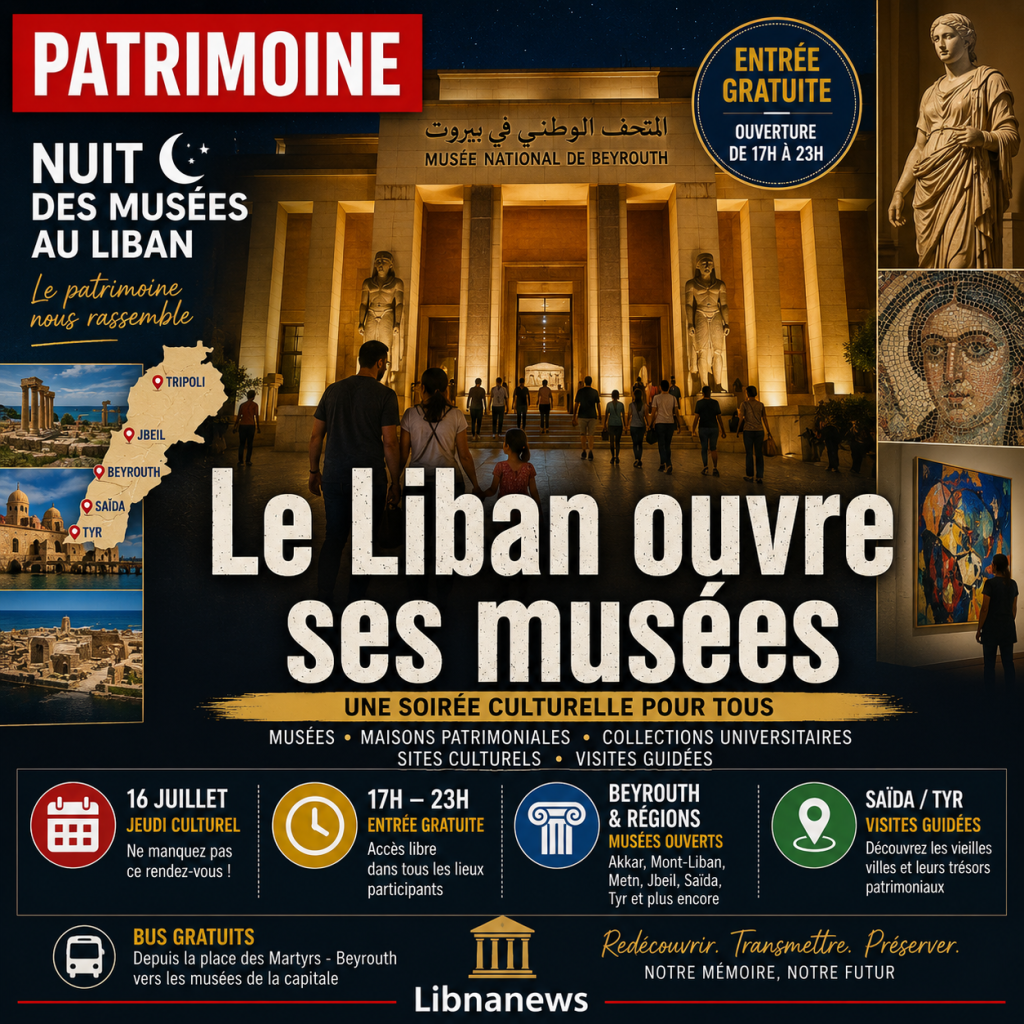
The Museum Night returns to Lebanon on Thursday 16 July, with a free opening scheduled from 5 p.m. to 11 p.m. in a series of museums, heritage houses, university collections and cultural sites spread across Beirut, Mount Lebanon, the North, Metn, Jbeil, Saida and other regions. The event wants to put the public back into direct contact with the heritage, at a time when culture remains one of the few spaces capable of connecting generations, territories and memories. The promise is simple: enter free of charge, travel differently, rediscover places often visited by tourists before being by the Lebanese themselves.
This edition comes in a particular context. Lebanon continues to face an economic, social and security crisis that affects families, institutions and cultural budgets. Opening museums for free during an evening does not solve these difficulties. But the initiative has concrete scope. It allows families who often give up paid trips to return to places of knowledge. It also gives visibility to lesser-known museums, sometimes far from the capital’s major cultural circuits. The Night of Museums becomes more than just a festive event. It raises an essential question: how can heritage be preserved and transmitted when public resources remain weak?
Free evening from 5 to 11 p.m
The programme announced provides for a free opening of participating museums on Thursday, 16 July, from 5 p.m. to 11 p.m. The choice of the evening schedule is important. It changes the usual report to the museum. Visitors no longer come only in a school, tourist or academic setting. They enter cultural places after work, with family, friends or guides. The museum becomes an urban and regional outing. It also becomes a way of reoccupying the city differently, through memory, objects, art, archaeology, archives and scientific collections.
Free movement is the other central element. In a country where purchasing power has deteriorated sharply, the entry price can be an obstacle, especially for large families. Museum Night removes this barrier for a few hours. However, it must not mask the permanent costs of cultural institutions. A free museum for the public is never free to operate. We must pay the guards, maintenance, electricity, conservation, mediators, restorers, insurance and sometimes safety. The event thus attracts the public, but it also recalls the economic fragility of the places that host this audience.
This evening can finally be used as a test. Lebanese museums need to know their visitors better. They must know who comes from, where families come from, where young people are attracted to, what schedules work, what routes are of interest to the public and what collections are poorly explained. High attendance on 16 July should therefore be followed by a serious assessment. Success should not only be measured by the number of entries. It should also improve reception, signage, mediation, accessibility and cooperation between museums.
Museum Night in Lebanon, between heritage and public access
The Museum Night in Lebanon is based on a strong idea: heritage should not remain reserved for specialists, tourists or regular visitors to cultural districts. It belongs to an entire society. Archaeological collections tell the civilizations that have crossed the territory. Heritage houses retain forms of housing, crafts and urban memory. University museums show the role of research. Local museums give public life to regions often absent from the national cultural map.
The list of participating places shows this diversity. It is not limited to the National Museum or the major institutions of Beirut. It includes prehistoric museums, mineralogic collections, fossil museums, artists’ houses, places linked to Armenian memory, museums of popular traditions, academic institutions and heritage sites in historic cities. This territorial dispersion is one of the advantages of the programme. It invites visitors to leave the Beyruthin reflex and to consider Lebanon as a cultural archipelago, where each region has its own objects, stories and frailties.
However, public access remains uneven. Museums in the capital often benefit from easier transport, better media visibility and more spontaneous visits. Regional locations are more dependent on signage, roads, security, guides and local communication. The announcement of free buses from Martyrs Square in central Beirut is therefore an important element for museums in the capital. But the question of regional transport remains broader. Accessible heritage requires safe roads, clear schedules and mobility arrangements beyond one evening.
Museums announced in the program
The programme mentions a series of museums and cultural places that will open their doors free of charge. The names below reproduce the announced titles, with a French transcript harmonized where possible. Some places may be known under a slightly different name depending on the institutions, languages or communication media.
Among the places announced are the Heritage House, the Archaeological Museum of Menjez in Akkar, the National Museum of Beirut, the Sursock Museum, the Geological Museum of the American University of Beirut, the Archaeological Museum of the American University of Beirut, the Mineral Museum, the Museum of Lebanese Prehistory of Saint Joseph University, the Eastern Library of Saint Joseph University and Beit Beirut. This first series illustrates the importance of Beirut and academic institutions in heritage conservation.
The programme also includes the Bank of Lebanon Museum, the Aram Bezikian Museum of Orphans of the Armenian Genocide, the Fossil Museum in Jbeil, the Byblos Archaeological Site Museum, the Alita Site Museum, the Louis Cardahi Foundation of the Lebanese-American University, the Archaeological Museum of the Holy Spirit University of Kaslik, the Billy Karam Museum in Nahr el-Kalb, the Ruins Museum in Ramhala, as well as places associated with private collections, heritage houses or cultural foundations.
Other sites announced include the Saloua Raouda Choucair Foundation in Ras el-Metn, the Mikhail Naimy Museum House in Baskinta or its region of memory, the Izzat Mazhar Museum, the Debbané Palace in Saida, the Mary Baz Museum, the Northern Lebanon and Akkar Museum in Tripoli Castle, the Museum of the Notre Dame Monastery in Balamand, the Balamand University Museum of Heritage and Popular Traditions and the Soap Museum in Saida. The programme also includes guided tours to the old town of Saida and the old town of Tyre.
Beirut, cultural showcase and starting point
Beirut naturally occupies a central place in the evening. The National Museum remains one of the major entry points to understand the history of the territory, from prehistory to ancient and medieval periods. Its symbolic role goes beyond its collections. It also recalls Lebanon’s ability to save part of its heritage despite wars, destruction and neglect. A free evening visit can attract an audience who would not have spontaneously crossed its doors, especially among younger generations.
The Sursock Museum offers another reading of Lebanese culture. It refers to modern and contemporary art, the history of a large Beyruthine residence and the place of the city in regional artistic circulations. Its presence in the program does not reduce the Night of Museums to archaeology. Lebanon is not limited to its ancient remains. It also has a modern history, artists, collectors, aesthetic conflicts and institutions that have had to rebuild after major shocks.
Beit Beirut, the Eastern Library, university museums and scientific collections complete this map of the capital. They give access to different memories: urban war, archives, geology, archaeology, prehistory and academic research. This plurality is precious. It shows that culture is not limited to objects displayed behind windows. It includes buildings, archives, traces of the city, natural sciences and stories that institutions choose to transmit.
The role of universities
Universities play a major role in Museum Night. The American University of Beirut, Saint Joseph University, the Holy Spirit University of Kaslik, the University of Balamand and the Lebanese-American University appear in the program through their museums, collections or foundations. This presence shows that the Lebanese heritage does not depend solely on the Ministry of Culture. It is also based on academic institutions that preserve, classify, study and exhibit.
This reality is a force, but it also creates a responsibility. University museums should avoid being confined to an audience of students and researchers. Museum Night forces them to open their language. It encourages them to explain their collections in an accessible way, without sacrificing accuracy. The public needs to understand why a fossil counts, why a rock tells a story, why an archaeological fragment illuminates an era or why an ancient library remains important in a digital country.
Universities can also train tomorrow’s cultural mediators. Students can guide, translate, explain, document and participate in the reception. This involvement creates a link between training and public service. It gives young people an active role in the transmission of heritage. It can also generate vocations in conservation, museum, archaeology, art history, restoration and scientific mediation.
Regions as a major issue of the evening
The presence of museums outside Beirut is one of the most interesting aspects of the programme. Menjez, Jbeil, Alita, Nahr al-Kalb, Ramhala, Ras al-Metn, Baskinta, Saida, Tripoli, Balamand and Tyre show that Lebanese heritage is not concentrated in the capital. It’s scattered. He lives in villages, monasteries, writers’ houses, local collections, castles, old souks and coastal sites. The Night of Museums can help to rebalance the look.
Saida occupies a special place with the Debbané Palace, the Soap Museum and guided tours in the old town. The city has a dense heritage fabric, where souks, houses, places of artisanal production and monuments interact with the sea. Guided tours are essential in this context. They make it possible to read the city as a whole, not as a succession of isolated buildings. They also recall that urban heritage is visited on foot, with the time needed to understand uses, transformations and threats.
Tyre, with its guided tours in the old town, refers to another dimension. The city bears a major ancient history, but it also lives in the present, with its inhabitants, its shops, its constraints and its risks. In the current regional context, Tyre’s presence in a cultural programme is of great value. It means that cities in the South are not just safe spaces of tension. They remain places of memory, life and transmission.
Tripoli and Akkar recall the importance of the North. The Northern Lebanon and Akkar Museum at Tripoli Castle can help to put this region in a more visible national narrative. The Archaeological Museum of Menjez in Akkar shows that geographical margins can become centres of knowledge. The challenge remains to transform this ad hoc visibility into regular attendance.
A cultural evening in a country under pressure
The Night of Museums arrives in a Lebanon where priorities often seem elsewhere. Families face the income crisis. Public institutions lack resources. Infrastructure is deteriorating. Security tensions weigh on the South. In this context, some may judge an evening of secondary museums. That would be a mistake. Heritage is not a luxury. It structures identity, education, tourism, collective memory and cultural economy. It can also restore confidence in institutions capable of welcoming, explaining and transmitting.
However, the event must avoid the window trap. Opening free once a year is not enough to democratize culture. Regular school curricula, adapted schedules, trained guides, materials in Arabic, French and English, access for people with disabilities and affordable rates for the rest of the year are required. Buildings must also be maintained and collections protected. A night of massive attendance can be beautiful. It may also reveal weaknesses in reception if it is not prepared.
Safety and mobility must be treated seriously. The announcement of dedicated and free buses from Martyrs Square for the museums of the capital is positive. It can encourage visitors to leave their cars, reduce traffic congestion and facilitate access to families. But it will require legible schedules, information points, clear routes and coordination with the security forces. A good cultural experience often begins before entering the museum, through transportation, reception and signage.
What the public can expect from July 16
The audience can expect from this evening a varied experience. Archaeology enthusiasts will be able to focus on the National Museum, the Byblos site, the Menjez Museum or university collections. Families interested in science can turn to geological, mineral or fossil museums. Visitors sensitive to old houses and urban memory can choose Beit Beirut, the Debbané Palace, heritage houses or regional museums. Modern and contemporary art lovers can visit the Sursock Museum or the Saloua Raouda Choucair Foundation.
It would be useful for visitors to prepare their journey. Six hours may seem long. They pass quickly when the places are distant or frequented. It is better to choose two or three coherent steps rather than looking at everything. Families with children should prefer simple routes, with breaks and accessible places. The groups that want to get out of Beirut must check the road times. Guided tours to Saida and Tyre can be particularly interesting, as they provide a reading environment for complex cities.
Museums, for their part, should take advantage of the event to present short routes. A free evening often attracts a non-specialist audience. It is therefore necessary to avoid visits that are too long or too technical. Simple explanations, visible mediators, maps, light panels and some flagship objects can produce a lasting effect. The point is not to say everything. It is to make want to come back.
The Night of Museums can thus become a moment of cultural conquest. It recalls that Lebanon is not reduced to its crises, political blockages or social divides. There remains a dense territory of memories, collections and knowledge. On Thursday, 16 July, from 5 p.m. to 11 p.m., this wealth will be available free of charge in several regions. The continuation will depend on the ability of institutions to turn this evening into a habit, and visitors to consider museums not as exceptional places, but as living spaces of Lebanese public life.




