

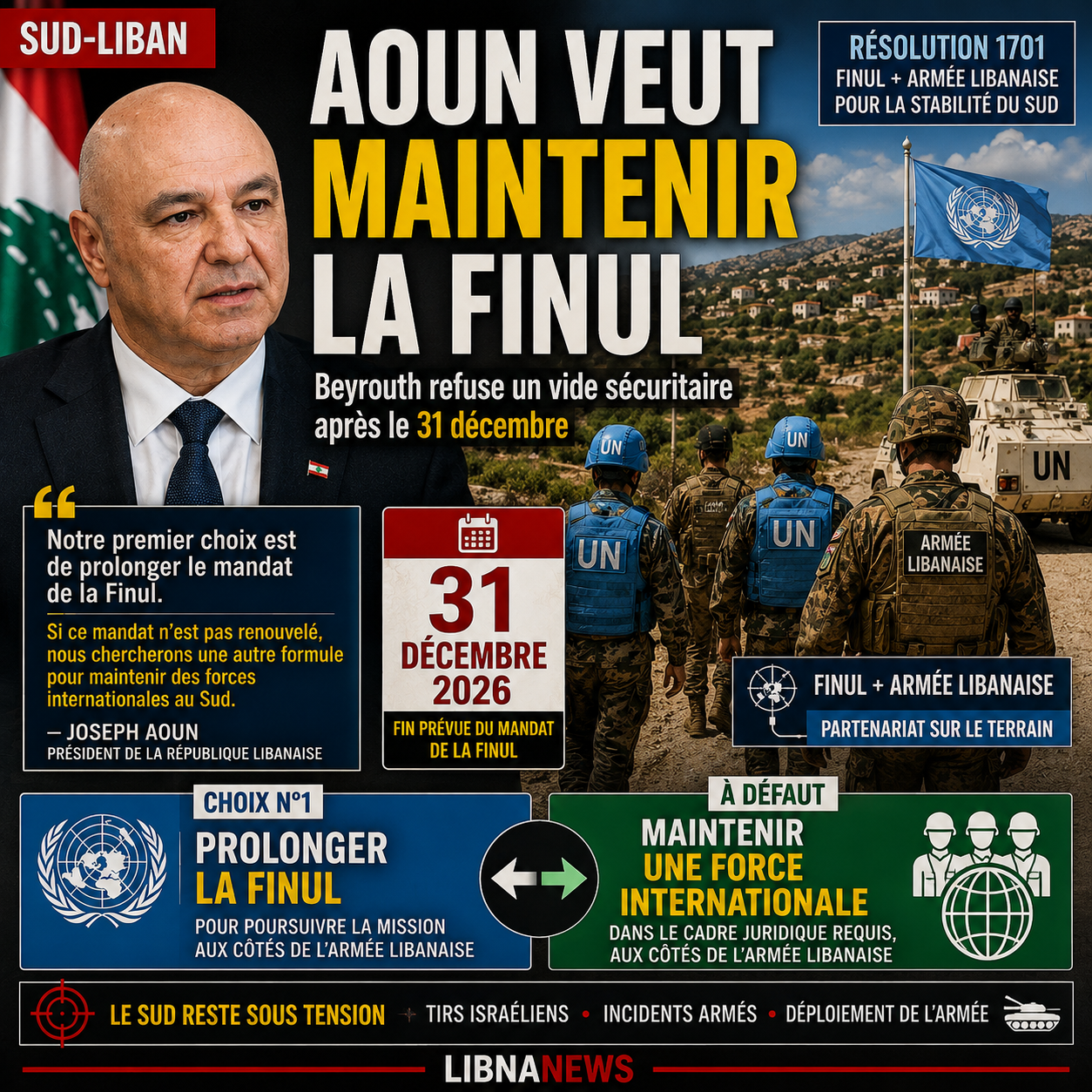
Lebanese President Joseph Aoun requested Monday, 17 August 2026 that the international presence be maintained in southern Lebanon after the current expiration of the United Nations Interim Force in Lebanon (Final). His position, however, faced a major diplomatic obstacle: the Security Council had decided in August 2025 that the current mandate would be the last, following a compromise reached, inter alia, under pressure from the United States, while Israel had long contested the effectiveness of the mission. Washington and Tel Aviv now favour another international mechanism, more focused on the verification of Hezbollah disarmament and the deployment of the Lebanese army. Joseph Aoun therefore proposes two options: to try to obtain a new extension of the Finul or to negotiate another international presence capable of avoiding a security vacuum in the South.
Joseph Aoun wants to return to the programmed end of the Finul
Joseph Aoun’s statement comes at a time when the future of Finul is already framed by a decision of the Security Council. By August 2025, the fifteen members of the Council had unanimously adopted resolution 2790. The Commission last extended the mandate of the United Nations Interim Force in Lebanon until 31 December 2026.
The text does not provide for a simple new administrative deadline. It then arranges for the cessation of operations of the mission and an orderly and secure withdrawal of its staff. The departure must take place over a period of up to one year. The request made on Monday by the Lebanese President therefore amounts to seeking a change in a trajectory already decided by the Security Council.
With a parliamentary initiative and a petition to maintain the international force, Joseph Aoun clearly outlined Beirut’s preference. « Our first choice is to extend the term of office of the Finul, » the President said, according to the Lebanese media reports on Monday.
However, it immediately provided for a withdrawal solution. « If this mandate is not renewed, the second option is to adopt a formula to ensure the maintenance of international forces in the south within the required legal framework, alongside and in coordination with the Lebanese Army, to support stability and carry out the missions entrusted to them, » he added.
The wording is important. Joseph Aoun does not condition the international presence to the maintenance of the name or current structure of the Finul. Above all, Lebanon does not wish to see any international force from the South disappear at a time when the main security issues remain unresolved.
The United States pushed towards a final extension
The main obstacle to a renewal of theFinishcomes from Washington’s position in the 2025 negotiations. The United States then insisted that the extension until December 2026 be the last. The compromise finally adopted in the Security Council had made it possible to retain peacekeepers temporarily while setting their departure.
This position marked an important development in American politics. Washington had long supported the maintenance of the mission, while regularly calling for a strengthening of its effectiveness and freedom of movement. In particular, US officials criticized Finul for not being able to prevent the presence of Hezbollah’s military infrastructure in its area of operation.
In 2025, the US administration went further. It considered that the Lebanese authorities should progressively assume sole responsibility for security in the South. The Lebanese army must, in this sense, become the only legitimate armed force in the area and gradually replace the current international arrangement.
The text adopted by the Security Council reflects that direction. The planned end of the Finul must be accompanied by a rise in the power of the Lebanese State and its army. Washington associates this development with the disarmament of non-State armed groups, including Hezbollah.
This position places Joseph Aoun before a considerable diplomatic difficulty. To extend the Finul beyond 31 December, Beirut must obtain a new decision from the Security Council. However, the United States had a veto power and had made the planned termination of the mission a condition of the 2025 compromise.
U.S. support is therefore becoming decisive. Without changing positions in Washington, the first choice announced by Joseph Aoun on Monday seems difficult to achieve.
Israel no longer wants Finul in its present form
The Israeli position is the second major obstacle. Israel has been critical of the functioning of the Finul for years and believes that the mission has not fulfilled one of its key objectives: to prevent the reconstitution of a Hezbollah military aircraft in the area south of the Litani River.
The Israeli authorities claim to have discovered, especially since military operations against Hezbollah, tunnels, weapons depots, military posts and various infrastructure belonging to the Shiite movement in areas theoretically subject to the provisions of resolution 1701.
For Israel, these findings demonstrate the limitations of the model applied since the 2006 war. The presence of thousands of peacekeepers would not have prevented Hezbollah from maintaining or developing military capabilities near the border.
This criticism explains why Tel-Aviv does not favour a simple renewal of the Finul. Israel now wants a mechanism that can effectively verify the disarmament of Hezbollah and prevent the movement from restoring its infrastructure after the possible withdrawal of Israeli forces.
The differences also relate to the powers granted to the forces responsible for verification. Israel would like to see sufficient inspections to search for weapons or military installations, including those suspected of being on private property.
This issue is extremely sensitive in Lebanon. The Lebanese Army wants to prevent inspections of private homes or land from causing clashes with the inhabitants of southern localities. Beirut also wishes to retain its authority over the operations carried out in its territory.
The disagreement therefore no longer concerns only the existence of the Final. It addresses the very nature of the future security system in southern Lebanon.
Washington and Israel favour another mechanism
Discussions in 2026 show that the United States and Israel are already thinking about post-Final. According to available information on the negotiations, Washington is working with the parties on a separate international mechanism to verify the deployment of the Lebanese army and the disarmament process of Hezbollah.
The United States and Israel expressed reservations about automatically entrusting this mission to the United Nations. Several countries were mentioned as potential contributors to a new international arrangement. In particular, the United Kingdom, Italy, Switzerland and Indonesia have been included in the discussions reported in recent weeks.
Beirut stressed, however, that no final agreement had yet been reached on the composition of a possible force. Negotiations are continuing and several models are still possible.
A mission could be formed by a group of countries accepted by Lebanon and Israel. Another possibility would be to establish an international arrangement with a new legal basis. A European force was also mentioned in the diplomatic discussions.
It is precisely in this space that the « second choice » presented by Joseph Aoun takes its full meaning. The President seems to publicly acknowledge that an extension of the Finul could encounter an American and Israeli refusal. It therefore seeks to preserve the essential: an international presence on the ground, although its name, composition and mandate must change.
This approach also allows Beirut to participate in the post-Final negotiations rather than undergo a mechanism designed exclusively by Washington and Israel.
Joseph Aoun wants a force placed alongside the army
The Lebanese President has placed an important condition on any alternative formula. International forces should be deployed « with and in coordination with the Lebanese Armed Forces ».
This clarification directly relates to the question of sovereignty. For Beirut, a future force must not have an autonomous authority to operate freely in the territory without coordination with Lebanese institutions.
Joseph Aoun thus placed the army at the center of the future device. This is consistent with its constant position since its assumption of the presidency: the Lebanese armed forces must gradually become the central military actor throughout the country.
The former commander-in-chief of the army knows directly the mechanisms of cooperation with the Finul. For years, Lebanese troops and peacekeepers have been conducting patrols and coordinating part of their operations in the South.
The challenge now is to significantly increase the responsibilities of the army. It must control areas from which Israeli forces withdraw, identify unauthorized military infrastructure and prevent the re-establishment of armed positions beyond the authority of the State.
This mission is all the more difficult as military incidents continue. Israeli fire was again reported on Monday in southern Lebanon, a few days after a new sequence of strikes and tensions with Hezbollah.
For the Lebanese presidency, asking the army to assume all these responsibilities immediately while removing the international presence would create an additional risk.
The resumption of fire reinforces Beirut’s arguments
The timing of the presidential statement is not insignificant. Joseph Aoun defends the maintenance of an international force as incidents resume in the South and de-escalation mechanisms remain in demand.
The events of the weekend recalled the fragility of the situation. The Israeli strikes of 15 August resulted in several casualties in Lebanon, including civilians. Israel presented its operations as a response to an action attributed to Hezbollah that had seriously injured three Israeli soldiers in the Ali al-Taher area.
The Israeli army also announced that it had eliminated two Hezbollah commanders. Diplomatic contacts were then initiated to prevent a response by the movement and a new spiral of reprisals.
The resumption of Israeli fire on Monday shows, however, that the situation does not yet correspond to that of a stabilized border. Several sectors remain exposed to military operations and disputes over Israeli positions remain open.
For Beirut, this context reinforces the argument for international continuity. The Finul cannot prevent all strikes or impose a political solution, but retains observation, liaison and coordination functions on the ground.
Its disappearance without a replacement mechanism would remove those capabilities at a time when Lebanon and Israel still did not have direct diplomatic relations.
Israeli withdrawal and Hezbollah disarmament remain linked
The future of the international presence now largely depends on two issues: the Israeli withdrawal and the disarmament of Hezbollah.
Israel claims that it will not leave the sectors it controls until it has obtained sufficient guarantees on the disarmament of the Shia movement. The Israeli authorities want to prevent a withdrawal from being followed by the return of Hezbollah fighters, weapons or infrastructure.
Hezbollah defends the opposite logic. He believes that the Israeli presence and continued strikes justify the continuation of his weapons. The movement refuses to address the issue of its arsenal as if Lebanese territory had already been fully evacuated by Israel.
This contradiction produces an impasse. Israel demands results on disarmament before its withdrawal. Hezbollah invokes the absence of withdrawal to justify the retention of its military capabilities.
The Lebanese authorities are trying to break this logic by strengthening the role of the army. The stated objective is to enable the State to progressively recover the arms monopoly while obtaining Israeli withdrawal.
Washington supports this direction, but wants an international mechanism capable of verifying commitments. Israel also requires concrete guarantees before abandoning the positions it deems necessary for its security.
A future international force could therefore become the instrument for articulating these different stages. It should check the ground, accompany the Lebanese army and provide the necessary guarantees for Israeli withdrawal.
Why Israel Considers the Final Insufficient
Israeli mistrust of the current mission did not date back to 2026. Since the July-August 2006 war, Israel has consistently stated that the implementation of resolution 1701 has remained incomplete.
The resolution provides, inter alia, that no armed forces or weapons are present between the Blue Line and the Litani, apart from those of the Lebanese State and the Finul.
Hezbollah has retained a military presence in the South for years. Israel believes that the infrastructure revealed during recent operations demonstrates that the international mission did not have the necessary means, freedom of action or will to prevent the settlement.
For its part, Finul regularly recalled the limits of its mandate. Blue Helmets are not an occupying force and cannot replace the Lebanese authorities. Their ability to access certain sites or properties also depends on the legal and operational framework applicable on the ground.
This difference in interpretation explains part of the current diplomatic confrontation. Israel wants the next mission to carry out more intrusive checks. Lebanon stresses the need to respect its sovereignty and the role of its army.
Washington is now closer to the Israeli position on the need to strengthen verification capabilities, although the United States supports the authority of the Lebanese government and the deployment of the army.
A European force is one of the scenarios
The planned disappearance of the Finul has already led several European countries to think about alternatives. Germany referred in July to the possibility of a European-mandated force to prevent a security vacuum following the departure of peacekeepers.
Such a force could accompany the deployment of the Lebanese army and provide guarantees during the Israeli withdrawal. It could also participate in the verification mechanisms requested by international negotiators.
This option partially joins the second scenario defended by Joseph Aoun. It would allow the Lebanese President to accept the institutional disappearance of the Finul while obtaining the continuation of an international military presence.
But the difficulties remain numerous. The mandate of the new force, its rules of engagement and funding should be defined. Participating countries should also agree to send military personnel to an area where strikes and exchanges of fire remain possible.
The question of political authority would be equally sensitive. A European force, an international coalition or a mechanism created by a specific agreement would not necessarily have the same legitimacy as a peacekeeping operation mandated by the Security Council.
Beirut will therefore have to determine how far it is prepared to accept a transformation of the scheme in order to avoid a complete international withdrawal.
Security Council remains essential to save the Finul
If Joseph Aoun wants to get his « first choice », the way goes through New York. As resolution 2790 had set the end of the mission, an extension would require a further decision by the Security Council.
The problem is not only to get a majority. The veto of one of the five permanent members should be avoided. The United States therefore has a decisive lever.
The parliamentary petition to the President may strengthen Lebanon’s political position, but it does not alter this international power relationship. Beirut will have to convince Washington that the security situation of 2026 justifies reviewing the decision taken in 2025.
Lebanon has a concrete argument: the conditions for withdrawal from the Final are not fully met. Israeli forces have not completely left the areas concerned, Hizbullah’s disarmament record remains open and military incidents continue.
However, Washington can respond that these difficulties clearly demonstrate the limitations of the current mission and the need to move to another verification system.
It is around this divergence that the discussions in the coming months should focus.
The battle is now over the post-Final
Joseph Aoun’s statement was therefore not merely a plea for peacekeepers. It officially opened the diplomatic battle on the system to ensure security in southern Lebanon after 31 December 2026.
The Lebanese president begins by defending the simplest solution for Beirut: to maintain a mission already deployed, with an international legal base and accustomed to working with the army. But it simultaneously acknowledges that such an extension can be blocked.
Israel wants a more effective mechanism to verify the disarmament of Hezbollah. The United States, which had pushed for the last mandate in 2025, shared the objective of transforming the system and had diplomatic means to prevent a renewal that would not meet its requirements.
Joseph Aoun therefore sought to move the debate. If the Finul itself cannot be saved, Beirut wants at least to negotiate the conditions for its replacement rather than to undergo a withdrawal without a transitional solution.
The next few months will have to determine whether Washington finally accepts a temporary extension, whether a new international force can be formed or whether a more limited verification mechanism will replace peacekeepers. The resumption of fire in the South gives this negotiation an additional urgency: on 31 December the security conditions that would allow a safe international withdrawal are still not in place.
Exact number of words in the body: about 2,300 words
Keyword:maintenance of Finul
Keywords Secondary SEO:Joseph




