

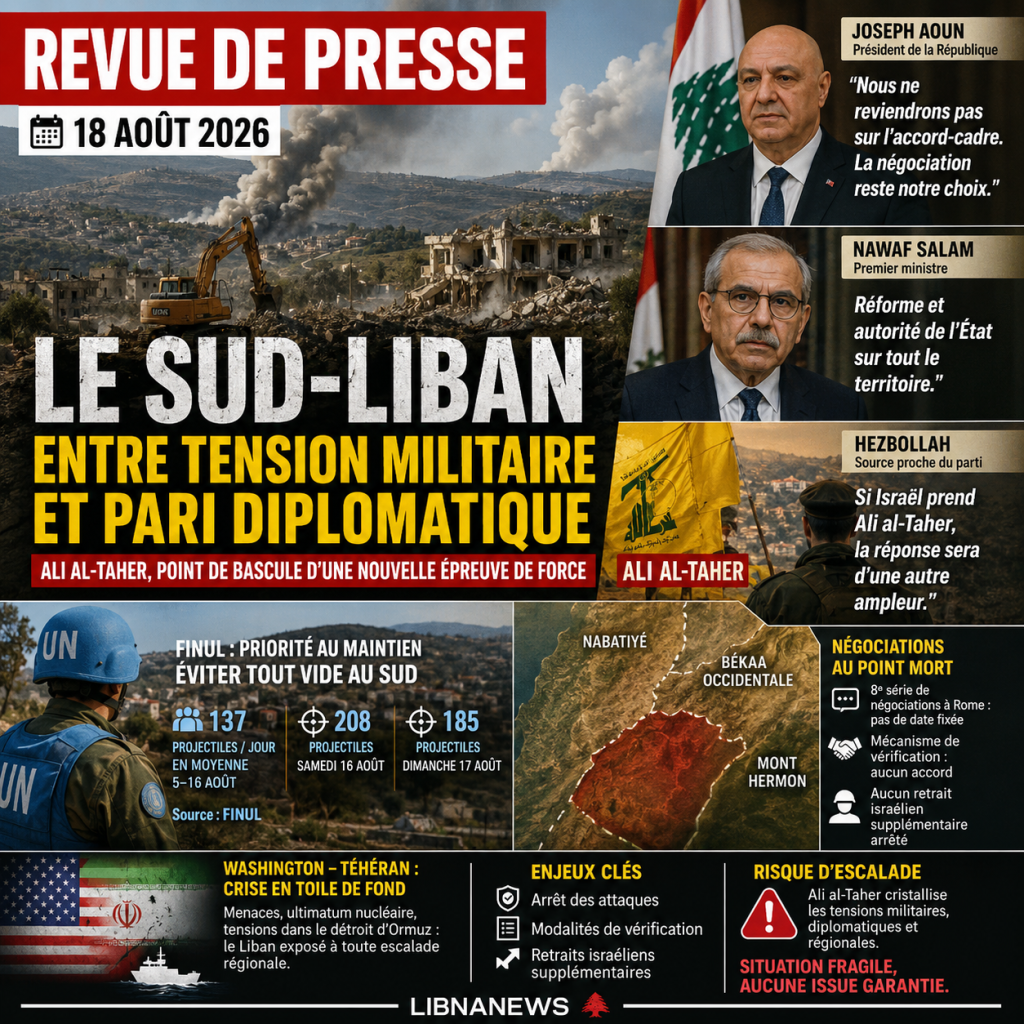
Ali al-Taher crystallises the risk of a new confrontation
The situation in South Lebanon dominates the political pages of the press of 18 August 2026. The various newspapers converge on a finding. The negotiations between Lebanon and Israel did not produce expected progress. At the same time, Israeli military operations continue. The Ali al-Taher area is now focused on concerns. It is presented as both a military issue, an object of negotiation and a possible starting point for wider confrontation.Al Joumhouriyaton 18 August 2026, reports that the sharp intensification of Israeli attacks against Ali al-Taher raised concerns that the clashes that began on 2 March would be a similar kind of outbreak. The newspaper points out that the file was central to the discussions between the army commander, General Rodolphe Haykal, and US General Joseph Clearfield. The Lebanese side described the consequences of the Israeli bombing, destruction and operations in several southern localities.Al Joumhouriyatit also reports on a security official saying that a large-scale Israeli operation against Ali al-Taher remains possible. However, according to the newspaper, Washington has not yet given its green light to such an offensive.
Al Akhbar18 August 2026 also describes a diplomatic process that remains blocked. The newspaper considers that Joseph Clearfield’s visit did not produce the breakthrough sought by Washington. He believes that Israel is instead seeking to consolidate its positions before the next Israeli political deadlines. Ali al-Taher occupies a central place in this reading. According to the daily newspaper, the value of the area lies in its dominant position over a vast area including Nabatiyah, the Western Bekaa and the outskirts of Mount Hermon. The newspaper also reports shelling, destruction and earth-moving operations in several sectors of the South. It considers that these operations show that Israel does not behave as if a lasting halt to the fighting was imminent. At the same time, the daily newspaper notes that the modalities of the disarmament verification mechanism and the composition of the international forum to monitor its implementation have not yet been established. Several countries are mentioned to participate. For example, discussions already focus on how to implement a possible arrangement while military conditions for its implementation remain fragile.
Al Sharq Al AwsatOn 18 August 2026, Ali al-Taher was also in the foreground. The newspaper reports, citing a political source close to a senior Hizbullah official, that the party would prepare for a confrontation if Israel decided to take control of the area. The same source states that Hezbollah is still waiting to determine whether Israel has actually chosen the confrontation or whether it uses military pressure to obtain concessions. It warns that an offensive would provoke a response of a different magnitude. The daily thus presents Ali al-Taher as the possible theatre of the next test of force between Israel and Hezbollah. This reading joins some of the concerns expressed byAl Joumhouriyat, although the two publications do not describe in the same way the intentions of the different actors.
Lebanon maintains the choice of negotiations despite bombardments
Faced with this military pressure, the Lebanese Presidency continues to defend the diplomatic path.Ad DiyarOn 18 August 2026, Joseph Aoun reported to a delegation of the Task Force for Lebanon. The President said that Lebanon did not want to return to the framework agreement despite the difficulties encountered. On the contrary, it wants to strengthen it and achieve progress on prisoners, the border, the experimental zone and the ceasefire. Joseph Aoun says he’s counting on the United States, sponsors of the deal. He believes that Washington remains committed to this process. The Head of State also announced that Lebanon was awaiting a new round of negotiations. In the same interview, he criticized the Israeli strategy. According to him, Israel reason in the short term by favouring military power, whereas this method cannot enable it to achieve its objectives on a sustainable basis. The President therefore defends a line based on two principles: to continue the negotiations and to obtain at the same time the means necessary to strengthen the Lebanese army.
The same approach appears in several publications.Al BinaOn 18 August 2026, Joseph Aoun reiterated his commitment to the framework agreement and presented diplomacy as an alternative to war. It recalls that Lebanon has undertaken this initiative and intends to continue implementing it. The newspaper also reproduces its position on Iran: relations must be relations between two States, based on mutual respect and non-interference in internal affairs. Nawaf Salam is developing an approach that combines restoration of public authority and reforms. According toAl BinaOn 18 August 2026, the Prime Minister explained to the US delegation that government policy was based on two inextricable lines: reform and the restoration of state authority throughout the country. Discussions also focused on economic relations with the United States and partnerships on transport, infrastructure and energy.
The difficulty lies in the growing gap between this diplomatic strategy and military events.Annaharon 18 August 2026, stresses that no firm date has yet been set for the eighth round of negotiations between Lebanon and Israel in Rome. The daily reports that discussions with Joseph Clearfield continue to focus on the verification mechanism and the countries likely to participate. No agreement has yet been reached on the extension of the experimental zones. Nor was any further Israeli withdrawal from the occupied positions in Lebanon definitively stopped. At the same time, Israeli operations continue in Mays al-Jabal, Khiam, Hadatha, Mansuri, Aitarun and the Ali al-Taher area. The newspaper therefore reveals two parallel dynamics: a negotiation that is hardly progressing and a military pressure that does not stop.
UNIFIL becomes a second diplomatic front
The question of maintaining an international presence in the South is the other major issue of the day.Ad Diyaron 18 August 2026, reports that a parliamentary delegation led by Melhem Khalaf provided Joseph Aoun with a text signed by 86 deputies from various blocs to support the continuation of the UNIFIL mission. The President said that Lebanon’s priority remained the extension of this mission. If this option fails, Beirut wants another international force with an appropriate legal framework to take over. Joseph Aoun insists above all on the need to avoid any international vacuum in the South. He also claims that Israel opposes the presence of UNIFIL and has been exerting pressure in this direction for almost a year. Nawaf Salam defends a comparable position. According to him, a United Nations force must remain responsible for three tasks: observation and information, coordination and liaison.
Al Joumhouriyaton 18 August 2026, adds an additional element by reporting UNIFIL data on Israeli military activity. Between August 5 and 16, the international force reported a daily average of 137 projectiles, with 208 projectiles on Saturdays and 185 on Sundays. It stresses the direct consequences of this escalation on civilians, with further family displacements and a worsening sense of security. These data give a quantitative dimension to the escalation described by the various newspapers. They also explain why the question of maintaining an international force is no longer treated as a mere institutional dossier. It is directly linked to the security of the inhabitants, the return of the displaced and the conditions for a possible Israeli withdrawal.
Al Liwa18 August 2026, for its part, refers to discussions on an alternative if UNIFIL is not renewed in its present form. The daily reports of reflections on a multinational force that could receive a different mission than that of peacekeepers. In particular, it would be responsible for verifying the implementation of the arrangements in the experimental areas. However, the paper presents this scenario as a hypothesis still under discussion. This issue accompanies the international consultations in Beirut. It must also be included among the cases defended by Joseph Aoun during his exchanges in Rome. The formal position therefore remains primarily favourable to the continuation of UNIFIL, while various options are being explored to avoid a vacuum if this option becomes impossible.
The confrontation between Washington and Tehran weighs on the Lebanese case
The crisis in the South cannot finally be separated from the confrontation between the United States and Iran, ubiquitous in the one of 18 August.Al Sharq Al AwsatOn 18 August 2026, Donald Trump reported that after the expiry of the 60-day period provided for under the Islamabad memorandum, he again called on Iran to abandon its nuclear programme and « lift the white flag ». Tehran, for its part, disputes the American interpretation of this deadline. At the same time, Iranian officials refer to the possibility of a shift from defensive logic to offensive logic if diplomacy fails. The newspaper also reports that an Iranian official threatened another escalation in the Strait of Ormuz. These developments maintain a regional climate in which the Lebanese situation remains exposed to the consequences of further deterioration between Washington and Tehran.
Annaharon 18 August 2026, explicitly establishes this link. The daily believes that Lebanese officials fear the consequences of tensions between Washington and Tehran on the South. In particular, he notes the statements of the President of the Iranian Parliament, Mohammad Bagher Ghalibaf, claiming to be in contact with the fighters present on the front lines in Lebanon. The newspaper sees this as a direct manifestation of Iranian involvement. It also reports information attributed to the US press that Iran had taken advantage of the lull in coordinating its regional allies. In this reading, a worsening of the conflict around the Strait of Ormuz could therefore have immediate repercussions in Lebanon. Hezbollah, for its part, continues to portray operations around Ali al-Taher as an Israeli initiative.AnnaharOn 18 August 2026, he reported on the statements of the deputy Hassan Ezzeddine, who accused Israel of seeking to gradually take control of the sector while avoiding an open war for the moment.
The day of 18 August thus makes Ali al-Taher appear as the point where almost all the files meet. The sector focuses on the military confrontation between Israel and Hezbollah, the difficulties of the Lebanese army in implementing the envisaged arrangements, the American-mediated negotiations and the tensions between Washington and Tehran. Newspapers diverge greatly when they attribute responsibilities or interpret the intentions of actors. However, they converge on the existence of a real risk of escalation. At the same time, Joseph Aoun and Nawaf Salam maintain the choice of negotiation, state strengthening and international presence in the South. This strategy remains suspended from three concrete developments: the cessation of attacks, the definition of the verification modalities of the framework agreement and the possibility of obtaining further Israeli withdrawals. As of 18 August 2026, none of these three issues have yet been definitively resolved.
Local policy: the state faces the dual challenge of the framework agreement and the restoration of its authority
Joseph Aoun maintains diplomatic leadership despite blockages
The Lebanese domestic policy of 18 August 2026 remains dominated by the consequences of the crisis in the South and by the ability of the State to resume the initiative. The Presidency places the framework agreement at the centre of this strategy. According toAl BinaOn 18 August 2026, Joseph Aoun told a delegation of the Task Force for Lebanon that Lebanon would not return to the agreement. The Head of State acknowledges the existence of difficulties in its implementation. However, he wanted to strengthen it and get progress on several issues. He cites prisoners, the border, the experimental zone and the cessation of fighting. The President believes that the United States, as the sponsors of the agreement, remains committed to this process. He also recalled that Lebanon was awaiting a new round of negotiations. His line is to present diplomacy as the only way to avoid a new war. Aoun claims that the country faces two possibilities, war or diplomacy, and rejects the idea that a third way can solve the crisis. He added that the Lebanese army had a high professional level, but needed additional resources to carry out its missions. This issue goes beyond the military domain. The President associates the deployment of the State to the South with the return of public services and the presence of ministries in the relevant localities.
This orientation is reflected inAl Sharq18 August 2026. The newspaper reports that Joseph Aoun sees the continuation of the framework agreement as an assumed policy and not as a simple response to external pressures. He also states that relations with Iran must be organized from State to State, on the basis of mutual respect and non-interference. This declaration has a direct domestic scope. It comes at a time when Tehran’s regional role and its relations with Hezbollah remain at the heart of the debate on the sovereignty and monopoly of armed force. At the same time, the Presidency insists on the fight against corruption, the continuation of reforms, the development of e-government and the functioning of justice. Domestic policy is thus structured around two interrelated issues: restoring state authority in security matters and rebuilding its institutional capacity. However, this line does not resolve the disagreement over Hezbollah’s weapons. Rather, it establishes the framework within which the Presidency intends to deal with the problem, prioritising institutions and negotiations rather than internal confrontation.
Nawaf Salam combines sovereignty and reform
Nawaf Salam is developing a close approach, but more focused on the functioning of the state.Al Binaon 18 August 2026, reports that the Prime Minister presented government policy as based on two interrelated lines: reform and restoration of state authority throughout the territory. This wording summarizes an important part of the government line. Sovereignty is not presented as an exclusively military issue. It also requires a functioning administration, infrastructure, a more stable economy and institutions with the means to act. During his meeting with the American delegation, Nawaf Salam discussed the possibilities for the development of economic relations between Lebanon and the United States. Trade focused on investment and public-private partnerships in transport, infrastructure and energy. The government is therefore trying to link the return of the state to a concrete improvement in its capacity to provide services. This approach is particularly important in the South, where the sustainable return of people depends on security, infrastructure and reconstruction.
However, the issue remains politically sensitive. There is broad institutional support for the principle of restoring public authority, but the means to do so divide actors. MP Qassem Hashem, quoted byAl BinaOn 18 August 2026, the issue of arms must remain an internal matter. It believes that it should be settled by national consensus and not by foreign or Israeli will. It also recalls Nabih Berri’s position that evolution becomes possible if Israel first respects the ceasefire and begins its withdrawal. This position introduces a condition into the political sequence. For part of the Shiite camp, the State cannot ask Hezbollah to deal with the issue of its armament independently of the maintenance of Israeli forces on Lebanese territory. Conversely, other actors consider that the State’s arms monopoly must be implemented without waiting for the resolution of the entire dispute with Israel. There is therefore less disagreement about the stated objective of sovereignty than about the order in which measures should be taken.
UNIFIL brings together an unusual parliamentary majority
At the same time, the question of the international presence in the South produced a rapprochement between deputies from different camps.Al Binaon 18 August 2026, reports that a parliamentary delegation led by Melhem Khalaf gave Joseph Aoun a letter signed by 86 deputies from several blocs and sensitivities. The text supports the continuation of the mission of UNIFIL. For Khalaf, these signatures represent more than a technical approach. They show, in his view, that divergent political forces can be found when the security of the South, the sovereignty of the State and the future of its inhabitants are concerned. Joseph Aoun replied that Lebanon’s first choice remained the extension of the mission. If this became impossible, he hoped that another force with an international legal framework could avoid a vacuum. The President felt that this issue should be prepared before the expiry of the deadlines and not dealt with at the last moment.
The same delegation visited Nawaf Salam. The Prime Minister reaffirmed the need for a UN presence in the South. It assigns it three essential functions: observing and reporting, coordinating and maintaining contacts. The UNIFIL file is thus a rare example of cross-cutting parliamentary mobilization in a period of deep divisions. However, this convergence does not mean that Members share a common understanding of national security. For some, the international force must accompany the strengthening of the role of the army. For others, its continued existence is mainly a means of reducing the risks associated with Israeli operations. There is therefore a consensus on the need to avoid the vacuum, rather than on all the political and military arrangements to follow. Nevertheless, the mobilization of the 86 Members remains significant. It allows the Presidency and the Government to present their request to maintain an international presence as a position beyond the executive alone.
Amnesty law opens a new internal power relationship
Apart from the Southern dossier, the General Amnesty Act is one of the main sources of political tension.Ad Diyaron 18 August 2026, reports that the families of the soldiers killed in the Battle of Abra are preparing a mobilization to prevent the entry into force of the text in its present form. Their action must follow two directions. The first is Joseph Aoun. Families want the president to refuse to sign the text or refer it to Parliament. They recall a statement made by the Head of State at a previous meeting at which he assured that the blood of soldiers and members of the security forces could not be compromised. The second approach is for MPs opposed to the law. Families consider with them the possibility of referral to the Constitutional Council on the provisions which they consider unfair to victims. Their stated aim is to prevent an amnesty from being granted without conditions to persons prosecuted or convicted in cases related to attacks against the army.
According toAd DiyarOn 18 August 2026, however, families sought to maintain their movement in a legal framework and to prevent it from being transformed into a partisan confrontation. They recognize that some political forces support their position, but refuse to present this convergence as a permanent political alliance. The newspaper also mentions the search for a solution allowing the president to refer the text back to Parliament in order to amend certain provisions. Such a decision would allow Joseph Aoun to express his reservations without entering into a frontal institutional confrontation with the House. But it would immediately reopen the political debate. The President is therefore faced with a delicate choice between parliamentary balances, family expectations and concerns expressed within the military institution. The amnesty law thus becomes a test of the relationship between the Presidency, Parliament and a part of public opinion directly affected by past violence.
Media law raises another institutional challenge
A second text voted by Parliament raises requests for presidential intervention.Al Binaon 18 August 2026, reports that the officials of the press unions and editors asked Joseph Aoun to dismiss the new media law. They denounce several provisions which they consider incompatible with public freedoms. Their main objection is to the legislation allowing a journalist to be imprisoned. They also reject any provision that may reduce the role of existing professional organisations or promote fragmentation of the sector. Both unions present their mobilization as a defence of press freedom and not as a mere corporate demand. They called for a new reading of the text in order to bring it into line with the Constitution and the Lebanese tradition of media pluralism.
This challenge comes at a time when the Presidency has just published Act No. 68 abolishing the death penalty, also adopted by Parliament. Legislative activity thus becomes another area on which Joseph Aoun must define his institutional practice. Several sensitive texts come simultaneously to the presidency. The question is not just whether the Head of State shares their content. It must also determine how to use its prerogatives without causing a permanent conflict with the House. The debate on amnesty and the debate on the media thus highlight a presidency called for by very different groups to play a monitoring role after parliamentary votes. This strengthens Baabda’s political weight, but also exposes the President to conflicting expectations.
Social and administrative institutions return to government agenda
The local policy of 18 August is not limited to security issues.Al Binaon 18 August 2026, also reports the installation of the new board of directors of the National Social Security Fund. Bechara Asmar took the Chair, while Wissam Alik became vice-president and Haroun al-Siqli secretary. Minister of Labour Mohammad Haidar welcomed the completion of the appointment process and called on the new council to work in a spirit of responsibility and cooperation. This appointment takes place in a context where social institutions continue to face the consequences of the economic crisis and the loss of purchasing power. It reflects the Government’s stated commitment to reactivate public bodies in parallel with the handling of sovereignty issues.
The coexistence of these dossiers defines the internal policy of the day. Joseph Aoun defends the continuation of negotiations and the international presence in the South. Nawaf Salam links the return of public authority to reforms and services. Nabih Berri and the members close to his camp insist on the need for an Israeli withdrawal before any decisive progress on weapons is made. The families of the victims of Abra challenge the amnesty law. Press representatives requested a revision of the Media Act. At the same time, the government is trying to restore several administrative and social institutions. These different fronts refer to the same question: the State’s ability to transform its decisions into applicable policies, in a country where the balance of power between security, parliamentarians and social forces continues to severely limit institutional flexibility.
Quotes and speeches by political figures: sovereignty, arms and negotiations at the heart of the battle for words
Joseph Aoun defends diplomacy and refuses to go back
President Joseph Aoun’s statements occupy a central place in the Lebanese press of 18 August 2026. They draw a political line based on maintaining the framework agreement, continuing negotiations and strengthening state authority.Ad Diyaron 18 August 2026, reports the remarks made by the Head of State to a delegation of the Task Force for Lebanon. Joseph Aoun acknowledged that there were difficulties in implementing the agreement. However, he refused to question the action taken. « There are difficulties in implementing the framework agreement, but we do not want to step back, » he says. On the contrary, the President wants to strengthen the mechanism and obtain progress in the cases of prisoners, the border, the experimental zone and the ceasefire. He places some of the responsibility on Washington. The United States is the sponsor of the scheme and the President assures that they remain committed to its implementation. Lebanon therefore awaits a new round of negotiations in order to assess the possibilities for concrete progress.
The presidential formulation goes further than simply supporting the ongoing process.Al BinaOn August 18, 2026, Joseph Aoun presented the choice as war or diplomacy. According to the Head of State, there is no third solution. He believed that the war would not produce a lasting result and that it was therefore necessary to treat the situation through diplomatic channels. In this context, the President also criticizes Israeli conduct. He believes that Israel is reasoning at the tactical level while neglecting the strategic consequences of its operations. Mass destruction and the use of force, he said, could not achieve a lasting solution. However, this criticism is accompanied by continued negotiation. The president does not present the Israeli bombings as a reason to abandon the agreement, but as an additional reason to ask his American sponsor to enforce it.
The Head of State also states his position towards Iran.Ad DiyarOn 18 August 2026, he reported that he called for a « State-to-State » relationship based on mutual respect and non-interference in internal affairs. This statement takes a particular meaning in the context of the Hezbollah debate and the confrontation between Washington and Tehran. It allows Joseph Aoun to place the Iranian case in an institutional framework. The president is not asking for a break with Tehran. However, it defines a limit: the relationship must go through the institutions of the Republic. This position joins his speech on the framework agreement, the army and the restoration of public authority. In all three cases, the Presidency seeks to make the State the main interlocutor both inside and outside.
Nawaf Salam
Prime Minister Nawaf Salam made a less military-centred speech, but he joined Joseph Aoun on the principle of restoring public authority.Al Binaon 18 August 2026, reports that Salam explained to the delegation of the Task Force for Lebanon that the government was working on « two inseparable tracks »: the reform and restoration of state authority throughout its territory. This formula gives the Prime Minister’s speech a broader dimension than the southern issue alone. The resumption of territorial control must, in its approach, be accompanied by institutional and economic reconstruction. Discussions with the US delegation included investment, transport, infrastructure and energy.
At the same time, Salam insists on the international presence in the South. In the commentsAd DiyarOn 18 August 2026, he reaffirmed that the Lebanese official position remained committed to the existence of a United Nations force. It is responsible for three main tasks: observation and information, coordination and liaison. The Prime Minister states that he has directly conveyed this position to the Secretary-General of the United Nations. He states that he understood the need to maintain an international presence that could succeed UNIFIL if the current mission were to end. The Salam speech therefore combines three levels: the role of the army, that of civil institutions and that of international coverage. For the head of government, the return of the state is not limited to the deployment of military personnel. It also presupposes that administrations can perform their functions and that the South is not left without an international stabilization mechanism.
However, there are political attacks on this direction.Al Akhbaron 18 August 2026, reports that Samir Geagea directly challenged Joseph Aoun and Nawaf Salam. The leader of the Lebanese Forces accuses them of not acting firm enough towards Hezbollah and believes that this attitude undermines the credibility of the State. It attributes the difficulties of the framework agreement to the failure to implement government decisions concerning the State’s arms monopoly. Geagea also criticized Joseph Aoun for having, according to him, kept Foreign Minister Youssef Raggi away from certain negotiations and presidential visits. The political debate is therefore not just about the declared goal of restoring the State. It also concerns the speed and means used to reach it.
Nabih Berri conditions progress to Israeli withdrawal
The position of Nabih Berri is relayed in particular through the statements of MP Qassem Hashem.Al Binaon 18 August 2026, reports that the latter considers that the daily events in the South cannot be described as a genuine ceasefire. He called for a complete cessation of operations and Israel’s withdrawal from the occupied territories. Above all, Hashem claims that the issue of arms is an internal matter that must be dealt with by national consensus. It cannot, in his view, be subjected to a foreign or Israeli will. He then sums up Nabih Berri’s position: if Israel respects the cessation of fighting and begins its withdrawal, Hezbollah has made a commitment and the Berri camp will take on what is necessary to preserve Lebanon’s security and stability.
This declaration shall set out a precise sequence. The Israeli withdrawal must precede or accompany internal measures concerning weapons. The Berri camp therefore refuses a reading in which disarmament would be a prerequisite for any Israeli military development. This position runs directly against the one attributed to Israel in several newspapers on 18 August, which, on the contrary, links its withdrawal to progress on the disarmament of Hezbollah. The blockage is therefore not only military. It results from two opposing priority orders. For Berri and his relatives, the end of attacks and withdrawal must create conditions for the internal treatment of weapons. For Israel, according to the information reported in the corpus, arms guarantees must precede further withdrawals.
Berri also intervenes on the regional reading of events.Ad Diyaron 18 August 2026, reports, through Druze sources, a statement in which the President of Parliament asks whether Hezbollah is present in Gaza, the West Bank or southern Syria. The question serves to support the idea that Israeli operations in several spaces cannot be explained solely by the presence of the Lebanese party. The sources cited use this statement to refer to the risk of regional fragmentation projects, particularly in the Druze areas of Syria. Berri’s remarks thus go beyond the Lebanese debate and place the Israeli offensive in a wider regional reading.
Naim Kassem puts the balance of power at the centre of the debate
Naim Kassem’s statements fuel another aspect of the political confrontation. A number of newspapers on 18 August recited his speech and his criticism of the policy followed by the State. The debate is particularly lively about the continuation of negotiations and the issue of arms.Al LiwaOn 18 August 2026, Hizbullah responded directly to Hizbullah ‘ s request to exit the framework agreement. The newspaper questions the party about the alternative it proposes and rejects the accusations against the government of Nawaf Salam. It recalls that the State did not decide the war that preceded the negotiations and considers that it cannot then be held solely responsible for the consequences of the conflict. The tone of this answer shows how much Naim Kassem’s statements have become an object of internal confrontation.
The Secretary General of Hezbollah defends, in the elements reported by the corpus, a logic based on the maintenance of the resistance capacity as long as Israel occupies territories and continues its operations. This line is in direct tension with forces calling for the rapid application of the state monopoly on arms. She was also in tension with Joseph Aoun’s strategy, which refused to abandon negotiations despite the difficulties. The differences therefore relate to the assessment of the balance of power. Hezbollah believes that maintaining its capabilities remains a guarantee against Israeli operations. On the contrary, its political opponents believe that the existence of these weapons prolongs Lebanon’s vulnerability and prevents the State from exercising its full authority.
This controversy also appears in the reactions to Ali al-Taher’s situation. Hezbollah representatives quoted in several newspapers claim that Israel is seeking to move progressively towards this strategic position. They present fighters who find themselves in a defensive posture. The party thus considers that the immediate problem is not its armament, but the Israeli attempt to change the lines on the ground. This reading leads its officials to ask the State to review its negotiating policy if it does not result in the withdrawal or cessation of attacks.
Samir Geagea attacks the presidential management of the weapons case
Samir Geagea’s speech offers the clearest counterpoint to Hezbollah’s.Al AkhbarOn 18 August 2026, the Lebanese Forces leader reported that he had broken with a phase of restraint to directly attack the management of Joseph Aoun and Nawaf Salam. It considers that the slowing down of the negotiation process is the result of the failure to implement decisions on non-State weapons. He thus reproached the executive for not going far enough in restoring the monopoly of legitimate force.
Geagea’s speech moves part of the debate. Where Joseph Aoun insists on Israeli obstacles and the need to maintain the diplomatic process, the leader of the Lebanese Forces emphasizes internal responsibilities. This difference is important. It shows that the proponents of state strengthening do not all share the same strategy. The Presidency favours gradual progress, linked to negotiations and developments on the ground. Geagea calls for stronger implementation of the decisions taken by the institutions. The disagreement therefore does not concern the claim of a State exercising its authority throughout the territory. It focuses on the timing and level of acceptable political confrontation with Hezbollah.
Qassem Hashem and the elected representatives of the South refuse an imposed solution from the outside
Qassem Hashem appears as one of the most explicit relays of the position of the Development and Liberation bloc. According toAl BinaOn 18 August 2026, he claims that daily Israeli operations make the expression of a ceasefire inappropriate. He called for a complete halt to the attacks before talking about a normalisation of the situation. Its weapon formula is equally clear: the issue must be dealt with by an agreement between Lebanese. This position is intended to prevent negotiations with Israel from becoming, in its terms, an instrument enabling a foreign party to determine the organization of Lebanese internal security.
The same official defends the maintenance of UNIFIL. It believes that the international presence remains necessary for the implementation of resolution 1701 and for documenting Israeli violations. This combination is significant. Hashem refuses external intervention in the political settlement of the arms issue, but supports an international presence to monitor the situation in the South. The distinction is based on the nature of the missions. The settlement of the arms issue must remain Lebanese. The observation of violations and the accompaniment of stability can, however, be an international framework.
Melhem Khalaf transforms UNIFIL into a parliamentary convergence ground
MP Melhem Khalaf, for his part, defends an initiative bringing together 86 parliamentarians.Ad DiyarOn 18 August 2026, he reported that he had presented the signatures given to Joseph Aoun as a national message. According to him, they show that the Lebanese can meet despite their differences when the security of the South, sovereignty and future of the inhabitants are at stake. Khalaf calls on the President to continue his efforts for the international presence, the army and the State.
The choice of terms is important. The MP does not present UNIFIL as a substitute for the State. On the contrary, it combines its continued support with the support of the army and the restoration of sovereignty. The petition thus offers Joseph Aoun a relatively broad parliamentary support in a case where the positions of the blocs remain very distant on other issues. This convergence does not resolve disagreements over Hezbollah or negotiations with Israel. However, it shows that a majority of MPs refuse the emergence of an international vacuum in the South.
The political statements of 18 August thus draw several lines of fracture. Joseph Aoun states that Lebanon will not retreat from the difficulties of the framework agreement and places diplomacy at the centre of its action. Nawaf Salam combines sovereignty with reform and the return of institutions. Nabih Berri and Qassem Hashem demand an Israeli withdrawal and defend national treatment of the weapons file. Naim Kassem maintains the logic of resistance and contests the strategy followed by the state. On the contrary, Samir Geagea accuses the executive of a lack of firmness towards Hezbollah. Melhem Khalaf is finally looking for common ground around the maintenance of an international presence in the South. The political battle is thus played out both in declarations and on the ground: everyone uses sovereignty as a reference, but Lebanese officials diverge deeply on the conditions necessary to restore it.
Diplomacy: Washington in the centre of the South Arm and the future of the international presence
Washington tries to preserve the framework agreement despite the blockage of the ground
Lebanese diplomacy remains focused on the attempt to preserve the framework agreement with Israel despite the lack of decisive progress and the continuation of military operations in the South.Al Joumhouriyaton 18 August 2026, reports that the visit to Beirut of US General Joseph Clearfield, chairman of the military coordination group on Lebanon, is directly part of this effort. His meeting with the army commander, General Rodolphe Haykal, focused on the latest developments in the South and the security arrangements related to the framework agreement. The context, however, complicates the American mission. The newspaper reports an increase in Israeli bombings, destruction of buildings and infrastructure, and operations targeting several localities. The Lebanese side presented these elements to the US official as obstacles to the implementation of the negotiated arrangements. According to the information reported byAl JoumhouriyatHowever, Washington continues to regard the success of the Framework Agreement as a priority. The United States seeks to prevent a return to a general confrontation and calls on the parties to honour the commitments made. Nevertheless, the newspaper quotes a senior Lebanese official who points out a central contradiction: Israel continues its attacks and refuses to withdraw from several positions, while these acts directly affect the heart of the mechanism that Washington seeks to preserve. For this official, therefore, the difficulties are not only a challenge for Beirut. They also test the ability of the United States to enforce an agreement that they themselves have sponsored.
Joseph Clearfield’s visit did not resolve the major disputes.Al AkhbarOn 18 August 2026, it is estimated that the displacement did not produce the desired breakthrough. The newspaper reports that Washington wants to move from general principles to concrete mechanisms for military deployment, weapons and experimental areas. However, several elements remain unresolved. The mechanism to verify the withdrawal of weapons is not definitively established. The composition of the international forum that could oversee operations also remains under discussion. Several States are cited as possible participants, including the United Kingdom, Italy, Switzerland and Canada. The Lebanese Armed Forces also reportedly expressed its objection to the continuation of Israeli attacks, which made it more difficult to implement new security measures.Al Akhbarmost importantly, the gap between American diplomatic language and events on the ground. The newspaper reports that US Ambassador Michel Issa presents the discussions in Rome in a positive way and ensures that negotiations continue. However, no specific dates are announced for the next meeting. At the same time, Israeli operations continue. American diplomacy therefore finds itself in a delicate position: it must keep the process open while avoiding military events gradually depriving it of its substance.
Joseph Aoun makes the United States the main guarantor of the process
President Joseph Aoun continues to place Washington at the centre of the Lebanese diplomatic strategy.Ad DiyarOn 18 August 2026, he reported to the delegation of the Task Force for Lebanon that Lebanon was counting on the United States to implement the Framework Agreement. The President acknowledged the difficulties encountered, but refused to go back. He wants to get some progress on the prisoners, the border, the experimental zone and the cessation of fighting. According to him, the United States remains « serious and committed » and has provided significant assistance. The Head of State therefore awaits a new round of negotiations to determine whether concrete progress is possible. This confidence does not mean that Beirut fully accepts US management of the case. Joseph Aoun directly criticizes Israeli methods and considers that the massive use of force prevents a lasting solution. He explained that military operations can produce tactical results without solving the strategic problem. The presidential process therefore consists in asking Washington to use its influence on Israel, while avoiding breaking the negotiating mechanism. This position places the United States on an increased responsibility. The more the Lebanese Presidency presents Washington as the guarantor of the agreement, the more the absence of Israeli withdrawal or the continuation of attacks become a question directly concerning the credibility of American mediation.
Al BinaOn August 18, 2026, Joseph Aoun also reported that he defended diplomatic choice as a strategic decision. The President said that Lebanon lies between war and diplomacy and that the war will not bring about a solution. This approach explains the continuation of the discussions despite the tensions around Ali al-Taher. It is accompanied by a request for support from the Lebanese Armed Forces. Aoun describes it as professional and well trained, but lacking the means necessary to accomplish all its tasks. This issue is directly related to the negotiations. Part of the arrangements discussed are based on expanding the role of the army in areas affected by possible Israeli withdrawals. The military strengthening of the State thus becomes an element of Lebanese diplomacy in Washington. The Presidency is not just calling for political pressure on Israel. It is also seeking assistance to enable the army to fulfil its obligations under the agreement.
Exchanges with the US delegation also have an economic dimension.Al Binaon 18 August 2026, reports that Nawaf Salam discussed the development of Lebanese-American relations, particularly in the areas of investment, transport, infrastructure and energy. The Prime Minister presents government policy as based on reform and restoration of state authority. This dimension allows Beirut not to reduce its relationship with Washington to the sole security issue. The stated objective is to include US support in a broader package, including investment and institution building. Lebanese diplomacy is thus trying to transform the stabilization of the South into a starting point for more sustainable economic and political cooperation.
Ali al-Taher becomes a diplomatic as well as a military issue
The situation around Ali al-Taher is now the main risk for further negotiations.Al Sharq Al Awsaton 18 August 2026, reports that a political source close to a senior Hizbullah official claims that the party prepared for a confrontation if Israel decides to take control of the sector. According to this source, Hezbollah is still seeking to determine whether Israel is approaching a large-scale decision or whether it is maintaining pressure to obtain concessions. The daily reports that the party would promise an important response in case of an offensive. In these circumstances, the file far exceeds a local discussion of a military position. A major attack could call into question the entire diplomatic process and reintroduce the risk of regional confrontation.
Al JoumhouriyatOn 18 August 2026, for its part, reports that there would be no American green light at this stage for a large-scale Israeli operation against Ali al-Taher. The newspaper quotes a security official that Washington does not want another escalation. However, he added that this situation could change. Regional data, including the confrontation between the United States and Iran, could alter the calculations. According to the same source, Tehran has transmitted messages indicating that it now considers the situation around Ali al-Taher as a case to which it is directly attentive. In particular, the President of the Iranian Parliament, Mohammad Bagher Ghalibaf, said that he was in daily contact with frontline fighters in Lebanon. For the person in charge quoted byAl JoumhouriyatThe importance of Ali al-Taher is therefore no longer limited to the Nabatiyah region. It extends to confrontation around the Strait of Ormuz and American-Iranian relations.
This internationalization of the file reduces Lebanese room for manoeuvre. Beirut seeks to maintain bilateral negotiations with Israel under American sponsorship. Yet the stakes related to Hezbollah refer directly to the power ratio between Washington and Tehran.Al AkhbarOn 18 August 2026, he asked about the American capacity to separate the Lebanese issue from its negotiations with Iran. The newspaper considers that Washington was able to separate the negotiating rooms, but not necessarily the strategic issues. Hezbollah’s military power remains, for the United States and Israel, linked to Iranian influence in the region. Tehran regards Hezbollah as part of its regional arrangements. According to this reading, the Lebanese-Israeli negotiation retains institutional autonomy, but its results remain influenced by a much wider confrontation.
UNIFIL puts Lebanon ahead of second international negotiation
In parallel with the framework agreement, Beirut is waging another diplomatic battle concerning the future of UNIFIL.Ad DiyarOn 18 August 2026, a delegation led by MP Melhem Khalaf reported to Joseph Aoun that a document signed by 86 parliamentarians supporting the continuation of the UN mission. The President replied that the extension of UNIFIL was Lebanon ‘ s first choice. If it is not possible, it would like another international force with an appropriate legal framework to be established. Its stated objective is to prevent any vacuum in the South. Joseph Aoun asserts that Israel is opposed to the presence of UNIFIL and has been exerting pressure in this regard for almost a year. The Lebanese approach is therefore to mobilize international partners early enough to avoid urgent resolution of the issue.
Nawaf Salam takes a similar position. The Prime Minister states that he has personally informed the UN Secretary General of the need to maintain an international presence. It defines three essential functions: observation and information, coordination and liaison. Thus, the issue is not just to retain the current UNIFIL name or structure. For the Government, the international functions deemed essential for the stabilization of the South must be preserved. This distinction becomes important when several scenarios are discussed.
Al Liwaon 18 August 2026, reports that consultations were held on a possible international or multinational force that could succeed UNIFIL in another form. The daily newspaper refers to a structure whose mission could be more directly linked to the verification of arrangements in experimental areas. He pointed out that discussions still focused on participating countries, missions and the operating framework. Lebanese diplomacy must therefore work on two hypotheses simultaneously: to secure the continuation of UNIFIL or to negotiate an alternative arrangement that is sufficiently robust to avoid a security vacuum.
Rome takes on greater importance in Beirut calculations
Italy occupies a special place in these consultations.AnnaharAugust 18, 2026, reports that Joseph Aoun is to visit Rome and the Vatican, where he will meet Pope Leo XIV, Italian President Sergio Mattarella and President Giorgia Meloni. The day-to-day discussion should focus on the role Italy could play in the verification mechanism for experimental areas. Rome’s interest is reinforced by its significant participation in UNIFIL and by the debate on the future of the international presence in the South.
This visit offers the Presidency a way to broaden its support beyond the American channel. The United States remains the main sponsor of negotiations with Israel, but the implementation of a possible arrangement requires the participation of other States. Italy can intervene in this phase because of its experience in the international force and its relations with Lebanon. The visit to the Vatican also has a political dimension. It allows Joseph Aoun to present Lebanon’s stability as an issue that goes beyond the military balance of the South and relates to the maintenance of the Lebanese political and social model.
The relationship with Iran remains framed by the formula « State to State »
The Iranian case is finally one of the most sensitive aspects of Lebanese diplomacy. Joseph Aoun reiterates that relations with Tehran must be based on mutual respect and non-interference. This wording, reported in particular byAl BinaandAd Diyaron 18 August 2026, several newspapers reported statements by Iranian officials on Hezbollah and the South. It aims to preserve diplomatic relations with Iran while affirming that decisions concerning Lebanese territory must be the responsibility of national institutions.
The difficulty is reinforced by the escalation between Washington and Tehran.Al Sharq Al Awsaton 18 August 2026, reports that the expiry of the sixty-day period associated with the Islamabad memorandum produced no breakthrough. Donald Trump maintains the pressure on Iran, while Iranian officials suggest a possible shift from defensive posture to offensive posture. Tensions around the Ormuz Strait remain high. For Lebanon, a deterioration of this front can have direct consequences. It risks changing Israeli calculations around Ali al-Taher, Hezbollah’s position and American margin of manoeuvre.
Lebanese diplomacy on 18 August thus evolves on several closely related levels. Beirut maintains negotiations with Israel under American mediation. She asked Washington to reduce military pressure and encourage further withdrawals. It also seeks to ensure the presence of an international force in the South, in the form of UNIFIL or a replacement. It calls on Italy and other partners to participate in the verification mechanisms. Finally, it tries to maintain an institutional relationship with Iran while refusing that Tehran’s regional choices officially determine Lebanese policy. The statements and approaches of 18 August show that Lebanon still has several diplomatic channels. They also show that their effectiveness depends largely on decisions taken in Washington, Tel Aviv and Tehran, while field operations continue to threaten the process that Beirut seeks to preserve.
International politics: Washington-Theran confrontation dominates a tense Middle East
Washington and Tehran at the end of 60 days without agreement
The confrontation between the United States and Iran is the main international press file of 18 August 2026. The expiry of the sixty-day period associated with the Islamabad memorandum resulted in neither a definitive agreement nor a clear resumption of negotiations.Al Sharq Al AwsatOn August 18, 2026, Donald Trump reported that he maintained a high-pressure line. The U.S. President states that his priority objective remains to prevent Iran from possessing nuclear weapons. He asked Tehran to « lift the white flag » and surrender. However, he claims that he is not in a hurry to end the confrontation. At the same time, the U.S. President warns that he will not accept any arrangements for the Strait of Ormuz that would run counter to the interests of the United States. Diplomacy therefore remains theoretically open, but it is accompanied by American demands that Tehran considers unacceptable. The Iranian Ministry of Foreign Affairs also contests the idea that the memorandum imposed a firm deadline of 60 days. According to his reading, the planned period could be extended to continue discussions on the nuclear programme and sanctions. Tehran attributes the lack of negotiations to American violations.
Iran’s position is growing stronger on the military ground.Al Sharq Al AwsatOn 18 August 2026, Yadollah Javani, a political leader with the Revolutionary Guards, reported that Iran’s operations could now become offensive. He also warns against « strategic surprises ». Another Iranian official, quoted by the newspaper, claims that Tehran could increase tension in the Strait of Ormuz and throughout the region if diplomatic efforts fail. In his view, Washington would have a few weeks to implement the provisions of the memorandum. However, the debate exists within the Iranian system itself. Saeed Ajorlou, member of the negotiating team and adviser to the Speaker of Parliament Mohammad Bagher Ghalibaf, acknowledges that some officials are defending the idea of a preventive attack against the United States. He cautioned, however, that Washington could easily be exhausted by prolonged confrontation. The press thus describes an Iranian power that hardens its rhetoric while continuing to debate the cost of a further escalation.
Al Binaon 18 August 2026, also insists on the absence of results at the end of the 60 days. The newspaper notes that Donald Trump minimizes the importance of the deadline and refuses to consider the date as a binding limit. Tehran and Washington remain in disagreement with the implementation of the memorandum, including the lifting of sanctions and the conditions for a resumption of negotiations. The newspaper directly links this uncertainty to the oil markets. Tensions around the Strait of Ormuz have caused significant price changes since the beginning of the confrontation. The risk is therefore not only military. It also affects maritime traffic, energy exports and international economic expectations.
The Strait of Ormuz becomes the main Iranian pressure instrument
The situation in the Strait of Ormuz occupies a special place in the various newspapers.Al Quds Al ArabiAugust 18, 2026, reports that Donald Trump threatened to strike Oman if the sultanat obstructed American activities in the Strait. This declaration comes at a time when Iran claims to have reached an agreement with Muscat on the organization of maritime traffic. At the same time, the US President maintains that the maritime blockade exerts significant economic pressure on Tehran. He ensured that the United States had a sufficient arsenal to intervene more if necessary. Trump also claims that an indirect channel exists with leaders of the Revolutionary Guards. However, the latter denied any direct discussion and presented American statements as an attempt to mask Washington’s difficulties.
The role of Oman thus becomes particularly delicate. Muscat retains its traditional role as a mediator between the United States and Iran, while being directly involved in the management of the sea crossing. The possibility of prolonged closure or heavy traffic restrictions would have consequences far beyond the two opponents. The Strait is presented by several sources as the main means of pressure still available to Tehran. But its use also exposes Iran to a more direct confrontation with the United States and with countries dependent on this sea route. Military and economic tensions are therefore becoming closely linked.
Ad DiyarOn August 18, 2026, Donald Trump’s statements on the existence of direct contacts with officials of the Revolutionary Guards were reported. The US President claims he is not in a hurry and maintains a rhetoric demanding Iranian capitulation. Tehran denies these contacts. The contrast between the two versions shows the opacity surrounding the exchanges. Both sides maintain a strong discourse while allowing for the possibility of indirect channels. None of the corpus newspapers, however, reported a new agreement to get out of the crisis.
Gaza: Jared Kushner trying to unlock a new phase
The Gaza Strip is the second largest regional issue.Al Quds Al ArabiAugust 18, 2026, reports that Jared Kushner met Benjamin Netanyahu after holding an exceptional meeting in Cairo with a Hamas delegation led by Khalil al-Hayya. Discussions focused on the transition to a new stage in the Gaza arrangements. Netanyahu and representatives of the Peace Council agreed on the establishment of two working groups. The first must deal with the disarmament of Palestinian factions. The second has to deal with sanitation, drinking water and public health. Israel, however, links the start of reconstruction to the disarmament of Hamas. An Israeli official quoted by the newspaper also claims that Netanyahu refuses any further withdrawal before an advance on arms.
Hamas presents a different approach. According to Palestinian sources cited byAl Quds Al ArabiOn 18 August 2026, the delegation assured Kushner that it was ready to abandon the Gaza administration entirely to the national committee foreseen by the Peace Council. The movement would also agree to place the small arms of the police and security services under the authority of the new administration. On the other hand, the issue of factions’ weapons remains at the heart of the differences. Discussions also focused on the timing of Israeli withdrawals. Washington would favour a gradual process combining disarmament and withdrawal, while Netanyahu called for disarmament to precede a wider Israeli evacuation.
Al Liwaon 18 August 2026, also reports that Kushner ‘ s visit to Israel did not produce a definitive breakthrough. According to the daily, Netanyahu and Kushner agree on the principle that no reconstruction should begin before Hamas’ disarmament. Donald Trump also called on Israel to stop its bombing of Gaza, believing that the Palestinian movement had agreed to lay down its arms. The newspaper also reports an unusual political threat from the US President to Netanyahu: in case of continued bombing, Trump could support another candidate in the upcoming Israeli elections. The negotiations on Gaza are therefore mixed with Israeli electoral calculations and the American will to make diplomatic progress.
Israeli operations continue in Gaza and the West Bank
Diplomacy did not end operations on the ground.Al Quds Al Arabion 18 August 2026, reports of further Israeli shelling and firing in the Gaza Strip despite the ceasefire. The Gaza Ministry of Health reports new victims and states that the record since the entry into force of the agreement continues to rise. The newspaper also describes a very degraded health situation. Only 12 out of 34 oxygen production stations would remain in operation, threatening intensive care services and newborn units. More than two million people still live in displacement conditions, and nearly 200,000 families are in rudimentary tents that need to be replaced.
The West Bank is also under heavy pressure.Al Binaon 18 August 2026, reports the continuation of settler operations and Israeli forces against Palestinians and their property. The newspaper refers to the siege of several houses in the village of Qusra, south of Nablus, as well as the restrictions imposed on the inhabitants. The Palestinian issue therefore remains divided between difficult negotiations in Gaza and a situation of continuing confrontation over the rest of the Palestinian territories.
Syria: Israeli incursions continue in the South
Syria remains directly confronted with Israeli operations.Al Quds Al ArabiOn 18 August 2026, an Israeli force of approximately one hundred soldiers, supported by a dozen military vehicles, reported entering the village of Abidin in the Yarmouk basin in western Deraa province. The operation was accompanied by reconnaissance drones and helicopters. Four young people Syrians have been arrested. Two were then released, while two were detained. The newspaper also reports an Israeli bombing of the Tell Ahmar al-Sharqi area in Quneitra province.
These operations confirm that the South of Syria remains another active front of Israeli policy. The incursions are no longer limited to point air strikes. They include land movements, searches and arrests. The situation is fuelling concerns about Damascus’ ability to fully restore its authority in the southern regions after the political upheavals of recent years.
Yemen plunges into military escalation
At the same time, Yemen is experiencing a strong resumption of confrontation.Al Sharq Al Awsaton 18 August 2026, reports that the Houthis launched five ballistic missiles towards Bab al-Mandeb in the southern Red Sea. This attack is the result of several operations that seriously damaged the Mokha port. Government forces claim to have conducted 181 operations in 24 hours against Huthies military positions and capabilities. They announce loss of life and destruction of weapons equipment and depots.
Al Quds Al ArabiOn 18 August 2026, the Houthis also reported that they claimed to attack a ship which they presented as belonging to Saudi Arabia, as well as four accompanying boats. Sources close to government forces, however, provide another version and indicate that the vessel was owned and maintained by a Yemeni businessman. At the same time, government forces bombed Houthis rallies in Al-Jawf and Marib provinces. The versions therefore differ on some targets, but all confirm a significant resumption of military activity.
Iraq directly affected by Iranian confrontation
The tension between Iran and its neighbours also reaches Iraqi Kurdistan.Al Sharq Al Awsaton 18 August 2026, reports that two Iranian explosive drones targeted in Erbil the office of the Kurdistan Prime Minister, Masrour Barzani, as well as the residence of the director of the local intelligence agency. No deaths were reported, but the Kurdish authorities described the operation as a serious escalation and violation of Iraqi sovereignty. Masrour Barzani claims that the region did not take part in the ongoing wars. Kurdish officials call on the federal government to shoulder its responsibilities and prevent further attacks.
The attack illustrates the geographical spread of confrontation. The conflict between Washington and Tehran is not limited to Iranian territory or the Strait of Ormuz. It affects allies, neighbours and areas where Iran considers its security interests to be threatened. This extension increases the risk of a local incident causing a chain reaction.
Riyadh and Khartoum institutionalize their reconciliation
In a different register, Saudi Arabia and Sudan are strengthening their relations.Al Sharq Al Awsaton 18 August 2026, reports the signature to Riyadh of a document establishing a Saudi-Sudanese Coordination Council. Saudi Foreign Minister Faisal bin Farhan and his Sudanese counterpart, Mohieddin Salem Ahmed Ibrahim, signed the text to provide an institutional framework for cooperation between the two countries. The discussions concern the political, security, economic and social fields. The Sudanese Minister also stressed the importance of Red Sea security and thanked Riyadh for its support since the outbreak of the war in Sudan.
The international day of August 18 is marked by an accumulation of hot spots. The face-to-face between the United States and Iran remains the structuring dossier, with the Strait of Ormuz as the main point of pressure. Gaza remains suspended from a complex negotiation on disarmament, withdrawals and reconstruction. Israeli operations continue in Palestinian territory and southern Syria. Yemen is experiencing a new escalation around Bab al-Mandeb, while Iraqi Kurdistan is directly affected by strikes attributed to Iran. In this environment, diplomatic initiatives are increasing, but they still face military operations that continue to change the balance of power on a daily basis.
Economy: declining competitiveness, tensioned electricity and financial reform at the heart of Lebanese fragility
Lebanese products lose ground and Gulf demand weakens
The Lebanese economy appears, in the press of 18 August 2026, faced with a combination of structural problems that go beyond the financial crisis alone. The competitiveness of local production, the cost of energy, the state of infrastructure, banking restructuring and the capacity of the State to finance its institutions make up the same picture.Al AkhbarOn 18 August 2026, in particular, the deterioration in the competitiveness of Lebanese products and the decline in demand from the Gulf countries were placed at the forefront. The problem directly affects an economic model that is largely dependent on external markets. Low demand reduces local producers’ opportunities at a time when their costs remain high. The daily newspaper thus links the situation of companies to a more general economic environment in which Lebanese production struggles to regain normal operating conditions after several years of crisis.
This deterioration in competitiveness cannot be separated from the energy situation. Lebanese companies must integrate an unstable and expensive supply of electricity into their costs. Producers therefore face a double challenge. They must maintain their market share while bearing burdens that reduce their ability to compete with foreign products. The decline in Gulf demand is becoming particularly important in this context. The Arab markets have historically represented essential markets for many Lebanese productions. A contraction of these sales affects not only exporting companies, but also employment, suppliers and local circuits that depend on their business.
The dossier also has a political dimension. The revival of production is regularly presented as one of the conditions for Lebanon to reduce its dependence on external financial flows. The difficulties described byAl Akhbarshow that the reconstruction of a productive apparatus does not depend solely on decisions taken by companies. It involves improving infrastructure, energy and trade relations with regional markets. Competitiveness thus becomes an indicator of the State’s capacity to create a more stable economic environment.
The electricity project raises concerns about liberalisation without a solid framework
The electricity sector is the other major economic issue highlighted byAl Akhbar18 August 2026. The newspaper devotes an article to a reform project which it presents as a disorderly opening of the sector. Its treatment focuses on the risks of disruption and sharing of interests rather than on the technical issue of production. However, electricity remains one of the main obstacles to economic recovery. It directly affects households, but also industry, trade and services.
The question is the nature of the reform. Openness to the private sector can theoretically attract investment and increase production capacity. But it requires precise rules on concessions, tariffs, regulation and division of responsibilities. Without these guarantees, the risk is to replace the shortcomings of the public system with a multiplication of actors whose interests do not necessarily correspond to those of consumers.Al Akhbarinsists precisely on this fear. The debate is therefore not just about the need to reform electricity, which is widely accepted. It focuses on the chosen model and the control mechanisms.
This is in line with government statements on public-private partnerships.Al Binaon 18 August 2026, reports that Nawaf Salam discussed with the delegation of the Task Force for Lebanon the development of such partnerships in energy, transport and infrastructure. The Prime Minister associates these projects with the government’s reform policy. Two readings thus appear in the corpus. The executive sees private investment as a way to re-start key sectors. Part of the press warns against a poorly framed opening that could replicate the practices of political sharing and bad governance.
Banking restructuring remains suspended at the return of confidence
The banking system is another pillar of the economic crisis.Al JoumhouriyatOn 18 August 2026, the restoration of trust was placed at the centre of the recovery process. The newspaper stresses that legislation and new rules can pave the way for restructuring, but that they alone are not enough to bring depositors and investors back. The banking crisis has profoundly altered the relationship between Lebanese and financial institutions. A credible reform must therefore address the question of loss, distribution and protection of the rights of applicants.
This dimension is essential to understand the limits of a revival based solely on new laws. The banking sector has long been central to financing the Lebanese economy. Its weakening reduces access to credit for businesses and households. It also complicates the financing of new investments. The restoration of confidence therefore requires clarification of the balance sheets and a division of responsibilities between banks, the state and other actors involved in the financial crisis.
The return of confidence also depends on institutional stability. Investors need to be able to anticipate the rules that will govern their business and how contracts will be enforced. This is why the banking, judicial and administrative files join together. The restructuring of the financial sector cannot be isolated from the functioning of justice, the fight against corruption and the reform of the administration. Joseph Aoun also insisted, in his statements reported by several newspapers on 18 August 2026, on the need to prosecute laws against corruption, electronic administration and the activation of justice.
The IMF remains behind the reform agenda
Al SharqOn 18 August 2026, part of its economic pages was devoted to discussions on reforms and relations with the International Monetary Fund. The issue remains related to Lebanon’s ability to adopt the changes required for several years in public finances and the banking sector. The IMF represents both a potential source of funding and a framework in which authorities must demonstrate that they can implement the commitments made.
The main problem remains implementation. Several reforms have already been announced or discussed without producing a complete transformation. The press on 18 August shows that this issue is also going through the South: the state is regularly confronted with a gap between decisions taken and their effective implementation. On the economic front, this gap directly affects the confidence of international partners. An agreement or a law is not enough if the administrations do not have the necessary means or political will to implement them.
The relationship with the IMF is therefore a test of credibility. Authorities must show that they can act on banks, public finances, governance and public enterprises. At the same time, they must avoid putting the bulk of their cost on an already fragile population through recovery measures. This tension explains why financial discussions remain politically sensitive.
Social security seeks to regain management capacity
The appointment of a new board of directors to the National Social Security Fund is one of the institutional developments of the day.Al Binaon 18 August 2026, reports the appointment of Bechara Asmar as Chair of the Council, Wissam Alik as Vice-Chair and Haroun al-Siqli as Secretariat. Minister of Labour Mohammad Haidar calls on the new team to carry out its duties with responsibility and in a spirit of cooperation.
The issue exceeds the only administrative appointment. Social security is directly exposed to loss of income, rising medical costs and labour market changes. Its operation affects employees and businesses. An institution unable to provide its benefits properly increases the costs directly borne by households. Conversely, recovery can help restore some of the social protection lost during the crisis.
The choice of Bechara Asmar therefore comes at a time when economic reform must also meet social imperatives. A financial stabilisation policy that does not go hand in hand with the restoration of protection mechanisms could exacerbate inequalities. As such, the Fund is a concrete indicator of the State ‘ s capacity to transform institutional reforms into accessible services.
Public expenditure feeds into debate on state priorities
Al Akhbaron 18 August 2026, also highlights the contrast between some public spending and the lack of resources allocated to Lebanese University. The daily refers to a « state of entrepreneurs » able to find millions for certain expenses while the public university lacks resources. This criticism refers directly to the question of the allocation of public funds.
The problem is economic as well as social. The Lebanese University is one of the country’s main training infrastructures. A sustained deterioration in its resources affects the quality of education and the ability of students from modest households to access higher education. It can also increase the emigration of young graduates and weaken the human resources needed for a more productive economy.
The debate on public expenditure thus contrasts immediate needs with long-term investments. Infrastructure, reconstruction, electricity and social protection all require significant funding. In a context of limited resources, the prioritization of expenditures becomes a major policy choice. The criticism expressed byAl Akhbarthe objective is precisely the perceived lack of coherence in this hierarchy.
War in the South weighs on any prospect of recovery
The economic files of 18 August cannot finally be separated from the security situation. The bombing and destruction in the South have a direct cost. They affect housing, agricultural land, shops, infrastructure and travel. They also delay reconstruction and prevent many families from returning to normal activity.
Joseph Aoun insists on this point in his statements reported byAd Diyar18 August 2026. The president asked for help to rebuild the South and stressed that ministries must be present in the localities where the army was deployed. Reconstruction is therefore not presented as a distant step that would begin only after a comprehensive political agreement. It is already part of the responsibility of the State.
Military uncertainty also affects investment. As long as companies and residents do not know whether fighting can resume, reconstruction decisions remain prudent.AnnaharOn 18 August 2026, residents returned to their villages in the South and Western Bekaa were reluctant to make full reparations because they had no guarantee of the end of the war. They are often limited to the work they need to live in their homes. This attitude shows how geopolitical uncertainty turns directly into an economic slowdown.
US investments are presented as a possible lever
At the same time, the government is seeking to attract new investments. Nawaf Salam spoke to the US delegation about the possibilities for cooperation in transport, energy and infrastructure. Joseph Aoun also spoke of a strategic, economic and security partnership with the United States.Al BinaOn 18 August 2026, it was reported that the presidential discussions with Washington included US investment in Lebanon and the resumption of direct air links.
This strategy aims to link political stabilization and economic recovery. A lasting agreement in the South could reduce some of the risk that discourages investors. In turn, new investments could strengthen institutions and create economic conditions enabling the State to expand its presence. But this relationship also works in the opposite direction. Without improved governance, banking and infrastructure, the only secure stabilization will not be enough to attract capital on a sustainable basis.
The economic picture on 18 August is therefore that of an economy which is still looking for the conditions for an exit from crisis. The competitiveness of Lebanese products is declining and some regional markets are weakening. Electricity remains a major obstacle to production. Banking restructuring progresses under the pressure of deeply degraded confidence. The IMF continues to place reforms at the centre of the international financial relationship. The Social Security and Lebanese University illustrate the difficulties of public institutions in fulfilling their tasks. Finally, the war in the South destroys assets and maintains uncertainty that hinders reconstruction. The investment and partnership projects mentioned by the government offer opportunities, but their implementation depends on a combination that the 18 August sources still show is incomplete: security, financial reform, functional public services and the real capacity of the state to implement its decisions.
Justice: amnesty, death penalty and extradition at the heart of judicial tensions
Amnesty law opens a battle between Abra families and Parliament
The General Amnesty Act constitutes the main Lebanese judicial file in the press of 18 August 2026. The text, adopted by Parliament, does not close the debate. It now moves confrontation towards the Presidency of the Republic and possibly the Constitutional Council.Ad Diyaron 18 August 2026, reports that the families of the soldiers killed in the Abra clashes are preparing a political mobilization on two fronts. The first is directed at President Joseph Aoun. They want it not to enact the law in its current form and to use its constitutional prerogatives to refer it to Parliament. Families rely on a statement made by the Head of State at a meeting in June. Joseph Aoun assured them that the blood of the military and security forces would not be compromised, regardless of political circumstances. The second front concerns Members who have fought against certain provisions of the text. The families wish that an appeal may be brought before the Constitutional Council against the articles which they consider to be infringing the rights of the victims.
The disagreement mainly concerns the scope of the amnesty. According toAd DiyarOn 18 August 2026, families refused that a general settlement could be granted without sufficient guarantees to persons accused or convicted in cases related to attacks against the army. They insist that their approach should not be transformed into partisan confrontation. Some political forces support their demands, but families do not want this convergence to be equated with a political alliance. Their stated objective remains the revision of the provisions which they consider incompatible with the memory and rights of the killed. The newspaper also reports that threatening statements have been attributed to relatives of victims against Islamist detainees who may be released. Family representatives minimize their reach and present them as expressions of anger. They claim to want to remain within the law. However, this clarification reflects the sensitivity of the file. An amnesty conceived as an instrument of political settlement could become a source of social tension if some families consider that crimes committed against the military institution are insufficiently taken into account.
The search for an institutional compromise is therefore under way.Ad Diyarrefers to the possibility of referring the law to Parliament to amend certain provisions. This would allow the Speaker to express his reservations without entering into a final confrontation with the House. But it would immediately reopen negotiations between the blocs that allowed the adoption of the text. The Head of State is thus faced with a decision whose consequences go beyond the legal sphere. Promulgating the text could be interpreted by families as approving provisions that they dispute. To send him back would cause a new parliamentary debate. The case thus illustrates the difficulty of reconciling a general amnesty with the protection of victims’ rights and the need to distinguish very different categories of facts.
Abolition of the death penalty changes the Lebanese penal framework
Another major change concerns capital punishment.Al JoumhouriyatOn 18 August 2026, Joseph Aoun reported that he had published Act No. 68, passed a few days earlier by Parliament, abolishing the death penalty.Al Sharqon 18 August 2026, also confirms the publication of this text by the President of the Republic. The reform represents a significant change in Lebanese criminal law. But its consequences immediately appear in a particularly sensitive extradition case.
The question of the exact moment when the new law became applicable took on practical importance. Until its official publication and entry into force are completed, judicial authorities must work with existing law. This legal transition is at the centre of the Syrian General’s retired Adel Issa file. The case involves several principles: judicial commitments between Lebanon and Syria, rules on extradition, the protection of a person liable to face capital punishment and requests for political refuge.
The concomitance between abolition and this procedure turns a general reform into an immediate element of an individual dossier. It also obliges the judicial and administrative authorities to determine whether the evolution of Lebanese law should change the way in which the country examines the guarantees offered by the requesting State. The corpus does not make it possible to state that this question is finally settled on 18 August. On the contrary, the available information describes a procedure which may still evolve.
Extradition of Adel Issa places justice between law and diplomacy
Al JoumhouriyatOn 18 August 2026, a long file was devoted to the retired Syrian General Adel Issa. According to the newspaper, the General Prosecutor ‘ s Office at the Court of Cassation, headed by Judge Ahmad Rami al-Hajj, is moving towards a decision authorizing his surrender to the Syrian judicial authorities. The case was reportedly examined under the judicial agreement signed between Lebanon and Syria in 1951. However, the daily newspaper points out that the procedure also has a strong political and diplomatic dimension. Damascus requests the surrender of the former officer, while his lawyer seeks to prevent the execution of this measure.
Lawyer Tony Chdid applied for political refuge for his client. According toAl JoumhouriyatOn 18 August 2026, this request was transmitted to the Minister of the Interior through the Director General of General Security, General Hassan Choucair. The aim is to suspend the surrender to Syria. The defence also invokes the evolution of the law concerning the death penalty. At the time described by the newspaper, the abolition law had not yet produced all its administrative effects since it still had to follow the official publication process. The defence hopes that this development will lead the General Security to postpone extradition.
The newspaper specifies several elements on Adel Issa. He reportedly commanded the 17th division of the Syrian army between 2011 and 2015.Al Joumhouriyatclaims that the main military confrontation mentioned in his file was that of Tabqa airport against the Islamic State organization. The newspaper also reports that Issa has entered Lebanon legally, contrary to reports of illegal entry. These elements are used by the defence to challenge the surrender of the general. However, they are not a final judicial decision.
According to the newspaper, the reasoning for extradition is based on the 1951 Convention. Adel Issa is a Syrian national and the alleged acts committed in Syria. The request was reportedly transmitted to the Lebanese Public Prosecutor ‘ s Office by the Syrian judicial authorities with the required documentation. The record would not be reached by the prescription. The acts prosecuted would not be considered political offences excluded from extradition. Finally, the offences referred to would have their equivalents in Lebanese law. These criteria are, according to theAl Joumhouriyat, the main legal basis for surrender.
Judicial guarantees in Syria support objections
However, the dossier is not limited to the interpretation of the bilateral convention.Al Joumhouriyaton 18 August 2026, reports the concerns of lawyers and rights defenders regarding a surrender to the Syrian authorities. They invoke, inter alia, conditions of detention, the risk of ill-treatment and the general situation of judicial guarantees in Syria. The debate therefore concerns the possibility for Lebanon to execute an extradition when the person concerned claims to be at serious risk in the requesting State.
Another concern concerns the precedent that this decision might create. According to the newspaper, security officials believe that the handing over of a former senior Syrian official could serve as a reference for other applications concerning persons living in Lebanon. This issue includes Syrians who left their country after the political changes in Damascus. The debate thus goes beyond the individual case of Adel Issa. It concerns the way in which Lebanon intends to deal with extradition requests from the new Syrian authorities.
The principle of reciprocity also appears in the discussions.Al Joumhouriyatrecalls that Lebanon itself claims to Syria several people sought by its justice. The daily reports a list of about 80 Lebanese whose release Beirut requests. In particular, he refers to a former member of the security forces who joined the Nusra Front at the beginning of the Syrian war and would now hold a security position in Homs. The newspaper also recalls the Lebanese request concerning Habib Chartouni. According to this reading, judicial relations between Beirut and Damascus cannot be assessed solely through Syrian applications. They also raise the question of Damascus ‘ cooperation with Lebanese requests.
The death of a bank manager triggers an investigation
Another judicial record appears inAd Diyar18 August 2026. The daily reports that a manager working as a director at SGBL was found dead at his home in the Ghadir-Jounieh area. The victim had a gunshot wound to his head. The security forces and the forensic police conducted an investigation to determine the circumstances and causes of death.
At this stage, the sources provided do not allow further progress. There is no sufficient evidence in the corpus to qualify death as homicide, suicide or accident. Nor is it possible to establish a link with the victim’s banking functions. The place given to the case in several comments shows that it raises questions, but these are not judicially established facts. For a factual press review, the file must therefore remain presented as an ongoing investigation.
This caution is all the more important as the banking sector remains politically sensitive. Any premature association between the victim’s professional function and his or her death could turn a hypothesis into information. As of 18 August, the only solid element provided by the sources is the initiation of investigations by the relevant services.
Media law raises the issue of penalties for journalists
Justice also appears in the debate on the new media law.Al Sharqon 18 August 2026, reports that the president of the Aouni Kaaki press union and that of the Joseph Kosseifi editors union asked Joseph Aoun to return the text adopted by Parliament. Their main objection concerns provisions which may lead to the imprisonment of a journalist. Both officials consider that a media law should protect and organise freedom of the press rather than create new instruments for penalizing journalists.
They also contest the provisions allowing the increase of trade union organisations in the sector. According to them, such an evolution could fragment professional representation. But the judicial issue remains the question of sanctions and deprivation of liberty. Trade unions called for a review of the law in order to respect the Constitution and public freedoms.
This controversy comes at a time when Lebanon abolishes the death penalty. Two separate debates on criminal policy thus appear simultaneously. The first concerns the heaviest sanction in the judicial system. The second concerns the place of imprisonment in the treatment of press offences. In both cases, the discussions question the relationship between criminal punishment and the protection of fundamental rights.
Lebanese justice faced with several institutional tests
The files of August 18 finally put questions of a very different nature before the courts. The general amnesty obliges institutions to arbitrate between a willingness to settle and the rights of victims. The families of the soldiers killed in Abra demand that certain offences should not disappear in a general political compromise. Their mobilization can lead to a referral of the law to Parliament or a constitutional remedy. Joseph Aoun’s decision thus becomes decisive for the continuation of the proceedings.
The abolition of the death penalty opens up a transformation of criminal law whose effects appear immediately in the case of Adel Issa. His extradition involves the Lebanese-Syrian judicial convention, the question of political refuge, the guarantees offered to the person sought and diplomatic relations with Damascus. The procedure also shows that court decisions cannot always be separated from the regional context.
The death of the SGBL framework recalls, in a different register, the need to distinguish established facts from assumptions until the investigation has delivered its conclusions. Finally, the Media Act opens a debate on the limits of criminal punishment when it concerns the exercise of journalism.
As of 18 August 2026, not all of these cases were completed. Some are in the presidential decision-making stage, while others are before the prosecutor’s office or the investigative services. Their common point is the question of the independence and credibility of the institutions. The manner in which amnesty, extradition, criminal guarantees and ongoing investigations will be handled will determine not only the fate of the persons concerned, but also the capacity of the State to demonstrate that political and diplomatic compromises remain subject to clear judicial rules.
Society: the people of the South face displacement, destruction and precarious return
Displacement becomes a daily reality in the villages of the South
The situation of the inhabitants of the South is the main subject of society in the Lebanese press of 18 August 2026. Behind the negotiations, military positions and diplomatic exchanges, several newspapers describe a population that is again living in uncertainty. The Israeli bombings and the fear of an extension of the fighting are changing the conditions for returning to the villages. Families that had regained possession of their homes must now consider the possibility of a new start.Ad DiyarOn 18 August 2026, this situation was described from attacks on Ansar and Deir al-Zahrani. The newspaper refers to residents who have returned to the South but who are forced to keep at hand the cases necessary for rapid displacement. It reports that population movements are repeated in each new phase of attacks. The precariousness of return thus becomes a lasting characteristic of daily life. Housing is no longer just a place to rebuild. There is still a space that people do not know if they can continue to occupy.
This uncertainty is also noted byAnnahar18 August 2026. The daily reports that residents returning to their villages in the South and Western Bekaa are reluctant to undertake a full rehabilitation of their homes. No one, they explain, gave them a guarantee about the end of the war. Most importantly, they do the necessary repairs to be able to live there. This attitude illustrates a concrete social consequence of insecurity. Even when families return, returning does not mean that their lives have returned to normal. Spending is limited by the fear of new work being destroyed. Family projects remain suspended from the development of the front. Private reconstruction becomes temporary, even though the needs are considerable.
Al JoumhouriyatOn 18 August 2026, UNIFIL provided data on this situation. The international force claims that Israeli military activity increased significantly between 5 and 16 August. It recorded a daily average of 137 projectiles, with peaks at 208 on Saturday and 185 on Sunday. UNIFIL stresses that civilians are again paying the price of this escalation. Several families had to move or change their lifestyle due to insecurity and uncertainty. The observation therefore joins that of the testimonies reported by the other newspapers: the social consequences of the confrontation do not start with a general war. They appear as soon as the bombings become frequent enough to prevent the inhabitants from considering their return as sustainable.
The destruction of villages threatens the sustainable return of families
Social consequences are aggravated by material destruction. The August 18 sources describe damaged or destroyed houses, affected land and earth-moving operations in several localities.Al JoumhouriyatOn 18 August 2026, bombardments and destruction were reported in Bint Jbeil, Kounine, Markaba, Zawtar al-Sharqiya, Wadi Zibqine, Hadatha and Bani Hayyan. The newspaper also reports an intense overview of several areas of the southern coast. In this context, families must not only decide whether they can return. They must determine whether their village still has the material conditions for a normal life.
The destruction of homes is only part of the problem. Agricultural land, plantations and local infrastructure are also affected. Fires and earth-moving operations affect a village economy in which agricultural incomes still play an important role. The loss of a house can be visible immediately. The destruction of trees, crops or equipment has longer consequences. It reduces future incomes and can make return economically impossible even when fighting stops.
This situation explains Joseph Aoun’s insistence on reconstruction.Ad DiyarAugust 18, 2026, reports that the President is seeking assistance in rebuilding the South. It also stresses the need to provide services to the inhabitants of areas where the army is deployed. Reconstruction is therefore linked to the presence of the State. It is not enough to allow people to return physically to their villages. Electricity, roads, telecommunications, water and administrative services must be available.
The president put forward the same idea before the US delegation. According toAl BinaOn 18 August 2026, he believed that the government’s response should be comprehensive and include the economic, social and political dimensions, not the military dimension alone. He cites, among other things, the Ministries of Energy, Public Works and Telecommunications among the authorities responsible for providing services in southern localities. This statement shows that stabilization cannot be reduced to military deployment. The institutional presence must be visible in the daily life of the inhabitants.
UNIFIL is also seen as a social security factor
The debate on UNIFIL has a social dimension that is often masked by military discussions. Joseph Aoun insists precisely on this aspect.Al Joumhouriyaton 18 August 2026, reports that the President considers the presence of international force important for humanitarian, social, economic and security reasons. In his view, it helped to give the inhabitants a sense of security and encourage them to stay in their villages.
This function partly explains the parliamentary mobilization for its continuation. A delegation representing 86 Members submitted a request to the Presidency for an extension of the mission. The presence of international soldiers is certainly linked to observation and coordination. But it has also become part of the life of the southern localities. The withdrawal of UNIFIL could therefore be perceived by some as the disappearance of additional protection in a period when the Israeli army maintains positions and attacks continue.
UNIFIL itself asserts that it maintains patrols, monitors developments, identifies obstacles and reduces explosive risks.Al JoumhouriyatOn 18 August 2026, it also reports that it facilitates access to humanitarian aid. These functions directly affect the lives of civilians. They are of particular importance in areas where unexploded ordnance is still present.
TheAd DiyarOn 18 August 2026, Lebanese soldiers dismantled unexploded air bombs in Kafra. Ad Diyar-18 08 2026.pdf The danger therefore persists after the bombings. A munition that did not explode at the time of the attack continues to threaten residents, farmers and children. Returning to the affected areas therefore requires security and mine-clearance operations, in addition to reconstruction needs.
Social protection tries to restore institutional functioning
Outside the South, the reorganization of the National Social Security Fund is one of the main subjects directly affecting living conditions.Al Binaon 18 August 2026, reports the installation of the new board of directors of the institution. Bechara Asmar becomes president, Wissam Alik vice-president and Haroun al-Siqli secretary. Minister of Labour Mohammad Haidar calls on the new council to work responsibly and collectively.
The re-establishment of this institution is important in a society marked by several years of economic crisis. Higher health costs and loss of income value have increased the direct burden borne by households. In this context, the effectiveness of social security determines the ability of part of employees to access care and certain benefits.
The appointment of a council obviously does not resolve the financial difficulties of the institution. However, it is a necessary administrative step. The challenge will be to transform the reorganization into better benefits. The August 18 corpus does not provide sufficient evidence to measure the future results of the new team. On the other hand, it makes it possible to establish that social protection returns to the institutional agenda after a long period when the crisis had considerably reduced the capacity of public bodies.
This issue is in line with Nawaf Salam’s strategy. The Prime Minister claims that reform and restoration of state authority are two inextricably linked paths. For citizens, this authority is not limited to territorial control. It also measures the ability to obtain care, services and social protection. The reconstruction of the State therefore requires institutions that have an immediate effect on daily life.
Lebanese University still facing a lack of resources
The situation of public education is another social aspect of the corpus.Al Akhbaron 18 August 2026, highlights the lack of resources at the Lebanese University and the contrast with other public spending. The daily criticises a management in which large funds can be mobilized for certain expenses while the public university lacks resources.
Al Akhbar-18 08 2026.pdf
The question goes beyond an institution’s budget. The Lebanese University remains an essential route of access to higher education for families who cannot afford to pay for private institutions. Its weakening therefore has a direct social effect. It reduces the training opportunities of part of the youth and can reinforce inequalities between students.
The deterioration of public education can also fuel emigration. Young people who find no satisfactory training or job prospects may seek to pursue their studies or careers abroad. Lebanon then loses some of the skills necessary for its economic and institutional reconstruction. So university funding is not just an educational issue. It affects the maintenance of human capital in the country.
The dossier finally highlights the debate on public priorities. State resources are limited and needs are high. But the choice of reducing or delaying educational spending has long-term consequences. The criticism expressed inAl Akhbarthis gap between the needs of the university and the budgetary choices observed elsewhere is precisely addressed.
Diet and health question daily habits
Al JoumhouriyatOn August 18, 2026, also devoted a dossier to a question of daily life: is domestic cooking always better for health? The newspaper examines the received ideas that automatically combine home preparation and healthy eating. Its treatment recalls that the quality of a meal depends on its composition, the quantities, the methods of cooking and the products used, and not merely on the fact that it is prepared at home.
This topic differs from the major political and security issues of publishing. However, it shows that societal challenges are not entirely absorbed by the war and institutional crisis. Food habits remain a matter of public health, particularly in a time when economic constraints can change household choices.
The cost of products, the availability of food and the time spent on preparation directly influence practices. The concept of healthy cooking must therefore be placed in the social conditions of families. One household faced with a sharp decline in purchasing power does not necessarily have the same choice options as another. The food dossier thus indirectly joins the questions of income and social protection.
Public services become a condition for returning to normal life
The press of 18 August finally shows that Lebanese social difficulties are strongly linked to the functioning of the State. In the South, people need security, but also water, electricity, roads and telecommunications. Displaced families must know whether their return is sustainable before they incur reconstruction expenses. Farmers must have access to their land without being exposed to bombardments or unexploded ordnance.
In the rest of the country, the same expectations take other forms. Employees depend on a social security system capable of covering part of medical expenditure. Students need a properly funded public university. Households continue to face the effects of the crisis on their food, health and essential expenditures.
However, the South concentrates the most acute forms of this fragility. The return of inhabitants cannot be measured solely by the number of people returning to their villages. A real return implies that families can repair their homes without fear of destruction a few weeks later. It assumes that children can resume their regular lives and that adults can return to work. It also requires that utilities function and that roads, land and housing are secured.
The sources of 18 August 2026 describe a society that not only lives the immediate consequences of confrontation. It must also manage prolonged uncertainty. The people of the South come back without knowing if they will have to leave. Social institutions are trying to regain their capacity after several years of crisis. Lebanese University lacks resources while it is a major tool for social mobility. Social protection must be rebuilt in a context of strong pressure on households. In these cases, the central issue remains continuity: continuity of housing, income, care, education and services. It is this continuity that war, economic crisis and institutional weakening continue to weaken.
Culture: Ziad Rahbani at the heart of tributes, between Lebanese memory, music and creation
In Saida, the work of Ziad Rahbani continues to unite artists and public
The figure of Ziad Rahbani occupies an important place in the cultural news recorded by the press of 18 August 2026. In Saida, the tribute to the Lebanese musician, composer and theatreman took the form of a multi-disciplinary event.Annahar, on 18 August 2026, reports that the Maarouf Saad Cultural Centre closed an event organized under the title « Hello, for the first time… we are not together », dedicated to the memory of Ziad Rahbani. The event wanted to restore several dimensions of its journey. He was not limited to the interpretation of his songs. An archive exhibition from the collection of engineer Hussein Maaz presented photographs and documents describing the stages of his musical and theatrical career. The programming then associated poetry, singing, music, visual arts and dance. The singer Osama Zeidan has performed national songs and several works by Rahbani. Jaafar al-Taffar offered poetic readings inspired by his universe and thought. A short film directed by Ali al-Ibriq was also screened, while a dance troupe presented a creation built on his music. Artists have finally made live works inspired by the musician.
The diversity of this programming reflects Rahbani’s special place in Lebanese culture. Her legacy is not just a song. It affects theatre, composition, social commentary and a form of political satire that has marked several generations. Saida’s tribute thus allows dialogue between the various aspects of this work. The archive exhibition plays a special role here. It transforms memory into documentary material and allows to follow the construction of an artistic journey that has accompanied several decades of Lebanese history. The event also shows how the work continues to be taken over by young artists. Dance, plastic creation and short film do not simply reproduce the forms used by Rahbani. They reinterpret them through other disciplines. The event thus becomes as much a work of memory as a new cultural production.
The choice of Saida also gives a local dimension to this tribute. It places the artist’s memory in a cultural space outside the large beyruthine halls. The presence of an audience around an exhibition, concerts and performances attests to the role that regional cultural centres can play in the circulation of Lebanese works. In a national news largely dominated by confrontations and economic difficulties, this programming offers another story of the country: that of local institutions that continue to organize artistic meetings and preserve archives.
Jerusalem opens its festival with a tribute to Lebanese musician
Ziad Rahbani’s influence goes beyond the Lebanese framework.Al Quds Al ArabiAugust 18, 2026, reports that the Jerusalem Festival chose its songs to open its thirtieth edition, after two years of interruption related to the war in Gaza. In a room at the Yabous Cultural Centre in East Jerusalem, the Jerusalem Orchestra for Arab Music devoted about an hour and a half to a selection of works by the Lebanese musician. The daily recalls that Rahbani was not only known as a composer and musician. His position in favour of the Palestinian cause also contributed to its importance in Palestinian cultural memory.
The chairman of the board of directors of the Yabous Centre, musician Souheil Khoury, explains inAl Quds Al Arabithat the festival reaches its thirtieth edition while its history spans forty years, several interruptions having been caused by intifadas and wars. He stressed the organizers’ willingness to return despite the war and destruction in Gaza. The festival is presented as a way to restore a collective space to a population facing a long period of violence. Rahbani’s music thus takes on a meaning that goes beyond tribute to a missing artist. It serves as a recovery point for a Palestinian cultural demonstration interrupted by the war.
The choice of a Lebanese artist for this reopening also shows the regional circulation of cultural references. Rahbani’s works have been produced in a very specific Lebanese context, but some of their political and social dimensions have been echoed far beyond the country. Jerusalem’s programming thus transforms Lebanese heritage into shared cultural language. It also recalls the historical links between Lebanese and Palestinian music scenes.
Finally, the event has an institutional dimension. According toAl Quds Al ArabiThe organizers consider that a festival bearing the name of Jerusalem participates in the maintenance of a cultural life in the city. The return of the event after two years of interruption is therefore presented as an act of continuity. In this perspective, the tribute to Ziad Rahbani combines artistic memory and the maintenance of cultural activity in a difficult political environment.
Algerian music revisited through the heritage of Dahmane El Harrachi
The corpus of 18 August also broadens the gaze to Arab musical creation.Al Quds Al Arabidevotes a subject to Marwa Salah Metwally and his work around Dahmane El Harrachi. The treatment goes back to the work of the Algerian musician and how his repertoire continues to be interpreted and transmitted. Al Quds-18 08 2026.pdf The interest of the subject lies in this circulation of musical memory between generations and between Arab spaces.
Dahmane El Harrachi belongs to a tradition whose reception far exceeded Algeria. His repertoire accompanied the experience of emigration and the social transformations of part of the Maghreb. The subject thus puts the song in a broader historical and human context. As in the tributes to Ziad Rahbani, the contemporary revival is not limited to nostalgia. It raises the question of the transmission of a musical heritage and the ability of new performers to give it a present form.
This presence of several musical subjects in the editions of the day shows the place given to works that cross generations. Newspapers do not only deal with discographic novelties. They also return to artists whose influence continues after their disappearance. Reconciliation does not mean that their works are comparable. Rather, it highlights the same cultural question: how to preserve a popular heritage without freezing it in the commemoration alone?
Cinema and television maintain a diverse artistic news
The cultural pages of the corpus also give an important place to cinema and audiovisual productions. Several publications devote specific spaces to outputs, interpreters and ongoing projects.Al Joumhouriyat, on 18 august 2026, thus reserves a page to cinematographic news, whileAl Sharq Al Awsatalso develops content devoted to cinema and culture. These pages allow us to expand the section beyond the music, even if the strictly Lebanese subjects are less numerous than in the tributes dedicated to Rahbani.
Al Quds Al ArabiOn August 18, 2026, he also presented several subjects relating to the arts and creation. Its edition combines political news, cultural pages, literature and music. This diversity is an important feature of the corpus. Culture does not appear as an isolated area from the regional context. Works and demonstrations are often placed in the societies that produce them. The Jerusalem Festival is the clearest example: the resumption of artistic activity is directly linked to the effects of the war.
This link between culture and political situation is also noticeable in Lebanon. The demonstrations dedicated to Ziad Rahbani take place while the current pages are almost entirely occupied by the South, negotiations and the risk of a new confrontation. The coexistence of these subjects shows that cultural life continues despite instability. It does not suppress the consequences of the crisis, but it maintains places of meeting and production.
Damascus’s medical heritage transformed into a museum space
Heritage is another aspect of cultural news.AnnaharAugust 18, 2026, highlights the Damascus Bimaristan, presented as a museum dedicated to medicine and science. The subject is interested in transforming a historic health care site into a heritage transmission space. Nahar-18 08 2026.pdf This approach extends the concept of culture to include scientific, architectural and medical heritage.
Bimaristan recalls that health care institutions have also produced an architecture, practices and knowledge whose preservation is now a matter of heritage. Its transformation into a museum makes it possible to present to the public the history of medicine in the region and the role played by these institutions in the organization of care. The place is not only worth its architecture. It tells a social history of science.
This type of topic occupies a special place in a corpus largely dominated by immediate news. It introduces a longer temporality. Where new policies follow events that sometimes evolve from one hour to another, heritage requires looking at historical continuity. It also recalls that cultural preservation does not only concern literary or musical works. Buildings, scientific practices and old institutions are also elements of memory.
Translation and literature prolong the debate on the circulation of works
Cultural pagesAnnaharon August 18, 2026, also included literary questions and translation. Nahar-18 08 2026.pdf The subject is essential in an Arab cultural space where a significant part of the circulation of works depends on the passage between several languages. Translation allows access to foreign literature, but it also allows Arab authors to reach other audiences.
The translator’s job is not just to replace words. He must maintain a voice, rhythm and cultural references. The debates on translation thus directly affect how a work is received in another society. In an edition where several events show the regional circulation of music, this literary dimension completes the picture: culture is also built through the passages from one language and from one space to another.
The presence of literary, heritage, musical and cinematographic subjects thus helps to avoid reducing the culture to the actuality of the show. On the contrary, the corpus shows several forms of transmission. Some go through archives, like in Saida. Others by musical reinterpretation, as in Jerusalem. Still others are based on the preservation of a building or the translation of a text.
Lebanese culture between memory and continuity
For Lebanon, however, the main cultural line of 18 August remains the memory of Ziad Rahbani. The tributes to Saida and Jerusalem give her work two complementary dimensions. In Saida, emphasis is placed on the plurality of his journey and on the reappropriation of his heritage by artists. In Jerusalem, his music accompanies the resumption of a festival interrupted by the war. In both cases, the works are not only replayed. They are used to create a collective space.
This news also highlights the importance of archives. The photographs, documents and objects gathered in Saida preserve traces that might otherwise remain scattered in private collections. The creation of a cultural memory depends precisely on this ability to preserve and make documents accessible. Special tributes may attract an audience, but long-term transmission requires organized funds, conservation sites and documentary work.
At the same time, the diversity of forms presented during the Saïda event shows that an artist’s legacy can become a subject for new creations. Poetry, dance, cinema and visual arts have been added to the music. This approach prevents the tribute from being merely a memorial. It shows how an ancient work can continue to produce new forms.
Cultural agenda: meetings identified in August 18 sources
The corpus makes it possible to identify several cultural manifestations, but it does not provide a comprehensive agenda for all the events taking place in Lebanon. The main clearly documented Lebanese demonstration is the tribute to Ziad Rahbani organized by the Maarouf Saad Cultural Centre in Saida.AnnaharOn 18 August 2026, however, it was the closing of the event. The archive exhibition, musical interventions, projection and performances therefore belong to a programming that ends at the time of publication.
At the regional level, however, the Jerusalem Festival has just opened its thirtieth edition.Al Quds Al ArabiOn 18 August 2026, it was reported that the opening was dedicated to Ziad Rahbani after two years of interruption of the festival. Al Quds-18 08 2026.pdf This event is the cultural event in progress best identified in the sources.
The August 18 PDFs do not provide sufficient reliable information to establish a complete calendar of exhibitions, concerts and shows currently scheduled throughout Lebanon. It would therefore be artificial to add events not documented by the corpus. The agenda can be supplemented later by a specific external search if a comprehensive timetable is desired. In available sources, cultural news remains mainly structured by the transmission of works, tributes to Ziad Rahbani, the resumption of the Jerusalem Festival, Arab music, cinema, literature and the preservation of heritage.
Sport: women’s football paves the way for Asia while Lebanese selections prepare for succession
No Limits wears Lebanese women’s football for the first time in the Asian Champions League
Lebanese women’s football plays a central role in the national sports news of 18 August 2026.Al AkhbarOn August 18, 2026, dedicated a development to No Limits, champion of women’s Lebanon, committed to the qualifications of the Asian Champions League. The club won less than a month before its first national champion title. His management then decided to participate in the continental competition despite the financial difficulties and the general context of the country. The newspaper highlights the scope of this decision. Lebanese male football is already suffering the consequences of the war. The difficulties are even greater for a women’s team, whose resources are more limited. Despite these constraints, No Limits obtained the necessary administrative facilities from the Lebanese Federation and entered the Asian competition. This is the first participation of a Lebanese club in the main Asian women’s competition.Al Akhbartherefore presents the presence of No Limits as a significant result in itself, regardless of the sporting outcome of the qualifications.
The club is due to play its second game on Thursday against Ayeyawady, a Burma squad.Al Akhbaron 18 August 2026, describes a difficult mission for the Lebanese representative in these preliminary qualifications. However, the issue goes beyond the outcome of a single meeting. Continental engagement offers Lebanese women’s football an exhibition and an experience that it still lacks. He intervenes mainly after the first national creek of No Limits. The club must move quickly from a local success to a competition where sport, financial and logistical constraints are higher. This transition is a test for the structure itself, but also for the ability of Lebanese women’s football to compete permanently in Asian competitions.
Participation takes on additional importance in the context described by the daily. The effects of war are not only about encounters or movements. They affect club finance, infrastructure, preparation and the possibility of building sports programs over several seasons. Under these conditions, a continental presence requires an investment that the usual revenues of women’s football make it difficult to cover. The Federation’s accompaniment thus becomes decisive. The case of No Limits raises more broadly the question of the transformation of a one-time success into a sustainable progression. A first Asian participation can pave the way. However, it will not be enough to develop the discipline if it is not accompanied by a stable championship, a training of the players and resources to keep the clubs in strength.
Under 15s win over Syria before Asian qualifications
The preparation of the succession is the other strong subject of Lebanese football.Al Akhbaron 18 August 2026, reports that the Lebanese under-15 selection won a 2-2 draw against Syria in Jounieh. This friendly meeting is part of the preparation of the Asian Cup qualifications scheduled for November. The draw is scheduled for 27 August. Lebanon began the encounter with an offensive approach despite a Syrian goal that had been received in the fifth minute. The result is presented as a zero obtained with character against a nearby selection used as a preparation step.
The meeting makes sense in a longer program. At this age, the objective is not limited to the immediate outcome. Friendly games must allow players, associations and a collective organization to be tested before the official competition. Meeting Syria also allows Lebanon to face a team from a close football environment before discovering its Asian opponents. The calendar leaves several months of preparation. The draw of 27 August will then make it possible to adapt the work to the teams Lebanon will face.
The development of youth selections directly meets the ambitions of the senior national team. The issue of continuity between categories appears to be an important issue for Lebanese football. Forming a generation produces results only if players can progress within a coherent framework, find playing time in their clubs and gradually access the top selections. The meeting with Syria is therefore part of a larger project.
Madjid Bougherra wants to transform the game identity of the selection
AnnaharOn 18 August 2026, he devoted a long subject to Madjid Bougherra and the design he wished to apply to Lebanese football. The Algerian technician wants to break with a long-standing approach based on defensive prudence. He says he prefers offensive football, risk-taking, creativity, balloon conservation and a dynamic game. The change sought does not only concern the first selection. Bougherra wants the same philosophy to be gradually applied to different age groups so that a player can move from one selection to another without having to learn an entirely new system.
This will give a particular dimension to the work done with children under the age of 15. The problem of Lebanese football is not only the level of players available for the first team. It concerns the way they are trained and the continuity between generations. According toAnnaharBougherra considers that the Lebanese player has qualities compatible with a freer and more technical game. He therefore refuses to regard the limits of the championship as a permanent justification for an exclusively defensive football.
The breeder, however, acknowledged the difficulties of the national championship.AnnaharOn 18 August 2026, he reported that he did not consider him without talent. Rather, its main problem is the lack of continuity. This observation concerns the very organisation of Lebanese football. A national selection depends on players who have to evolve regularly in their clubs. Interruptions, instability of competitions and economic difficulties reduce the ability of a breeder to build automation over time.
Nahar-18 08 2026.pdf
Bougherra also claims to want to maintain its independence in the choice of players. He remains ready to observe a player who would be reported to him, but the decision must remain sporting. This approach aims to install a selection based on performance rather than external interventions. The principle seems basic in professional sport. In an environment where structures are fragile, its application becomes an important element of the credibility of the project.
Lebanese under-18 basketball suffers in Asian Championship
Basketball offers a more difficult picture.Al LiwaOn August 18, 2026, reports that the Lebanese men’s under-18 selection suffered its third consecutive defeat at the Asian Championship held in Ahmedabad, India. Lebanon leaned heavily against New Zealand, 113 to 62, at the end of the first round. The Lebanese had already lost their first two matches, against Bahrain and then against Syria.
The gap against New Zealand shows the difficulties encountered by the selection in this tournament. Intermediate scores cited byAl Liwareflect a progressive domination of the adversary. For a team of young people, however, a series of three losses cannot be assessed only through the ranking. Asia’s competition also allows us to measure the gap between Lebanon’s formations with different development programmes. It must therefore be used to identify technical, physical and collective gaps before these players move to higher categories.
Basketball occupies a special place in Lebanese sport. Expectations about selections are high due to the place of this discipline in the country. The difficulties of a category of young people therefore become an indicator to be monitored. The renewal of the senior national team depends on the ability of the intermediate generations to advance. Poor competition does not necessarily mean a lasting decline. However, it stresses the need for continuity in training and regular exposure at continental level.
Men’s basketball selection prepares two tests in Georgia and Turkey
At the same time, the Senior Men’s National Team continues its preparation.Al Liwaon 18 August 2026, reports that the Lebanese delegation visited Georgia to participate in an internship. The selection must play a friendly game against the host country team. She then had to join Istanbul for a second preparatory meeting against Portugal before returning to Lebanon.
These two meetings give the staff the opportunity to confront the team with different styles. Georgia has a strong basketball tradition and a demanding physical profile. Portugal offers another kind of European opposition. For Lebanon, the value of these matches lies less in the results than in the ability to test tactical choices and the state of the workforce in a competitive context.
The contrast with the selection of children under 18 is also interesting. On the one hand, the recovery comes out of a difficult first Asian tour. On the other hand, seniors have an international preparation including several meetings. The question of the transition between these levels therefore remains central. The Lebanese basketball team must preserve the performance of its first team while preparing the players likely to join in the coming years.
Arsenal dominates Manchester City and wins the Shield of the Community
International news is dominated by English football.Al Quds Al ArabiOn August 18, 2026, Arsenal reported that he won the 104th edition of the Community Shield by beating Manchester City 3-0 in Cardiff. The London club won the trophy for the eighteenth time in its history. Riccardo Calafiori opened the score after only 23 seconds, which, according to the newspaper, is the fastest goal in the history of this competition. Kai Havertz scored second in 28th minute and Martin Ødegaard scored third in 48th. The Norwegian captain estimated that his team had produced a high-level football and sent a signal before the start of the championship.
The scope of this victory lies mainly in the moment it takes place. Arsenal has to defend his title as champion of England and uses this match as the last test before the start of the season. Beat Manchester City with three gap goals reinforces the impression of an already ready team. Conversely, defeat fuels questions around City and its adaptation.Al Joumhouriyatin addition, in its August 18 edition, Tijjani Reijnders questions the difficulties encountered since his arrival in Manchester City.
The Shield of the community does not alone determine the power ratio of a season. However, it is a first indicator. Arsenal displayed immediate efficiency and an ability to quickly sanction his opponent. The result increases expectations around the defending champion before the return of the English championship.
Tennis enters a new phase of the American season
Al Quds Al Arabi, August 18, 2026, also follows the big tennis tournaments. Elena Rybakina, world’s second player, beat American Taylor Townsend in two rounds, 6-3, 6-4. Mirra Andreeva, world sixth and Roland Garros champion this year, dominated Ukrainian Oleksandra Oliynykova 6-1, 6-0 in 65 minutes. The title holder and world seventh Iga Wisek won 6-3, 6-0 against Colombian Emiliana Arango. Coco Gauff faced more difficulties against Liudmila Samsonova before reversing the match in three rounds. Among the men, the American Ben Shelton, who recently finished sixth in the world after his title in Montreal, was eliminated by Portuguese Jaime Faria.
These results show a strong and competitive female hierarchy. Many of the world’s leading players are advancing in the tournament, but their career paths are not the same. Andreeva and юwiśtek clearly dominated their opponents, while Gauff had to come back after the loss of the first set. In men, the elimination of Shelton recalls the difficulty of chaining after great success.
Spanish championship resumes with several landmarks already laid
Spanish football completes international news.Al Quds Al ArabiOn August 18, 2026, reported in particular the 3-0 victory of Espanyol against Levante. Roberto Fernández scored twice before Tyreece Dolan added the third goal. The newspaper also recalls the victories of Alavés against Getafe and Seville against Rayo Vallecano. The FC Barcelona meeting against Athletic Bilbao was postponed to 27 August, while Real Madrid had to face the Real Sociedad the day before.
The Spanish recovery comes in a time when the big clubs must quickly find their rhythm. However, carry-overs change the calendar of favorites and delay some comparisons. The first results therefore concern mainly teams which seek to immediately install a positive dynamic.
For Lebanese sport, the stakes of 18 August are more structural. No Limits discovered the highest level of Asian women after her first national title. Under-15s prepare continental qualifications with a zero against Syria. Madjid Bougherra wants to establish an offensive identity common to the different selections. In basketball, the under-18s finish a difficult first Asian tour while the seniors multiply the preparation games abroad. These dossiers place training and continuity at the centre of national sports news, before the enlargement to include the major results of international football and tennis.




