

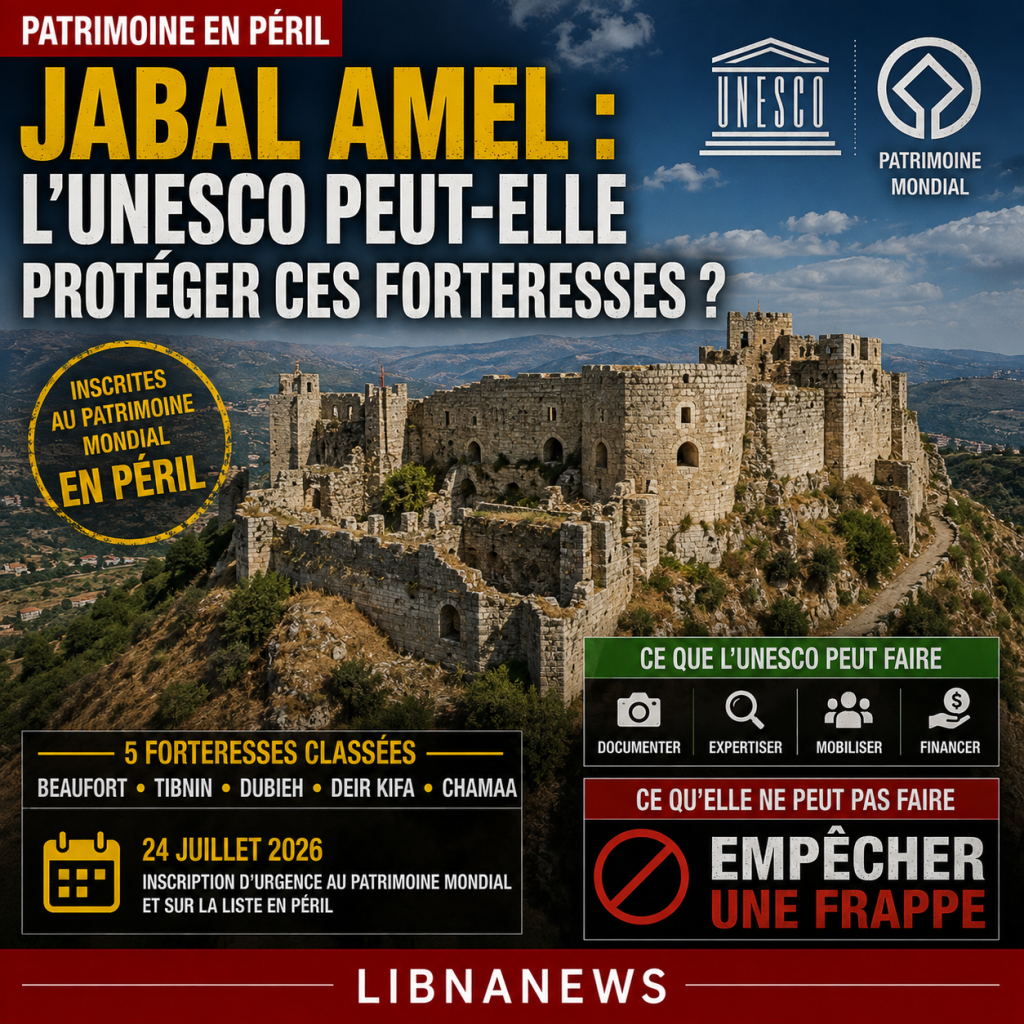
The five historic fortresses of Jabal Amel, in the South Lebanon, are under enhanced international protection while the threat to them remains immediate. Beaufort, Tebnine, Chakra, Deir Kifa and Chamaa were listed on the World Heritage List under an emergency procedure and simultaneously placed on the World Heritage List at risk. This decision is taking place in an area always exposed to Israeli bombing and operations. Unesco has already verified damage to the Chamaa citadel and reported reported strikes near Beaufort. The visit to Lebanon by its director general, Khaled El-Enany, therefore raises a question that goes far beyond symbolic recognition: what can international law really do to protect historical monuments when an army continues to operate around them?
Khaled El-Enany’s handing over to President Joseph Aoun of the document formalizing the international recognition of the five fortresses constitutes a diplomatic and heritage victory for Lebanon. It gives more visibility to the sites, facilitates the mobilisation of experts and can help to seek funding for their preservation. However, it does not create any physical shield above monuments.
This is the contradiction of this inscription. The five fortresses now enjoy one of the highest levels of international recognition, but they are in a part of Lebanon where Israel continues its military operations. Unesco mechanisms can document, alert, mobilize and prepare restoration. They cannot physically prevent a strike.
Damage already seen in the heritage of the South
The threat is not hypothetical. On 29 May 2026, Unesco reported havingverified damage to the citadel of Chamaa, one of the five fortresses today listed. The organisation also expressed concern about reported strikes near Beaufort Castle.
These elements make it clear why the World Heritage Committee used an urgent procedure on 24 July. It was not just about recognizing the historical value of a monumental ensemble. There was also a need to address a threat that was sufficiently serious and immediate to justify its simultaneous placement on the World Heritage List at risk.
Chamaa’s precedent is particularly sensitive. The citadel had already suffered damage during the 2006 war between Israel and Hezbollah. The new violations show the problem facing Lebanese authorities and heritage specialists: a monument restored after a war can again be damaged in the next one.
The continuation of Israeli strikes in the South maintains this risk. Even when a monument is not directly targeted, a nearby strike can cause damage by explosion, projections, vibrations or collapse of already fragile structures. For buildings whose parts are centuries old, vulnerability can be particularly important.
International protection that cannot stop bombs
The fortresses of Jabal Amel do not only enjoy their new status as world heritage. By November 2024, they had already obtainedprovisional enhanced protectionunder the 1999 Second Protocol to the 1954 Hague Convention for the Protection of Cultural Property in the Event of Armed Conflict.
This protection imposes specific obligations on parties to a conflict. In particular, it aims to prevent the property concerned from being attacked or used in a manner likely to expose it to destruction.
Registration for the World Heritage at Risk now adds a second level of international mobilization. But recent experience shows the limit between legal protection and material protection.
An international convention may establish that a monument must be spared. Unesco may document damages and recall applicable obligations. Experts can record the condition of a building and prepare its restoration. None of these mechanisms, however, physically neutralize a munition or prevent a military operation in the vicinity.
That is precisely why the continuation of Israeli operations is today the main obstacle to the effectiveness of this protection.
Documenting damage becomes an emergency
In this context, documentation acquires a function that goes beyond traditional preservation. It is necessary to have as precise a state of monuments as possible before further degradation, to identify the damage already produced and to be able to compare their evolution.
The Unesco regional office in Beirut and Lebanese specialists can contribute to this work with the General Antiquities Directorate. Photographs, architectural surveys, archives, cartographies and structural analyses help determine which parts are old, which have already been restored and which degradations have recently occurred.
This documentation is also necessary to distinguish what is established from what remains reported. In an active military environment, not all information about a damaged monument can be immediately verified on the ground. Thus, Unesco explicitly distinguished the damage that it had been able to verify in Chamaa from the reported strikes near Beaufort.
This caution is essential. It avoids assigning damage that has not yet been found, while keeping track of alerts requiring inspection.
Joseph Aoun inscribed the fortresses in a universal heritage
For Joseph Aoun, the five sites represent centuries of South Lebanon history. Their registration also means that their value is now officially beyond the national framework.
The fortresses of Beaufort, Tebnine, Chakra, Deir Kifa and Chamaa belong to a network that bears witness to the various powers that controlled this region. Their history goes through several periods, from the Middle Ages to the Ottoman era, with successive transformations linked to the Crusaders, Ayyubids, Mamluks and local authorities.
This accumulation gives their possible destruction a special scope. A destroyed modern building can be rebuilt. A missing medieval wall can be restored, but its original historical material is definitely lost.
It is this irreversibility that explains the special attention given to heritage during armed conflicts. Reconstruction can reproduce a form. It does not recreate centuries of material history.
Ghassan Salamé: behind the stones, the memory of the inhabitants
The Minister of Culture, Ghassan Salamé, insisted on this dimension during Khaled El-Enany’s visit. Attacking heritage not only means attacking stones, but also the memory of the inhabitants and the history of the country.
This idea takes on a particular dimension in the villages of the South affected by Israeli operations. A fortress is not only an isolated archaeological object. It belongs to the daily landscape of a community. It sometimes dominates dwellings, gives its identity to a locality and constitutes a visible landmark for the inhabitants who have had to leave their villages.
The reconstruction of the South is therefore not confined to housing and infrastructure. It also concerns the possibility of finding a recognizable territory.
When a population returns after a war, the presence of a monument, a religious place, an old house or a historical landscape helps maintain continuity between the village before and the one to be rebuilt.
Restoration remains conditional upon cessation of operations
It is here that the Israeli threat has its most concrete effect on safeguard programmes. A restoration does not start with scaffolding. She starts with an inspection.
Specialists should be able to reach the site, examine cracks, measure structural movements, identify fragile stones and determine emergency work. If the area remains exposed to strikes, such operations may be impossible or limited.
Then we need to secure the teams. Archaeologists, architects, engineers and workers cannot work on a sustainable basis in an area where a new military operation can take place.
Finally, donors must be able to consider that the money committed to a restoration will not be lost immediately. Investing several million in a conservation program makes little sense if the building is likely to be damaged again before work is completed.
The long-term cessation of military operations around the sites is therefore, in practice, the first condition for their restoration.
The five fortresses represent only part of the heritage threatened
The inscription today draws attention to five major monuments. However, it raises the question of everything that does not enjoy the same visibility.
The South also has ancient houses, religious buildings, rural structures and historical landscapes. The available information does not allow for a comprehensive inventory of this heritage or all the damage caused by recent military operations.
It would therefore be imprudent to draw up a list of destructions that have not been documented.
But this lack of inventory is itself a problem. An internationally known monument generally has photographs, surveys and archives. A traditional house or rural architectural element can disappear without having ever been properly registered.
The protection of the Jabal Amel fortresses could thus become the starting point for much broader documentation of the southern heritage, particularly in villages exposed to bombing.
Rebuild without losing the historical South
Khaled El-Enany’s visit finally came at the intersection of two temporalities. The military emergency, where people must be protected and further destruction prevented, and the much longer heritage, where every loss can become irreversible.
The listing of the five fortresses is an additional tool for Lebanon. It internationalises their protection, facilitates the mobilization of experts and can help to seek the necessary funding. It also gives more weight to warnings of damage that could affect them.
But its effectiveness now depends on an element that Unesco does not control: military evolution in South Lebanon.
As long as Israeli strikes and operations continue, Beaufort, Tebnine, Chakra, Deir Kifa and Chamaa will simultaneously remain among Lebanon’s best-known monuments and among those whose physical protection remains the most difficult.
The next step will not be a new registration ceremony. It will be an opportunity for Lebanese and international teams to gain long-term access to the fortresses, to establish the exact extent of the damage and to start work without fear that a new strike will add destruction to those they are precisely responsible for repairing.




