

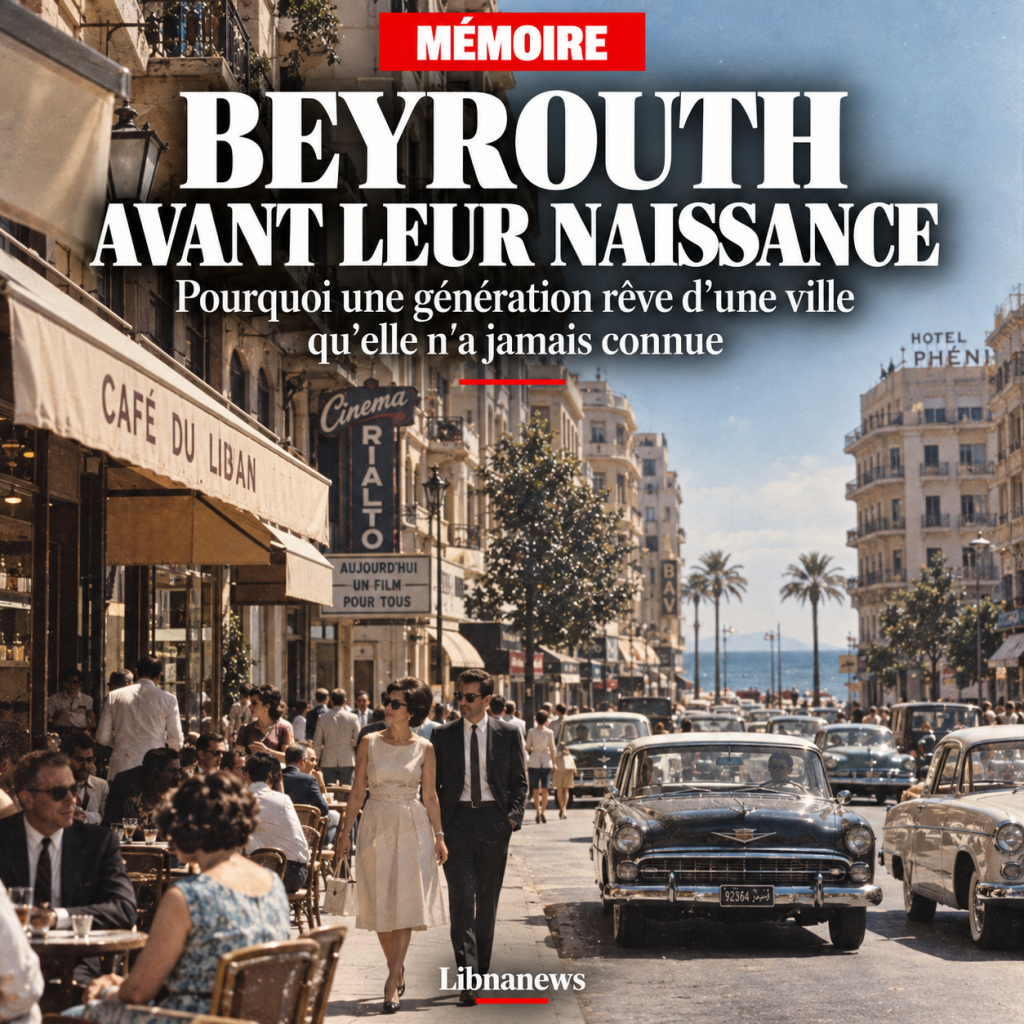
The nostalgia of an era lived only through images
Lebanese young people are now watching photographs of Beirut from the 1960s as one sometimes looks at the memories of a childhood. Yet they were not born. For some, their parents themselves were still children or had not experienced this period. This does not prevent images of the old city centre, cinemas, cafes, hotels, shopping streets or beaches from producing a strange familiarity. They circulate on social networks, are shared in groups dedicated to old Beirut and reappear in videos where old photographs and music respond. Moreover, this phenomenon does not concern only the 1960s. The music of the 1980s is also experiencing a renewed interest among an audience too young to have experienced its first broadcast. This attraction for an unlived past turns nostalgia into a particular cultural object. It no longer consists of regretting a personal experience. It is based on the appropriation of a memory transmitted by images, songs, family stories and archives. The past becomes an inner epoch without having been a biographical experience.
The phenomenon is particularly strong in the case of Beirut because the image of the pre-war city acquired considerable symbolic power. The old photographs show a capital immediately recognizable and yet different. They fix missing facades, transformed streets and places whose function has changed. They also give the impression of interrupted continuity. The viewer does not simply look at an old fashion fashion or automobiles. He looks at a city he knows the rest of the story. Civil war, destruction, successive reconstructions, the explosion of the port and economic crises are mentally behind every image, even when they do not appear. A peaceful photograph thus acquires a meaning that it did not have at the time it was taken. It becomes the document of a world that the viewer knows will be upset. It is this retrospective knowledge that gives beyrouthine nostalgia a particular depth. Young generations do not necessarily regret the 1960s themselves. They may regret the possibility of a historical trajectory which they imagine to be interrupted.
Digital archives produce memory without personal experience
Social networks have profoundly altered the circulation of archives. A photograph previously kept in a family album, a private collection or a newspaper archive can now reach thousands of people within a few hours. The images are copied, redecorated, colorized and integrated into mounts. They appear between two contemporary content on a phone. This proximity erases part of the historical distance. A street of Beirut photographed sixty years ago can be watched a few seconds after a video shot the same morning in the same place. The past and present are on the same screen, in the same format and sometimes with the same music. Comparison becomes almost automatic. What’s left of the building? Why was this place different? What business was this street? The archive then ceases to be only a document. It becomes a tool for measuring the transformations of the city.
However, this circulation produces a very selective memory. The most shared photographs do not necessarily represent the average life of all the inhabitants of Lebanon in the 1960s. They often favour the most photogenic spaces: central Beirut, hotels, shops, leisure venues, modernist architecture, lively streets and urban sociability scenes. They can thus create the impression of a more homogeneous prosperity than it really was. Social inequalities, less documented peripheries and political tensions appear much less easily in nostalgic montages. An elegant image of a café circulates better than a statistical table on income disparities. Digital nostalgia therefore operates a sorting. It preserves what can be transformed into a desirable symbol. This does not make the images false. This means that they tell part of the past and not all of it. To understand the phenomenon, it is necessary to distinguish the historical Beirut from the Beirut rebuilt by contemporary memory.
An idealized capital becomes the mirror of the frustrations present
The interest of the younger generations in the old Beirut takes on another dimension when it is placed in their own experience. A person born in the early 2000s grew up in a country marked by political crises, the deterioration of public services, the explosion of 4 August 2020, the financial collapse and new wars. Its relationship to the capital is therefore built in an environment where uncertainty seems almost permanent. Faced with this experience, old photographs can function as the inverse image of the present. They show an orderly city, active cultural places, frequented public spaces and architecture that seems to belong to a period of confidence. Nostalgia becomes less the desire to return exactly in 1965 than the desire to live in a city capable of offering an impression of normality.
This distinction avoids naive reading. Young people who share these images do not necessarily demand the return of the social and political structures of the time. They sometimes use the past to express criticism of the present. An old photograph of a clean street can implicitly become a comment on the current state of public space. The image of a missing cinema can evoke the reduction of cultural places. A view of the seafront can generate debate about access to the coast. The past then serves as a political language without the need for explicit political discourse. Saying « look at Beirut in the past » can mean « look at what we’ve lost » or « look at what the city might still be. » Nostalgia is thus transformed into a comparison between two urban models, one of which is partially real and partially reconstructed by the imagination.
The 1980s come back by music, despite the war
The renewed interest in 1980s music further complicates the relationship with the past. This decade cannot be transformed so easily into a Lebanese golden age. It corresponds to years of war, division and violence. Yet his songs, his sounds and his aesthetics now find a new audience. This shows that nostalgia does not necessarily select a historically happy period. It can isolate cultural production from its context and give it a second life.
For a person who lived in the 1980s, a song can recall a specific place, a relationship, a radio or an event. For a young listener of 2026, the same song is associated with no personal memory. It can be discovered on a platform, in a video or through a parent’s musical collection. The song becomes new while bearing the signs of another era. Instruments, arrangements and voices make a difference to contemporary productions. This difference becomes precisely attractive.
The mechanism is reinforced by digital platforms. An ancient song no longer needed to be reissued physically to find an audience. It can circulate in a short video and lead the listener to an entire catalog. Forgotten pieces can thus acquire a second life several decades after their release. The border between heritage and contemporary consumption becomes blurred. A young person can listen in the same list to a song released in 1984 and a production of 2026 without considering the first as a museum object.
In the Lebanese case, this rediscovery also has a family dimension. Songs are often objects transmitted between generations. They were heard in the parents’ car, at family meetings or on the radio. The personal memory of the young listener does not relate to the time of release, but to the way in which this music was transmitted to him. He can therefore experience an authentic nostalgia for a song from the 1980s because it belongs to his childhood in the years 2000 or 2010. Several temporalities overlap in the same piece.
Family stories fill spaces left by official history
In Lebanon, the transmission of the past goes largely through the family. The stories of parents and grandparents play a role all the more important as national memory remains fragmented. A street can be described by the person who worked there. A missing cinema survives in the story of someone who went there every week. A beach photograph triggers an anecdote. Private archives thus become gateways to a story that is not always taught or shared.
This transmission naturally produces different versions of Beirut. A family can remember a period of prosperity. Another is more concerned with social difficulties. A person who has lived in the centre of the capital does not have the same memory as a resident of a periphery or rural area. Yet, when the narratives arrive to succeeding generations, they can mix with public images and form a more homogeneous representation of the past.
The risk of idealisation is clear here. Family memories also select. It is a pleasure to tell about a party, a party or a beloved place. Ordinary difficulties can disappear over time. The past becomes more coherent than the present because we already know the story and we have kept certain moments of it.
But this reconstruction is not without value. It shows what families consider worthy of transmission. While stories focus on meeting places, shops, cinemas or neighbourhood life, they also reveal what is lacking today in the eyes of those who listen. Nostalgia becomes an indirect inventory of contemporary expectations.
Old Beirut has also become a market
This fascination has a commercial dimension. Ancient aesthetics can be used by restaurants, cafes, brands, hotels or real estate projects. A historical photograph immediately gives an identity to a place. A furniture inspired by past decades produces an atmosphere. An old sign becomes a decorative element. The past turns into a sales argument.
The phenomenon can help preserve visual memory. It can also simplify it. An entire era is sometimes reduced to a few patterns: old posters, typography, colours, music and retro objects. The historic city becomes a style.
This commercialization is particularly paradoxical when the contemporary place that uses nostalgia has contributed to the transformation of the neighborhood of which it celebrates the old identity. An establishment can take over the popular aesthetics of an area that has become too expensive for some of its former inhabitants. The memory is then preserved at the very moment when the social fabric that had produced disappears.
The issue is linked to that of architectural heritage. Digital fascination for old buildings does not guarantee their physical preservation. A house can receive thousands of mentions on social networks and remain threatened with destruction. Nostalgia therefore produces a symbolic mobilization that does not automatically translate into heritage policy.
To become a conservation tool, you have to move from image to building, then from building to right. This requires inventories, urban planning rules, financing mechanisms and property arbitration. Without this, old Beirut is likely to survive on screens more easily than in its streets.
The old capital must not become a fiction without contradictions
The image of a cosmopolitan, cultural and prosperous Beirut contains a part of reality. The city occupied an important regional position in finance, commerce, publishing, press, tourism and culture. This reality explains the lasting power of his image. But the period also included political tensions, inequalities and territorial imbalances that often disappeared from the nostalgic narrative.
Caution is necessary precisely because nostalgia is emotionally effective. The more beautiful an era seems, the less the viewer is tempted to examine its contradictions. Yet understanding why Lebanon has turned into war requires looking at what the elegant photographs do not show.
It is not about correcting each nostalgic image with a history lesson. The aim is to distinguish two uses from the past. The first is to say that once everything was fine and that the present is only a fall. The second uses the traces of the past to understand what worked, what did not work and what could be rebuilt differently.
For younger generations, the second use is much more fruitful. They can admire architecture, cultural production or the intensity of urban life without turning the 1960s into lost paradise. They can listen to the music of the 1980s without forgetting that this decade was also that of war. Memory then becomes a resource rather than a refuge.
Nostalgia perhaps expresses less a desire for the past than a lack of future
The most interesting question is finally this: why is this fascination taking so much strength now? The answer is probably not only in the beauty of the archives. A society often takes an intense look at its past when its future seems difficult to imagine. Successive crises have reduced the ability of many young Lebanese to project themselves in their own country. Emigration remains an important prospect. Employment is uncertain. Public services are fragile. Wars can suddenly interrupt projects.
In this environment, the old photographs provide visual proof that another Beirut existed. They make it possible to imagine that the city can be something other than the sum of its current crises. Nostalgia is paradoxically becoming a way of talking about the future.
The young person who shares a photograph of a street in the 1960s does not necessarily want to go back. He may want a city where to walk, work, go out and build a life with a predictability comparable to the one he thinks he perceives in the image. The apparent object of desire is the past. Its real content can be a request for contemporary normality.
This is also why ancient music is successful. It offers continuity in a country where there are many ruptures. A song goes through war, post-war, economic collapse and new crises. It remains available as physical places disappear. It connects several generations without requiring them to share the same historical experience.
Beirut thus has two ancient cities. The first is the one that really existed, with its successes, its tensions and its inequalities. The second is the one that current generations rebuild from photographs, songs and narratives. The two are not confused. But their encounter tells something very contemporary: in a capital where part of the physical heritage has been destroyed or transformed, young people use the archives to make continuity and sometimes to formulate, without saying directly, the type of city in which they would like to live.





Comments