

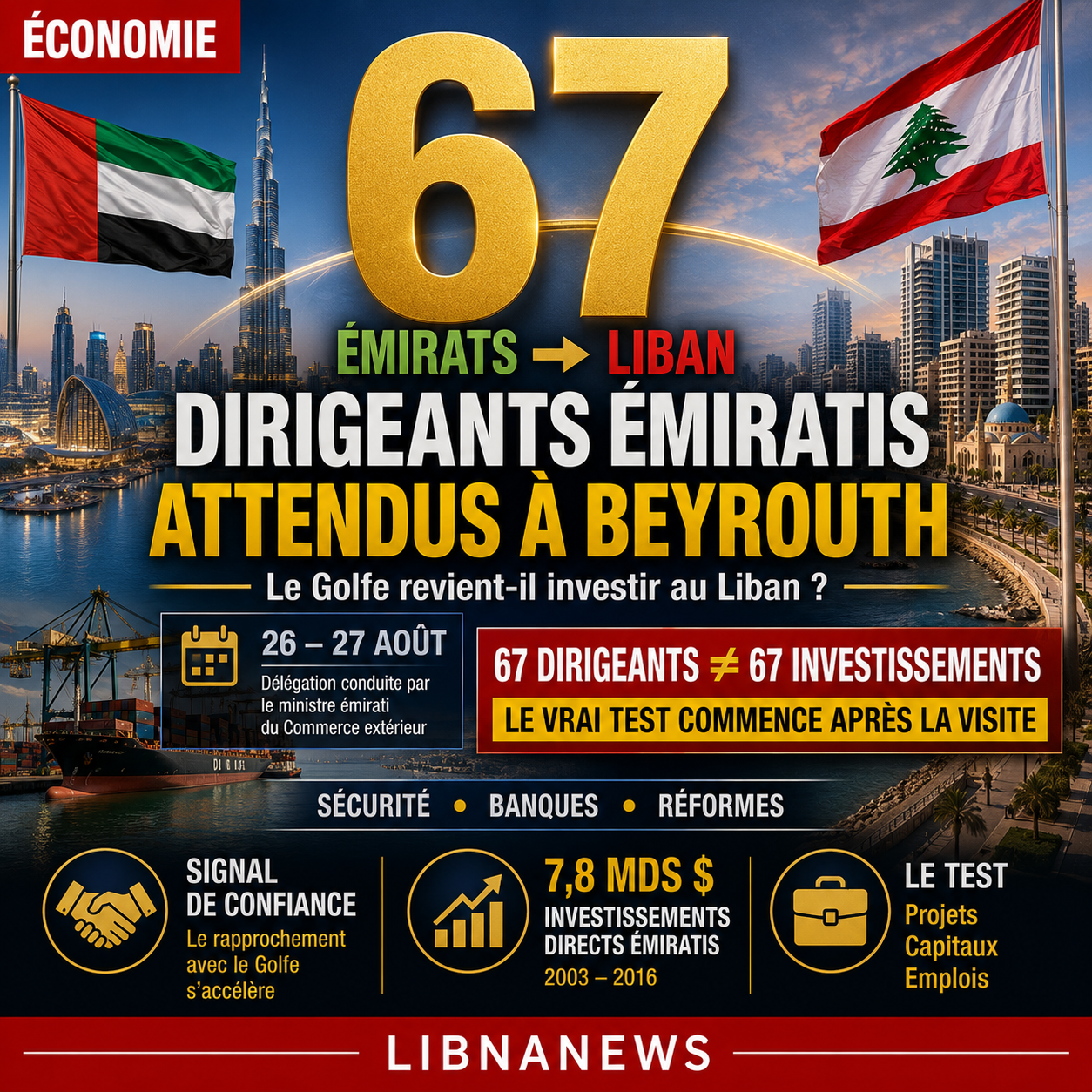
The announced arrival in Beirut on 26 and 27 August of an Emirati economic delegation led by Foreign Trade Minister Thani ben Ahmed Al Zeyoudi is another test of normalization between Lebanon and the Gulf countries. The group must include 67 economic and business leaders. By its magnitude, the visit sends an unusual political and commercial signal after several years of prudence. But it does not yet mean that 67 investors are preparing to invest capital in Lebanon.
The challenge is precisely to distinguish what is a sign of trust, what is a commercial prospect and what can be counted, after the meetings, as a real investment. For a Lebanese economy still marked by the banking crisis, war-related destruction and security uncertainty in the South, the difference is essential. A delegation may reopen doors. Only funded projects, new businesses and new jobs would make it possible to talk about a real return of capital from the Gulf.
An unusual delegation by its size
The mission announced on 26 and 27 August will be led by Thani ben Ahmed Al Zeyoudi, Minister of Foreign Trade of the United Arab Emirates, responsible for developing non-oil trade and international economic partnerships. The announced presence of 67 economic and business leaders gives the visit a dimension that goes beyond that of a protocol shift.
For the Lebanese private sector, the number counts first as an indicator of interest. A delegation of this size makes it possible to increase sectoral meetings, contacts between enterprises and the examination of opportunities which would not necessarily have reached the level of government. It also creates a signal effect with other Arab investors who observe the evolution of Lebanese risk before deciding to return.
However, there is no need to confuse presence with financial commitment. There is no evidence that the 67 participants each prepared an investment project. Their arrival reflects an organized interest in the Lebanese market. It does not yet measure the amounts that can be mobilised or the sectors that will actually benefit from new capital.
Mohammad Choucair wants to turn the signal back on
Mohammad Choucair, President of the Lebanese economic organizations, presents this visit as an important step towards reactivating economic relations between Lebanon and the United Arab Emirates. Its aim is to put Lebanese companies back in the Gulf business circuits and to convince the Emirati groups that the country can again offer opportunities despite the persistent risks.
The approach is part of a political rapprochement initiated at the highest level. Joseph Aoun and Emirati President Mohammed bin Zayed Al Nahyan have increased contacts since the Lebanese President took office. Abu Dhabi also reaffirmed its support for the security, stability and sovereignty of Lebanon. The lifting of restrictions on the movement of Emirati nationals to Lebanon was another signal of relaxation.
This political rapprochement creates a more business-friendly environment, but it does not guarantee any investment. Private companies, funds and family groups in the Gulf evaluate their projects according to criteria of performance, legal certainty, monetary stability and political risk. The relationship between Heads of State can facilitate market access and improve confidence. It does not replace an investment decision or the economic conditions that make it possible.
Why Gulf capital remains decisive
The possible return of Emirati capital would be greater than the amounts invested. The Emirates has historically occupied an important place among Arab investors in Lebanon. According to data published by the Emirati Embassy in Beirut, Emirati direct investment amounted to $7.8 billion between 2003 and 2016, almost two thirds of the value of Arab projects identified during this period.
This past explains the attention paid to the August delegation. For a long time, capital in the Gulf has fed real estate, tourism, services, businesses and various infrastructure projects in Lebanon. These sectors may again be of interest to investors, but no specific project should be assigned to the delegation prior to a formal announcement.
The return of a recognized Emirati investor can also have a driving effect. In an economy where the perception of risk remains high, the first decision sometimes counts as much as its amount. It can convince other companies that a market is becoming accessible again, that banking relations are improving or that the authorities have sufficient political will to protect investment.
The opposite is also true. If the visit is limited to general meetings and statements, it will remain a signal of reopening without measurable changes in capital flows.
Safety remains the first filter
The main unknown remains the security situation. Joseph Aoun has regularly linked economic recovery to the restoration of stability and the strengthening of state authority. This relationship is particularly direct for Gulf investors, many of whom reduced their exposure to Lebanon when political and military risk increased.
The situation in the South therefore remains decisive. Israel’s operations, the areas still disputed, the question of the deployment of the Lebanese army and the risk of further escalation are directly involved in the calculation of an investor. A real estate, tourist or logistics project immobilizes capital for several years. Its profitability depends on the continuity of transport, insurance, banking and the ability of foreign customers or partners to travel to the country.
The recent return of Emirati travellers is a positive but reversible indicator. The Emirates had already suspended the movement of its nationals to Lebanon in the past when the regional situation deteriorated. For investors, the country’s ability to maintain stability over several months will be more than an ad hoc improvement.
This is also why the South and the investment dossier cannot be separated. A lasting appeasement would reduce the cost of risk. A new confrontation would immediately raise insurance premiums, delay projects and could call into question decisions taken during the standardization phase.
The financial crisis remains the other major obstacle
Even with a security improvement, Lebanon maintains a structural problem: its financial system has not yet fully overcome the crisis that began in 2019. Investors must be able to transfer funds, repatriate profits, obtain financing and have a predictable legal framework. Confidence therefore depends not only on the level of violence or the situation at the border.
Reforms remain at the centre of the issue. On August 19, Joseph Aoun received Jihad Azour, Director of the Middle East and Central Asia Department of the International Monetary Fund. The Presidency reported that both men had examined the economic and financial situation in Lebanon and the region and recent developments.
This meeting does not mean that a new programme with the IMF has been concluded. It recalls, however, that Lebanon’s financial normalization remains linked to substantive reforms, restructuring of the banking sector, consolidation of public finances and the re-establishment of institutions that can inspire investor confidence.
For Gulf capital, these reforms are as important a filter as security. Investors can accept a commercial risk. They are much more reluctant when they do not know clearly how contracts will be executed, how disputes will be settled or how capital will flow.
The return of the Gulf is already measured differently
The Emirate visit took place as several rapprochement signals accumulated. The dialogue between Joseph Aoun and Mohammed ben Zayed has intensified. Travel restrictions have been eased. Beirut is openly seeking to attract Emirati capital again and is working to establish mechanisms to facilitate relations between the two countries.
The Ambassador of Lebanon to the Emirates, Tarek Mneimneh, had already indicated in July that Emirati investors were showing an interest in Lebanon, while recognizing that reforms and better security guarantees remained indispensable. A Lebanon-Emirates Business Council was also to help structure private contacts.
These elements make it possible to talk about a gradual normalisation of economic relations. They do not yet make it possible to talk about an investment cycle comparable to the years in which Gulf capital occupied a central place in real estate, tourism and Lebanese services.
The difference will be visible within months of the visit. If the August contacts lead to concrete decisions, displacement can be seen as the beginning of a new phase. Otherwise, it will remain an important diplomatic stage but without immediate transformation of the real economy.
After August 27, what results should be looked at?
The first indicator will be the possible announcement of identified projects. An investor who specifies a sector, schedule, local partner and committed amount produces verifiable economic information. A general statement of interest in Lebanon does not have the same scope.
The second will be the signing of memorandums of understanding. These are not yet an investment, but they allow us to know whether discussions are moving towards structured projects. Their content will be essential: some protocols remain exploratory, while others already set the conditions for financing or starting up a business.
It will then be necessary to monitor quantified investments, company creations or extensions, partnerships between Lebanese and Emirati groups and actual capital transfers. Finally, employment will be the most concrete criterion. A lasting recovery is measured not only by the number of delegations received in Beirut, but also by the capacity of these relations to create activity and work places.
The visit of 26 and 27 August therefore has political value even before its opening. After several years of distance and prudence, 67 Emirati economic leaders must come to the Lebanese market under the leadership of a minister responsible for foreign trade. This is a signal that the Lebanese private sector was waiting for.
But the test will actually start after they leave. Standardization with the Gulf can be considered economic once the meetings have produced projects, financing projects, and financing of businesses and jobs in Lebanon.




