

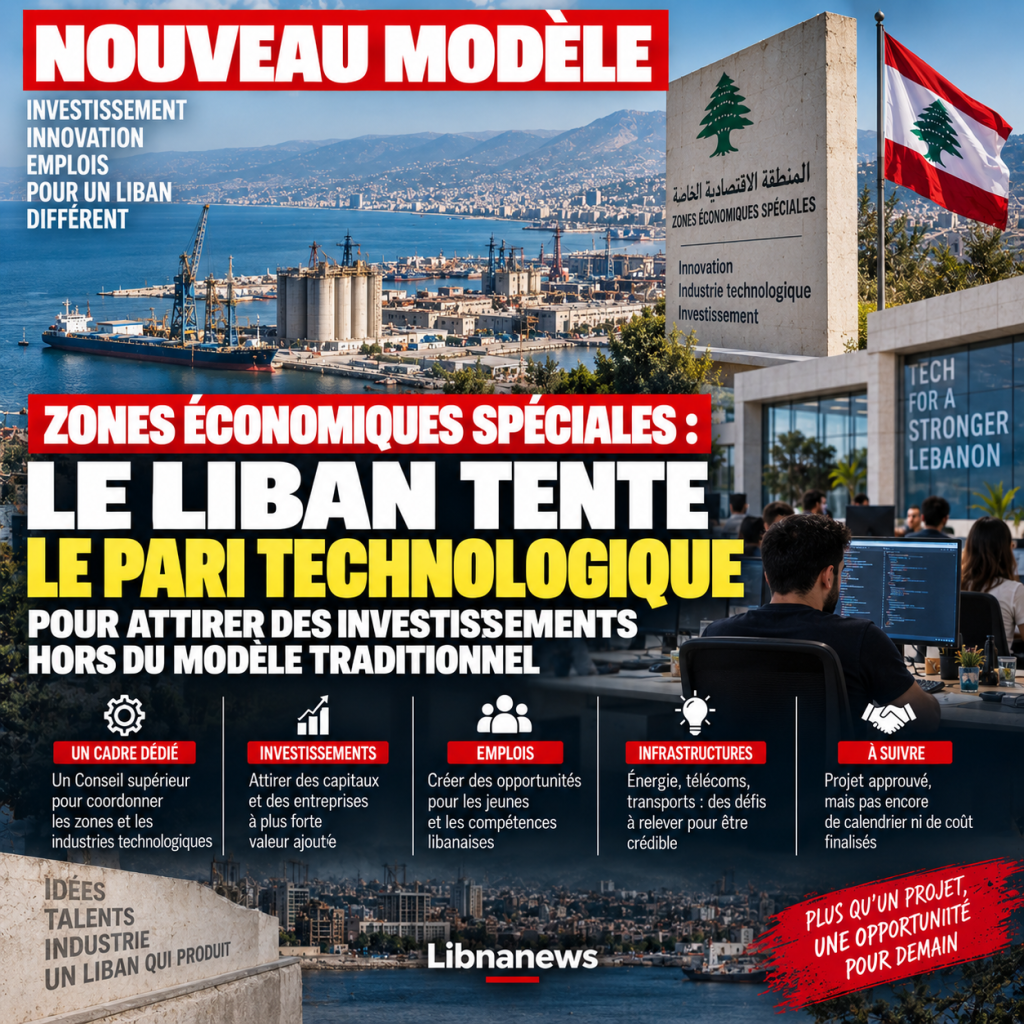
The Council of Ministers approved the establishment of a Higher Council for Special Economic Zones and Technology Industries, a decision that remained relatively quiet behind the debates on the 2027 budget, fuel and social measures. Yet this initiative touches on a much broader question: can Lebanon create economic spaces that can attract technological investment while the country continues to face a banking crisis, high energy costs and fragile infrastructure? The stated objective paves the way for a model in which certain areas would benefit from an administration and an environment specifically designed to host economic and technological activities.
The government’s decision does not mean that these areas are already physically created or that investors have committed themselves. The sources of 2 October 2026 confirm the approval of the proposed creation of the Higher Council, but they do not provide a definitive list of the areas concerned, the details of the tax advantages or the amounts of investment expected. They also do not provide a comprehensive deployment schedule. The institutional ambition must therefore be distinguished from its realization. At this stage, the government is first and foremost creating a tool to organize a policy that will then have to be translated into concrete projects.
A Higher Council to group previously dispersed policies
The creation of a Higher Council for Special Economic Zones and Technology Industries reflects a desire to give this dossier a central structure. The principle of a special economic zone is generally based on the creation of a particular administrative environment to facilitate investment. However, the available information does not yet detail precisely the regime to be applied in Lebanon. It would therefore be premature to announce tax exemptions, special customs procedures or regulatory advantages whose terms are not set out in the sources.
The interest of the new Council lies first in coordination. Industrial and technological investments depend on several administrations. Land, permits, energy, telecommunications, transport, customs and taxation may be the responsibility of different institutions. An investor faced with a succession of procedures and interlocutors can abandon a project even before it is launched. A higher authority can theoretically reduce this fragmentation if it has clearly defined competences.
But the creation of a new body also entails a reverse risk. If its competencies overlap with those of existing ministries, municipalities and agencies, the country can add a new administrative layer instead of simplifying procedures. The effectiveness of the Council will therefore depend less on its title than on how its powers will be defined. It will be necessary to know whether it can really speed up decisions or whether it becomes essentially a coordinating body without enforcement capacity.
This issue is particularly important in a country where investment is already suffering from institutional uncertainty. To be credible, a special economic zone must offer more than a new public structure. It should allow a company to know exactly what rules it will be subject to, how long it will take to install it and what administrations can intervene.
The choice of technology industries marks an attempt to change the model
The explicit association of « technology industries » with special economic zones is the most interesting aspect of the decision. Lebanon does not appear to want to restrict the facility to traditional warehouses, commercial activities or industries. The announced objective includes activities with a stronger technological component.
This is a search for sectors capable of producing more value without depending exclusively on the size of the internal market. A technology activity may provide services or products abroad while retaining part of its teams in Lebanon. It can also draw on the human skills available in the country and its economic diaspora.
But the term « technology industries » remains broad. Available documents do not provide a formal list of priority areas. It would therefore be risky to claim that the government is already targeting artificial intelligence, semiconductors, financial technologies or other specific sectors. The operational definition will have to appear in the next steps.
This choice will also have to take into account regional competition. Several countries in the Middle East are investing heavily in technologies, digital infrastructure and hosting international companies. Lebanon does not have the same financial capacity. It will therefore have to build a different proposal based on its human resources, location, costs and flexibility of its entrepreneurial environment.
Without reliable electricity, technological ambition will remain theoretical
The first contradiction appears immediately: how can we develop technological industries in a country where electricity supply remains one of the main structural problems? Digital companies need stable power, reliable telecommunications and a permanent connection. Some activities also require technical installations whose interruptions can cause significant losses.
The government’s decision on special zones comes at a time when the executive is trying to revive several energy projects. The Council of Ministers approved the principle of a liquefied natural gas infrastructure in Deir Ammar. Regional discussions also concern electrical interconnections. These cases can become complementary if future economic zones have priority access to reliable infrastructure.
But the sources do not suggest that such a mechanism is already foreseen. There is still no indication that areas will benefit from a specific electricity grid or energy regime. However, the problem must be solved. A tax advantage loses much of its interest if a company itself has to finance expensive electricity production to ensure its business.
The same applies to telecommunications. Technology industries rely on the quality of digital networks. The strategy will therefore have to be accompanied by investment in infrastructure rather than just regulatory change.
Tripoli could find a place in this new economic map
The creation of the Council also takes place as several projects restore potential economic importance to the north of the country. Tripoli is at the center of discussions on the railway to Syria, the energy infrastructure and the possibility to strengthen the role of its port. This convergence can create an environment conducive to certain industrial and logistical activities.
However, available sources do not indicate that Tripoli has already been officially designated as one of the future areas under the new Council. It is therefore important to avoid turning an economic opportunity into an acquired government decision. But the city has many advantages that make this hypothesis relevant: a port, proximity to the Syrian border, existing infrastructure and potential for connecting to regional corridors.
An economic zone associated with a port and a rail network would have a different logic of a technology hub based in Beirut. It could host processing, logistics or production activities for export. Specialisation of areas could thus be more effective than a uniform model applied across the country.
The same reasoning may apply to other regions. Lebanon has very different economic realities between Beirut, the North, Bekaa and the South. A credible strategy should identify the benefits of each territory rather than multiply areas with the same vocation.
Syria can transform the economic value of northern Lebanon
Another variable is the gradual reopening of the Syrian economy. Lebanon can once again become a gateway to a nearby market under reconstruction. The railway projects studied between Tripoli and Syria already show that some officials are seeking to benefit from this new configuration.
For companies located in northern Lebanon, access to Syria could represent an additional market. In the longer term, connections to Jordan, Iraq and Turkey could also change the business geography. A special economic zone located on a transport corridor would then have an advantage that cannot be achieved simply by reducing taxes.
However, this perspective remains dependent on regional stability. Land-based infrastructure cannot be cost-effective if borders close regularly or roads are exposed to security crises. The Lebanese strategy will therefore have to assess both risks and opportunities.
The development of economic zones cannot be based on the assumption that regional normalisation is irreversible. Investors will seek guarantees to continue their activities even in the event of new tensions.
Banking remains a major obstacle for investors
The second major problem is financial. A company can benefit from a favourable administrative environment and have electricity, but it still needs to be able to open accounts, transfer money, finance its investments and repatriate its profits. Lebanon has not yet completed the restructuring of its banking system.
The crisis opened since 2019 has profoundly damaged confidence. The government is currently working on institutional restructuring and addressing the financial divide. Negotiations with the International Monetary Fund remain linked to these reforms.
This situation creates a paradox. Lebanon seeks to attract new capital before it has completely settled the fate of the old deposits. International investors will necessarily address this issue. They would like to know whether the new funds deposited in the country were protected, what rules applied to transfers and what jurisdiction guaranteed contracts.
Special economic zones could potentially benefit from an appropriate financial framework. But no specific provision of this nature appears in the available elements. It would therefore be premature to announce it. However, the government will have to resolve this issue if it wants to convince foreign companies to invest capital in the country on a sustainable basis.
A special area cannot become a territory beyond the rules
The very principle of a particular economic regime may raise concerns. To attract investors, the state may be tempted to grant many exemptions and reduce certain procedures. But administrative simplification should not be transformed into a lack of control.
Environmental, social and financial rules remain essential. An economic zone designed to bypass administrations rather than make them more effective could create inequalities between companies and foster opportunistic behaviour. It could also become a means of obtaining tax benefits without producing the investments or jobs announced.
Transparency must therefore be central. The criteria for access to areas, the benefits granted and the obligations imposed on businesses must be sufficiently clear to avoid discretionary treatment. The results must also be measurable: investments made, jobs created, exports and value added.
This requirement is all the more important as Lebanon seeks to restore its credibility to international institutions. The new areas will be judged both on their governance and on their ability to attract businesses.
The danger of tax competition without real investment
Tax benefits are often used to make economic zones attractive. But low taxation is not enough to trigger investment. A company also compares political stability, infrastructure, energy costs, labour quality and legal certainty.
If Lebanon significantly reduces its tax revenues without obtaining in exchange for new activities, the transaction can become costly for the State. It is therefore necessary to avoid a logic in which the zones simply move companies already present in the country towards a more advantageous regime.
The real objective must be additional investment. A company that has in any event been active in Lebanon should not be the main beneficiary of a mechanism designed to attract new capital.
The October 2 sources do not give the envisaged tax system. The risk therefore remains theoretical at this stage. However, it should be taken into account when the precise rules are defined.
Employment will be the main political test of the project
For the population, the success of economic zones will not be measured by the number of enterprises registered but by the jobs created. The crisis has prompted many qualified young people to look for opportunities abroad. A credible technology policy can help retain some of these skills or create opportunities for return.
But the quality of jobs will count as much as their number. An area specialised in low-value-added activities would not meet the same ambition as a pole capable of hosting engineers, researchers and exporting companies.
The link with universities and vocational training will therefore become important. Companies must be able to recruit the skills they need. Educational institutions, for their part, need to know what sectors are developing in order to adapt part of the training.
No detailed curriculum linking the new Council with universities is presented in the sources. However, this dimension will be one of the criteria for determining whether the project is a genuine industrial policy or a simple administrative mechanism.
The state must choose some advantages that it can really guarantee
Lebanon will probably not be able to compete with the largest regional economies over the amount of public subsidies. It must therefore identify the benefits it can provide in a credible way. Its geographical position, its qualified population, its links with the diaspora and its proximity to several markets can be a basis.
Administrative speed can become another advantage if it is actually guaranteed. For a company, knowing that a licence will be processed according to a predictable schedule can sometimes count more than a complex exemption. Legal certainty of contracts and the ability to transfer capital are also essential.
The new Supreme Council can play a role if it becomes the place where these guarantees are organised. But it must avoid promising what other administrations cannot provide. An economic zone cannot guarantee stable electricity if the energy sector does not follow. It cannot promise normal financial transactions if bank restructuring remains incomplete.
The project therefore requires the government to coordinate several reforms that were previously dealt with separately.
The transition from decree to investment will be the real test
The approval of the Higher Council marks a first institutional step. It states that the government wants to make economic zones and technological industries a focus of its policy. But the essential remains to be built. The areas concerned, the powers of the new institution, the business regime and the necessary infrastructure must be defined.
Then investors will have to be convinced. This step will be much more difficult than creating an administrative structure. Companies will compare Lebanon to other destinations and demand concrete guarantees. The country’s historical reputation as a service centre will not suffice.
However, the project comes at a time when several transformations can create an opportunity window. Syria is entering a reconstruction phase. Regional corridors are discussed. Tripoli could regain a logistics function. The government is seeking to improve energy supply. The banking sector needs to be restructured.
If these sites move forward together, special economic zones can become a repositioning tool. If they remain separate, the new Council risks having an institutional framework without an economic environment that can make it attractive.
The decision of 1 October 2026 therefore opens up a question more than it does. Lebanon wants to attract technology industries and develop specialized economic spaces. It must now demonstrate that it can provide them with what they really want: energy, financing, connectivity, regulatory stability and market access. Without these elements, a special area will remain a line in a decree. With them, it could become one of the instruments of an economic model less dependent on the mechanisms that preceded the crisis.





Comments