

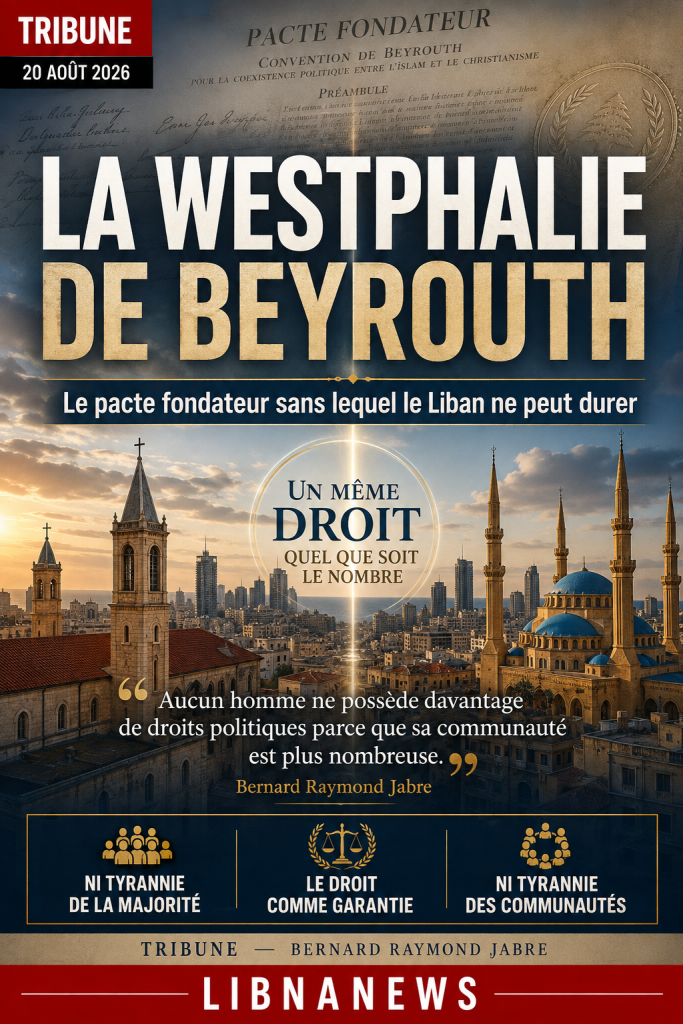
The founding pact without which Lebanon cannot last
—
There are times in the history of peoples when a Constitution is no longer sufficient. From the moments when we have to go up from the Constitution to the most primitive question of any political community: do we really agree to live together, with equal dignity and rights, even though we do not share the same faith, the same conception of God, nor necessarily the same demographic weight?
Europe faced this issue after more than a century of religious wars. The Treaties of Westphalia of 1648 certainly did not invent modern democracy or establish religious equality as we conceive it today. But they were a fundamental turning point: denominational diversity could no longer be settled indefinitely by war, forced conversion, exclusion or political elimination of the other. Catholics, Lutherans and Reformed had to find their place in a more stable legal and political order. In the same movement gradually consolidated a system of sovereign states whose existence no longer depended on absolute religious unity.
Westphalia was thus much more than a peace between belligerents. It participated in the profound transformation of the European political order by making the right a means of containing religious war and opening the way for the modern state.
Such a founding moment never really took place between Islam and Christianity in the political space of the Middle East.
That is precisely where, in my view, the original problem of Lebanon lies.
Lebanon has built constitutions, institutions, community balances, pacts and compromises without having previously enshrined the principle that everything else should be possible: no demographic majority, present or future, can abolish, reduce or subordinate the fundamental political rights of a minority community.
A Constitution may allocate seats. It can hold elections. It may define the powers of the President of the Republic, the Government or the Parliament. It can proclaim equality of citizens.
But it is not enough if an existential fear remains behind it: that of seeing the number become the source of political legitimacy alone, and a permanent demographic majority use its majority to question the political existence of those who have become fewer.
In such a situation, democracy itself ends up worrying.
For democracy cannot be reduced to the simple arithmetic power of the majority when this majority can become permanent and the minority, too permanent, may never be able to democratically reverse the balance of forces.
We must therefore add to democracy a higher principle: the principle of non-domination.
On issues relating to the political, religious, cultural or identity of a community, no majority should be able to suppress the fundamental rights of a minority.
Otherwise, suffrage ceases to be an instrument of freedom and can become an instrument of domination.
This is where the Lebanese problem really begins.
A community that believes that its survival depends on its demographic weight will necessarily look elsewhere for guarantees that it does not find in the state. It will seek a protective power, a regional sponsor, an international alliance, a military force or a balance of forces to compensate for its inner weakness.
And that is how Lebanon’s sovereignty weakens.
Every community seeking its security outside Lebanon eventually imported into Lebanon the conflicts of the outside world. Sunni and Shiite rivalries, clashes between regional powers, the conflict between Israel and its adversaries, and tensions between the West and the Middle East are then extended within Lebanese territory.
Regional wars become our wars because regional fears meet our own fears.
The Lebanese problem is therefore not simply constitutional.
It is preconstitutional.
Before building the house, we must establish the foundations on which it can stand.
This is precisely the reason for a Beirut Islamic-Christian Convention, which could be symbolically called Beirut Westphalia.
Its principle would be both simple and revolutionary: in any multi-faith State acceding to this Convention, the fundamental political rights of an individual are never dependent on the number of persons belonging to his religion or community.
That a community represents 50%, 30%, 10%, 5% or 1% of the population should not change the political dignity of its members.
No man has more rights because his community has become the majority.
No man has less rights because his own has become a minority.
But this Convention should go even further.
It should protect both the individual against his community and communities against a dominant majority.
Every person must be a full citizen, free to believe, change belief, not to believe, to express and to participate in political life without being confined to his or her religious affiliation.
But when a decision directly affects the political, religious, cultural or educational existence of an entire community, institutional guarantees must prevent a majority from simply deciding on its political disappearance.
Thus could be formulated the fundamental balance: neither tyranny of communities over the individual nor tyranny of the majority over communities.
This Convention would therefore not aim to freeze confessionalism forever.
It’s even exactly the opposite.
Confessionalism persists because communities are afraid.
They cling to quotas, reserved posts, institutional balances, external alliances and sometimes weapons because they see these instruments as the last guarantees of their survival.
To remove the Community guarantees brutally without having removed this fear would be to remove the roof before building the walls.
The overcoming of confessionalism cannot therefore begin with the forced abolition of identities.
It must begin with the suppression of their political fear.
If the fundamental rights of each individual and the political existence of each community become legally inviolable, regardless of demographic fluctuations, then communities will gradually need less quotas that protect them today.
The Community guarantee can thus, paradoxically, become the condition for one day to go beyond Community logic.
The Westphalia of Beirut would therefore not be a new religious pact or a new distribution of privileges.
It would have exactly the opposite ambition: to gradually render privileges useless because rights would have become inviolable.
As long as a community needs a foreign post, quota, militia or protector to feel secure, Lebanon remains a balance of fear.
On the day its existence is guaranteed by law, it will finally be able to fully accept the State.
Nor would the Beirut Convention require religions to regard all beliefs as theologically equivalent.
That would be absurd and useless.
A Christian can believe in Christ and the Trinity. A Muslim can believe the Qur’an and Muhammad’s prophecy. A Jew can remain faithful to his tradition. A Druze can preserve his own religious conception. An atheist may consider that no religious revelation is true.
Political coexistence does not imply theological uniformity.
It requires something much simpler and much more difficult: to accept that divergence over God never produces fundamental inequality between men.
We can have different truths about God without having different political dignitys.
Perhaps this is the philosophical heart of this Convention.
It should therefore be governed by public international law.
It could be signed by States, subsequently incorporated into their Constitutions and laws, publicly recognized by major religious authorities and protected by legal mechanisms guaranteeing its respect.
It would therefore not simply be an agreement between Lebanese religious leaders.
It would become a principle of law that could go beyond Lebanon.
For the question of Lebanon is universal.
How can we make men living together in the same political destiny who do not have the same conception of religious truth?
How can we prevent a religious majority from turning its demographic majority into political domination?
How can we protect a minority without forever locking up the individual in the community to which he was born?
The Beirut Convention could answer those questions.
It would naturally concern the relationship between Islam and Christianity, but its principle could also extend to Judaism, other religions, other minorities and those who profess no faith.
It would then become truly universal.
For Lebanon, however, this issue is existential.
If the main Muslim components of the country — Sunnis, Shiites and Druze in their own singularity — and the different Christian communities manage to consecrate this fundamental rule together, then something new will become possible.
For the first time, Lebanon will cease to be only a moving compromise between concerned communities.
It could become a political pact based on an irreversible right.
A new Constitution can then be built on this foundation.
It will be able to organise the state, powers, decentralization, Parliament, the government, the independence of the judiciary and all institutions.
But these institutions will finally be based on something deeper than a provisional balance of forces: a definitive mutual recognition of the other’s right to political existence.
On the other hand, if such a principle is refused, whatever the justification, it will be necessary to have the courage to draw the consequences.
If one considers that a majority community can legitimately obtain more political rights simply because it has become more numerous, then multi-faith Lebanon remains structurally condemned to live in demographic fear.
And a society governed by demographic fear will always find weapons, protectors or borders.
Under these conditions, the « Lebanon-message » can survive in discourse, but it will gradually become impossible in reality.
Because a country-message can’t just be a nice formula.
It must be a legal architecture.
Lebanon could then cease to be simply the country where several communities have been forced by history to live together.
It could become something much more ambitious: the legal laboratory of global religious pluralism.
His tragic history would paradoxically give him that vocation.
After experiencing wars, occupations, foreign intervention, militias, displacements and community fears, he could turn his experience into a universal proposition.
Beirut could become the place where a new rule of political coexistence among religions would be formulated: all identities can remain what they are, provided that no one can use their religious truth or numerical superiority to diminish the political rights of the other.
The real transition from confessionalism to citizenship does not therefore involve the suppression of communities.
It consists first of suppressing their fear.
And perhaps that is the whole philosophy of Beirut Westphalia: to make law what communities have always demanded of arms, quotas and foreign powers: the guarantee of being able to continue to exist.
Lebanon’s real foundation could eventually be in one sentence:
No man has more political rights because his community is larger, and no man has less because his own has become a minority.
On the basis of this principle alone, many truths about God can live in the same country without having to be destroyed.
On the basis of this principle alone, different identities can become the components of the same destiny.
And perhaps this is the historical vocation that Beirut could offer the world: finally invent this interreligious Westphalia that our region has never really known, so that the difference ceases to be a threat and becomes politically possible.
Bernard Raymond Jabre




