






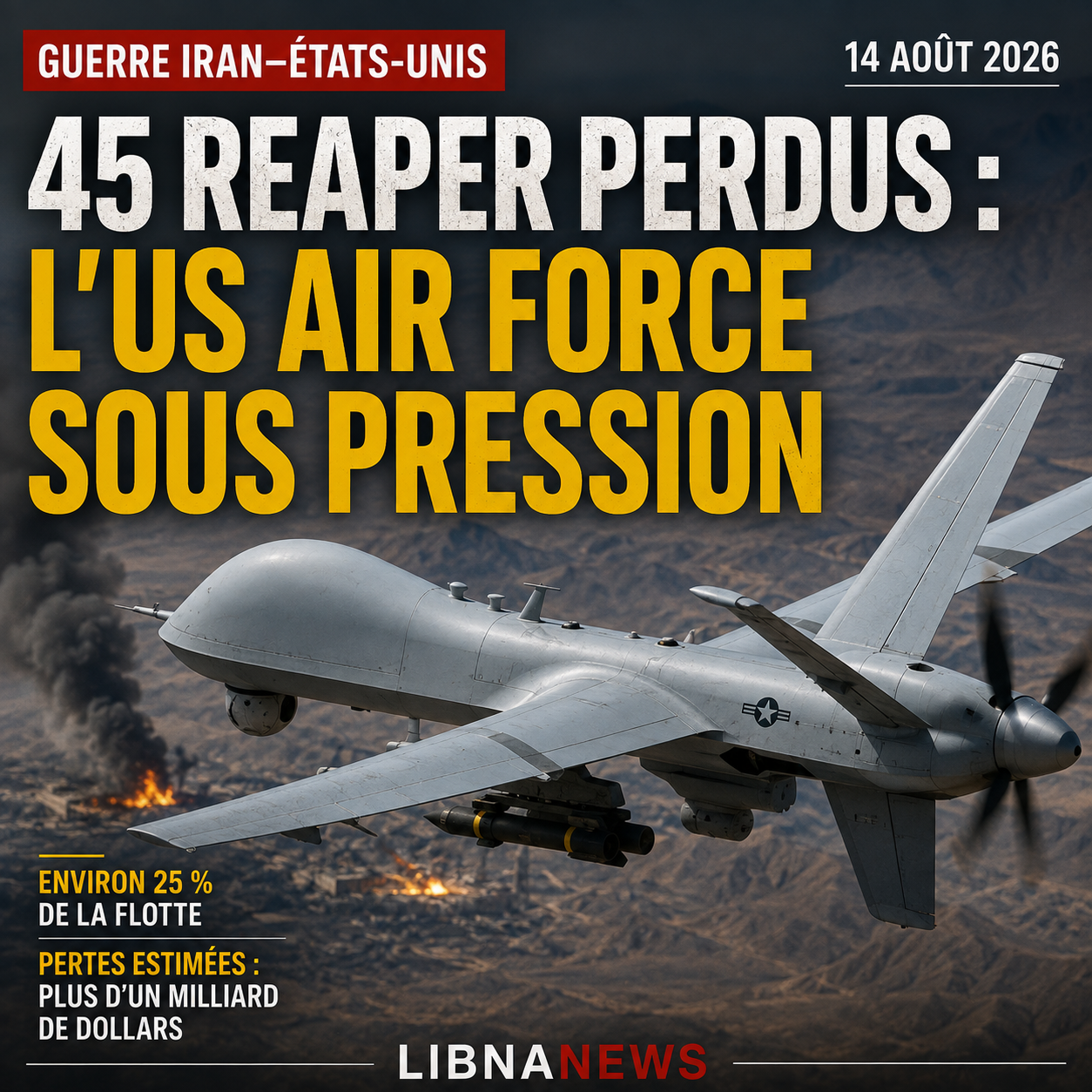
The US Army reportedly lost 45 MQ-9 Reaper drones since the beginning of the war against Iran, about a quarter of its pre-conflict fleet. Revealed by the American press on the basis of several officials informed of the state of the park, this review was not officially detailed by the Pentagon. However, it constitutes a major data on the material cost of the campaign. Depending on the configuration chosen, sensors and on-board equipment, a Reaper engaged in operation can amount to several tens of millions of dollars. Beyond the bill, the disappearance of approximately 25% of the fleet raises a more serious question for Washington: how long can the United States continue to engage so intensively a drone essential to its intelligence and strike missions, while its replacement cannot be ensured at the same rate as the losses?
The results also reveal a transformation of the battlefield. The MQ-9 Reaper became one of the symbols of American military power during the wars of Afghanistan and Iraq, then in operations against jihadist groups. These conflicts usually allowed it to evolve in areas where the anti-aircraft threat remained limited. Faced with Iran, the context is radically different. The drone must operate in an environment where there are ground-to-air defences, radars and electronic warfare capable of threatening both the aircraft and its communications. The 45 reported losses do not mean that Iran killed 45 Reaper: several aircraft were reportedly lost after breach of the link or under ill-established circumstances. This distinction is essential to properly measure what American attrition reveals.
45 MQ-9 Reaper lost: the number that worries Washington
The figure of 45 devices is central information. According to several American officials quoted by the US press, the armed forces have lost at least as many MQ-9s since the beginning of the war against Iran. Returned to the pre-conflict inventory, this total would represent about 25% of Reaper’s U.S. fleet.
The Pentagon did not publish a table detailing device by device the circumstances of each loss. The balance sheet should therefore be presented as an estimate firmly attributed to US officials, but not as an inventory officially certified by the Department of Defense. This reserve is all the more important because the causes of accidents and destruction would be multiple.
However, the extent of the phenomenon does not depend on a few additional or missing devices. If the order of magnitude is confirmed, the US Air Force has lost in a few months a considerable proportion of a fleet formed for nearly two decades. Attrition of this magnitude necessarily affects the availability of aircraft for current operations, but also the American ability to maintain Reaper in other theatres.
Comparison with pre-war one-off losses is also significant. MQ-9s had already been killed in the Middle East, notably by the Houthis in Yemen. Each destruction caused special attention because of the price and capacity of the aircraft. In the war against Iran, the loss of the drone is no longer exceptional. It becomes a regular component of the cost of operations.
An invoice that can exceed $1 billion
The price of an MQ-9 Reaper cannot be summed up by a single figure. Part of the confusion comes from the difference between the cost of the aircraft itself and that of a complete system ready to fight. The cell, engine and basic equipment represent only part of the value committed during a mission.
The drone can receive electro-optical and infrared systems, radar, laser designator, secure communication equipment and various weapons. It also depends on a ground infrastructure and data links allowing its crew to control it at very long distances. The most sophisticated configurations therefore greatly increase the value of the device actually sent in operation.
U.S. estimates thus estimate the value of a Reaper equipped for some missions between about $30 million and $50 million. The price of the single cell may be significantly lower. It would therefore be misleading to systematically multiply 45 by 50 million and present the result as a certain accounting loss.
Even with a conservative assumption of $30 million per equipped aircraft, 45 losses would nevertheless amount to approximately $1.35 billion. At $40 million, the theoretical amount would reach $1.8 billion. At $50 million, it would exceed $2.2 billion.
These calculations give an order of magnitude. They are not an official bill from the Pentagon. All lost drones did not necessarily have the same configuration and not all had the same sensors or weapons at the time of their disappearance.
The real military cost is also more difficult to calculate. A destroyed device must be replaced, its absence must be compensated by other means and the remaining units can be requested more. Attrition therefore simultaneously affects material assets, operational readiness and future investment needs.
Why Reaper remains so important to the US Army
The MQ-9 Reaper is not just an armed drone. His interest lies in his ability to stay over a region for a long time, to observe ground movements, to transmit information and, if necessary, to hit a target without waiting for another aircraft to arrive.
This permanence is fundamental to American operations. A piloted combat aircraft has superior capabilities in many areas, including speed, survival and air combat. However, it is much more difficult to keep several hunters permanently above the same area for hours.
The Reaper responds precisely to this need. Its autonomy allows it to monitor an area for a long time. The sensors can track a vehicle, observe a military site, identify an unusual activity, or transmit images to a command centre. When he is armed, he can then intervene against the target he has just watched.
This combination of intelligence and strike explains its intensive use in the Middle East. In the war against Iran, U.S. forces need to detect mobile launchers, monitor military movements and maintain as much knowledge as possible of the situation.
The drone has a considerable political and human advantage: no pilot is on board. The loss of a Reaper is expensive, but it does not automatically mean the death or capture of an American airman. For commanders, this difference profoundly alters the calculation of risk.
Iran imposes on the Reaper a war for which it was not conceived
This is also the main weakness of the system. The Reaper gained its reputation in wars where the United States had a very strong aerial superiority. In Afghanistan or in some operations in Iraq and Syria, opponents generally did not have an air defence network comparable to that of a state like Iran.
The MQ-9 is not a stealth plane. Its speed remains relatively low and its design favours endurance. These qualities become handicaps when they evolve in a space monitored by radars and protected by ground-to-air missiles.
A slow drone can be particularly vulnerable once detected. It does not have the performance of a fighter to speed up and manoeuvre quickly, nor the discretion of a stealth platform designed to penetrate a strongly defended environment.
Iran has for years a set of air defence systems of different origins and generations. Tehran has also developed its own ground-to-air missiles and gained significant experience in detecting U.S. drones. The destruction of an American RQ-4 Global Hawk by Iran in June 2019 had already shown that high-value unmanned aircraft were not out of reach.
However, the current conflict is changing the scale of the problem. The question is no longer whether Iran can occasionally destroy an American drone. It is to determine whether Washington can sustainably accept a rate of attrition that quickly reduces its fleet.
45 losses do not mean 45 drones shot by Iran
The distinction is crucial. The information available does not indicate that Iranian forces directly destroyed the 45 MQ-9 Reaper.
According to US officials, some drones were lost after an interruption of their liaison with the operators. Others were allegedly victims of the adverse action. The circumstances of part of the losses remain insufficiently documented publicly.
The Reaper is remotely controlled. Behind the common expression of « drone », there is a complex human and technical system. Crews control the aircraft and operate its sensors from installations that are sometimes very far from the combat zone. The data and controls shall circulate between the aircraft and these operators.
Communication therefore becomes a potential vulnerability. A platform can be mechanically intact while facing serious difficulties if the link required for its control is disturbed.
However, this does not automatically assign communication losses to an Iranian action. A link may be interrupted for various reasons, including technical reasons. Without Pentagon data on each incident, it would be abusive to present all ruptures as the result of enemy interference.
The war nevertheless reveals an important reality: the survival of a drone depends as much on the protection of its communications and electronic systems as on its resistance to missiles.
Electronic warfare becomes as important a threat as missiles
Recent conflicts have shown the growing importance of the electromagnetic spectrum. Bridging a link, disrupting satellite navigation, or preventing a platform from correctly transmitting information can reduce its effectiveness without the need for physical destruction.
For a system like Reaper, this dimension is central. The aircraft must not only fly, but also transmit images, receive instructions and maintain reliable navigation during long missions.
Iran has long invested in electronic warfare. Tehran has consistently claimed that it has the means to disrupt or intercept certain opposing systems. Not all Iranian statements in this area can be independently verified, but the threat itself is taken seriously by Western armies.
The loss of devices after communication problems becomes particularly instructive. It requires the US military to determine whether it faces conventional failures, the effects of an extremely dense electromagnetic environment or deliberate action by the adversary.
This technical investigation will have consequences beyond the Iranian conflict alone. The United States is preparing its forces for a confrontation with adversaries capable of conducting much more sophisticated electronic operations than armed groups fought during the two decades following the 11 September attacks.
A quarter of the fleet lost does not mean a quarter less missions
The 25 per cent figure should also be interpreted with caution. A military fleet does not function as a fleet with all vehicles immediately available.
At any time, some devices are under maintenance. Others are used for crew training or testing. A party can be engaged in different theatres while drones remain in the United States to support operational readiness.
Therefore, the loss of one quarter of the fleet does not mechanically mean a 25% reduction in the number of missions. The U.S. Air Force can change rotations, concentrate more aircraft in the Middle East or increase the rate of use of the remaining cells.
However, these solutions have a cost. More intensive use increases maintenance requirements. It accelerates the accumulation of flying hours and reduces the margins available to the commands to deal with a new crisis elsewhere.
The Pentagon must also avoid focusing all its capabilities on Iran. Intelligence and strike drones are still needed in other regions, while the US strategy places increasing emphasis on the Indo-Pacific.
The question thus becomes that of the depth of the stock. The United States can absorb 45 losses. However, they must wonder how many more dozens could be lost before attrition begins to impose much more difficult operational choices.
The industrial problem behind the military problem
The wealth of the United States makes it impossible to solve this equation instantly. A power can have considerable credits without being able to immediately transform these billions of dollars into dozens of additional aircraft.
The MQ-9A belongs to a generation whose major American orders have already been placed. The U.S. Air Force had gradually planned to reduce its acquisitions as the Pentagon shifted its investments to platforms considered better suited to conflicts against powers with sophisticated air defences.
This approach seemed logical as long as Reaper’s losses remained low. It becomes more problematic when several dozen devices disappear during a single campaign.
Rebuilding an industrial capacity is not simply about reopening a factory door. Supply chains, subcontractors, electronic components, engines, sensors and specialized labour are required. The manufacturer must also arbitrate between different versions and the orders of several customers.
Time therefore becomes a variable as important as money. A drone destroyed in seconds may require months of production and preparation before being replaced by a fully operational aircraft.
War attrition changes the value of a drone
During counter-terrorism campaigns, the sophistication of the Reaper was a force. The United States could invest in an expensive platform because it hoped to use it for thousands of hours and many years.
A war attrition upsets this reasoning. The higher the probability of losing a device, the higher the unit price. An extremely efficient but difficult-to-replace platform can eventually be a bad choice for some missions if the opponent is able to destroy it regularly.
The dilemma is not unique to Reaper. All modern armies face the same question: do we need a small number of high-performance systems or a large number of cheaper platforms that we can accept to lose?
The war in Ukraine had already put this debate at the forefront. Sometimes very simple and relatively cheap drones have shown that a mass of consumable systems can produce considerable effects. At the same time, sophisticated devices remain essential for missions requiring powerful sensors, high autonomy or complex communications.
The American losses in Iran now give this discussion a concrete dimension for Washington. The Reaper remains useful, but its value must be compared to the risk of losing it in an environment where its survival is no longer guaranteed.
The cost of an Iranian missile against that of a Reaper
Another challenge is the economic relationship between the attack and defence. If a relatively cheaper anti-aircraft system destroys a drone worth several tens of millions of dollars, the opponent gets a potential financial advantage.
However, this comparison should be handled with caution. The price of a missile that destroys a drone is not enough to determine who « wins » economically. The cost of the air defence system, its radars, its crews and its maintenance in operational condition must be taken into account.
Above all, a Reaper may have produced significant military effects before its destruction. If it identifies several objectives, contributes to their destruction or provides decisive information for tens of hours, its usefulness does not disappear because it is finally destroyed.
The issue becomes operational performance. The United States must determine whether the intelligence and strikes obtained through its Reaper justify the rate at which they lose them.
As long as the response remains positive, commanders will probably continue to engage them. But as the park decreases, the risk acceptance threshold may change.
The Reaper remains preferable to the loss of a pilot
Another factor explains why the United States can accept a significant attrition. The MQ-9 is precisely designed to perform dangerous missions without directly placing a human crew in the aircraft.
The destruction of a drone causes material loss. The death or capture of a soldier may also be caused by a piloted fighter. In a war against Iran, the recovery of a pilot who fell into hostile territory may require a complex operation and expose other forces.
The political cost would also be very different. The images of a captured American aviator would be a major event in the United States and a propaganda victory for Tehran.
The Reaper thus allows to transfer part of the human risk to the material. This principle remains valid even when the drone costs several tens of millions of dollars.
The difficulty arises when the material itself does not exist in sufficient quantity to be considered as consumable. A Reaper protects a pilot, but it was not conceived as a munition that the army could lose by dozens every month.
This is precisely what the 45 losses reported now require the Pentagon to reconsider.
Washington was already preparing for Reaper
The American Air Force was thinking before the present war about a new generation of unmanned systems. Its priorities move towards devices capable of operating in much more contested environments and towards architectures in which the loss of certain platforms can be accepted.
This transformation is based in particular on modularity. Instead of systematically installing all the most expensive sensors on each device, a force can distribute functions among multiple platforms. Some provide intelligence, others act as communication relays and others carry weapons.
Such an organization makes the destruction of a single device less catastrophic. It also allows to design some drones to be relatively inexpensive and produced in quantity.
The Reaper will not disappear immediately. Its autonomy, sensors and operational experience still give it an important value. The US and several partner countries continue to use the MQ-9 family.
But the Iranian conflict could accelerate the passage between two epochs. The first was the sophisticated drone designed to stay in service for a long time in a widely controlled sky. The second could be a larger, more distributed fleet designed from the start to absorb losses.
The 45 Reaper become a strategic warning
The biggest consequence of US losses is ultimately not in their price. Even an invoice in excess of $1 billion remains absorbable by the United States military budget. The problem is the speed at which a capacity can disappear relative to the speed needed to rebuild it.
If 45 MQ-9 actually corresponds to about a quarter of the US fleet available before the war, Washington has just obtained in a few months a full-scale demonstration of what a prolonged confrontation means with a state with significant anti-aircraft and electronic means.
This experience will be of interest far beyond the Middle East. American planners have been working for years on the hypothesis of a war in the Pacific, where distances would be much greater and opposing defences more sophisticated. In such a scenario, the ability to quickly replace drones, missiles and other systems would become crucial.
The war against Iran thus transforms the MQ-9 Reaper into an indicator of a broader problem: the gap between a technologically dominant army and an industrial base that must be able to sustain this domination during a long war.
For now, the Reapers continue their missions. Their autonomy and their ability to monitor and then hit targets remain valuable enough to justify their commitment despite losses. But every new device destroyed reduces the available margin.
The next published figure will thus be more important than the financial value of drones alone. If the balance sheet stabilizes around 45, the US Air Force may consider that it has suffered severe but circumscribed attrition. If it continues to progress rapidly, Washington will have to choose between further exposing a fleet that has become more rare, reducing some missions or accelerating the use of other platforms. The real military cost of the campaign against Iran is now measured on this ability to sustain the duration, not just on the spectacular price of a Reaper.