





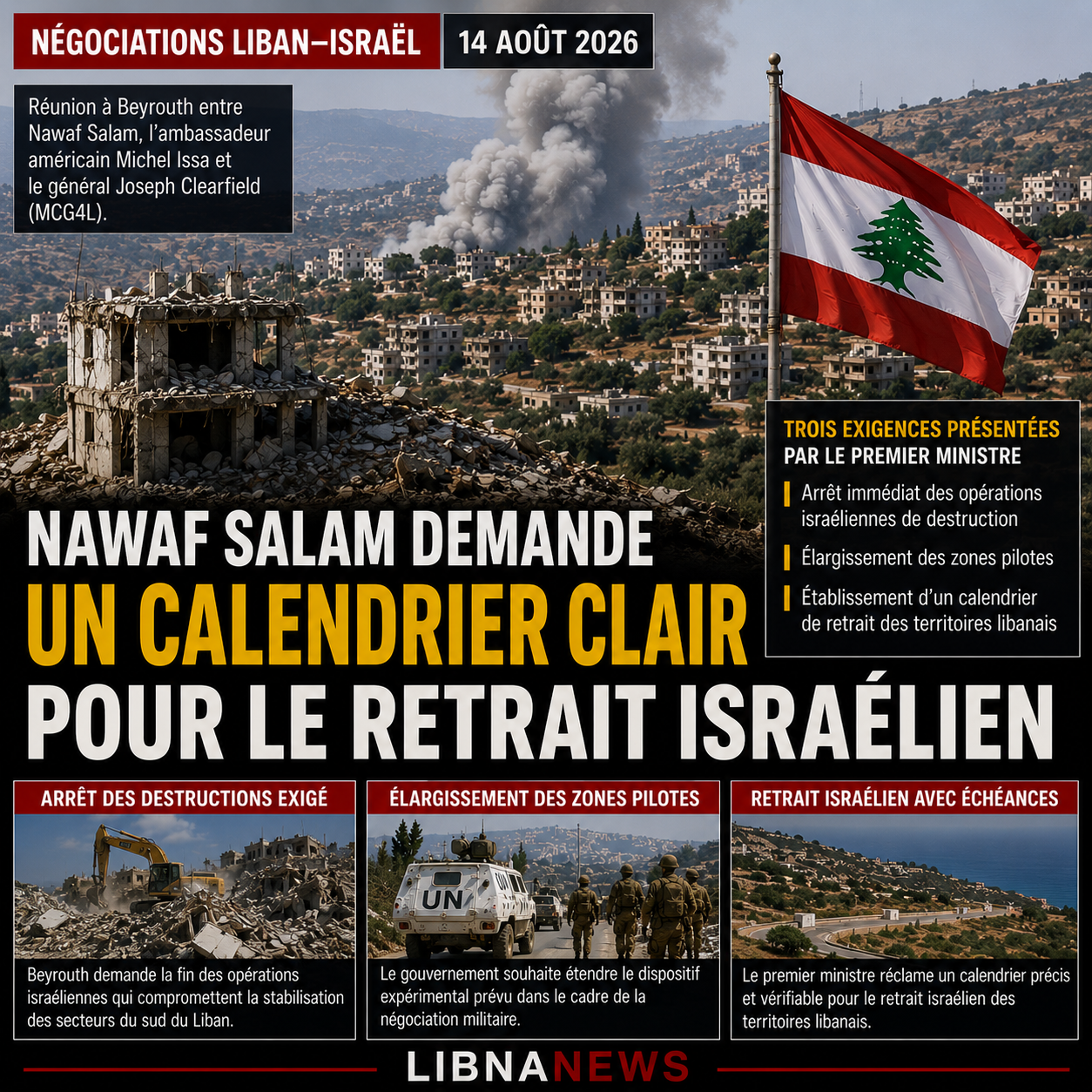
Lebanese Prime Minister Nawaf Salam called for a clear timetable for Israeli withdrawal from Lebanese territory on Friday, 14 August 2026. At a meeting in Beirut with the United States Ambassador to Lebanon, Michel Issa, and General Joseph Clearfield, who leads the military coordination group on Lebanon (MCG4L), he also called for the cessation of Israeli destruction operations and the expansion of the pilot areas. The meeting focused on the military aspect of the negotiating framework and developments on the ground in southern Lebanon. The demands made by Nawaf Salam thus aim to combine any progress in the negotiated framework with concrete and verifiable measures on the ground.
Salam puts three requirements on the military file
Nawaf Salam received on Friday morning Michel Issa, US Ambassador to Lebanon, as well as General Joseph Clearfield and the accompanying military delegation. The meeting focused on the military aspect of the negotiating framework and developments in the south of the country.
The Prime Minister made three applications directly related to the application of this framework.
He first stressed the need for Israel to end its destruction operations. He then called for an expansion of the pilot areas. Finally, he called for a clear timetable for Israeli withdrawal from Lebanese territories.
These three points constitute the main political and operational aspects of the meeting. They show that the Lebanese Government now wants to involve military discussions at observable stages.
Beirut, therefore, is not limited to requesting withdrawal in principle. The government is asking that the deadline be extended. At the same time, he hoped that the devices experienced in certain areas could be extended.
No agreement on these requests was announced at the end of the meeting. The communiqué does not mention an agreed timetable, a date of withdrawal, or an immediate decision on the enlargement of the pilot zones.
The Lebanese position is, however, unambiguous. Nawaf Salam wants military negotiations to produce measurable results in the south.
Israeli withdrawal, central issue for Beirut
The request for a calendar ofisraeli withdrawalrepresents the most precise point of the position expressed on friday by the head of government.
The choice of the term « calendar » is significant. It turns a general claim into an operational claim. A deadline would determine the different steps of the withdrawal and evaluate their implementation.
The communiqué does not specify the form of this timetable. It does not mention any dates proposed by Lebanon, intermediate stages or sectors that would be concerned first.
He did not further clarify whether the United States delegation had submitted a proposal in response to that request.
It is therefore necessary to distinguish clearly what is acquired from what remains in negotiations. The Lebanese request is official. The existence of an agreement on its content is not.
This distinction is particularly important in a case where military developments, security arrangements and diplomatic negotiations are closely linked. Any announcement of a timetable would require specific commitments and observable implementation on the ground.
For Nawaf Salam, the territorial issue cannot be left without a deadline. The Prime Minister calls for the withdrawal of Lebanese territories to be part of the concrete results expected of the process.
Stopping Israeli destruction requested before any extension
The second major focus of the meeting was on Israeli destruction operations.
Nawaf Salam requested their arrest. However, the official communiqué does not provide a list of the operations concerned and does not designate the locations covered by this request.
This wording should therefore be reported within its exact limits. The Lebanese government states that Israel must stop these operations, but no Israeli response to this demand was announced on Friday.
This issue is directly related to the situation in the south. It affects the conditions necessary to stabilize the sectors concerned and enable the application of durable military arrangements.
For Beirut, an advance in the negotiated framework would lose some of its scope if it accompanied, at the same time, further destruction.
The Prime Minister’s request seeks to establish a relationship between negotiation and behaviour on the ground. The government wants military discussions to be accompanied by an effective reduction in actions that undermine the stabilisation of the areas concerned.
This logic explains why the issue of destruction appears alongside the withdrawal and extension of pilot areas. The three topics are not presented as independent files. They are the components of the same approach defended by Beirut.
Salam wants to expand pilot areas
The third point concerns the enlargement of the pilot areas provided for in the scheme discussed.
Nawaf Salam requested that their perimeter be extended. However, the communiqué does not specify the current boundaries of these areas, the new localities envisaged or the desired pace of expansion.
No date is also announced.
This caution is important. The meeting on 14 August did not mark the entry into force of an enlargement. It confirms that the Lebanese Government is calling for an extension of the mechanism in the negotiations.
The principle of pilot zones is based on a progressive logic: to apply provisions in specific sectors, to observe their operation and then to consider their extension.
Nawaf Salam’s request indicates that Beirut wants to move to a higher scale. However, according to Friday’s position, this development must be accompanied by Israeli measures.
The government does not therefore present enlargement as an isolated concession or an end in itself. It links it to the cessation of destruction and the definition of a withdrawal path.
This articulation is at the heart of the meeting with the American delegation.
A negotiation that must now produce results on the ground
The Friday meeting illustrates an important development in the way Beirut presents its priorities.
The Lebanese authorities are seeking to translate the negotiating framework into concrete steps. The question is no longer just to maintain a channel of discussion, but to determine what it should change in the south.
Three criteria emerge: Israeli operations must cease, pilot areas must be able to be expanded and Israeli withdrawal must follow an identifiable timetable.
This approach gives the military component a directly measurable dimension.
If a timetable were adopted, compliance could be assessed on the basis of evacuees and deadlines. Similarly, the extension of the pilot areas could be verified geographically. The cessation of destruction operations would also be observable on the ground.
It is precisely this passage from the principles to the execution modalities that is at stake in the open sequence on Friday.
For the time being, however, none of these three points has been presented as definitively accepted.
Michel Issa and Joseph Clearfield, two American interlocutors
The composition of the delegation received by Nawaf Salam underlines the nature of the discussion.
Michel Issa represents the United States in Lebanon diplomatically. General Joseph Clearfield intervenes in the military component through the military coordination group dedicated to Lebanon, referred to as MCG4L.
The Prime Minister therefore addressed both levels of American involvement simultaneously: diplomatic and military.
This configuration is consistent with the topics examined. The Israeli withdrawal had a political and diplomatic dimension, but its execution also raised military questions. The same applies to pilot areas and to the security conditions under which their extension may occur.
The presence of a military delegation alongside General Clearfield thus enabled the operational aspects of the arrangement to be addressed.
However, the press release does not reveal the details of the exchanges. It does not specify the American proposals, any reservations made during the meeting or the modalities that would have been discussed.
So Washington should not be given commitments that have not been made public.
On the other hand, the meeting confirms that the United States remains directly involved in discussions on the military application of the negotiating framework.
Southern Lebanon remains the test of the device
Southern Lebanon is the main area on which the results of the process can be assessed.
This is where the issues raised on Friday are concentrated: the Israeli presence, destruction operations, the evolution of military arrangements and the expansion of pilot areas.
This fact explains why Nawaf Salam linked the negotiated track to developments on the ground.
For the Government, a diplomatic framework can only be considered effective if it gradually changes the situation in the sectors concerned.
The request for a withdrawal schedule directly meets this requirement. It aims to prevent a general commitment from remaining without a precise deadline.
The enlargement of the pilot areas is another need: to give the mechanism a greater territorial scope.
Finally, the request for cessation of destruction seeks to create conditions compatible with this extension.
These three dimensions are therefore interdependent in the position defended by the Head of Government.
A timetable for measuring commitments
The issue of timing can become one of the main indicators of the continuation of negotiations.
Without a deadline, withdrawal remains a political objective. With dates and steps, it becomes a process that can be executed.
However, Nawaf Salam did not indicate on Friday how long Beirut would be acceptable.
Nor does the news release state whether the government is requesting a one-phase withdrawal or several successive steps. It provides no details on the order in which the various sectors could be concerned.
These questions therefore remain open.
They should play an important role in future discussions if Lebanese demand is used as a basis for work.
In particular, the content of a possible timetable should be compatible with the military arrangements implemented in the south. It will also be necessary to determine precisely when each commitment is to be fulfilled.
It is on this ground that negotiations can move from political declaration to operational arrangements.
Beirut seeks a simultaneous progression of the three files
The position expressed by Nawaf Salam does not consist in dealing successively with the three subjects.
On the contrary, the government seems to be seeking parallel progress.
The extension of the pilot areas must lead to an improvement of the safety system. The cessation of destruction must preserve the conditions necessary for this stabilization. The Israeli withdrawal must, for its part, move forward on a determined path.
This architecture also allows the Lebanese government to present specific criteria to its American interlocutors.
It prevents an advance on a single part from being automatically presented as a settlement of the whole file.
An extension of the pilot areas, for example, would not alone respond to the Lebanese request for withdrawal. Similarly, a discussion on the timetable would not immediately resolve the issue of Israeli destruction operations.
The three requests must therefore be addressed separately while remaining integrated into the same negotiating framework.
What is confirmed and what remains to be negotiated
The meeting of 14 August makes it possible to distinguish several confirmed elements.
Nawaf Salam met Michel Issa, Joseph Clearfield and a military delegation. Discussions focused on the military aspect of the negotiating framework and developments in the south.
The Prime Minister has formally asked for three things: the cessation of Israeli destruction operations, the expansion of pilot areas and a clear timetable for the withdrawal of Lebanese territories.
On the other hand, there is no information published at the end of the meeting to indicate that an agreement has been reached on these requests.
No withdrawal schedule has been made public. No new pilot zone has been announced. No Israeli commitment to halt destruction has been communicated.
This difference between requests and decisions is an essential element in understanding the scope of the meeting.
Friday’s interview represents a stage in military negotiations, but not its outcome.
The next step will depend on concrete responses
The issue is now moving towards the response to Nawaf Salam’s three requests.
The first indication will be the possible presentation of a calendar ofisraeli withdrawal. Such a document would help to determine whether Lebanese demand leads to concrete deadlines.
The second concerns pilot areas. Their effective extension would constitute a tangible change in the application of the negotiated framework.
The third will be directly observable in the south: the evolution of the Israeli destruction operations denounced by the government.
The meeting with Michel Issa and Joseph Clearfield has not yet produced a public announcement on these three points. However, it has made clear the criteria Nawaf Salam intends to place at the centre of the military component.
For Beirut, therefore, the continuation of the process will not only be measured by the number of meetings or the continuation of contacts. It will depend on the changes achieved on the ground and their timing.
The next concrete development will therefore be decisive: either the discussions will lead to deadlines and an identified extension of the mechanism, or the three requests made on Friday will remain at the stage of Lebanese positions transmitted to the American interlocutors.