





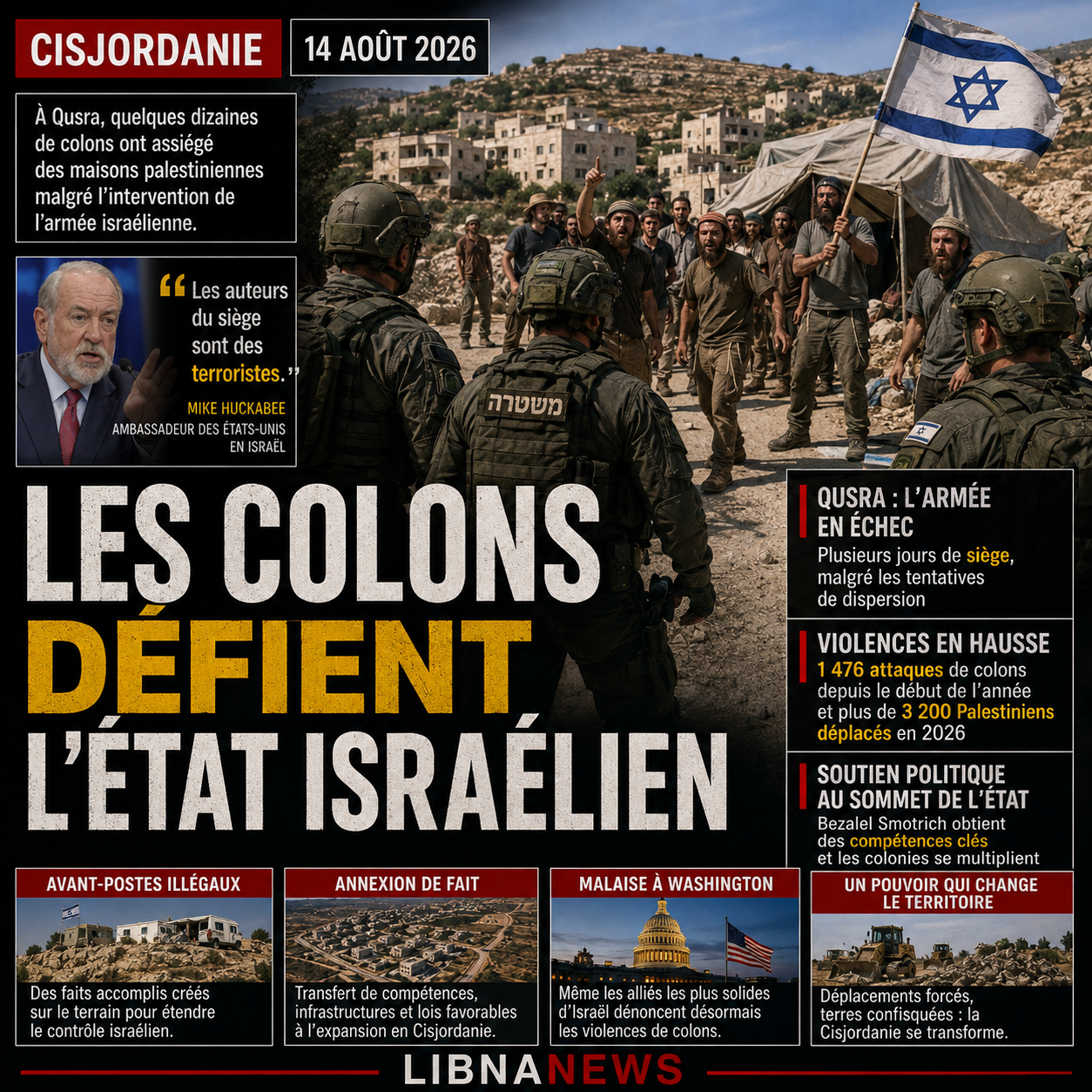
In the occupied West Bank, the balance of power between the Israeli state and the most radical settlers has become visible even in army operations. In Qusra, south of Nablus, a few dozen militants managed this week to maintain the siege of Palestinian houses for several days, despite attempts by Israeli forces to disperse. The episode, spectacular by the perceived impotence of the security apparatus, comes as settlements and outposts multiply, administrative skills have been transferred to officials from the settlement movement and violence against Palestinians reach particularly high levels. The malaise now exceeds the traditional opponents of Israeli politics: Mike Huckabee, American ambassador to Israel and historical defender of the settlements, himself called the perpetrators of the siege of Qusra « terrorists ».
The incident does not mean that settlers literally took control of the West Bank or the Israeli State. The army, the police, the military administration and the government retain their prerogatives. However, it reveals a deeper evolution: a fraction of the settler movement now has a political environment that is favourable enough to create facts, openly challenge the security forces and then push the state to adapt its decisions to a reality imposed on the ground. This dynamic is reinforced by the presence at the top of Benjamin Netanyahu’s government of officials who share part of their territorial objectives and reject the creation of a Palestinian State.
In Qusra, a few settlers put the army in check
The starting point of the current crisis is at the heights of Qusra, a Palestinian village south of Nablus. Early this week, Israeli settlers set up tents in the immediate vicinity of three isolated Palestinian houses. According to residents and several consistent reports, access was blocked, while water and electricity were cut off. Some 15 Palestinians, including children, were confined to housing with limited reserves.
The Israeli army publicly denounced the installation of the outpost. She called him illegal and unacceptable, and then sent military and police personnel to try to evacuate the settlers. But the operation quickly turned to the demonstration of weakness. Confrontations between security forces and militants, tear gas were used and part of the facility was dismantled. The soldiers then withdrew and failed to prevent the return of the settlers on a lasting basis.
The scene took on a political dimension when, following the departure of the forces, militants again tried to approach Palestinian houses. Images broadcast during the week also showed men wearing military clothes participating in a prayer with the settlers in the outpost. The army has announced disciplinary measures against the personnel involved. This episode fed questions about the border, sometimes blurred in the West Bank, between serving soldiers, reservists, settlement residents and armed activists.
On Thursday, 13 August, the army increased its presence in the area and dismantled facilities that were reported to be illegal. But his intervention produced a paradox: while the security forces claimed to want to protect Palestinian families, soldiers took positions in several houses and residents were ordered to regroup or temporarily leave certain homes. In other words, the initial inability to permanently remove the assailants led to the imposition of new constraints on the Palestinians whom the operation was supposed to protect.
It is this inversion that gives Qusra its symbolic significance. A handful of activists managed to provoke an army mobilization, resist an initial evacuation attempt and change the daily life of an entire area. For Israeli opponents of colonization, the episode illustrates a situation in which extremist settlers no longer merely challenge Palestinians: they also test the State’s ability to impose its own decisions.
Illegal outposts become a political instrument
The difference between settlements recognized by Israel and outposts not authorized by the State is essential to understand this evolution. The former have an Israeli administrative framework, although their settlement in the occupied territory is considered illegal by most of the international community. The latter are built without the authorizations required by Israeli law itself. They can start with a few caravans, a tent, a short road or a farm.
For years, these outposts have been a method of fait accompli. A small group settles down on a hill, creates a permanent presence, demands military protection, opens or improves access routes, and then starts a political battle to prevent evacuation. Some sites remain precarious. Others end up receiving infrastructure, budgets or a form of regularization. Their real weight is therefore measured not only by the number of their inhabitants, but by their ability to change the use of the territory in a sustainable way.
This logic seems particularly effective in rural areas. The installation of an outpost or farm may restrict Palestinians’ access to large agricultural or pastoral areas much larger than the actual occupied parcel. Violence, threats, theft of livestock, destruction of crops or restrictions of access, as documented by the United Nations and human rights organisations, contribute to continued pressure on often few communities.
The result is territorial. More than 3,200 Palestinians had already been displaced in the West Bank since the beginning of 2026 on 10 July because of settler attacks and demolitions related to the lack of Israeli permits, according to United Nations humanitarian data. By the end of July, the organization believed that settler violence and restrictions had become one of the main displacement factors, particularly for Bedouin and pastoral communities in Area C.
Settler violence is changing scale
Qusra is not an isolated incident. The village itself had already been identified as one of the most exposed points to settler attacks in 2026. Houses, vehicles, agricultural land and a mosque were targeted in successive incidents. Palestinian authorities have recorded 1,476 settler attacks since the beginning of the year, while the United Nations has observed an acceleration of attacks causing injury, damage to property or displacement.
Statistics vary according to the criteria used, but the trend is converging. The Israeli security services themselves had witnessed an increase in settler attacks against Palestinians and the security forces. In the first half of 2026, the phenomenon had become significant enough for military officials to describe illegal outposts as one of the main challenges facing the army in the West Bank.
This changes the nature of the problem for the Israeli state. As long as the violence could be described as the marginal acts of a few activists, it remained politically separable from the government-led settlement project. The increase in outposts, attacks and clashes with the military makes this distinction more difficult. The perpetrators of violence remain a minority among the hundreds of thousands of Israelis living in the West Bank, but their actions are part of a territory where settlement expansion is supported by official political support.
The Israeli government continues to distinguish violent settlers from the settlement movement as a whole. Several officials claim that the attacks are committed by a small minority of young extremists. This distinction exists and must be maintained. However, it does not fully answer the question posed by Qusra: how can such a small minority return to a site several times, challenge soldiers and maintain lasting pressure on families without being quickly neutralized?
Government moved centre of gravity
The answer lies in part in the political transformation of the West Bank since Benjamin Netanyahu’s return to power in late 2022. The coalition associates Likud with nationalist and religious formations that openly defend the extension of Israeli sovereignty over all or part of the territory. Finance Minister Bezalel Smotrich, a historical figure in the settler movement, has gained major expertise in the civil administration of the West Bank.
This transfer of powers is less spectacular than a formal proclamation of annexation, but it has very concrete consequences. Planning decisions, legalization or settlement development, infrastructure and several administrative mechanisms can be directed by politicians who do not regard the West Bank as the territory of a future Palestinian State, but as an integral part of Israel’s land.
In February 2026, the Israeli cabinet again adopted a series of measures facilitating, inter alia, the acquisition of land by Israelis and the modification of certain skills related to Palestinian areas. In June, decisions concerning Hebron transferred to Israeli institutions planning prerogatives previously exercised within a Palestinian framework for certain sectors and sites. Israeli organizations opposed to colonization see it as the successive elements of a de facto annexation.
The government does not hide the expansion objective. On Thursday, at the same time as the army was trying to regain control in Qusra, several Israeli officials in the West Bank were celebrating the reconstruction of a settlement evacuated in 2005. Defence Minister Katz, Israel, declared the end of the withdrawal era and the beginning of a new construction phase. This simultaneity summarizes the contradiction that the army is confronted with: it can be ordered to dismantle a specific outpost while operating in a political environment that encourages the rapid growth of the Israeli presence in the territory.
When the army protects a project it must sometimes contain
The Israeli army is thus placed in an increasingly uncomfortable institutional position. Its official mission includes security in much of the West Bank and the protection of Israeli civilians. The settlements, the roads that serve them and the movements of settlers require a significant military presence. As the Israeli population and outposts progress in dispersed areas, security needs increase.
At the same time, forces must theoretically intervene when Israelis attack Palestinians, illegally occupy land or attack soldiers. This dual function creates a practical conflict. The same units can be charged, within hours, to protect an settlement, escort Israeli residents and evacuate militants from the same ideological milieu when they cross the limits set by the authorities.
The situation is further complicated by the weight of reservists and the sociology of certain units. Some of the soldiers mobilized in the West Bank live in or near settlements. This does not make it possible to generalize complacency to the entire army, but episodes of military fraternizing with militants when they should enforce an order inevitably fuel Palestinian mistrust and Israeli internal criticism.
In Qusra, the military hierarchy publicly condemned the settlers’ behaviour. However, the effectiveness of intervention has itself become the subject. The image of an extremely powerful army unable to quickly reverse a few dozen Israeli militants contrasts strongly with the means it deploys in its operations against Palestinians. It is this disproportion that turns a local confrontation into a national political problem.
Washington is irritating, and this time the critic is Mike Huckabee
The most revealing reaction came from the United States. Mike Huckabee, US Ambassador to Israel, described the actions against the families of Qusra as criminal and used the word « terrorists » to refer to their perpetrators. Washington has asked the Israeli authorities to intervene, in particular because one of the houses belongs to a Palestinian American living in Ohio.
Huckabee’s choice gives this conviction an unusual scope. The former Republican governor of Arkansas does not belong to the traditionally critical American wing of colonization. Evangelical Christian, a long-time advocate of Israel and Jewish settlements in the West Bank, for years he challenged the very vocabulary of « occupation » and « colonies ». Since his appointment as ambassador, he has continued to display ideological proximity to the Israeli currents in favour of a permanent presence in the territory.
Also in February 2026, Huckabee’s statements on Israel’s historical and biblical rights triggered a protest from several Arab and Muslim countries. The diplomat was therefore difficult to assimilate to an American official hostile to the settlers’ project. When such an actor calls some of them terrorists, the signal sent to Jerusalem is all the more severe.
Criticism does not necessarily concern colonization in principle. This is precisely what makes it interesting. Huckabee drew a line between his political support for settlements and methods of violent coercion which he now considered likely to undermine Israel’s interests, American citizens and the relationship with Washington. For part of the pro-Israeli camp in the United States, the problem becomes less only moral or legal than strategic: the most visible violence may render politically indefensible a policy that they also continue to support.
Radical settlers become a problem for their allies
This concern also goes through some American pro-Israeli circles that defend a two-state solution. J Street, which defines itself as pro-Israel, pro-peace and diplomacy, has long warned about the role of outposts, attacks on Palestinians and administrative measures that make territorial separation more difficult. His opposition to the settler movement was therefore not new.
What changes in August 2026 is the widening of malaise beyond these circles. Huckabee’s reaction shows that violence can now lead to a one-time break-up with officials who have historically defended the colonies. According to the Israeli press, the U.S. administration has also expressed strong irritation at what it perceives as an inability of the Israeli authorities to prevent anarchy in certain areas of the West Bank.
For Benjamin Netanyahu, this evolution is politically sensitive. Its coalition depends on formations for which expansion in the West Bank is a central objective. But the relationship with the US administration remains essential to Israel. If the most radical militants cause incidents involving US nationals or place Washington in the position of publicly denouncing Israeli « terrorists », they create a diplomatic cost for the government they seek to push towards further annexation.
The paradox is that radical settlers benefit from the most favourable political environment they have known for a long time, but their methods may threaten the international acceptability of larger projects carried out by their ministerial allies. The power acquired by their camp therefore also makes their overflows more dangerous for the government.
A conquest of territory more than a classical takeover
To say that « the colonists take power » requires precision. They do not constitute an autonomous power capable of commanding the army. What is happening is more diffuse and, in some respects, more effective. Their influence is exercised by government representation, territorial administrations, budgets, infrastructure, planning decisions and a continuing capacity to create local achievements.
The process works on several levels. At the top, ministers close to the colonization movement have institutional levers. In the field, official settlements continue to expand. On their outskirts, small groups create new outposts and farms. When Palestinians leave an area under the pressure of repeated violence or access that has become impossible, territorial balance changes even before a final legal decision is taken.
This is why Israeli organizations opposed to the settlements are increasingly talking about « de facto annexation » rather than waiting for a formal annexation voted by the Knesset. The territory can be profoundly transformed without a single proclamation: expansion of settlements, new roads, transfer of administrative powers, restrictions on movement and the gradual decline of the space accessible to Palestinian communities have cumulative effects.
The Qusra episode adds one element to this mechanism: the ability of a small group to put the state in front of the fait accompli, and then to force the army to manage the consequences of its initiative. Even when the outpost is finally dismantled, several days of crisis have sufficed to show who owns the initiative.
More than 500,000 settlers in a fragmented territory
The West Bank has approximately three million Palestinians and more than half a million Israeli settlers outside East Jerusalem, according to accounts used by several agencies. The settlements recognized by Israel are surrounded by several hundred outposts of varying size. The territory has also been divided since the Oslo agreements between various administrative areas, including zone C, under complete Israeli control and where most settlements are located.
This geography explains why some new settlements may have consequences far exceeding their built area. A road, security zone, military post or farm can change traffic and separate villages from their land. In some areas, Palestinian pastoral communities live in areas where access to pasture is the very condition for their economic survival.
The increase in the number of documented departures since 2023 shows that the pressure is not only reflected in occasional clashes. Whole communities or some of their inhabitants have left their places of residence after a series of attacks, threats and restrictions. Displacement then becomes a means of transforming territory without massive administrative expulsion organized into a single operation.
This is fuelling the fear of a West Bank where Palestinian territorial continuity would gradually become impossible. It also reinforces the contradiction between the policy pursued on the ground and the idea of a viable future Palestinian State, which is still officially supported by many foreign governments.
Israeli electoral deadline increases pressure
The crisis occurred as the Israeli elections were scheduled for October 2026. This deadline increases the weight of nationalist and religious voting in coalition calculations. For parties to the right of Likud, the consolidation of settlements is both an ideological project and an electoral marker.
Benjamin Netanyahu must therefore maintain the support of partners who consider any outpost evacuation suspiciously, while preventing the most extreme violence from further damaging relations with the United States. The Qusra incident places these two imperatives in direct collision. The army must restore order to activists whose territorial objectives are defended by important members of the government.
This contradiction partly explains the nervous reactions within the Israeli system. The army can denounce the illegality of an outpost, but it knows that the political movement to which its occupants belong has powerful relays. Those responsible for settlement may condemn certain violence, while simultaneously calling for more Israeli settlement and control. Washington can strongly support Israel, while noting that the absence of effective sanctions against certain activists ends up reaching its own nationals.
Qusra concentrates these tensions on a few hundred meters. Palestinians besieged in their homes, settlers determined to stay, soldiers sent to separate them, a hierarchy unable to impose his order immediately and an American ambassador particularly favorable to Israel who ended up talking about terrorism: the scene sums up a problem far beyond the village.
Qusra, test of the real authority of the state
The question is no longer whether the Israeli government wants to expand the settlements. On this point, its guidelines are public. It is to determine how far the State still controls the actors it has politically strengthened and whose objectives it sometimes shares.
If the army can quickly dismantle the next illegal outposts and if the perpetrators of the attacks are prosecuted, Qusra may appear as a serious but circumscribed crisis. If, on the contrary, the same groups continue to settle, return after their evacuation and cause the displacement of Palestinians, the episode will take the value of a precedent: that of a field power capable of imposing its pace on the administration and the army.
The American reaction now adds an additional constraint. For the first time in this sequence, the cost of violence is no longer denounced solely by Palestinians, the United Nations, Israeli NGOs or the traditionally critical governments of the settlements. It is formulated by one of the American diplomats most ideologically close to Israel and the colonization movement.
In Qusra, tents can be dismantled within hours. The balance of power they have revealed will be much more difficult to erase. The next confrontation between the army and an illegal outpost will show whether the state is taking over the initiative or whether radical settlers in the West Bank continue to decide where the next front line will move.