

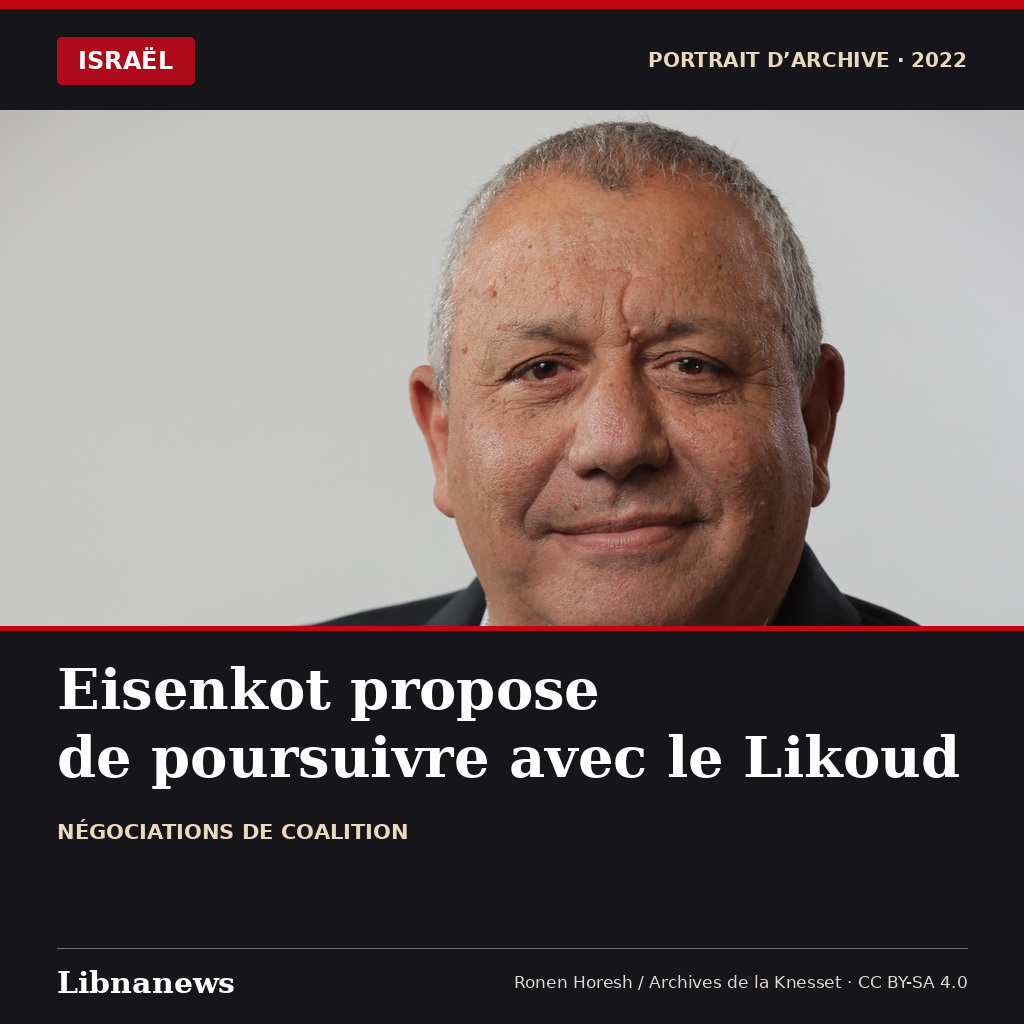
Responsible for forming the next Israeli government, Gadi Eisenkot proposed Saturday, 21 November, to start a series of negotiations with the Likud of Benyamin Netanyahu. A meeting between the teams was already scheduled for Sunday, November 22. The Likud set its conditions, without a coalition agreement being announced.
Sunday’s appointment was already scheduled
In a statement broadcast Saturday night, the Yashar party reported that its leader had asked its negotiators to invite their Likud counterparts to an intensive series of discussions. The Likud announced the resumption of trade on Sunday. What Eisenkot proposes is therefore to make an appointment already planned the starting point for more sustained talks, not to open an initial contact between the two formations.
Former Prime Minister Naftali Bennett, the head of the government, supported the search for an expanded government on Saturday, but reaffirmed that he would not join Netanyahu camp and that such a government should be headed by Eisenkot. Yashar and B This exchange should not be confused with a meeting between Yashar and Likud.
Likud sets conditions
In a separate statement, Netanyahu’s party presented Saturday night its terms for a union government. In particular, he called for the lifting of political exclusions against the outgoing Prime Minister and the rejection of the establishment of a Palestinian State. He also wanted an agreement on the status of students in religious schools, with ultra-Orthodox leaders. These are the requirements of the Likud, no provisions accepted by the other training courses. The party did not announce its acceptance of the entire Yashar round of negotiations.
President Isaac Herzog instructed Eisenkot to form a government on 8 November. During the consultations, 67 elected had recommended that he be given the mandate, compared with 46 for Netanyahu, while seven had recommended no candidates. These recommendations concerned the choice of the person to negotiate. They do not constitute a vote of confidence for a coalition or a commitment by the parties to participate.
The Basic Law gives Eisenkot 28 days from the mandate to form a government. The President may extend this period by a maximum of 14 days. A new executive must then gain the confidence of the Knesset. For the time being, the announced resumption of discussions does not prejudge this vote.





Comments