

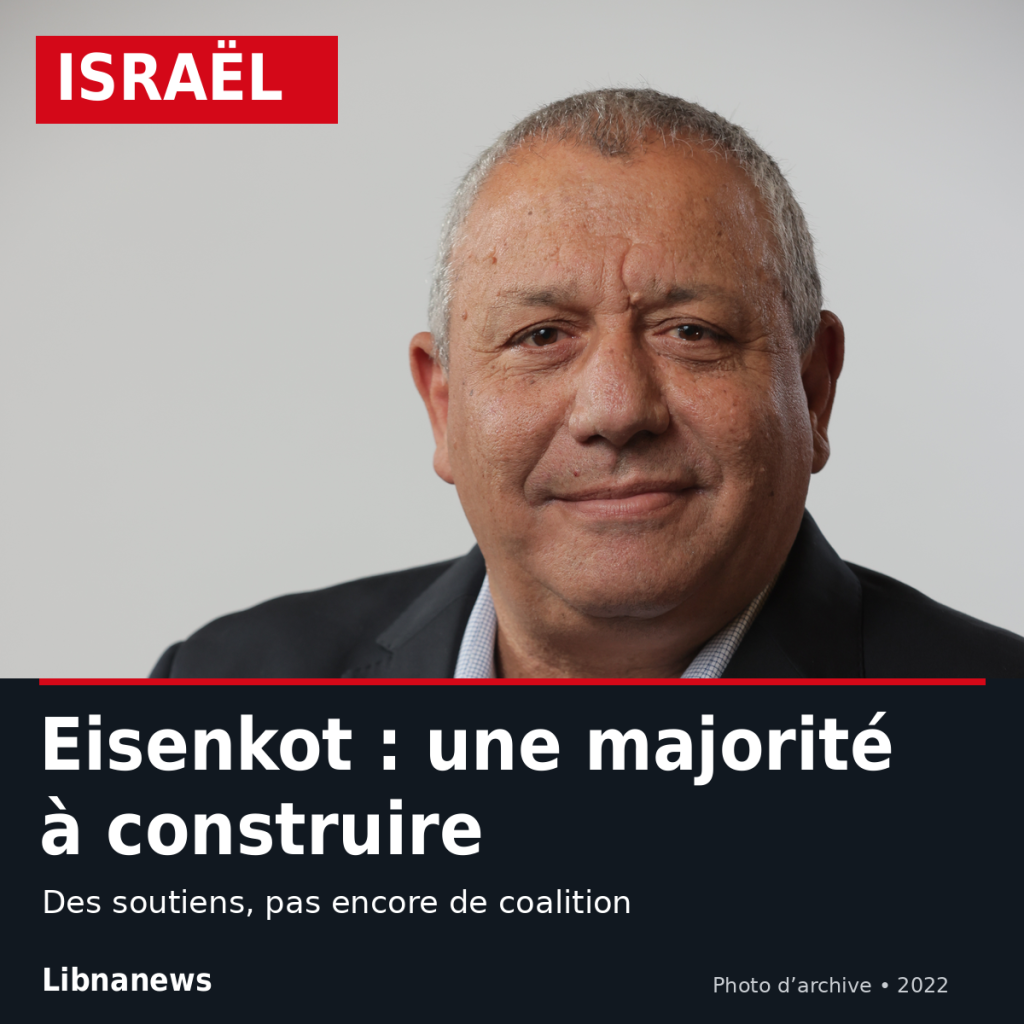
Gadi Eisenkot seeks a majority to govern in Israel and claims to have made progress. On Friday, 6 November, Avigdor Liberman accepted the principle of compromise with the ultra-Orthodox parties, particularly on conscription. This inflection opens a new possibility to replace Benjamin Netanyahu. However, no coalition agreement was announced. UTJ awaits a proposal, while Shas remains engaged alongside the outgoing Prime Minister.
Ten days after the 27 October parliamentary elections, the Israeli negotiations are undergoing a significant change. Liberman, leader of Yisrael Beytenu, no longer makes his refusal to cooperate with the ultra-Orthodox formations an absolute obstacle. However, he maintained his opposition to a government dependent on Arab parties.
Eisenkot, former Chief of Staff and President of Yashar, describes the progress achieved discreetly. In a message published before the Shabbat began, he spoke of significant progress and breakthroughs. He states that many discussions continue outside the public arena. The precise content of these exchanges remains unknown.
Eisenkot seeks a majority to govern quickly
The Yashar leader wants to form a national emergency government around the four formations of his camp. He invited other parties and deputies to join him immediately or gradually, provided that he accepted his principles. This formulation leaves open the question of the timing of rallying. It does not prove that a majority is already gathered.
In particular, Eisenkot maintains its commitment to a compulsory service for all. He stated that the latter could be military, national or civilian. This distinction counts in the discussions with the ultraorthodox. It allows different forms of participation to be considered, without announcing a general exemption or regulating the modalities of application.
The Leader of the Opposition describes the change of government as a democratic and security emergency. He accuses the outgoing executive of threatening the institutions and criticises the conduct of the military fronts still open. He used these risks to demand an acceleration of negotiations.
Liberman accepts concessions on conscription
The most concrete change comes from Liberman. The former defence minister had made the end of the military exemptions a marker of his campaign. He now agreed to discuss concessions on this issue to allow Netanyahu to leave.
Liberman recognizes the cost of this choice for himself and some of his constituents. However, it considers it a priority to break the parliamentary deadlock. His reasoning is based on two continued refusals: he does not want to extend Netanyahu’s power, nor does he want to support a government that is dependent on Ra的am or the Common List.
This position therefore directs the discussions towards the two ultra-Orthodox formations, Unified Judaism of the Torah, generally referred to as UTJ, and Shas. Their participation would allow for a majority on paper without Arab parties. But Liberman did not submit a common text on military recruitment. No timetable for incorporation or sanctions agreed by potential partners has been made public.
UTJ welcomes the opening, Shas stays with Netanyahu
Yaakov Asher, UTJ leader, welcomed this development. He welcomed the flexibility shown on conscription, while regretting the tensions caused by this debate in recent years. However, he indicated that no partnership proposals had yet been submitted to his party. The rabbinic authorities would consider any formal offers.
The day before, Thursday, 5 November, UTJ refused to recommend Netanyahu during the presidential consultations. Nor did the party recommend Eisenkot. This abstention deprived the outgoing Prime Minister of seven supporters at this stage, without automatically transferring those voices to his rival.
Shas retains a different position. The sefarad ultraorthodox formation recommended Netanyahu and announced that it would remain at its side. However, its six seats are indispensable to the formula envisaged with the only parties of Camp Eisenkot and UTJ. An agreement with only one of the two religious formations would therefore not suffice.
The ultra-Orthodox parties demand guarantees for students in religious institutions. Their disagreement with Netanyahu on the inclusion of exemptions in the law weakened their relationship with him. It does not mean that they accept the conditions of Eisenkot, nor that they move together towards an alliance with the opposition.
Golan reports progress between negotiators
Yair Golan, leader of the Democrats, shares Eisenkot’s optimism. On Friday, he said he was more confident than the day after the election. He reported several meetings between his party’s negotiating teams and Yashar’s during the week.
These exchanges aim to prepare a national emergency government. Nevertheless, Golan recognizes the existence of obstacles. His statements describe a negotiating dynamic, not an agreement with UTJ or Shas. Nor do they lift Liberman’s veto over a majority supported by Arab parties.
Military service remains at the centre of challenges. The exemptions granted to ultra-Orthodox students aroused strong opposition in other parts of Israeli society. Since the Hamas attack of 7 October 2023, the repeated mobilizations of the reservists have reinforced the demands to share this charge.
Several camp officials opposed to Netanyahu campaigned on this issue. To agree to discuss with religious formations therefore does not exempt them from defining a common policy. The possible place of civil service should be specified.
Thirteen seats required, one mandate still awaited
The results of the election explain this new search. The four formations of Camp Eisenkot total 48 seats out of the 120 of the Knesset. UTJ holds seven and Shas six. Their addition would reach exactly the 61 seats of the absolute majority.
The Arab parties together have 19 elected representatives. Their support could provide another parliamentary basis, but this path runs counter to Liberman’s refusal. The recommendations addressed to the President should therefore not be confused with commitments to participate in the same government.
Following consultations, Isaac Herzog identified recommendations representing 67 MPs for Eisenkot, compared to 46 for Netanyahu. However, the President stressed the reciprocal vetoes between and within the blocs. He still wants to examine the real ability of each candidate to form a government.
Herzog plans to grant the mandate Sunday, November 8. Eisenkot believes he should receive it. By then, it must transform Friday’s political openings into acceptable proposals for partners whose demands remain distant.





Comments