

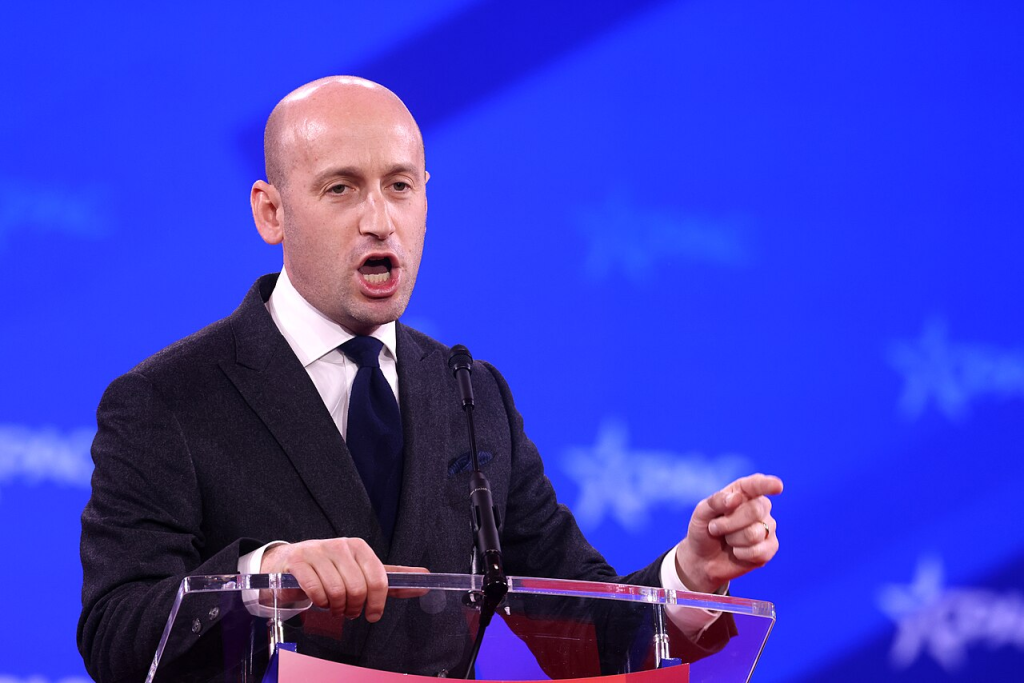
Donald Trump announced Friday, November 6, 2026, the appointment of Stephen Miller as Chief of Staff of the White House, with an appointment scheduled Monday, November 9. Susie Wiles must join her political apparatus. A central figure in the hardening of migration, Miller also defended a line of power against Iran, sustained support for Israel and American primacy even in relations with NATO allies.
Trump set the change on November 9 in his message on Truth Social. The announcement marks the promotion of a long-time faithful. Miller is therefore the designated Chief of Staff and not yet the incumbent who took office on the date of this announcement.
Cover photo: Stephen Miller at CPAC, February 22, 2025.Gage Skidmore / Wikimedia Commons,CC BY-SA 2.0. Resized image, without cropping.
Conservative activist becomes one of Trump’s trusted men
Stephen Miller was born on August 23, 1985 in Santa Monica, California. He studied at Duke, graduating in 2007. His conservative commitment precedes his arrival in Washington, D.C., where he is made known by his positions in the academic paper and the media.
He then worked with Republican elected officials, including Michele Bachmann and Senator Jeff Sessions. Along with the latter, he fought the bipartisan migration reform of 2013, which was to pave the way for legal status for millions of undocumented people. Then he joined Trump’s campaign in 2016 and participated in the drafting of his speeches. Immigration is thus the driving force behind a career built on both the ideological battle and the mastery of administrative machinery.
Between Trump’s two terms, he co-founded America First Legal. At its launch on April 6, 2021, he presented an assumed judicial combat project for the America First program. His return to the White House was announced in November 2024 with the position of Deputy Chief of Staff in charge of Public Policy and Internal Security Advisor.
Immigration, matrix of its power
Miller is associated with several of the most controversial measures of the first mandate: entry restrictions initially targeting seven predominantly Muslim countries and policy of separating families at the border. He participates in their conception and publicly defends them. In the second mandate, he also supported the challenge of land law and the acceleration of evictions. These positions make him a leading actor of the American nationalist right.
On May 28, 2025, Miller publicly announced that the administration was targeting at least 3,000 daily arrests by the immigration police. It presents this figure as an objective yet to be identified, not as a result already achieved. His functions as Deputy Chief of Staff for Public Policy and Internal Security Adviser give him a role in the preparation of decisions and coordination between administrations.
The distinction counts for his promotion. Miller is not only an offensive spokesperson: he is able to transform a presidential priority into instructions, numerical targets and regulatory arrangements. Its defenders see consistency and effectiveness. His criticisms denounce a punitive policy, which has reached the limits of constitutional protections.
An extensive conception of presidential power
On 9 May 2025, when questioned before the White House, he explained that the administration was studying a suspension of the habeas corpus, the procedure allowing a person to challenge his detention before a judge. It invokes an « invasion » situation and links this option to the conduct of the courts.
This declaration documents his willingness to seek exceptional powers; it does not demonstrate their legality or implementation. The Constitution strictly regulates the suspension of habeas corpus, in case of rebellion or invasion when public security so requires. Assimilating irregular immigration to an invasion remains a legal challenge.
On Iran, an explicit advocate of coercion
His positions on Iran are not reduced to a supposed proximity to Trump. On 18 March 2026, interviewed on television by Laura Ingraham, he defended American military operations and their intensity. « In a war you have to fight completely, » he says, in translation, « in a war you must fight fully. » It justifies action by the nuclear and ballistic threat it attributes to the Iranian regime. It thus expresses support for the use of force, not an isolationist reserve.
On 21 August 2026, his defence of the pressure on Tehran remained explicit. In a press briefing, he jointly boasts the blockade, sanctions and economic campaign, which he describes as weakening the regime. This is his political assessment of the results, not an independent assessment of Iran.
These interventions set a hard line: to reduce Tehran’s military and economic resources by coercion. However, they are not sufficient to give him a detailed personal plan for the post-scheme, nor to conclude that he would systematically favour a new war over any negotiation.
Israel and Gaza: military support and security reading
A precise statement on Israel sheds light on its position. On February 11, 2025, while Trump imposed an ultimatum on Hamas for the release of hostages, Miller explained in a television interview that the presidential process was intended to give the Israeli government the flexibility to resume military operations if necessary. It reflects its support for Israel’s freedom of military action in this context.
On 29 August 2025, when questioned about the refusal of visas to the Palestinian delegation to visit the United Nations, he referred to the need to prevent the use of the United States visa system by persons likely to support terrorism. This justification does not constitute evidence that the perpetrators actually supported terrorism.
His action on this issue also affects American domestic policy. In a judicial testimony made public in July 2025, John Armstrong, then Acting Head of Consular Affairs, described Miller’s participation in inter-administration exchanges on the revocation of pro-Palestinian university visas.
However, one limitation must be maintained: the elements verified here do not allow for a full annexation of the West Bank, displacement of the population of Gaza or explicit rejection of the two-State solution. Trump’s initiatives on these issues do not automatically become a doctrine specific to each of his advisers.
NATO: American primacy before solidarity between equals
The Greenland case provides a particularly clear example of its conception of alliances. On January 5, 2026, in an interview with Jake Tapper, Miller maintained that the territory should belong to the United States on behalf of Arctic security and NATO defence. He challenged the basis of the Danish territorial claim and minimized the possibility of a military response against Washington.
Its formula is unambiguous: « The United States is the power of NATO », in other words, the United States is NATO’s power. The argument is revealing: Miller invokes Alliance protection to defend an American claim on a territory under another ally. He thus favoured a hierarchical reading of the transatlantic relationship, dominated by American military capacity.
In the March 18 interview on Iran, he also echoed Trump’s criticism of Europeans about Ormuz, comparing them with US aid to Ukraine. This documents a requirement of reciprocity; not, in these statements, an explicit request for the withdrawal of the United States from NATO.
What its promotion changes
The office of Chief of Staff will give him a central place in the organisation of presidential work and the arbitration between employees. It does not make him the sole decision maker of diplomacy or military operations, which remain subject to the responsibilities of the President and the competent institutions.
However, its journey makes it possible to identify continuity: priority to migration control, search for a powerful executive, resort to coercion against Iran and support for Israel, with a conception of alliances based on Washington’s preeminence. For both Europeans and Middle East actors, the question will now be one of translating these positions into the White House’s daily arbitrations.






Comments