


The American rebound of this Friday, November 6, is not enough to erase the quake of the day before. Technology values are regaining ground on Wall Street, while Tokyo and the major European squares have finished in red. The U.S. employment report provides a tangible confirmation of economic resistance: 165,000 more jobs in October. For investors, this good news has a counterpart. An economy that hires more can support business sales, but also leaves less reason for the central bank to quickly relax the financing conditions.
In this evening’s edition, the thread is the gap between activity and its financing. Travellers continue to book at Airbnb, but IAG’s fuel bill affects its profitability. Artificial intelligence infrastructure operators record revenues, while having to finance investments and maintain industrial schedules. In Lebanon, the same distinction between pledged funding, mobilized funding and concrete implementation remains essential to understanding reconstruction.
Friday, November 6, 2026 edition. The courses below are those of the last readings available during preparation, with their own time stamping. Asian and European markets are closed; Wall Street is staying in session. This case does not constitute a review of the US closure. Cover: editorial composition based on a photo of Libnanews archives published in June 2019, used as an illustration.
Scholarships: US rebound remains partial
- S&P 500:7 402.91 points (+0.67%), 20:40:57 time stamp in Beirut (18:40:57 UTC), 6 November; American sitting in progress, deferred flow.
- Nasdaq Composite:24 635.97 points (+1.32%), 20:41:22 flux time stamp in Beirut (18:41:22 UTC), 6 November; American sitting in progress, deferred flow.
- ACC 40:8 139.00 points (−0.81%)19:05:02 in Beirut (17:05:02 UTC), 6 November; European meeting closed.
- DAX:25 820.36 (−1.92%), 18:50:00 in Beirut (16:50:00 UTC), 6 November; European meeting closed, flow postponed.
- Nikkei 225:57,434.77 (−5.96 per cent)8:30:03 in Beirut (06:30:03 UTC), 6 November; Japanese session finished, level confirmed by Nikkei Indexes.
Boursorama statements on the specific pages of each instrument. Variations use the previous-day reference fence displayed by the supplier. French hours converted from Paris to UTC and Asia/Beirut, UTC+2. US flows are delayed; the site does not indicate a guaranteed duration. The readings are not simultaneous. In New York, this Friday’s regular meeting ends at 9 p.m. UTC, or 11 p.m. in Beirut.
% change from 5 November reference.
| Index | Lower ← | → Increase | Change |
|---|---|---|---|
| Nikkei 225 | -5.96 % | ||
| DAX | -1.92% | ||
| ACC 40 | -0.81 % | ||
| S&P 500 | +0.67% | ||
| Nasdaq Composite | +1.32 % |
Scale: Each half column represents 6 percentage points. November 6 UTC records: Nikkei 06:30:03, DAX 16:50:00, CAC 40 17:05:02, S&P 500 18:40:57, Nasdaq 18:41:22. Asia and Europe: closed sessions. Wall Street: sitting in progress, delayed flow. Original Libnanews graphic, Boursorama data; Nikkei crossed with Nikkei Indexes.
The difference between continents lies first in the order of the sessions. Tokyo absorbed Thursday’s American shock during its day. Paris and Frankfurt then composed with this deterioration in the financial climate, before US transactions showed a partial recovery. Therefore, juxtaposing these variations does not mean observing several markets reacting exactly at the same time to single information.
Nor do the indices have the same structure. The place of technology, banks, energy and industry varies considerably from one reference to another. The Nikkei is a price-weighted index of shares, while the weight of companies in the S&P 500 depends on their floating capitalization. A decrease concentrated on a few large values can therefore have very different effects depending on the indicator chosen. This prohibits the direct deduction of the health of a national economy from the only daily variation in its index.
The U.S. political context remains an explanatory element, without providing certainty about future decisions.Reuters reported Fridayinvestors reassess the risk of stricter management of AI and data centres after mid-term elections. The projects mentioned for the next Congress are not already passed laws. Their scope, time limits and modalities of application remain to be established.
Nor does a rebound prove that these questions have disappeared. After a sharp decline, purchases can be a fresh appreciation of prospects, portfolio arbitrations or the closure of sales positions. Without data to separate these mechanisms, assigning each won point to a single cause would be excessive. The robust observation, at this stage of the session, remains that of a partial recovery of Wall Street, after a day particularly unfavourable to AI values.
American employment resists, but its details count
TheBureau of Labor Statistics, in its report issued on 6 November at 8.30 a.m. in New York, at 1.30 p.m. UTC, figure to165 000the increase in non-agricultural wage employment in October. This increase exceeds the monthly average of 48 000 jobs calculated by the Agency over the previous 12 months. The unemployment rate is4.1 %, after 4.2% in September. The BLS describes this as a limited variation, ranging from 4.1% to 4.3% since March.
The revision of previous months reinforces the table. August rose from 133,000 to 186,000 net creations, and September from 29,000 to 60,000. This represents an additional 84,000 jobs compared to previously published estimates. These corrections are not a second wave of hiring in November. These include additional responses from the institutions surveyed and the recalculation of seasonal factors.
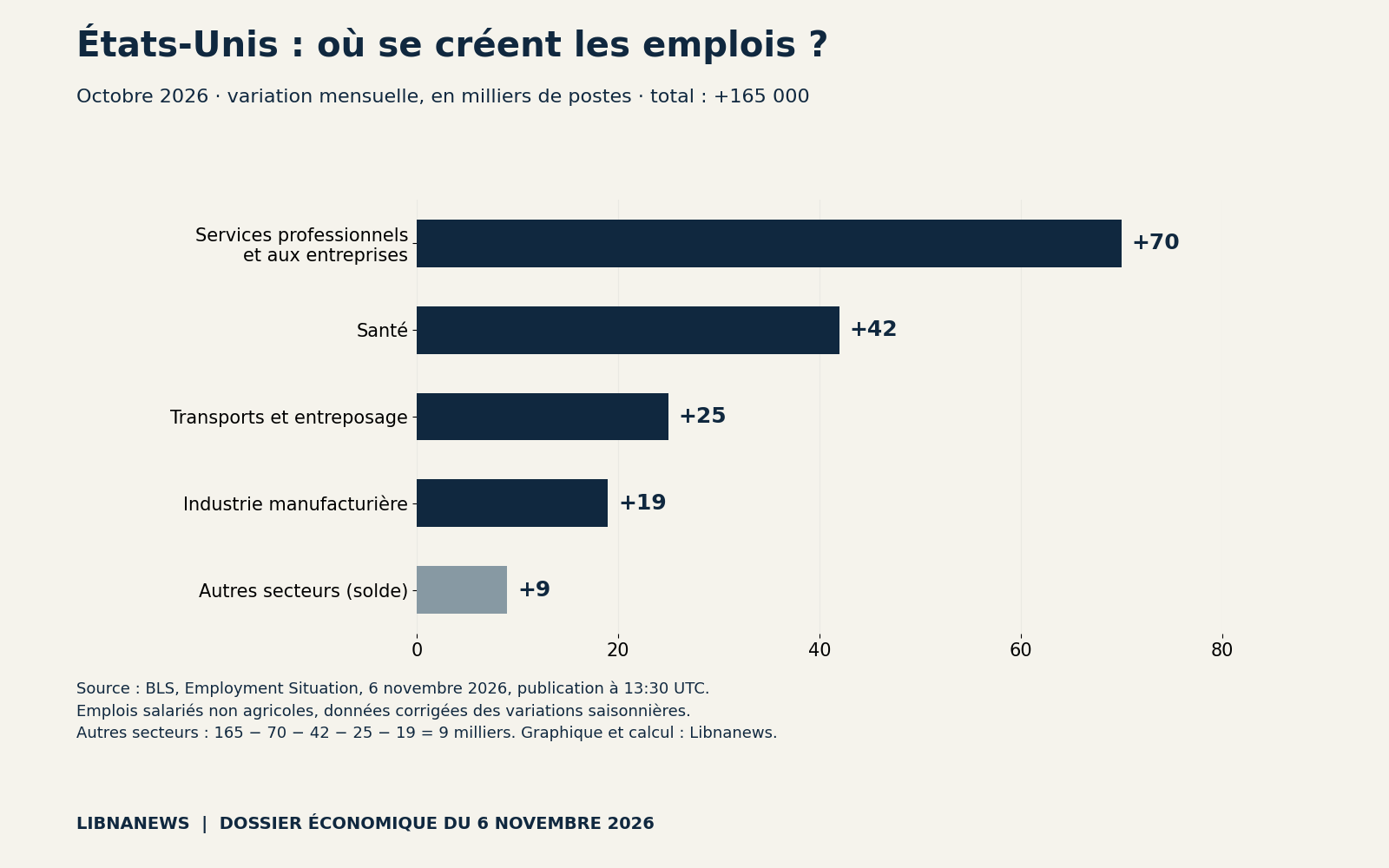
Professional and business services bring 70,000 jobs in October. Health adds 42,000, transportation and storage 25,000. Manufacturing increased by 19,000 jobs. These four categories represent most of the net gain, but they should not be added to their own subsectors, at the risk of having several times the same jobs. Health job creation does not describe, for example, the same economic cycle as orders for industrial equipment.
The average hourly wage for the private sector is $38, up 0.4 per cent over one month and 3.1 per cent over one year. The average weekly time remains at 34.4 hours. In order to assess income from work, it is necessary to examine together hourly remuneration, hours worked and number of persons employed. An increase in hourly wages does not necessarily mean the same increase in monthly income if the volume of work decreases.
The report is also fragile: the number of people working part-time for economic reasons is increasing from 339,000 to 4.8 million. They would like to work full time, but their schedules have been reduced or they have not found such a job. The participation rate was 61.9%, compared with 61.8% the previous month. Thus, only one statistic does not summarize the labour market. The low unemployment rate coexists with incomplete employment situations and large differences between categories of workers.
Finally, job creation and the unemployment rate come from two separate surveys. The first questions institutions; households. Their fields, methods and margins of uncertainty differ. Monthly movements are not required to match exactly. For economic analysis, a series of publications and its revisions are worth more than an isolated reading of the main figure.
Rate and dollar: a solid activity can increase money
A central bank examines employment because it provides information on demand, income and certain production pressures. If households have more regular incomes, they can support consumption. But when inflation remains a concern, it can also reduce the urgency of monetary relaxation. The day’s report alone does not make it possible to announce a Federal Reserve decision: it will also depend on prices, activity and financial conditions.
For markets, this reasoning creates two competing effects. Companies able to sell more can improve their profits. On the other hand, high rates increase the cost of new loans and reduce the present value of expected profits far over time. Today’s profitable companies and those whose most profitability is expected in several years do not therefore have the same sensitivity to a change in the cost of money.
The foreign exchange market transmits part of these differences. Thereference rate of the European Central Bank of 6 Novemberis1 euro for 1.1165 dollars. It is a daily benchmark published for information, not a bank offer or instant quotation. The ECB indicates that the consultation to establish these rates normally takes place at around 14.10 CET, i.e. 13.10 UTC, and does not recommend their use as a transaction price.
For an importer who cashes in dollars and buys in euros, the meaning of this quotation is concrete: a cheaper euro reduces, all things equal, the amount in dollars required for a European settlement. The reverse effect applies to a revenue in euros converted into dollars. Hedging contracts, payment deadlines and intermediary margins may however change the amount finally paid. A reference rate should therefore never be presented as the tariff actually available at the counter.
Oil and gold: market prices, not final invoices
The seriesBrent ICE BRNdisplay$97.40 per barrel (−1.93%), at 20:46:15 in Beirut (18:46:15 UTC). The seriesWTI ICE WBSis tous$ 90.02 per barrel (−1.12%)at 20:44:31 (18:44:31 UTC). Both statements are dated November 6 and distributed late, with no warranty posted. Their variations are calculated against the previous day’s reference.
These pages do not specify the expiry of the oil series. Therefore, values are presented as indicative benchmarks, not as prices of specified delivery contracts. The WTI ICE WBS series is not assimilated here to the NYMEX contract. No price differences between contracts or return on investment are deducted.
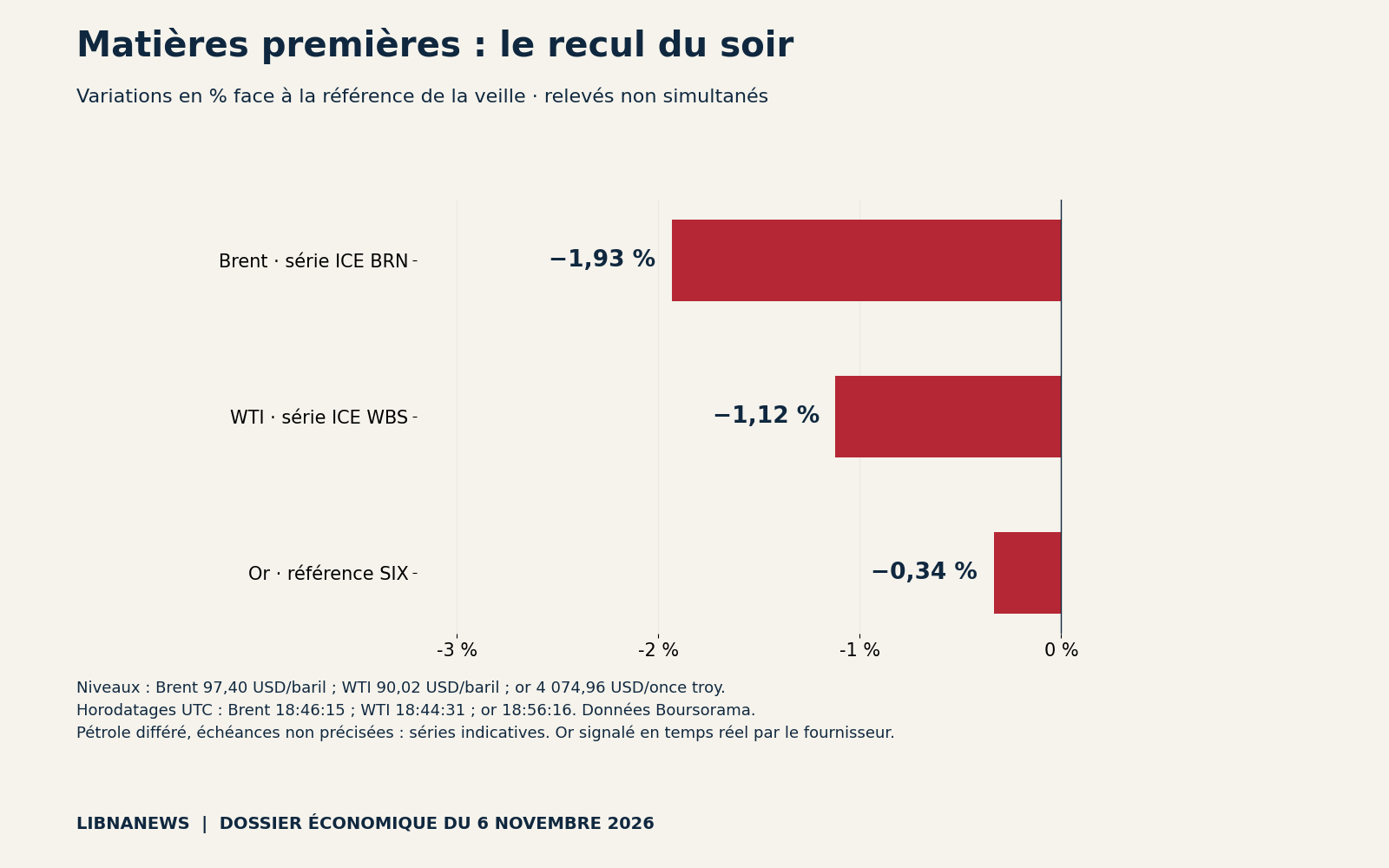
The drop in the barrel observed on Friday comes in a context where markets reassess regional risk. In its6 november analysisReuters links the recent decline in oil to hopes of de-escalation around Iran, while highlighting questions about growth and inflation. Diplomatic anticipation is not a guarantee on production or transport flows. The price may change before a physical modification of the offer is observed.
The price of crude oil also remains a single component of the energy bill. Consumers usually buy a refined, delivered and taxed product. Maritime transport, insurance, refining, storage, distribution and exchange take place between the barrel and the final price. A release of the crude can therefore coexist with a slower reduction in locally sold fuel. A previously purchased stock at a higher price also continues to weigh the average cost of a distributor.
The same precaution applies to airlines. They consume kerosene and may have set the price of part of their purchases in advance using blankets. Their expenses do not instantly follow the Brent, and their bills also depend on the number of flights, distances travelled and the efficiency of the aircraft. The IAG accounts published this Friday make it possible to observe these mechanisms over a quarter, rather than deduct them from a single oil session.
Forgold, SIX reference broadcast by Boursorama, the November 6 reading at 20:56:16 in Beirut (18:56:16 UTC) gives(-0.34%). The supplier describes this flow as real time; It is not a promise of execution at this price. A troy ounce is about 31.1 grams. Variation is established against the previous day’s reference.
Gold should not be read as a single thermometer of anxiety. It pays neither coupon nor dividend: the return on other investments, the movements of the dollar and liquidity needs can influence its demand. Its reputation as a safe haven does not guarantee an increase every time the shares fall. Purchases of jewellery or parts add manufacturing costs, premiums and commercial margins that are not included in the benchmark.
Airbnb: Travel growth remains visible in accounts
In itsresults published on 5 novemberAirbnb announces a quarterly turnover of $4.9 billion, up 19% year-on-year. The gross value of reservations reached $27.7 billion, a 21 per cent increase, while reserved nights and places increased by 16 per cent. The company attributes this to sustained demand and moderately higher average rates.
Net income was $1.9 billion. Adjusted EBITDA, a separate indicator of accounting results, reached 2.5 billion, with a margin of 52%. The Board also authorizes up to $12 billion in additional share buybacks. It is an authorized envelope, not an amount already spent.
These figures illuminate a specific segment of consumption: the reserved stays on this platform. They are not enough to describe the budgets of all households. In order to analyse a tourist company, the comparison between volumes and prices remains essential. A higher recipe may reflect more travel, more expensive stays or a change of clientele. Here, the growth of reservations accompanies the growth of revenues.
IAG: fuel absorbs part of the growth
Air transport shows the other side of this demand. In itsresults of 6 november, IAG has a turnover of €9.744 billion in the third quarter, up 4.5%. But the operating profit before exceptional items fell by 15.9% to 1.726 billion. The corresponding margin increased from 22 per cent to 17.7 per cent.
The group explains this pressure by fuel and operational disturbances. Its fuel bill increases by 30.4 per cent, even after the positive effect of financial hedges. This precision counts: to cover part of its purchases amortizes the variations, without removing energy exposure. The results of a company therefore do not react mechanically to the last daily price of oil.
IAG maintains for 2026 an operating margin target before exceptional items of at least 12 %. This forecast is not an acquired result. The group also reported that its capacity in the Africa, Middle East and South Asia area decreased by 19 per cent in the quarter, with several Gulf destinations no longer served. Reassignment of aircraft can preserve revenues, but it requires rebuilding programs and sales.
IREN: Real AI income, a still constrained calendar
Thecommuniqué of 5 Novembermakes it possible to distinguish growth and promises. In the quarter ended September 30, the first quarter of its fiscal year 2027, the company generated $228 million in revenues, of which $200 million was in its cloud business for the AI. It remains in deficit: the net loss is 263 million, despite a positive adjusted EBITDA of 66 million.
The target of more than $4 billion in annualized revenues in the run-up to the end of 2026 is now set for January 2027, with a possible extension to the end of February. IREN invokes a change requested by a customer and supplier deadlines. This ARR is an operating indicator based on price and usage assumptions, not an annual turnover already achieved.
For its overall programme, IREN is still planning $15 billion in investments: 9 billion in cash, committed financing and prepayments are identified, and 6 billion are still being sought. The ARR target of over 4 billion is presented as financed, subject to conditions. These two perimeters must be distinguished.
NuScale: industrial time behind energy promise
The electrical needs of digital infrastructure draw attention to modular nuclear power. In itsquarterly point of 5 november, NuScale announces that it has signed an agreement with Doosan Energility to manufacture the upper part of the cooling circuit of its nuclear module. This stage concerns an industrial component. It does not mean that a power plant already produces electricity or that a customer immediately has a new power supply.
The company has short- and long-term cash and investments of $1.9 billion as of September 30th. It also explains the decline in its quarterly revenues by the end of the engineering work associated with the Romanian RoPower project in 2025. A completed study contract and future equipment delivery are at different stages of the business cycle.
To assess this sector, you must follow authorizations, firm orders, construction costs and delivery dates. Making a component reduces certain technical risks; it does not automatically regulate the financing of a whole project. The industrial calendar thus remains a central element of the analysis, beyond the announcements on future energy demand.
Lebanon: tracking imported costs and money actually mobilized
For Lebanon, international variations mainly depend on their transmission channels. Lower-cost imported fuel can reduce some transport and production costs, but the benefit depends on the rate of impact in local prices. More expensive global financing can, on the other hand, complicate investment even when its equipment becomes cheaper. Both movements can occur simultaneously.
This reading requires separating several realities: price in dollars, possible conversion into books, settlement conditions and effective access to financing. A drop in oil does not automatically resolve the difficulties of a household or company that lacks liquidity. Similarly, displaying a stable price in a currency is not enough to measure its accessibility: it must be linked to the buyer’s income and method of payment.
Reconstruction provides another example of this necessary precision. Theregister of the Development and Reconstruction Councilclassifies the Nabatiyé Road Clearing and Rehabilitation Contract, LEAP Program File 1250, as assigned. The card mentions World Bank financing and a notification dated 9 October. These elements, discussed inour follow-up published this fridayestablish an administrative stage. They do not constitute a balance sheet of work received in November.
Moving from advertising to economic activity requires disbursements, supplies, teams and verifiable execution. An enterprise may have a contract without having yet received all the necessary payments; a site can progress without each step being immediately documented online. The useful follow-up is to bring decisions, timetables and achievements closer together, without turning the absence of a public exhibit into evidence of cessation.
No recent Beirut Stock Exchange prices or sufficiently documented local fuel prices are included here. Their absence is preferable to the presentation of an old rating as a figure of the day. The global benchmarks of this edition shed light on external constraints; they do not replace a measure of the conditions actually encountered in Lebanon.
What to check after rebound
Three questions will guide future market points. First, will the resumption of technological values extend beyond the titles that had fallen the most? Secondly, will the new statistics confirm the resistance of employment without a lasting acceleration of price pressures? Finally, can companies that are very committed to infrastructure turn their orders and objectives into revenue without degrade their financing?
These questions require separate comments. The U.S. closure will bring a more complete sitting statement, future economic publications will clarify the trend and business accounts will track margins and cash flow. For the time being, the verified data show a still job-creating U.S. economy, partial rebound technology and declining oil in evening readings. They do not lead to the conclusion that uncertainties over rates, energy or investment have been removed.





Comments