

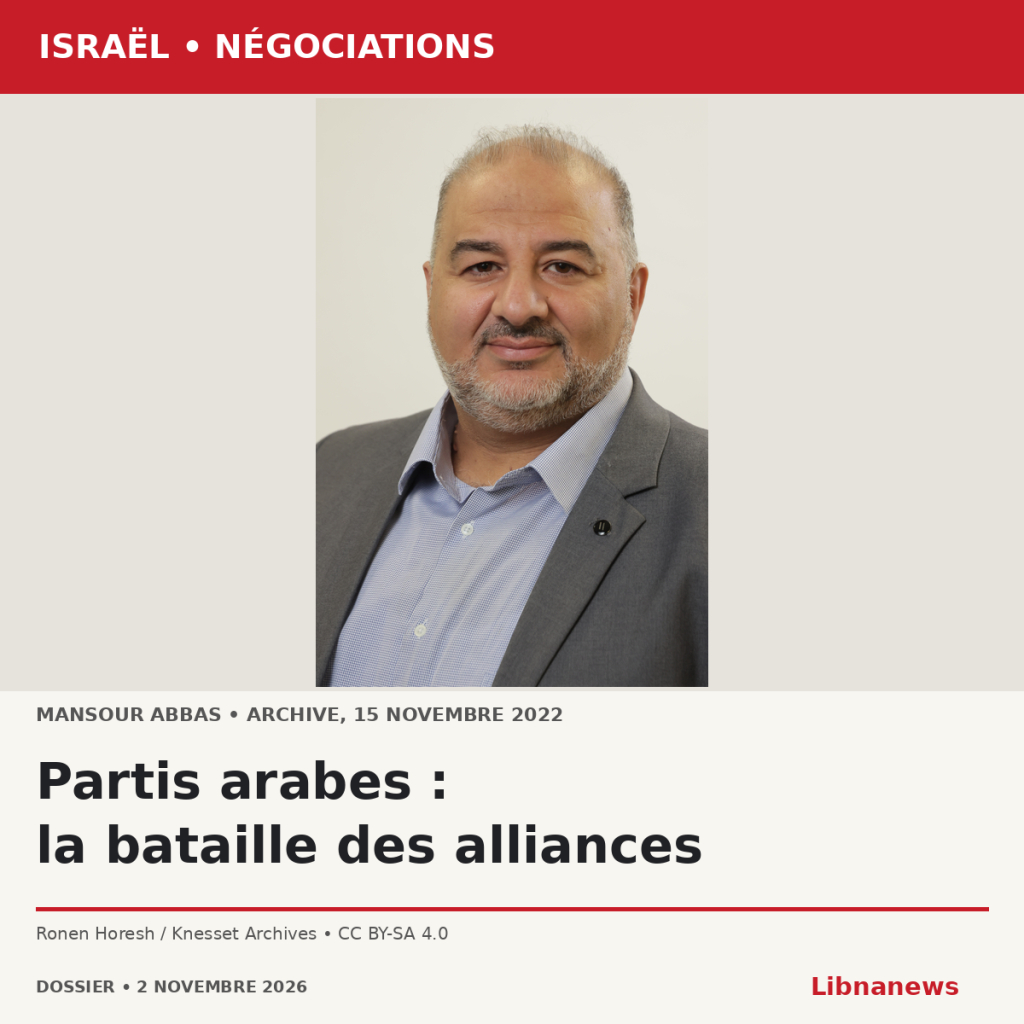
The Arab parties occupy a central place in the negotiations opened after the Israeli elections on 27 October. With 19 deputies, they could allow Benjamin Netanyahu’s opponents to exceed the absolute majority. But their participation in power remains contested by several officials of the same opposition. Trade on Sunday 1 November has not yet reached agreement.
Arab parties have 19 seats
The count allocated 11 seats to the Common List and 8 to Rasam, led by Mansour Abbas. Together, these formations almost double their previous representation, which had ten deputies. However, they are not a single party and should not be confused in negotiations.
In front of them, the Netanyahu block has 53 seats. The four opposition groups total 48. The 19 Arab elected representatives thus represent a sufficient reserve of support, on an arithmetical level, to give a majority to the Prime Minister’s opponents. The political agreement remains to be built.
On Sunday, Yair Golan, leader of the Democrats, exchanged with Yousef Jabareen and Ahmad Tibi, responsible for the Common List. According to the Israeli press, the interlocutors are scheduled to meet this week. Golan had also met Mansour Abbas after the election. It defends a coalition of Jewish opposition groups and Arab parties.
Three forms of support, three different commitments
Discussions can lead to several types of cooperation. A recommendation to President Isaac Herzog would support the appointment of Gadi Eisenkot. Participation in the government would require a broader agreement. External parliamentary support would support certain votes without holding a ministerial portfolio.
Neither of these formulas is automatically deduced from the other two. Parties can share the goal of replacing Netanyahu without accepting the same government commitments. A favourable recommendation does not regulate the terms of a nomination or the negotiations on the programme.
It already has experience of participating in a coalition. In 2021 the party joined the government led successively by Naftali Bennett and Yair Lapid. This alliance ended in 2022. This precedent establishes that cooperation exists in recent history; it does not guarantee its reproduction after the vote of 2026.
The conditions of Eisenkot remain a point of friction
On Saturday 31 October, Eisenkot proposed an opening to elected officials accepting four principles. In particular, it calls for a commitment to a Jewish, democratic, liberal and egalitarian state. He also demanded military, national or civilian service for all citizens.
Its framework includes the recognition of Hamas as a terrorist organization, as well as the destruction of its military and governmental capabilities in Gaza. These requirements illustrate the distance between a convergence against Netanyahu and a common program. No compromise published at this stage allows this distance to be regarded as crossed.
The challenge also concerns the legitimacy of the election. Netanyahu challenged the vote in Arab localities. On Sunday, the election authorities claimed that the charges examined would not call into question the results. An investigation does not prove the allegations and should not be presented as an established fraud.
The next concrete step remains the consultation of the parties by Herzog, scheduled from 4 November. It will distinguish formal recommendations from reported intentions. Commitments for possible participation in government will then need to be discussed separately.





Comments