

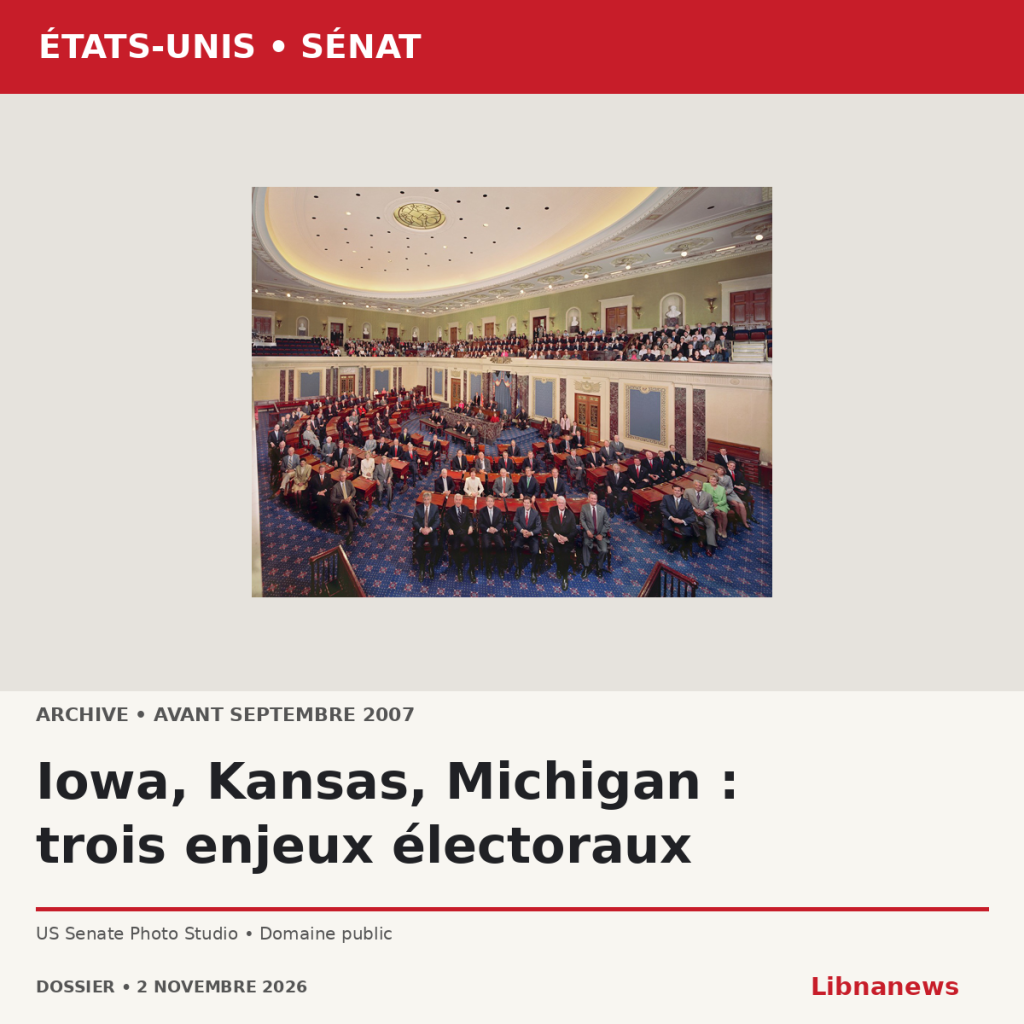
On the eve of the November 3 elections, the battle of the U.S. Senate overflows the usual terrain. Donald Trump campaigned Sunday in Iowa and Kansas. In Michigan, a break between Democrats complicates the defence of an open seat. These States illustrate three priorities: conquer, conserve and avoid losses.
The presidential movements of 1 November underline the importance attached to the protection of Republican positions. However, they do not allow the result of the vote to be deduced. A campaign stage indicates a political priority, not the choice of voters.
American Senate: Each seat counts in the same way
The Senate currently has 53 Republicans, 45 Democrats and two independents. The latter sit with the Democrats. The Democratic Camp must therefore achieve a net gain of four seats to reach 51 elected. Three gains would not be enough to ensure control: on an equal basis, the Vice-President can split the votes.
This arithmetic gives the same parliamentary value to a victory in Kansas and a victory in a much more populated state. Each State has two senators. But not all seats are renewed simultaneously. The term of office lasts six years and approximately one third of the Senate passes before the electors every two years.
Therefore, the Senate card does not reproduce that of a presidential. It depends on the seats actually renewed, the departures of the outgoings and the candidates chosen. A party can win a state while losing elsewhere a seat it needed to change the majority.
In Iowa, a succession rather than a re-election
In particular, the election contrasts Republican Ashley Hinson with Democrat Josh Turek. Libertarian Thomas Laehn is also on the official list of candidates. Voters must appoint a senator for a six-year term.
Joni Ernst’s departure explains this configuration. The Republican senator announced in September 2025 that she would not seek a new term. His party therefore defended a seat without presenting its holder. For the Democrats, on the contrary, it is a possibility of conquest.
Iowa also renews its four seats in the House of Representatives and elects its governor. These elections share the same date, but their results will remain separate. A senatorial victory would not automatically transfer other mandates to the same party. The presence of several important elections also renders imprudent any shorthand between the observed mobilization and the choice of voters for the Senate.
In Kansas, one exiter against an atypical candidate
Roger Marshall is trying to keep his mandate. The official results of the primary schools confirm his nomination by the Republicans and that of Adam Hamilton by the Democrats. Unlike Iowa, the presidential party can here rely on an outgoing senator.
Hamilton, Methodist pastor, presents an unusual profile in this national competition. Its religious establishment gives it visibility that goes beyond partisan structures. However, it does not prejudge the vote of the faithful. The Kansas has not elected a Democratic Senator since 1932: a victory would therefore be a historical break, not the mere repetition of a regular alternation.
Michigan, a democratic seat to protect
Michigan is not a new disputed electoral ground. His interest here lies in the opposite risk of the Iowa: the Democrats defend the siege of Gary Peters, who does not represent himself. Abdul El-Sayed faces Republican Mike Rogers.
On November 1, Haley Stevens, defeated by El-Sayed at the Democratic Elementary, announced his support for Rogers. This break does not allow us to measure how many voters would change sides. However, it exposes a division to two days of voting.
The three races must thus be read together, without confusing them. A loss in Michigan would force Democrats to compensate elsewhere before even increasing their total. The November 3 ballots will determine whether their possibilities of conquest exceed their vulnerabilities.





Comments