Lebanese tourism enters the summer of 2026 with a deeper question than immediate cancellations: has the sector become too vulnerable to crises to remain one of the pillars of the national economy? The war, the strikes in the South, the uncertainty about the airport, the consular warnings and the caution of the airlines have already compromised part of the season. But the problem goes beyond the economic situation. For years, Lebanon has depended on a short window, focusing on a few weeks of summer, strongly linked to the diaspora, Gulf visitors, weddings, festivals and foreign exchange spending. Each regional shock therefore threatens the entire chain.
The fragility of Lebanese tourism is not new. It only got worse. The sector survived the banking collapse, the pandemic, the port explosion, political crises, tensions with the Gulf countries and successive wars. It has shown a remarkable rebound capacity, but this resilience often relies on improvisation, cash payments, family networks and the emotional attachment of the diaspora. It is not yet based on a protection strategy. The country still attracts. He’s less reassured. It is this difference that now threatens the ability of tourism to remain a stable driver of foreign exchange, jobs and local activity.
A dangerous dependence on short seasons
The Lebanese tourism model is based on a high temporal concentration. June, July and August concentrate a significant part of arrivals, marriages, family stays, festivals, restaurant reservations, car rentals and stays in hotels or guest houses. This seasonality has long been an advantage. It allowed the country to quickly capture currencies and support thousands of temporary jobs. Today it becomes a major weakness. A crisis that erupts in May or June can erase most of the tourist year before the start of the peak.
This dependency makes professionals highly exposed to the safe schedule. A hotel can prepare for months, hire, renovate, negotiate with agencies, and then lose bookings in a few days. A restaurant can order, train a team, organize evenings, and then drastically reduce its stocks. A festival can sell tickets, hire artists and providers, and then postpone or cancel for security reasons. Tourism does not like uncertainty. However, Lebanon lives in almost permanent uncertainty.
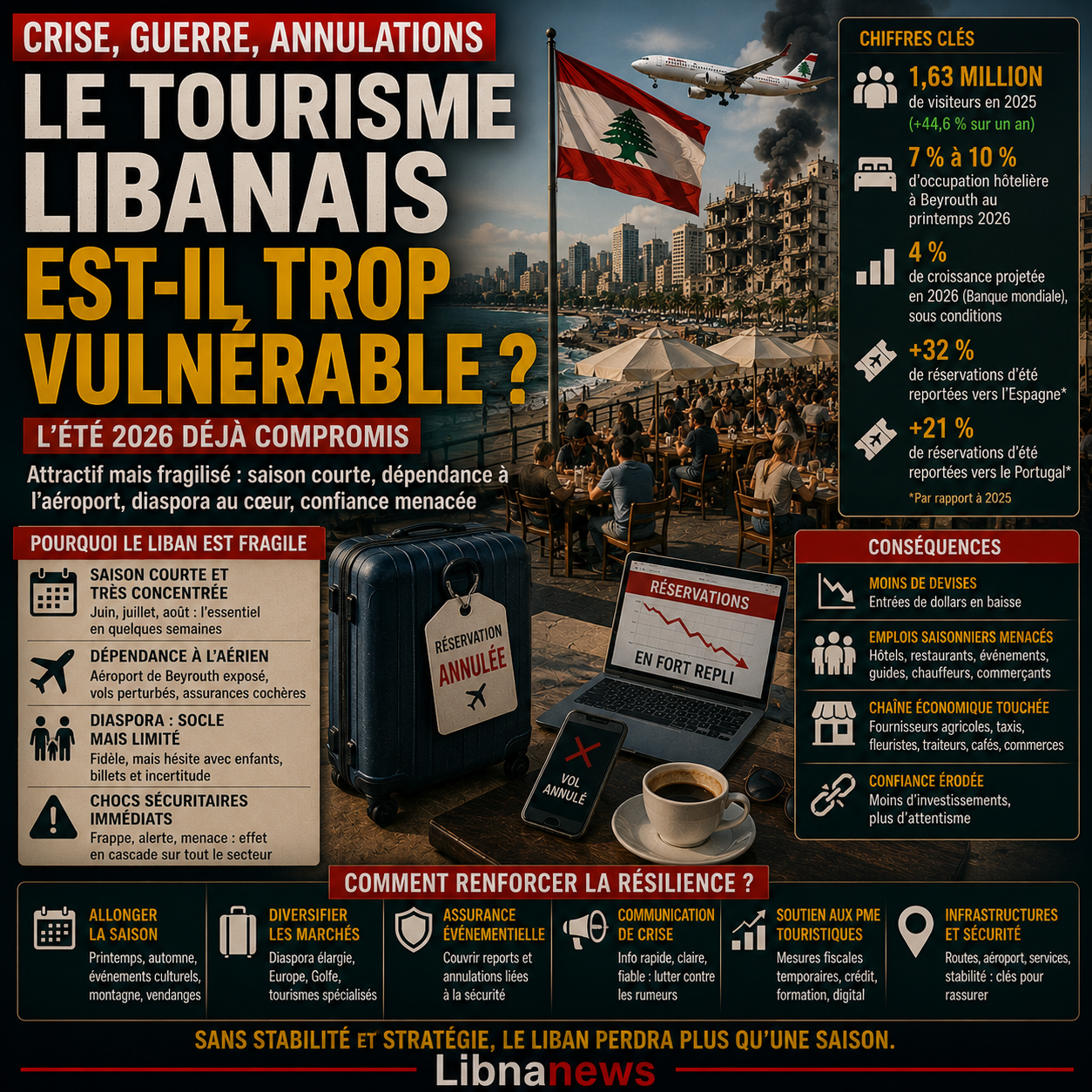
The rebound of 2025 showed the potential of the sector. More than 1.63 million visitors were registered, with an increase of 44.6 per cent over one year according to data from the Lebanese economic press. The World Bank has also integrated tourism among the drivers of the country’s fragile recovery, along with diaspora transfers and early signs of macroeconomic stabilization. But this rebound had a flaw: it remained dependent on a calm security environment. The war of 2026 showed that this condition could disappear very quickly.
Figures that summarize fragility
| Indicator | Level or evolution | Sectoral reading |
|---|---|---|
| Visitors in 2025 | More than 1.63 million | Real rebond, but dependent on stability |
| Annual increase in 2025 | +44,6 % | Recovery effect after several years of crisis |
| Hotel occupancy in Beirut in spring 2026 | About 7% to 10%, sometimes 12% | Climbing of confidence before summer |
| Lebanese growth projected in 2026 | 4 % under conditions | Tourism remains an engine, but only if stability holds |
| Reorientation of reservations to Spain | +32 % for summer flights | Regional crises benefit destinations perceived as safe |
| Reorientation of reservations to Portugal | +21 % for summer flights | The demand does not disappear, it moves |
These figures show a simple reality. The problem is not Lebanon’s lack of attractiveness. The problem is the conversion of this attraction into firm reservations. The country remains desired, especially by its diaspora. It remains associated with gastronomy, nightlife, mountain, sea, villages, heritage and family ties. However, for the foreign traveller or for the expatriate family with children, the safety criterion prevails. When the risk seems too high, demand does not always evaporate. It refers to other Mediterranean countries.
This displacement is one of the most serious threats. Tourism professionals like to believe that visitors only postpone their trip to Lebanon. Sometimes it’s true. But some of them choose another destination, discover other circuits, create new habits and do not come back immediately. Spain, Portugal, Greece, Cyprus, Turkey or Jordan can absorb this demand with more predictable infrastructure, simpler insurance and less exposed flights. Lebanon therefore not only loses nights in a hotel. He loses loyalty.
The diaspora, a solid but insufficient foundation
The diaspora remains the main shock absorber. Lebanese from abroad come for their families, homes, marriages, approaches and attachment to the country. They often accept a higher level of risk than foreign visitors. They are familiar with neighbourhoods, roads, local habits and phases of tension. Their presence supports restaurants, shops, car rentals, private services, summer schools, family holidays and part of seasonal real estate. Without it, Lebanese tourism would be much more vulnerable.
But this addiction has its limits. The diaspora is not a block. Young families living in Europe, North America, the Gulf or Africa arbitrate according to leave, tickets, insurance, aviation safety and professional obligations. They may want to come and give up if the return seems uncertain. They can shorten the stay. They can send only one family member. They can replace Beirut with Cyprus or Athens and keep Lebanon for another year. Emotional attachment is not enough to deal with the risk of being stuck in a country at war.
The diaspora also does not fill the sector in the same way as international tourists. Many live with relatives or in family apartments. They spend heavily on restaurants, outings, gifts, services and private events, but they do not always compensate for the decline in groups, Gulf visitors or foreign travellers. High-end hotels, guides, agencies, cultural circuits and certain seaside establishments are more dependent on external customers. A model focused almost exclusively on the diaspora protects from total collapse. It limits growth.
Safe shocks break the whole chain
Every security crisis has a cascade effect. A strike in the South or Beirut leads to embassy alerts. Alerts result in flight delays or insurance concerns. Travellers cancel. Hotels lose their bookings. Restaurants reduce their stocks. Event companies lose contracts. Drivers, caterers, photographers, florists, musicians and technicians are down. Agricultural suppliers sell less. Students lose seasonal jobs. A military crisis quickly became a social crisis.
Rafic Hariri International Airport focuses on this vulnerability. It remains the main gateway to the country. When its safety is discussed, the whole sector trembles. Even if flights continue, concern is enough to change decisions. A traveller who fears a flight suspension or an airspace closure may cancel without delay. A company that changes its schedules creates a negative signal. A safety audit, even to reassure, recalls that the risk exists. Tourism starts before the visitor arrives. It begins in the perception of the road to the country.
The northern Qolayaat project shows that access diversification becomes a strategic topic. A second airport can reduce dependency in Beirut, secure some connections, support northern tourism and reassure some travellers. But it won’t be enough. An airport needs companies, insurance, roads, services, controls and an image. Lebanon ‘ s tourism vulnerability will not be addressed by a single infrastructure. It requires a risk management policy.
Local tourism, diaspora and foreign visitors
Lebanon must distinguish three clienteles. The first one is local. It includes Lebanese who travel inside the country, frequent beaches, mountains, restaurants, festivals, wine estates, guest houses and villages. This clientele can support regions when foreigners retire. However, it remains limited by lower purchasing power, fuel costs, lack of credit and uncertainty. It does not replace visitors’ expenses in foreign currency.
The second customer is diasporic. She is the most faithful, but she reacts to family risks. It can be encouraged by flexible offers, flight guarantees, reliable information and continued events. She needs trust, no slogans. Professionals must offer them cancellation conditions, flexible bookings, adapted insurance and circuits that avoid risk areas. The diaspora can save some of the difficult seasons if it believes that the country remains practicable.
The third customer is foreign. It is the most volatile but also the most strategic for diversification. It includes Gulf visitors, Europeans, Americans, cultural groups, business travelers, food lovers, heritage and mountain enthusiasts. This customer base requires more visible security, professional international communication, stable flights, simple insurance and reliable services. To win it back, Lebanon must stop relying only on its charm. It must build a reputation for managed destination, even in an unstable regional environment.
Resilience paths
The first track is the lengthening of the season. Lebanon can no longer concentrate as much activity on eight to ten weeks of summer. Spring and autumn must become true tourist seasons, with cultural, gastronomic, sporting and rural offers. Harvesting, hiking, village festivals, religious tours, mountains, remote work trips and professional events can distribute income. A longer season reduces the destructive effect of a shock in June. It also allows for more regular use and smoothing costs.
The second track is domestic tourism. It should not be treated as a secondary solution. In times of regional tension, foreign visitors retire faster. Lebanese residents can then maintain a minimum level of activity in relatively quiet areas. This requires suitable prices, transport, family offers, off-season discounts and coordinated promotion of local destinations. Domestic tourism will not replace foreign currency, but it can avoid the complete stop of some guest houses, restaurants and guides.
The third track is event insurance. Weddings, concerts, congresses and festivals account for a significant share of summer income. They are also the most vulnerable to cancellations. Lebanon should develop, together with local and international insurers, mechanisms covering security, flight or official alert carry-overs. These products will be expensive initially. However, they can allow organizers to take calculated risks rather than cancel preventively. Without confidence, uncertainty becomes paralysis.
The fourth line is crisis communication. Authorities and professionals must speak quickly, clearly and without contradiction. Visitors need to know what flights work, which roads are open, which areas are not recommended, what events are maintained and what procedures to follow in case of emergency. In the absence of a reliable voice, social networks decide. A video out of context can ruin a week of reservations. The country must have a tourist communication centre in times of crisis, connected to the airport, ministries, trade unions and municipalities.
Diversifying markets without dispersing
Market diversification is necessary, but it must remain realistic. Lebanon cannot replace visitors to the Gulf or expatriates overnight with distant markets. However, it can target segments less sensitive to certain crises: religious tourism, extended diaspora tourism, gastronomy, culture, telework, private health, short education, mountain tours and regional business events where security permits. Each segment must be worked out with specific offers. Too often the country has sold a general image without a structured product.
Arab countries remain essential. Warming up with Riyadh, resumption of exports and discussions on reconstruction can help improve perception. But visitors to the Gulf will only return for a long time if security, airport, services and political relations stabilize. The confidence of the Gulf has been undermined by diplomatic tensions, drug trafficking, the perception of Hezbollah’s influence and repeated wars. The win will be slow. It must be supported by concrete measures, not just promotional campaigns.
European markets can be developed around heritage, gastronomy, hiking, wine, design, music and urban tourism. But they are very sensitive to official alerts. As long as several chanceries advise against travel, tour operators hesitate. Lebanon must therefore also work with issuing governments, insurers and airlines. Modern tourism depends as much on diplomacy as on hotels. A destination perceived as risky must produce more guarantees than others.
Rethinking the role of the State
The Lebanese state has often left tourism with private sector energy. This energy remains remarkable. Restaurateurs, hoteliers, guides, organizers of events, guest houses and municipalities maintained an offer despite the collapse of public services. But this private force is no longer enough. Security crises require national coordination. The state must protect the airport, improve roads, support municipalities, publish reliable information, negotiate with airlines, facilitate insurance and accompany companies in times of massive cancellation.
Temporary tax measures can help. A reduction in certain charges, a deferral of local taxes, facilities for events, guaranteed credit mechanisms or targeted aid to small tourist enterprises may limit bankruptcies. But support must be conditional on transparency and employment. The country cannot afford a massive plan. However, it can prevent small structures from disappearing in each crisis. Guest houses, family restaurants, independent guides and event providers are the most vulnerable fabric.
The state must also produce data. Lebanese tourism suffers from a lack of rapid, reliable and public statistics. Arrivals, occupancy rates, cancellations, expenses, original markets, jobs and losses must be monitored in real time. Without data, decisions are made from impressions. Professionals need indicators to adjust their prices, hirings and campaigns. Donors need figures to support the sector. Resilience begins with measurement.
A structural vulnerability
Lebanese tourism has become too vulnerable to crises because its model is based on three simultaneous frailties: a short season, air dependence and unstable political confidence. Each of these frailties could be managed separately. Together, they make the sector extremely exposed. The country can be attractive, affordable for some visitors, culturally rich and supported by its diaspora. However, he can lose his season in a few days if security changes. This contradiction has become the core of the problem.
The regional ceasefire can provide breathing. It can save part of the summer, reassure the diaspora and maintain certain events. It is not enough to address vulnerability. Even a good end of season should not mask the urgency of a reform of the tourism model. Lebanon must prepare to live in a sustainable and unstable regional environment. He cannot wait for a perfect peace to organize his resilience. It must learn how to protect its seasons, distribute its markets, cover its events, talk to travellers and support its businesses.
The answer will be in the coming months. If the 2026 season is treated as an isolated accident, the area will return to its habits from the first lull. If it is understood as a warning, it can be used as a turning point. Lebanese tourism still has a powerful capital: desire, memory, diaspora, landscapes, gastronomy, culture and hospitality. But this capital is no longer enough. It must be protected by policies, insurance, data, infrastructure and reliable communication. There are many tourist attractions in the country. It lacks a system capable of preventing every crisis from resetting everything to zero.