





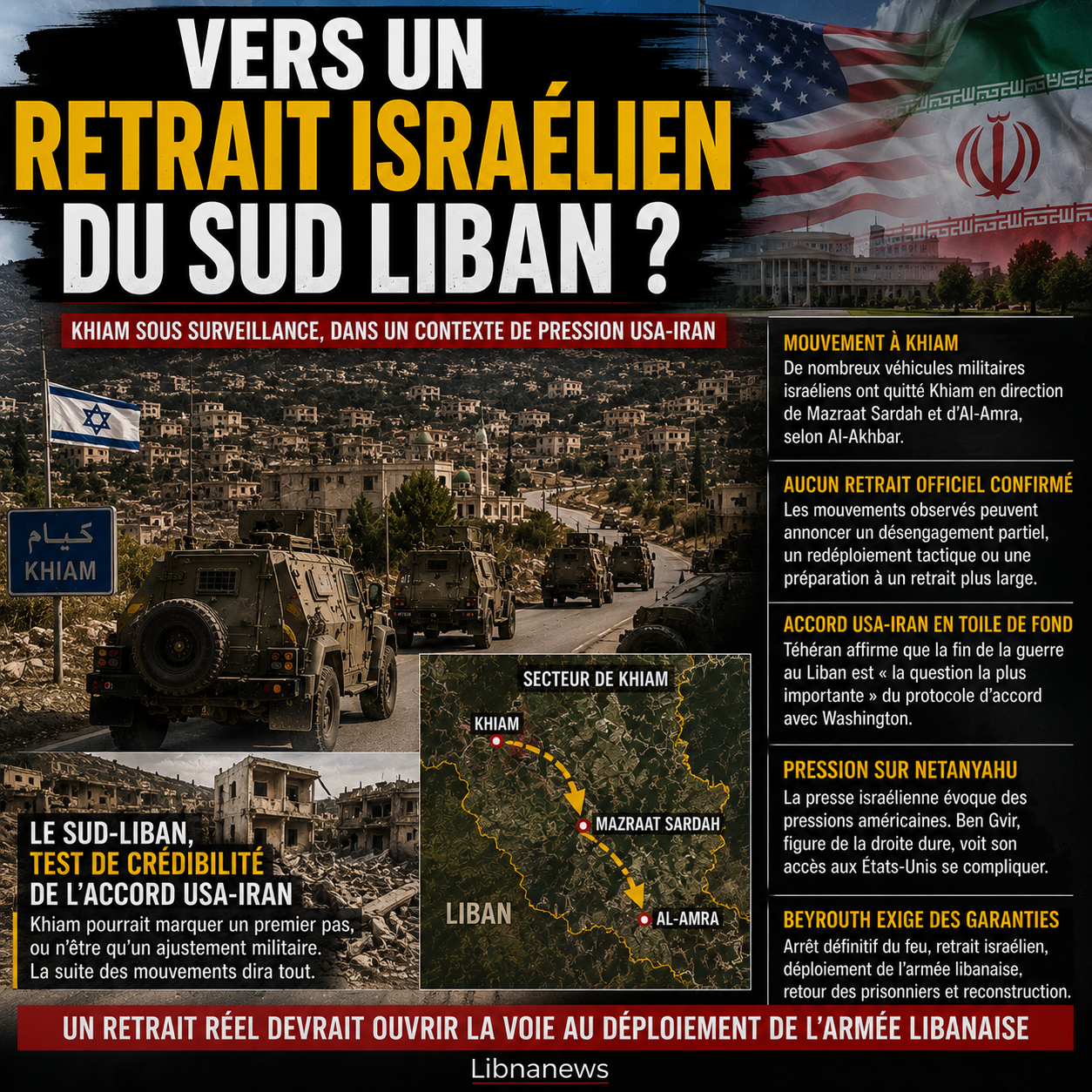
The movement reported on Tuesday around Khiam revives a central question: has Israel started to alleviate its system in South Lebanon, or is it only a tactical redeployment before a new phase of military pressure? According to the correspondent of Al-Akhbar, a significant number of Israeli military vehicles withdrew from the city of Khiam towards Mazraat Sardah and the area of Al-Amra, south of the town. The withdrawal comes in a context of strong diplomatic pressure, after the agreement between Washington and Tehran, which Iran now presents as explicitly including the end of the war in Lebanon.
No official Israeli announcement confirmed a general withdrawal. Caution is therefore required. Vehicle movements in a city as sensitive as Khiam can announce partial disengagement, rotation of units, consolidation of rear lines or preparation for wider withdrawal. But their political significance is important. Khiam was one of the most exposed points on the southern front. An Israeli relief in this area would be observed as a first test of the American-Iranian agreement and Tehran’s ability to impose the Lebanese issue in negotiations with Washington.
Khiam, first signal or simple redeployment?
The movement reported to Khiam comes at a time when the Israeli press has for several days been talking about an arm of iron between American demands, the Iranian position and the security imperatives displayed by the Netanyahu government. According to reports from Israeli media, one of the central questions is whether Iran will succeed in making the Israeli withdrawal from southern Lebanon a political condition of the memorandum with the United States.
This question is not theoretical. Iranian Foreign Minister Abbas Araghchi said on Tuesday that the end of the war in Lebanon was « the most important issue » in the Memorandum of Understanding with Washington. According to him, the text provides for the announcement of an immediate and permanent cessation of war on all fronts, including Lebanon. This wording reinforces the pressure on Israel. It places South Lebanon at the heart of an agreement that no longer concerns only Iranian nuclear power, sanctions or the Strait of Ormuz.
In this sequence, the movement of vehicles outside Khiam can be read in two ways. The first sees a signal of withdrawal, even limited, under diplomatic pressure. The second sees it as a simple military manoeuvre designed to reposition forces in more favourable areas, without abandoning the logic of Israeli presence in Lebanon. The next few hours should make it possible to distinguish these two readings: whether or not to maintain the points of occupation, whether to continue or stop the strikes, whether to enter the Lebanese army, and whether to evolve on other axes of the front.
Israeli press describes real pressure
Contrary to the image of a completely free Israeli position, several elements reported in the Israeli press show that the Netanyahu government is under pressure. Israeli media reported a debate on a demand for complete withdrawal from Lebanon in the framework of the American-Iranian agreement. Others point out that the Prime Minister and his defence minister want to maintain « safe areas » in Lebanon, Gaza and Syria, but that this line is facing growing US pressure.
This pressure is not only military or diplomatic. It also affects the Israeli coalition. The hard right rejects any agreement perceived as limiting Israel’s freedom of action. Itamar Ben Gvir called Netanyahu to say « no » to Donald Trump about the ceasefire in Lebanon. He also had to cancel a trip to the United States on the grounds of visa difficulties, an episode interpreted in the Israeli debate as a new sign of tension between Washington and the most radical figures in the Israeli government.
This visa file is not sufficient to demonstrate a direct sanction linked to Lebanon. But politically, it counts. Ben Gvir is the toughest wing in the coalition. The fact that its access to the United States has become problematic, at a time when Washington is pushing to contain the regional escalation, is fuelling the idea of cooling with ministers who refuse any concessions. This also reinforces the American margin of pressure on Netanyahu, already caught between his electorate, his far right allies and the agreement with Tehran.
Netanyahu promises to stay, but the land is moving
Officially, Israel continues to display a firm line. Benjamin Netanyahu and his defence minister, Israel Katz, said the army would remain in the safe areas for as long as necessary. Katz described these areas as essential to protect borders and prevent Hezbollah from rebuilding its infrastructure in northern Israel. This position is intended to reassure Israeli residents displaced or threatened by firing from Lebanon.
But this line has a political and strategic cost. The more Israel maintains forces in southern Lebanon, the more Hezbollah finds the argument of occupation. This presence also complicates the position of the Lebanese government, which calls for a permanent cessation of fire, the Israeli withdrawal from the occupied sectors, the deployment of the Lebanese army to international borders, the return of prisoners and reconstruction. An Israeli withdrawal would allow Beirut to put the army back at the centre of the arrangement. A prolonged retention gives Hezbollah a justification that it can exploit in the internal debate.
The Israeli press also notes a strategic impasse. Israel has achieved significant military gains against Hezbollah and Iranian relays. But the agreement with Iran, negotiated without Israel’s direct involvement, now limits its ability to turn these gains into a lasting political outcome. The Israeli government wants to prevent Hezbollah from running for victory. But he must also avoid being isolated from Washington, which seeks to stabilize all fronts.
Iran wants to make Lebanon the test of the agreement
For Tehran, Lebanon has become the main credibility test of the memorandum with Washington. Abbas Araghchi said that the permanent cessation of the war must concern all fronts, « including Lebanon ». The main Iranian negotiator, Mohammad Baqer Qalibaf, also stated in an interview with Nabih Berri that Israel should withdraw from the occupied areas and allow the inhabitants of the South to return home.
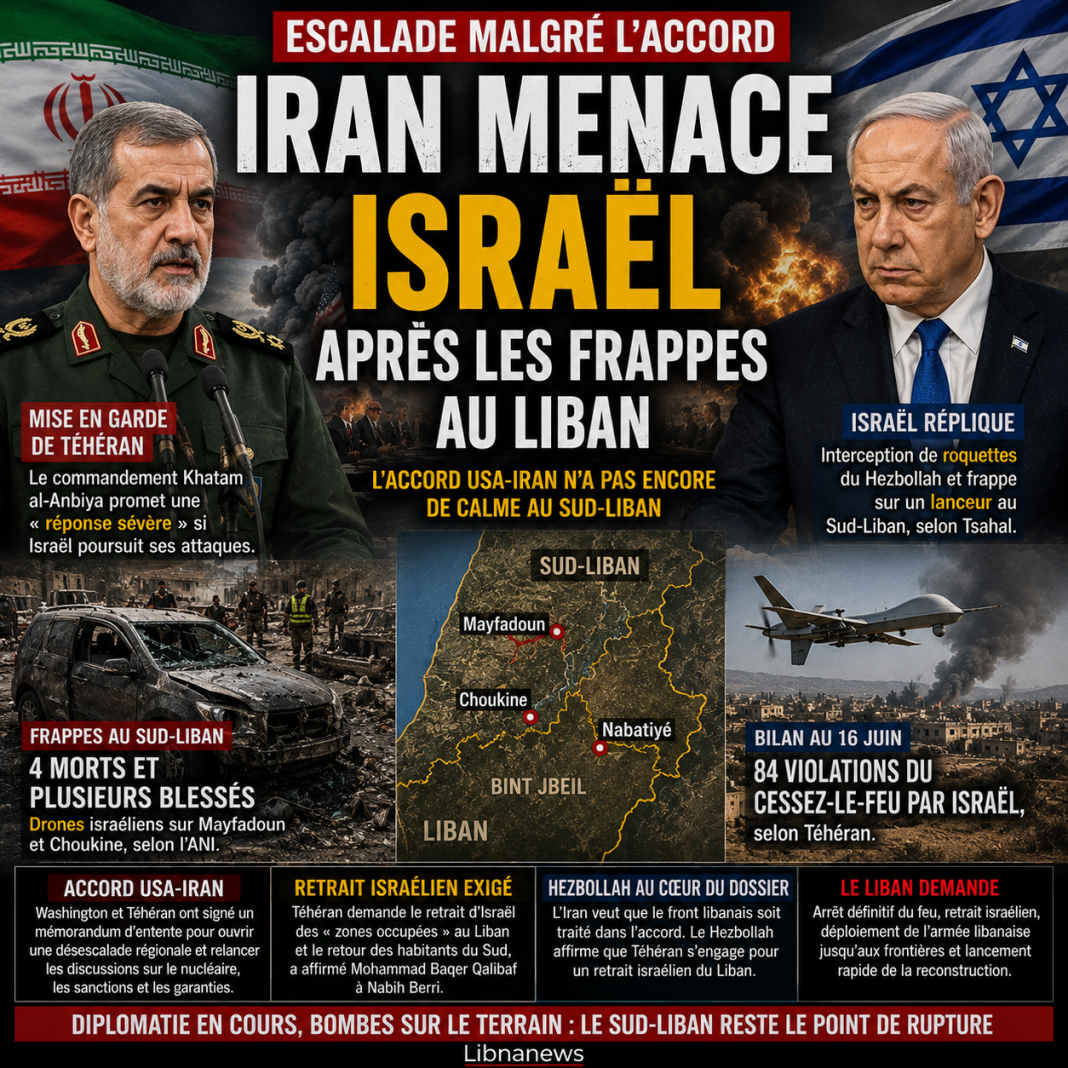
At the same time, the Iranian army threatened Israel with a « severe response » after further strikes in southern Lebanon. According to a count quoted by Iranian state television, Israel had violated the ceasefire in Lebanon on 84 occasions since the announcement of the agreement. This rhetoric is intended to show that Tehran does not regard Lebanon as a secondary issue. It also aims at politically protecting Hezbollah, which is a part of the regional power balance.
For Hezbollah, the stake is clear. If Iran gets an Israeli withdrawal, the movement can say that its front has weighed in the negotiations. If Israel stays, it can maintain that its weapons remain necessary in the face of occupation. In both cases, the Israeli refusal to withdraw politically reinforces Hezbollah. This is precisely the paradox facing the Lebanese sovereignist camp: the pressure to disarm the party becomes more difficult as long as the Israeli army retains positions in Lebanon.
Khiam signal under surveillance
The withdrawal reported in Khiam should therefore be monitored as an indicator, not as a conclusion. In order for this to be an early withdrawal, several elements will have to follow. There will be a sustained decline in Israeli forces outside urban areas, the lack of replacement by new units, the cessation of destruction operations, the reduction of air strikes and the opening of space for the deployment of the Lebanese army. Without these signs, the movement will remain a local redeployment.
The direction taken by the vehicles is also significant. A trip to Mazraat Sardah and Al-Amra may be a distance from the heart of Khiam, but not necessarily a departure from Lebanese territory. Israel could seek to reduce the exposure of its forces while maintaining dominant positions. This logic would allow the Netanyahu government to say that it partially responds to pressure without yielding to the principle of the safe zone.
For the inhabitants of Khiam and neighbouring villages, the difference is crucial. A real withdrawal would pave the way for damage assessment, road security, the search for unexploded ordnance and the progressive return of internally displaced persons. A simple repositioning would maintain uncertainty. Families will not be able to return permanently if drones, artillery and incursions remain possible.
Washington tries to contain Israel
American pressure is now one of the major factors in the case. Donald Trump wants to present the deal with Iran as a regional success. To that end, it must prevent the Lebanese front from failing the de-escalation. The United States has already shown that it can slow down certain Israeli decisions, particularly when more massive strikes against Hezbollah threaten Beirut or compromise discussions with Tehran.
The Ben Gvir case reinforces this political reading. Although it remains difficult to make a measure directly related to Lebanon, the visa difficulties encountered by the Israeli Minister of National Security show that Washington is keeping levers against the most radical figures in the coalition. They also recall that the US administration can distinguish between its strategic support for Israel and its disapproval of certain political lines defended by the Israeli far right.
For Netanyahu, the equation becomes narrow. If he refuses any withdrawal, he may conflict with the American goal of de-escalation and strengthen Hezbollah politically. If he accepts a withdrawal, he exposes himself to the attacks of his toughest allies and to the accusation of having abandoned a position acquired by the army. This constraint may explain the tactical movements observed in Khiam: visible enough to signal an adaptation, but not yet clear enough to announce a general withdrawal.
Lebanon calls for a verifiable timetable
Beirut cannot simply observe Israeli movements. The Lebanese Government will have to demand a clear timetable, guarantees and a verification mechanism. President Joseph Aoun and Prime Minister Nawaf Salam have already set the constants of the Lebanese position: final ceasefire, Israeli withdrawal, army deployment, return of prisoners and reconstruction. These requirements will only be credible if they are based on an effective state presence in the evacuated areas.
The role of the Lebanese army will therefore be central. It will have to deploy without appearing as an auxiliary force of Israel and without entering into a direct confrontation with Hezbollah. This mission requires real Israeli withdrawal, international coordination and significant material resources. The Finul will be able to accompany this process, but it will not replace the political decision.
The Khiam movement could thus mark the beginning of a new phase. It could also be a military adjustment in an open war. The difference will be made on the ground, but also in capitals. If Washington maintains pressure, if Tehran makes Lebanon a priority point in signing the memorandum, and if Israel seeks to avoid isolation, a gradual withdrawal becomes possible. If Netanyahu chooses to preserve the safe area at all costs, Khiam’s retreat will remain a limited episode.
A withdrawal still uncertain, but less impossible
Newness is not just the movement of vehicles in Khiam. It is about the surrounding political environment. The Israeli press is talking about pressure. Iran claims that Lebanon is the central issue of the agreement with Washington. The United States wants to avoid a resumption of regional war. Ben Gvir, a hard-line figure, finds himself caught in a sequence of tensions with Washington. Not all of this proves withdrawal. They show, however, that Israeli retention in southern Lebanon is no longer a cost-free decision.
For Israel, staying in Lebanon can respond to an immediate security logic. But this choice strengthens Hezbollah politically and weakens the agreement with Iran. For Lebanon, partial withdrawal will not suffice. It will require a verifiable start, a real ceasefire and the return of the Lebanese army. For now, Khiam offers a signal. Future movements will say if he announces a first breach in the Israeli presence or a simple recomposition of the military device.