

There comes a time when politics ceases to be a matter of ideology to become a mere arithmetic question.
Today the problem of Hezbollah’s weapons has reached this point.
Hezbollah autonomous weapons + ability to attack Israel = permanent threat perceived by Israel.
Permanent threat + inability of the Lebanese State to guarantee its disappearance = Israeli military intervention.
Repeated intervention + military settlement of Hezbollah in predominantly Shiite areas = repeated destruction of these areas.
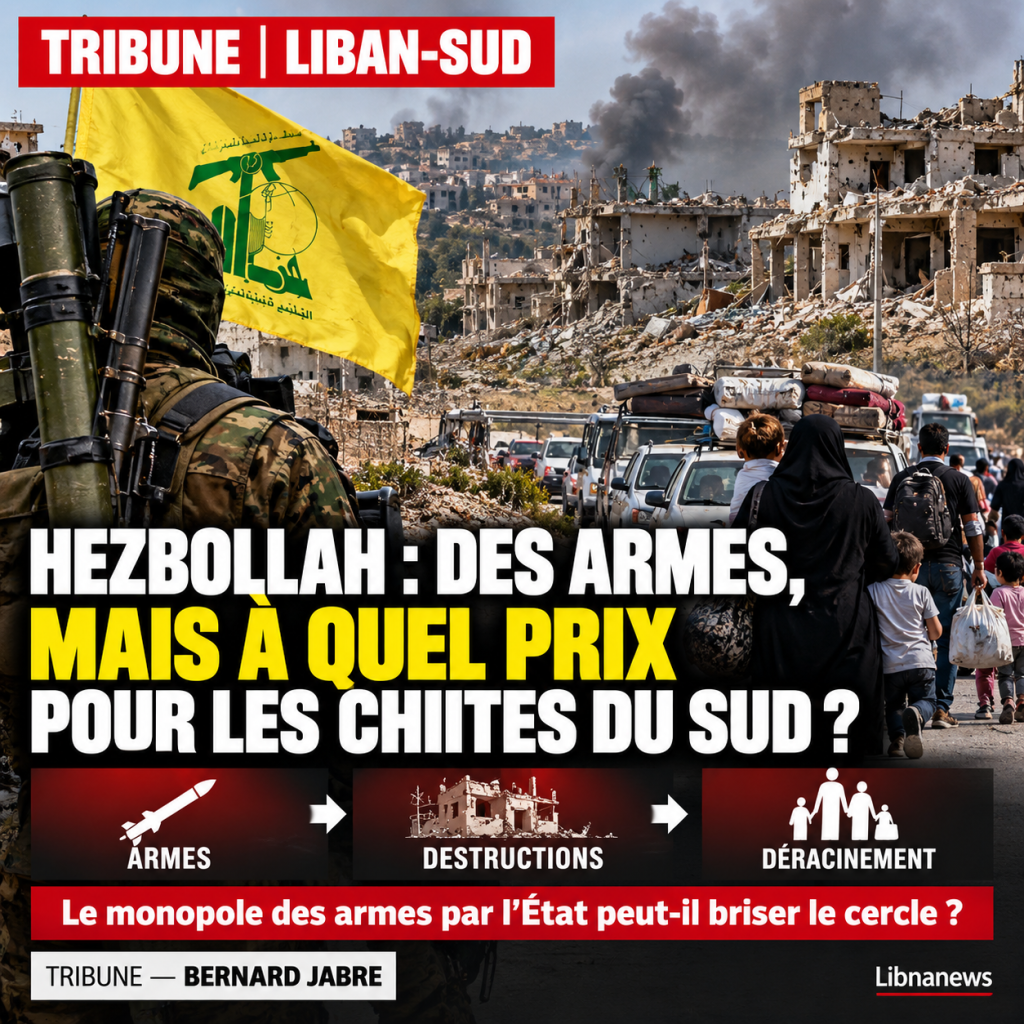
Destruction + displacement + inability to rebuild + lack of security = gradual uprooting of the population.
That’s the problem.
It is not even about knowing who loves Israel, who hates it, who still believes in « resistance » or who no longer believes in it. It’s about understanding mechanics.
A + B = C
Let’s take the facts cold.
A. Israel considers Hezbollah’s autonomous arsenal at its border as a strategic threat.
B. Hezbollah refuses to hand over this arsenal entirely to the Lebanese State until the conditions it imposes are met.
So C: Israel retains a strategic motive to continue its military operations in Lebanon.
This obviously does not mean that Israel acquires an unlimited right to bomb Lebanon.
Both questions must be strictly separated. Hezbollah is responsible for deciding to retain its weapons and possibly conduct military operations independently of the State. Israel bears full legal and moral responsibility for the operations it decides to carry out, their targets, their proportionality and the protection of civilians.
But from a strategic point of view, the result for Lebanon is the same: as long as the military cause remains, the risk of war remains. Unfortunately, the same people pay the price.
Recent events give a terrible illustration. Hundreds of thousands of civilians from the South have been displaced, communities have been evacuated and destroyed, and the Israeli military presence in positions in Lebanon is in a situation of confrontation.
Who lives mainly in these areas? The Lebanese Shiites. This is where the tragic paradox lies.
A weapon supposed to protect a population ends up exposing
Hezbollah has historically claimed that its weapons protect Lebanon, particularly the South, against Israel. But a military doctrine must be judged on its outcome.
If a sustainable strategy produces more exposed or occupied territory, more destroyed villages, more houses lost, more displaced, more dead, less economic activity, less agriculture and fewer return opportunities, then a question becomes inevitable:
At what point does the protective instrument itself become a risk factor for those whom it claims to protect?
This is not a theological question. This is no longer even an ideological question. It’s a question of outcome.
The vicious circle
The current mechanics are particularly dangerous because they are self-maintenance.
Hezbollah says, « I am not returning my weapons because Israel occupies part of Lebanon. »
Israel replied: « I do not withdraw completely because Hezbollah retains its weapons and military capabilities. »
occupation → weapons maintenance → threat maintenance → strikes → occupation → justification for weapons maintenance
The circle is perfect. And while everyone justifies their behaviour by the other, neither Tel Aviv nor Tehran is gradually destroyed. It’s the South Lebanon.
Resolution 1701 provides a clear understanding of the two dimensions of the problem: it aims to prevent the resumption of hostilities, restore the authority of the Lebanese State and ensure respect for the sovereignty and territorial integrity of Lebanon.
But there is now a third variable: the Lebanese state
She’s changing the whole equation.
The question no longer is: Hezbollah or Israel? It must become: Hezbollah or Lebanese state?
For if Hezbollah gradually surrenders its weapons to the State and the Lebanese army effectively exercises the monopoly of force over the entire territory, the situation changes radically.
state military monopoly + effective control of territory + absence of attacks from Lebanon = gradual disappearance of Israeli security justification
Israel must then withdraw from Lebanese territory and respect Lebanese sovereignty. And if he continues his attacks without a military threat from Lebanon, political and international responsibility will become much more clearly and exclusively Israeli.
That is precisely why the State’s monopoly of arms is an infinitely more powerful diplomatic weapon than is believed.
Resolution 1701 is already based on this logic: no weapons and no authority in Lebanon other than those of the State, in parallel with respect for the Blue Line, Lebanese sovereignty and the obligations imposed on the parties.
This is the only equation that could break the circle.
The real danger is demographics
Finally, there is a dimension that we talk too little about. A community does not necessarily disappear because it is physically exterminated. It can gradually disappear from a territory because its inhabitants can no longer live there.
Imagine ten or fifteen more years of identical cycles: war, destruction, ceasefire, partial reconstruction, new war, new evacuation.
What will a family of Bint Jbeil, Khiam, Nabatiyé or a border village do after rebuilding their house two or three times? What will the young graduate do? What will the farmer do if the land becomes inaccessible? What will parents who no longer want to raise their children do under drones and bombings?
They’ll leave. First to other parts of Lebanon. Then, for those who can, abroad.
The ultimate danger is therefore not only military. It is territorial, economic and demographic.
A region that is continuously transformed into a battlefield eventually loses its inhabitants. Thus, the persistence of a military strategy supposed to defend the Shia community could, paradoxically, become one of the greatest threats to its historical roots in South Lebanon and the Bekaa.
Resistance should change today
Resisting today should no longer mean retaining missiles indefinitely. Resisting should mean staying on his land.
Rebuild Nabatiyah. Cultivate the South. Bring back the families. Creating businesses. Build schools. Ensure that children can live in Khiam, Bint Jbeil or Tyre without having to go to every new war.
And above all, rebuild a State strong enough that no foreign power — Israel, Iran or any other — can decide war and peace in place of the Lebanese.
Hezbollah must therefore answer a much more serious question than whether it can retain its weapons.
What are these weapons for if, by wanting to preserve them, we end up losing the land and the men they were supposed to protect?
Because arithmetic becomes implacable:
no state monopoly on arms = incomplete sovereignty
incomplete sovereignty = possible permanent confrontation
permanent confrontation = repeated destruction
repeated destruction = sustainable displacement
sustainable displacement = uprooting
The historical choice that presents itself to Hezbollah is perhaps no longer between resistance and surrender. It is between two radically different conceptions of resistance: to preserve its weapons, at the risk of gradually losing its human territory; or hand over weapons to the State in order to save the land, rebuild the villages and allow the Shiites of Lebanon to continue to live there.
A weapon is never an end in itself. It only makes sense if it protects a population.
When its conservation ends up contributing to the destruction of this population, the courage is no longer necessarily to keep it.
The courage can be to put it back.
Bernard Jabre





Comments