

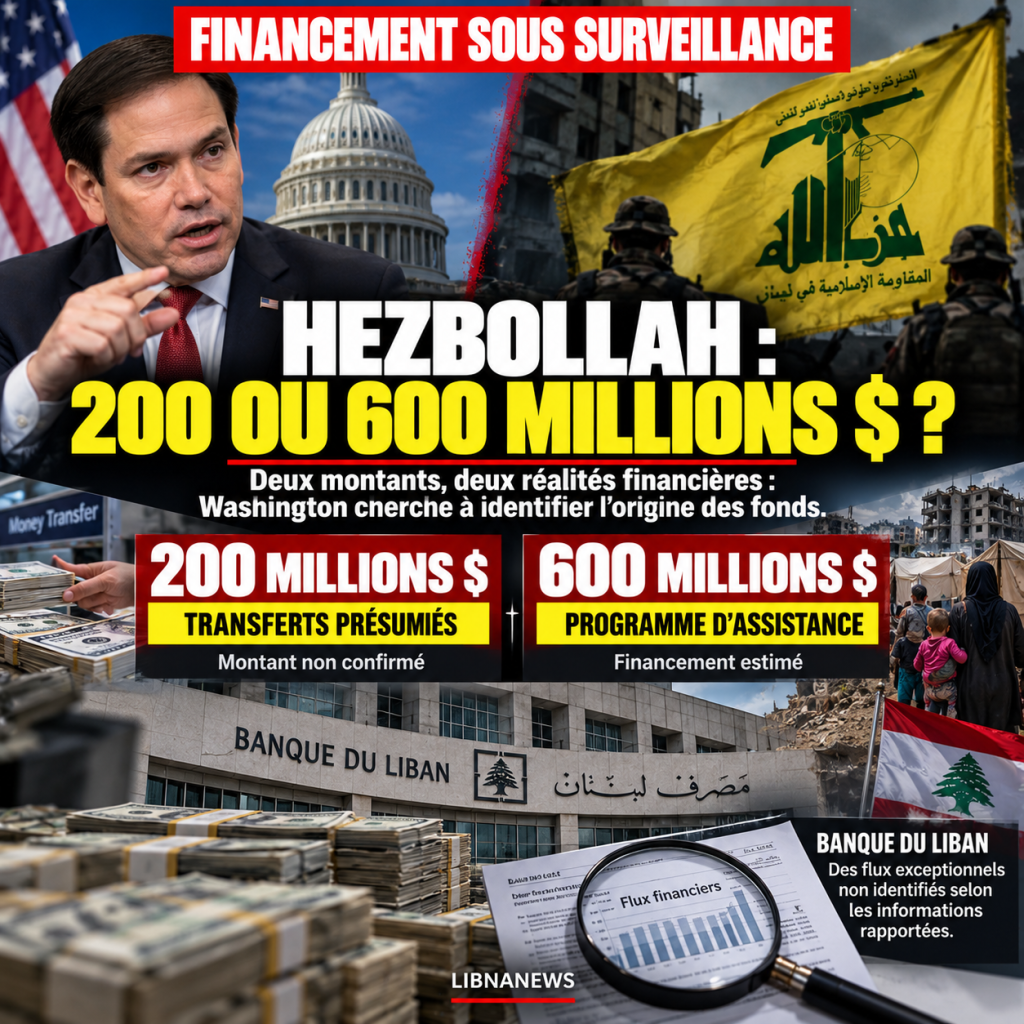
Two amounts contribute to questions about Hezbollah’s financial resources: $200 million and $600 million. The first corresponds to alleged transfers to the movement. The second concerns an estimate of the financing of its programme of assistance to displaced populations. These figures, referred to in the information of 20 October 2026, led to verifications by Lebanese financial institutions. They intervene as Washington seeks to strengthen the monitoring of Hezbollah’s resources. However, the two estimates do not refer to the same transactions. Their rapprochement mainly reveals the difficulties encountered in determining the origin, amount and financing channels of the movement’s activities.
The $200 million that would have attracted US attention
The first amount appears in reports of the arrival of $200 million for Hezbollah. This amount would have raised American questions about the circuits used to channel the funds. In particular, the US authorities would seek to determine whether these transfers have borrowed commercial banks, money transfer companies or other financial intermediaries. The case is part of a period of increased pressure on the movement. However, the available documents do not specify the exact dates of all alleged transactions. They also do not provide records to identify the senders, consignees or establishments concerned. The figure of $200 million must therefore be considered as reported information, not as an amount definitively established by a judicial or financial investigation. This distinction is essential to assess the extent of suspicion. The announcement of a major transfer alone does not allow the origin or use to be determined. Nor does it demonstrate that the funds would have been used for military activities. The above-mentioned investigations would specifically seek to obtain the elements for a better understanding of the operations concerned. The lack of detailed data, however, limits the scope for independent verification.
The United States would also address the current financial capacity of Hezbollah. The published information refers to research concerning the regular payment of the remuneration of its members and the maintenance of its social institutions. This approach suggests that audits would not be limited to a particular transfer. They would aim more broadly at assessing the resources available to the movement to continue its activities. Health, education and social institutions are among the structures which would have received attention. However, the documents do not provide an accounting balance sheet to determine their expenditure. Nor are they sufficient to measure the resources required for their operation. The available information therefore describes a search for financial information rather than an verified inventory of Hezbollah’s capital. However, they show that the issue of its resources has become an important issue in relations between Washington and Beirut. The United States authorities would like more precise information on the movement of funds, while Lebanese institutions would be asked to examine transactions that could be identified in the financial channels.
An estimated $600 million assistance programme
The second amount relates to a support programme presented by Ali Damush, head of the Hezbollah Executive Council. According to information published on 20 October 2026, this scheme, which is intended, inter alia, for displaced populations, would amount to approximately $600 million. This estimate is significantly higher than the $200 million reported in the information on alleged transfers. However, there is no evidence that the two figures correspond to separate funds or that they can be added together. The assistance programme addresses needs related to population displacement and the consequences of confrontation. Its funding would have raised questions about the resources mobilized by the movement. However, the information available does not specify the exact period covered by the $600 million estimate. They also do not provide a breakdown of expenditure between the various forms of aid. It is therefore impossible to determine what share would be intended for housing, family expenses or other needs. This lack of detail also prevents verification of whether the amount represents funds already spent, available resources or an estimate of future needs. The distinction is important because these categories do not correspond to the same financial realities.
The alleged scale of the programme would have led several intelligence services to examine Hezbollah’s financial capabilities. The above-mentioned audits would examine, inter alia, whether the movement continues to pay its members’ salaries and to fund its health, educational and social institutions. This orientation extends the scope of questions to the general functioning of its structures. Assistance programmes are particularly important in this area, since they concern populations affected by the clashes. Their financing cannot automatically be equated with military activities. Moreover, the information available does not make it possible to distinguish precisely the resources allocated to the various sectors. Nor do they demonstrate that the sums mentioned would all have passed through the same circuits. Financial estimates should therefore be considered separately. The $600 million figure is an indication of the alleged magnitude of the assistance package, but does not allow for an audited balance sheet of actual expenditures. The documents do not provide any evidence to determine whether this estimate has been independently verified.
Karim Souaid faced with questions about financial flows
The Governor of the Bank of Lebanon, Karim Suaid, is said to have been asked in connection with questions about Hezbollah’s resources. According to the information reported, he reportedly informed United States interlocutors that the financial circuits operating in Lebanon had not recorded capital movements corresponding to certain exceptional estimates over a short period of time. This assessment would relate to transactions through the Bank of Lebanon, commercial banks, money transfer companies and bureaux de change. It introduces an important element into the file: the amounts mentioned in the Hizbullah financing information would not necessarily correspond to identifiable movements in the financial circuits monitored. However, the documents do not reproduce the data used by the Governor. They also do not specify the exact reference period for their observations. It would therefore be excessive to infer that the sums pledged would necessarily have borrowed clandestine circuits. This conclusion cannot be drawn from the information available. Rather, they reveal difficulties in bringing published estimates closer to the actual financial transactions identified.
This would have contributed to a stronger interest in financial intermediaries. Money transfer companies and bureaux de change are among the structures whose operations would have been subject to verification requests. The investigations attributed to the Attorney General of the Court of Cassation, Ahmad Rami Hajj, are in this context. The magistrate reportedly asked the intelligence branch of the Internal Security Forces to investigate possible operations related to Hezbollah or Al Qard Al Hassan. The information also refers to an extension of research to real estate transactions. This may allow for a review not only of movements of funds but also of their use in certain acquisitions. However, the documents do not show that the $200 million or $600 million would have been used to finance real property purchases. No direct link between these estimates and specific transactions is established. The alleged investigations therefore concern several aspects of the financial circuits, without the information available allowing to reconstruct a precise path of capital.
Washington seeks to increase financial pressure
Questions about Hezbollah’s resources arise in a context of growing US pressure on the Lebanese authorities. According to information published on 20 October 2026, Secretary of State Marco Rubio reportedly asked President Joseph Aoun to strengthen the measures aimed at the movement’s military and financial activities. In particular, the US official would have expressed his astonishment at the lack of precise information on certain capital movements. These alleged applications would form part of a strategy to reduce Hezbollah’s funding opportunities. However, the documents do not reproduce the full contents of the interview between Rubio and Aoun. Nor can they independently confirm all the requirements assigned to the Secretary of State. However, the information available shows that financial issues play an important role in tensions between Washington and Beirut. They accompany U.S. requests for security operations and investigations into the movement’s military activities. The pressure would therefore not only be on weapons, but also on the resources that would enable Hezbollah to maintain its structures.
The alleged strengthening of financial investigations could have consequences beyond the organizations directly targeted. Research on transfer companies and real estate transactions could include capital from Lebanese emigration. The published information refers to funds sent by Lebanese in North America, Europe and Africa. Some of these resources support displaced families in southern Lebanon. However, the documents do not indicate any general restrictions on family transfers. Nor can they claim that expatriates were prevented from making real estate transactions because of the investigations. The possible consequences would depend on the criteria adopted by the judicial authorities and the operations actually examined. The central question therefore concerns the ability to distinguish ordinary transfers from movements of funds that may be linked to illegal activities. The information available does not specify the exact details of the checks envisaged. They also do not make it possible to estimate the number of people likely to be affected.
Financial estimates that are not an audited balance sheet
The amount of $200 million and $600 million is an important part of the information on Hizbullah financing. However, they fall into two different categories. The first refers to alleged transfers whose terms are not detailed. The second concerns an estimate of the funding of an assistance programme. Therefore, their addition would not allow the total amount of the movement to be determined. The documents do not provide an accounting balance sheet to verify the amounts announced. They do not further specify the proportion of funds that would have actually been received or spent. Nor does the available information determine whether some resources could be included in both estimates. This uncertainty requires separate treatment of the figures. It also prevents the conclusion that Hizbullah would have an additional $800 million. Such an assertion would not be supported by the documents.
The alleged investigations could provide new information on the origin and flow of financial resources. However, the information available as at 20 October 2026 does not indicate any court results to confirm the amounts mentioned. They do not provide a list of identified transfers or detailed bank statements. They also do not allow for the establishment of any responsibilities of particular financial intermediaries. The file is therefore based on estimates, United States queries and verification requests attributed to the Lebanese authorities. Its importance is less related to the certainty of the figures announced than to the steps they would have helped to trigger. The amounts mentioned have placed Hezbollah’s resources at the centre of a debate that combines financial surveillance, assistance programmes and diplomatic pressure. Their verification, however, remains essential to determine the true scope of suspicions and to distinguish between actual and unconfirmed transactions.





Comments