

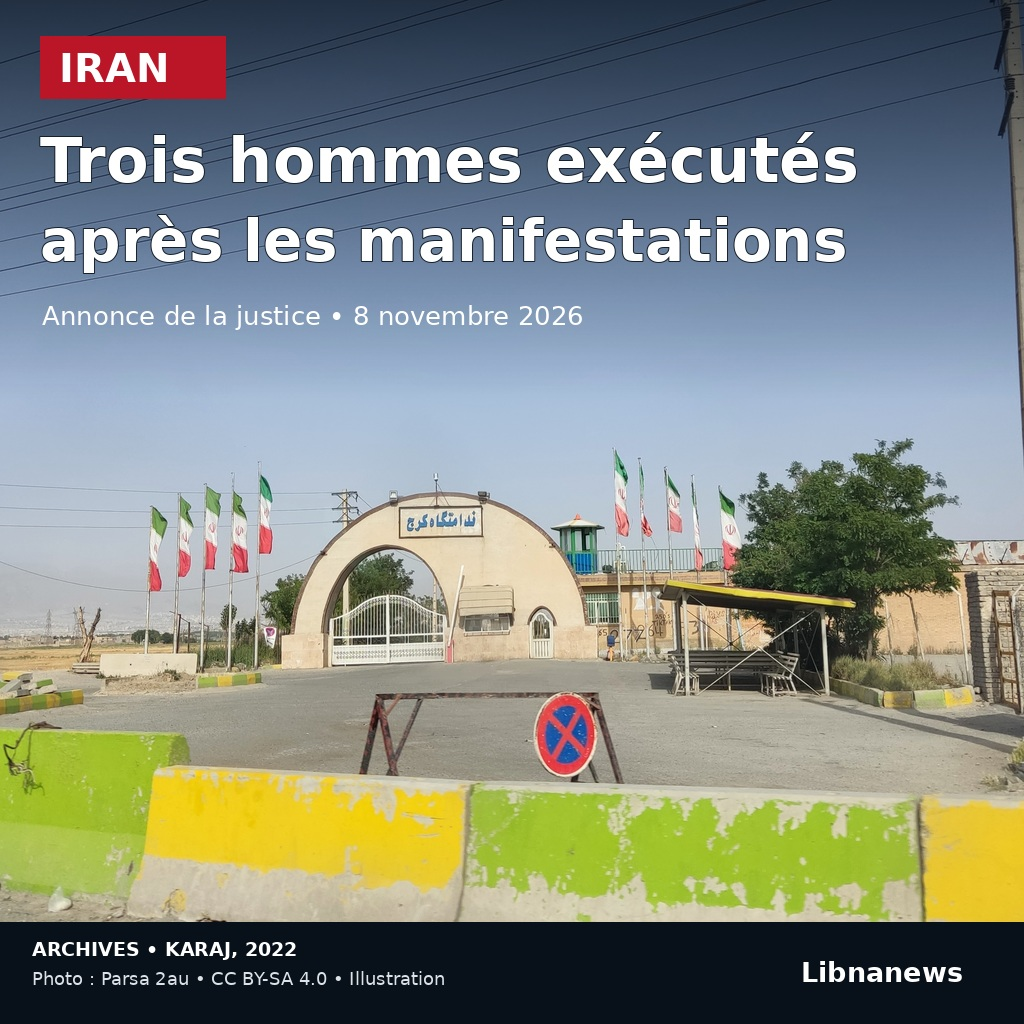
On Sunday, 8 November, the Iranian judiciary announced the execution of three convicted men in a case related to the January 2026 protests in Karaj, west of Tehran. The authorities accuse them of having participated in armed actions on behalf of Israel, the United States and hostile groups. These alleged links with foreign powers have not been independently established.
Hassan Divband, Hamid Kazemi and Reza Zanganeh were convicted by the Karaj Revolutionary Court. According to the judicial announcement, capital punishments were applied after their confirmation by the Supreme Court. The confiscation of the property of convicted persons accompanies the executions.
A case related to the January violence
The authorities’ account covers two nights of unrest in January. He blamed them for attacks on public buildings, fires, the destruction of cameras and the degradation of an electrical station, which would have deprived part of Karaj of power. He also mentioned the assault of two persons taken for security officers.
The court says it relies on confessions, video surveillance recordings and an investigation by intelligence services in Alborz province. The detailed version of the defence and the conditions under which the statements of the accused were collected are not established by the elements consulted. Formal charges cannot therefore be presented as facts verified by an independent investigation.
The file consists of eleven persons. The remaining eight accused were sentenced to five to ten years in prison, according to the authorities. The announcement alone does not allow for the reconstitution of the full course of the hearings or the grounds invoked in the appeals.
The use of national security charges
The conviction is based on legislation that strengthens sanctions against espionage and cooperation with Israel or States considered hostile. The qualification chosen is that of participation in an operational activity for the benefit of these opponents. It thus gives a national security dimension to acts that the accusation relates to demonstrations.
That mechanism had been criticized before the three executions. In a report published on 10 September, Human Rights Watch and the Abdorrahman Boroumand Centre documented the use of capital punishment against demonstrators and dissidents. Their investigation included at least 59 men executed between 18 March and the end of August 2026 for political or national security charges, 29 of which were related to the demonstrations of December 2025 and January 2026.
Disputed judicial guarantees
Both organizations reported that they had obtained confessions under duress, restrictions on access to a chosen lawyer and expeditious procedures in the files they had examined. They reported that in 16 of the 29 cases related to demonstrations, the charges were not about homicide. These findings concern their previous sample and do not constitute a specific survey of Divband, Kazemi and Zanganeh.
The three executions announced this Sunday therefore prolong a sequence already denounced by human rights defenders. For this specific case, full judicial documents and contradictory evidence remain necessary to assess the evidence provided by the authorities and the guarantees granted to convicted persons.





Comments