

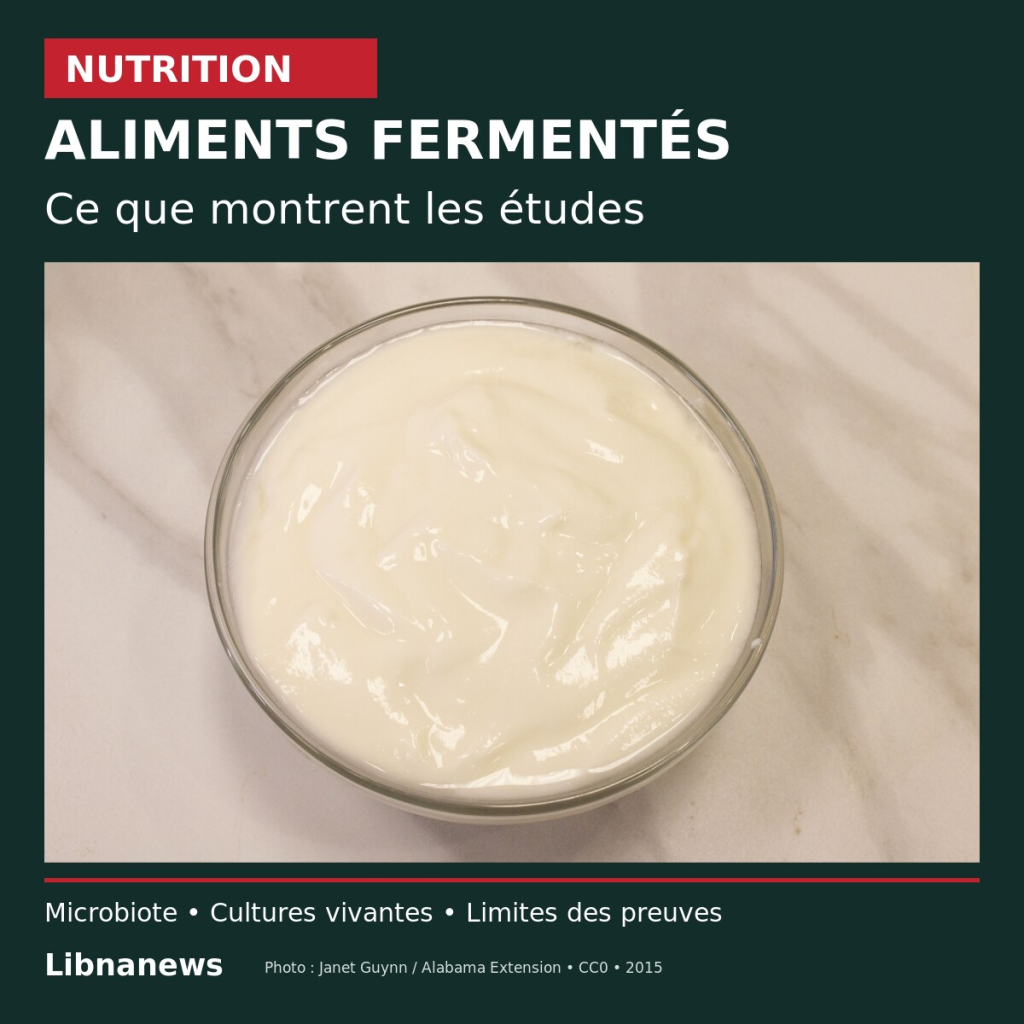
Fermented foods occupy an ancient place in food, from yogurt to vegetables preserved by fermentation. Their scientific interest is real, especially for the intestinal microbiota. But three concepts are often confused: a fermented product, a food containing living micro-organisms, and a product whose specific health benefit has been demonstrated. They are not equivalent.
The Stanford study of 36 adults, regularly cited in this debate, dates back to 2021. It brings interesting results on microbial diversity and some inflammatory markers. It does not show that a portion of kefir or yogurt prevents cancer, treats diabetes or replaces a medicine.
Fermented foods: a process before a promise
Fermentation transforms the components of a food through the activity of micro-organisms. It can change its flavour, texture and composition. The processes vary greatly between a dairy product, a soy preparation and a fermented vegetable.
The treatment then applied also changes the product consumed. Cooking, pasteurization or certain filtration operations can eliminate living microorganisms. A food remains from fermentation even when it no longer contains live crops at meal time.
Bread gives a familiar example. Fermentation is involved in its manufacture, but cooking does not leave a population of live ferments comparable to that of fermented milk. Conversely, some unheated yogurts, kefirs and vegetables may contain them.
An acidic taste also does not identify the process. Vegetables can be stored in vinegar without having fermented themselves. To understand what a jar contains, the method of manufacture and label indications are more important than its appearance.
What Stanford’s essay shows
Researchers randomly split 36 healthy adults into two dietary interventions: more fermented foods or more fibre. The comparative food programme covered ten weeks. The measurements concerned microbiota and immune function.
In the fermented food group, microbiota diversity increased and several blood inflammatory markers decreased. The academic report mentions a decrease of 19 proteins associated with inflammation. The fibre-enriched group did not show the same average trend over this period.
The interest of the result is due to a food intervention observed in individuals, with comparison between groups. Its limitations also relate to the protocol: small size, short duration and healthy participants. It was not a question of testing the cure of a disease.
Participants consumed a selection of foods. Therefore, experience does not allow for assigning all effects to a single product or defining a universal dose for each reader.
A biological marker is not a clinical result
A protein associated with inflammation can provide information on a biological response. To establish a medical benefit, one must still show a relevant effect for patients: symptoms, complications or progression of a disease, depending on the question.
This difference explains why a decline in markers is not enough to promise protection against several diseases. A research may open a lead without answering prevention or treatment questions. The population concerned, duration of follow-up and adverse reactions should also be included in the assessment.
Nor does the result of the fibre-rich group suggest that the fibres would be useless. Food recommendations are based on a set of data and objectives. The nutritional quality of a diet is not measured by a single indicator of the microbiota.
« Probiotic » requires additional evidence
The term probiotic refers to living micro-organisms that provide health benefits when they are administered in adequate quantities. Such a qualification therefore requires more than the presence of bacteria in a food.
The nature, quantity and effects of microorganisms are important. The results obtained with a particular preparation do not automatically extend to all products sold under a close name.
For the consumer, the useful question concerns the specific claim. Does the manufacturer simply announce live cultures, or does it promise an effect on digestion or another function? The second claim requires evidence tailored to the product and the advertised benefit.
Food supplement and fermented food are not interchangeable. Their composition, concentration and use may differ. Commercial promises must be examined for what they actually say, without assigning them the scope of validated treatment.
Salt and sugar remain in the equation
Fermentation does not exempt reading the nutritional composition. A product can be fermented while adding a lot of salt or added sugar. A drink, a wild yogurt and a brine vegetable do not occupy the same place in the diet.
The general recommendations favour a varied diet, with vegetables, fruits, legumes and whole grains. They also call for limiting excess salt and free sugar. The interest of a food is judged in this way, taking into account the quantities consumed and the needs of each.
Caution should be exercised in cases of severe illness or immunodepression. Health organizations report an increased risk of adverse reactions with certain probiotics in these individuals. This alert does not mean that any fermented food is dangerous, but it justifies a medical opinion prior to a major supplementation or food change.
For future research, the challenge will be to specify which products, populations and clinical effects are involved. For the daily purchase, the directly verifiable information remains the composition, the possible heat treatment, the storage conditions and the exact scope of the claims on the package.





Comments