

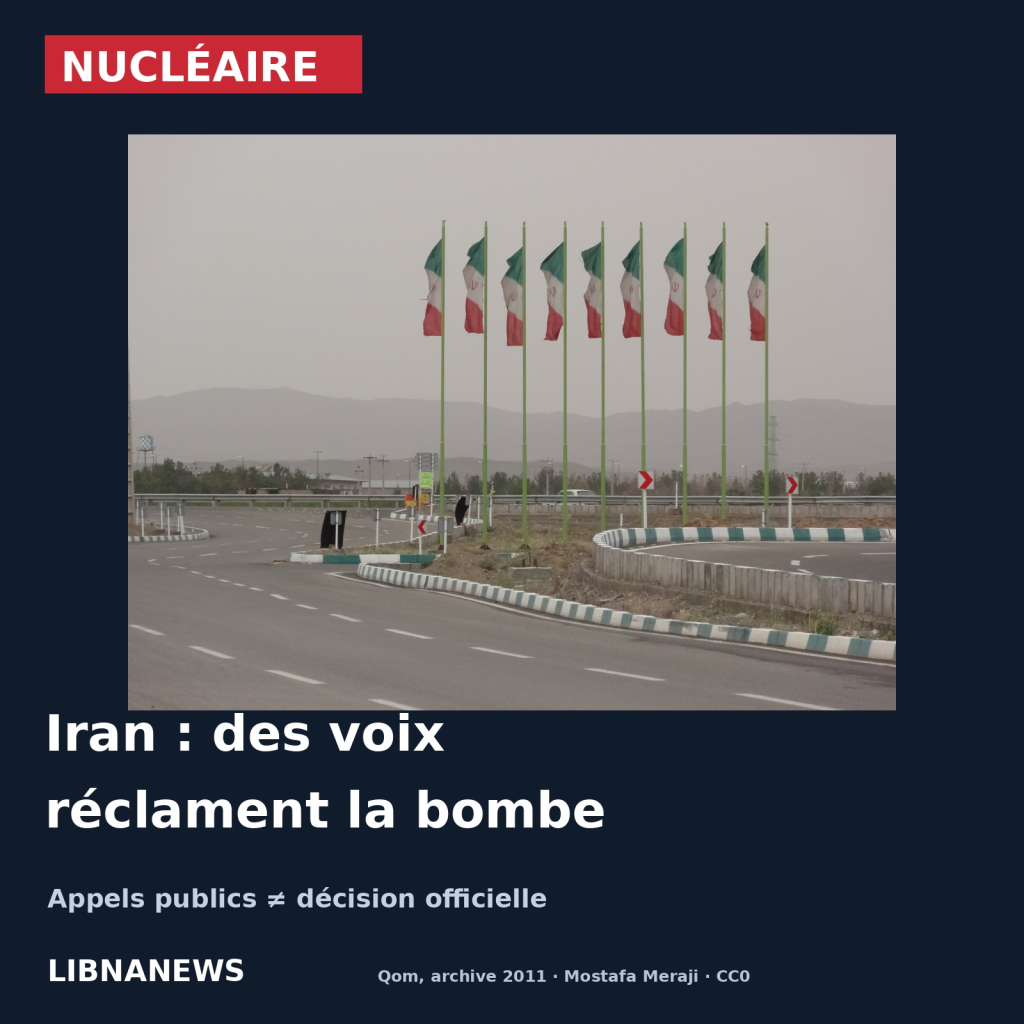
In Iran, calls for nuclear bombs are no longer limited to isolated parliamentary statements. Religious leaders now publicly defend this option. On 2 November, the diplomatic spokesman himself recognized the scope of the debate. But none of these statements demonstrate a decision to make the weapon. Between political pressure, official doctrine and verifiable capabilities, three different issues overlap.
The debate comes after the American and Israeli strikes against Iran and its nuclear facilities. Its supporters invoke the vulnerability of the country to challenge its declared restraint. His adversaries fear that a change in doctrine will aggravate precisely the threats he claims to prevent.
Nuclear bomb calls, not a popular warrant
Mohammad Javad Haj Ali Akbari, interim imam of Friday’s prayer in Tehran, requested a revision of the doctrine during his sermon on 30 October. In several media reports, he describes the acquisition of the weapon as a national demand. He wished to forward proposals to the Mojtaba Khamenei guide.
MP Ahmad Naderi also defends a breakup. He believes that the new guide might take a different position than his father. This anticipation belongs to the MP. It is neither a new fatwa nor an announcement of the guide.
These interventions demonstrate the existence of a public campaign for the nuclear option. They do not measure support in the population. Without an identifiable representative survey, transforming the « national demand » formula into a majority opinion would be a shortcut.
Diplomacy holds two messages
On 2 November, Esmaïl Baghaei described the discussion of a change of doctrine as a real issue. The spokesman for the Ministry of Foreign Affairs linked to the American and Israeli attacks. In particular, he invoked the death of Ali Khamenei, the author of the religious ban regularly cited by the authorities.
Baghaei simultaneously reaffirmed the peaceful vocation of the programme. He also recalled that Iran remains a member of the NPT and bound by its commitments. This double speech must be read in its entirety: a political warning accompanies the maintenance of the declared official position.
Mohsen Rezai had already set this distinction in a television interview on 31 October, reported the following day. The Secretary of the Supreme National Security Council stated that no new formal decision had changed the doctrine. However, it recognized requests for review in the event of a resumption of war. His statement describes the announced state of the decision, not all individual intentions at the top of the power.
Fatwa does not replace NPT commitments
Religious discussion has an obvious political significance. It touches on an argument that Iranian leaders have long used to defend their peaceful intentions. But we must distinguish between a religious rule, its institutional application and the international obligations of a State.
In an analysis published on November 1, researchers Jo Chitlik and Rashid Mehmood propose precisely this separation. They call for an examination of the scope of the prohibition, the authority of its author and its implementing rules. Their work does not sever Iranian intentions. He stresses that religious insurance can count diplomatically without replacing a physical verification.
The NPT makes explicit commitments. Article II prohibits non-nuclear-weapon States parties to the treaty from producing or acquiring nuclear weapons. Article III provides guarantees to verify obligations and to prevent the diversion of materials. Thus, a new religious interpretation alone would not alter these international commitments.
IAEA mainly describes incomplete verification
Access to facilities and materials remains the most concrete point on the file. On 7 September, Rafael Grossi reported lack of information and access during the reporting period. The Director General of the International Atomic Energy Agency stressed the loss of continuity in the knowledge of stocks. He described this situation as a serious concern for non-proliferation.
On 27 October, Grossi told the Security Council that regular inspections had not resumed. He did, however, mention one exception: audit activities at the Boucheshr plant. To speak of an absolute absence of cooperation would therefore erase an important distinction.
Grossi also indicated that it had not identified any activity to repair or rebuild damaged facilities since June 2025. He immediately recalled that physical access remained essential to ascertain the real situation. This does not prove the disappearance of the programme or the existence of a weapon.
A verification deficiency is a serious uncertainty. This is not a positive proof of manufacture. Conversely, the political assurance of a peaceful programme is not enough to resolve this gap.
A contested security bet in Iran
The debate is not limited to a confrontation between the Iranian authorities and their foreign opponents. Iranian analysts also challenge the promise of protection associated with the bomb. Qader Bastani fears that an emotional campaign will fuel the justifications for a new confrontation. Kiomars Ashtarian distinguishes the deterrence of a nuclear attack from protection against a conventional war. He also referred to the cost of new sanctions.
These objections concern the expected benefit of the weapon, not just its prohibition. They recall that a new capacity does not automatically guarantee more safety. Public debate opens up several possible trajectories; It makes no one inevitable.
To assess the follow-up, the next decisive elements will be identifiable: an official decision, a doctrinal text and verified changes on the ground. In his intervention of 27 October, Grossi proposed gradual technical measures to restore inspections. Their implementation remains a concrete test, distinct from the volume of declarations.
Sources and references
- Sermon of 30 October 2026, record
- Statement by Esmail Baghaei, 2 November 2026, report
- Mohsen Rezai interview, report of 1 November 2026
- Public appeals and Iranian objections, 2 November 2026
- Study by Jo Chitlik and Rashid Mehmood, November 1, 2026
- NPT text, articles II and III
- IAEA, Rafael Grossi Statement of 7 September 2026
- UN, 27 October 2026 intervention, automatic transcription
- Report of 27 October 2026 on IAEA verifications
- IAEA: Absence of reconstruction observed, report
- Previous Libnanews: Doctrine remains in debate





Comments