

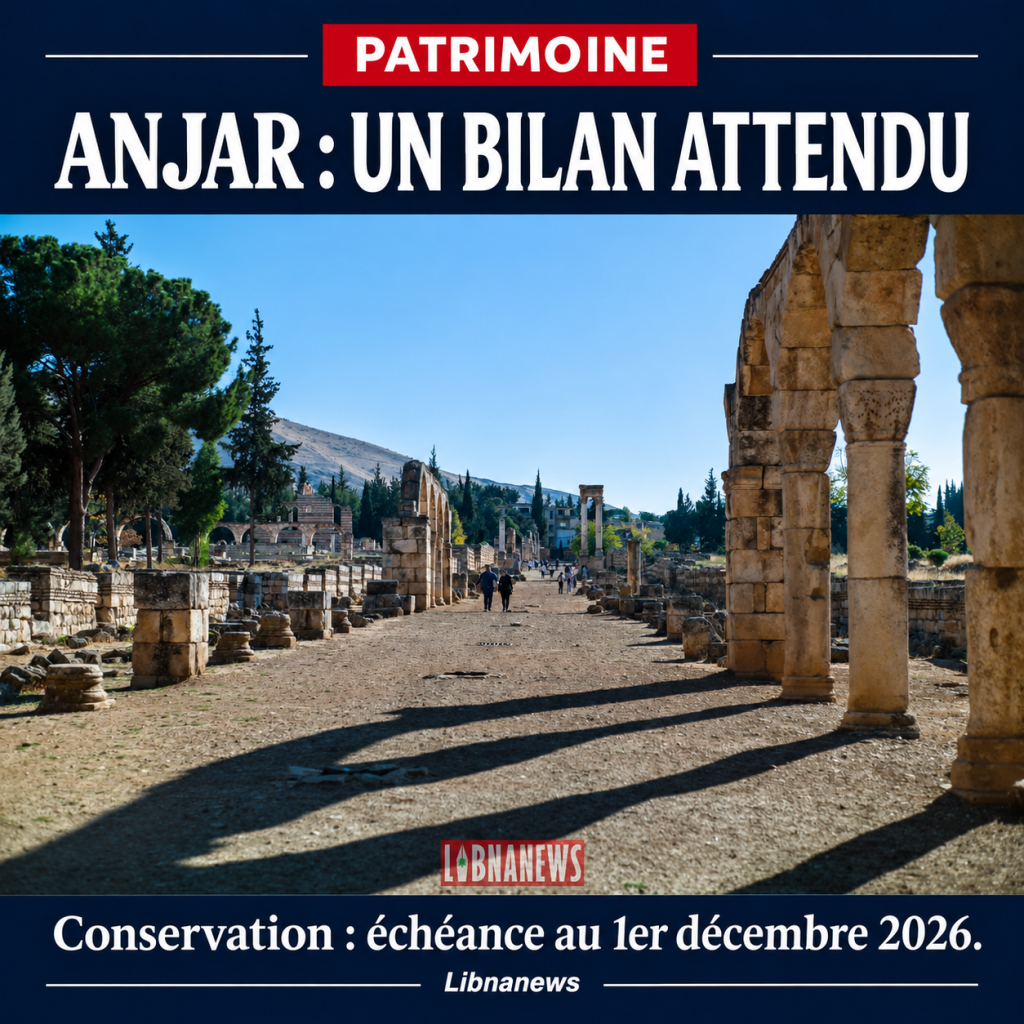
Less than one month from a deadline of 1 December 2026, Anjar returns to the Lebanese heritage calendar. Lebanon is to submit an updated report on the conservation of the Umayyad city of Bekaa. This request is contained in a decision adopted in 2025. It invites you to look at the site beyond its colonnades: maintenance of remains, protection of the landscape and examination of projects form a single file.
This appointment concerns a World Heritage Site since 1984. It does not correspond to a new registration or announcement of a completed project. In Anjar, the next documentary step is to clarify the state of the property and the measures taken to preserve it. Previous documents provide a point of comparison, provided they meet their date.
Anjar: a report due on 1 December
The 2025 decision calls on the Lebanese authorities to continue their efforts with their local and international partners. It also notes that projects that may affect the heritage value of the site must be submitted for review. This is done prior to any decision that may produce irreversible effects.
The same text notes Lebanon’s assurance that the 2024 hostilities had not damaged the property. This applies to this specific period. It does not constitute on-site expertise dated November 2026. The balance sheet requested must provide up-to-date information, rather than automatically prolonging an old assessment.
A city whose plan is itself a heritage
Founded under Walid I’s Caliphate at the beginning of the eighth century, Anjar occupied an inner commercial crossroads. The roads from Beirut to Damascus and Homs to Tiberias crossed this part of the Bekaa. The city maintains a plan organized around two axes which divide the space into four sectors.
The large palace and mosque occupy the southeast sector. Baths and small palaces are on the northeast. The enclosure, punctuated with forty towers, frames this organization. The remains also show the re-use of ancient elements in an architecture of the Umayyad era.
The interest of the site lies in the relationship between its constructions and each monument. A street, door or evacuation network contributes to the understanding of the city. Preserving this package requires keeping the paths and perspectives that make its organization readable.
Protection is also played around the walls
The summary of the Lebanese report submitted in 2025 mentions cooperation with the Directorate-General for Urban Planning. It refers to zoning rules established in 2004 to frame the outskirts of the old city. This urban dimension is essential: an external intervention can alter the perception of remains.
The document also presents the national protections applicable to the property. At the time of writing, it did not report major restoration work in the site or its protected areas. This indication describes the situation then reported. It cannot be said that no transactions have been initiated since then.
For the reader, this distinction avoids frequent confusion between the status of a place and its material state. Heritage recognition establishes its importance. Conservation monitoring provides information on the interventions, needs and evolution of its environment.
Rain, frost and maintenance of masonries
The periodic report of the third cycle describes less spectacular work than the restoration of a large colonnade. The protection of the upper parts of the walls aims to limit rain infiltration. It must also reduce the degradation of the stones due to frost and temperature variations.
This old document also refers to the consolidation of fragile structures and the preparation of staff for rapid interventions. Documentation and security of site elements are included in these guidelines. These indications inform the methods envisaged; they do not prove their complete realization in 2026.
The same exercise covered training, research and visitor needs. It is a useful baseline for measuring progress. A serious comparison must, however, be based on new data and not present its responses as a photograph of the current situation.
What the next review will make clear
The public record of Anjar contains information of a different nature: description of the property, national reports and follow-up decisions. Their cross-reading shows why the date of a document counts as much as its content. An announced project, a planning rule and an executed intervention do not describe the same result.
In particular, the expected report will inform the follow-up to conservation measures and the management of the landscape framework. For this city of Bekaa, the deadline of 1 December 2026 must bring an updated point on the preservation of the remains and the projects that concern them.
Sources and references
- World Heritage Committee, Decision adopted 47 COM 7B.173, 2025.
- World Heritage Centre, Anjar: presentation and exceptional universal value.
- Lebanon, summary of the conservation status report submitted in 2025.
- Third cycle periodic report, section II: Anjar, background document prior to 2026.
- Archive photography: François El Bacha for Libnanews.com, axes of the city of Anjar. Editorial cover made from this photograph; it does not constitute an observation of the state of the site in November 2026.





Comments