

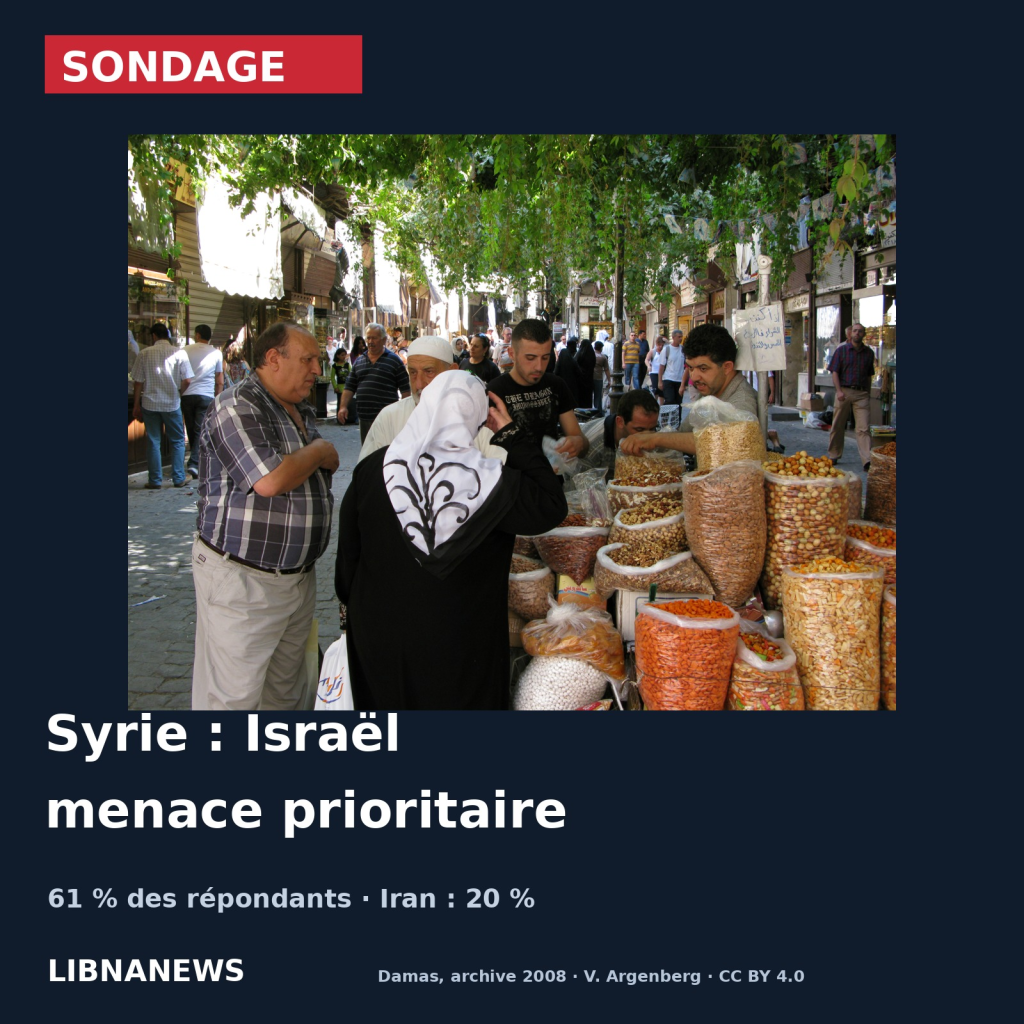
Israel is at the top of the threats perceived by those interviewed in the new Syrian opinion index. But the results published on November 2 are not just a ranking. They also show that a very negative assessment of Israeli policies can coexist with a debate on the usefulness of diplomatic meetings. Iran is second.
Syrian opinion: two questions, two measures
In the report, 61% of respondents identified Israel as the main threat to Syria’s security, ahead of Iran, cited by 20%. Turkey accounts for 6% and the United States for 5%. For the security of the Arab world, the order remains the same: Israel reaches 58 per cent, Iran 24 per cent.
Another issue deals separately with the policies of several powers. In this case, 97% consider Israel to be a threat to regional security and stability, and 93% to be a threat to Iran. These responses are not exclusive: the same person can view several States as threats. This is therefore not a second ranking in which percentages should total one hundred.
This distinction changes the reading of the survey. Being designated as the priority hazard does not mean being the only identified hazard. Conversely, not coming in the lead proves no confidence. The gap between the two series prohibits in particular the presentation of Iran’s relative position as a sign of adherence to its policy.
Diplomacy is not confused with recognition
Direct meetings between Syrian and Israeli officials divide respondents: 41% consider them useful for Syrian interests, 49% think they do not. In addition, 80 per cent opposed the recognition of Israel and 74 per cent refused an agreement without the return of the Golan. These questions relate to different acts.
Discuss can be used to negotiate a withdrawal, prevent an incident, or seek a security arrangement. Recognizing a State engages in a political relationship of a different scope. It is therefore not possible to mechanically convert an opinion favourable to interviews in support of complete standardization. The report does not publish here the individual cross-section which would allow us to know exactly how these positions combine.
The territorial file gives concrete content to this difference. In September, Syrian President Ahmed al-Charaa reaffirmed to the United Nations Damascus’ attachment to the Golan. He also recalled his commitment to the 1974 separation agreement, according to a press agency. An official position does not automatically describe the opinion of the population; However, it specifies the subject matter of possible negotiation.
Land completed before US elections
The Arab Centre for Research and Political Studies conducted the survey with the Arab Center for Studies on Contemporary Syria. The interviews took place from 28 September to 15 October 2026. The sample includes 3,600 respondents using a multi-degree stratified cluster method. The organizers announced coverage from all provinces, a 98% confidence level and a margin of error of two to three points.
The results released in November therefore do not measure a reaction to the American elections of 3 November. The date of publication and the interview period must remain separate. Nor should the survey become a statement by all Syrians, especially those living outside the country.
The statistical margin announced does not alone solve the difficulties of an opinion survey. Conditions of access to persons, refusal to respond, formulation and freedom felt during the interview must also be considered. The interest of this work lies in its separate questions, rather than in a single verdict on a population. Future cross-sections by region and social characteristics will allow for a more detailed examination of the differences than the national results do not show.
References and photographic credit
- Arab Center for Contemporary Syria Studies: Presentation, Methodology and Comprehensive Reports, 2 November 2026
- Syrian Speech at the United Nations, Associated Press, 23 September 2026
- Libnanews: economic aspects of the same survey, 3 November 2026
- Photo:Vyacheslav Argenberg, Damascus, 16 August 2008,CC BY 4.0. Resized whole photo; Libnanews dressing off photography.






Comments