

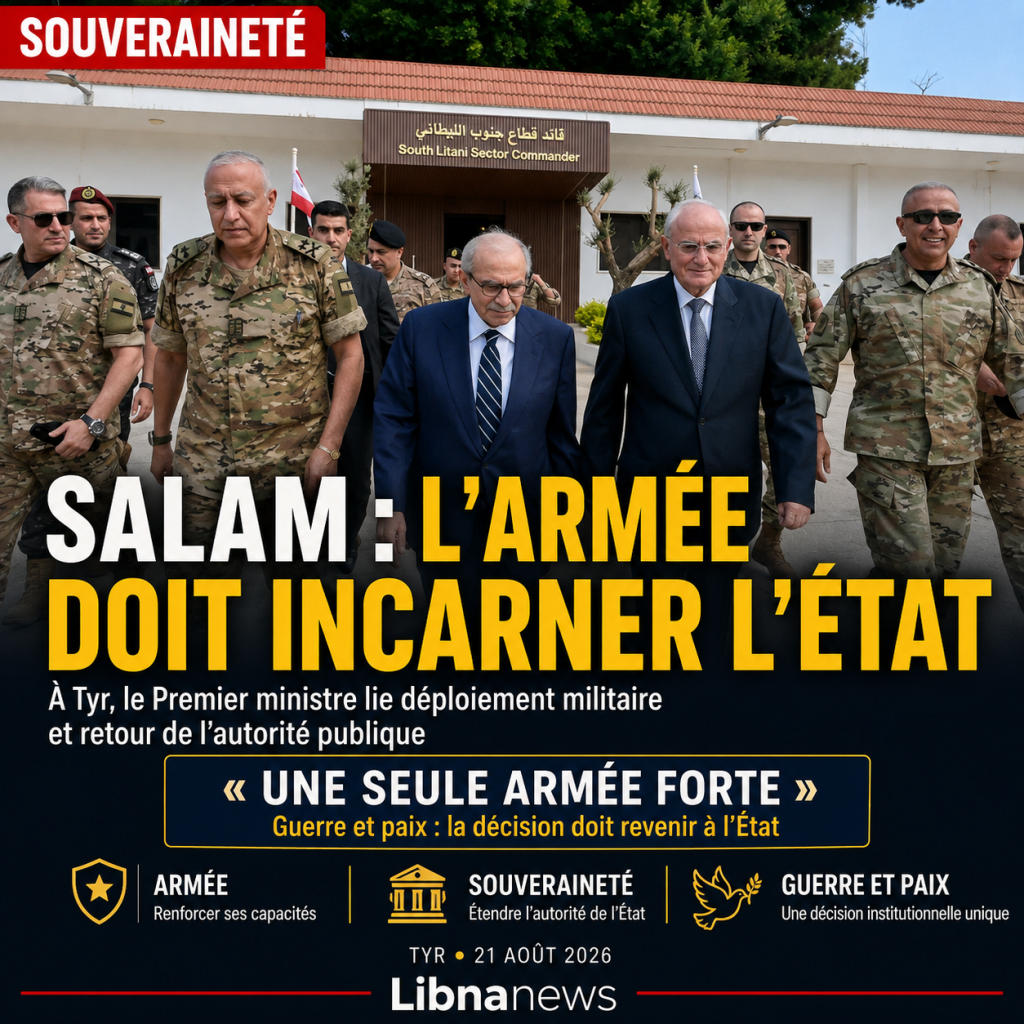
From Tyre, in the heart of a South Lebanon still exposed to Israeli strikes and tensions around the future of Hezbollah’s weapons, Prime Minister Nawaf Salam gave on Friday 21 August a political scope to the deployment of the army. In front of the military, he claimed that their presence in the South was not merely a security deployment, but a return of the State, its sovereignty and its authority. His speech directly links three issues that the government seeks to advance simultaneously: strengthening the Lebanese army, restoring the state monopoly on decisions of war and peace, and extending public authority to the entire territory.
The words chosen in Tyre thus go beyond the traditional government tribute to the armed forces. In a region where the question of military authority remains at the centre of the relationship between the state and Hezbollah, Nawaf Salam defined the deployment of the army as one of the instruments of institutional transformation. His message is based on a simple equation: Lebanon cannot recover its sovereignty without a State capable of acting, and that State cannot exercise its authority without a single and strong national army.
In Tyre, Salam links directly armed and sovereignty
» The meaning of your presence in the South is not just that of a military deployment, but that of the state presence, » said Nawaf Salam, addressing the soldiers.
The sentence was the political heart of his intervention. The Prime Minister went on to say that every position where the army deploys becomes a place where the state recovers « its sovereignty, authority and prestige. ».
This formulation gives territorial control an institutional dimension. In the reading presented by the Head of Government, it is not enough for Lebanese soldiers to be physically present in the South. Their deployment must mean that the decision-making chain is the responsibility of the State and its institutions.
Salam explicitly linked this logic to the question of war and peace. He said that he wanted the South, like all of Lebanon, to be placed under the authority of a single State and that citizens could live there safely because a national army protected them.
It then set the political objective: the country must regain stability with the restoration by the State and its constitutional institutions of the decision on war and peace.
In the Lebanese context, the latter is particularly cumbersome. It directly affects the debate on the existence of a Hezbollah military capability independent of the state chain of command, without Salam having to name the movement in this part of his intervention.
» One strong army »
The Prime Minister made his reasoning unambiguously: « The restoration of sovereignty can only be achieved by building a capable state, and there can be no capable state without a single strong army. »
The choice of singular is politically significant.
For years, the Lebanese authorities have affirmed their support for the army while at the same time at times avoiding turning this position into explicit doctrine on the uniqueness of the armed force. On the contrary, Tyre’s speech is in line with the government’s line: the reconstruction of the State requires the effective exercise of its security and military prerogatives.
This does not mean that Friday’s speech addresses the issue of Hezbollah’s weapons. The problem goes beyond a government statement and involves internal political balances, security considerations and the regional power relationship with Israel and Iran.
But Nawaf Salam clearly defines his government’s intended destination: a territory under a single state authority and a decision on war and peace under constitutional institutions.
The shade is important. The Prime Minister does not refer to the strengthening of the army as simply improving its operational capabilities. It places it at the centre of a project to rebuild public power.
The South gives this speech a special meaning
These statements in Beirut have already had a political dimension. Made in Tyre, they acquire additional meaning.
The South remains the territory where the issue of the monopoly of force is most directly confronted with military reality. The army must expand its deployment as Israeli attacks continue and several security issues remain open.
Moreover, Salam acknowledged before the military the difficulty of their mission. He said to measure the challenges they face and the burdens they bear as Israeli attacks continue.
This mention allows the head of government to place his speech on two levels that might otherwise appear contradictory.
On the one hand, he claims that the state must fully regain its military authority. On the other hand, it recalls that this army is called upon to deploy in an area still subject to Israeli actions. The sovereignty he claims must therefore be exercised both in the face of weapons outside the State authority within the country and in the face of Israeli attacks on Lebanese territory.
This double constraint explains much of the difficulty of the file.
Deploying the army is not enough
Tyre’s speech, however, raises an immediate material question: a state monopoly of force requires capabilities corresponding to the responsibilities transferred to the army.
The deployment of more troops is not enough if the institution does not have the necessary manpower, equipment, intelligence, mobility, infrastructure and financial resources to sustain the ground.
Nawaf Salam made it one of the axes of his intervention.
He assured that the strengthening of the army was neither a secondary component of the government programme nor a purely technical issue. According to him, this is a « strategic choice » placed at the heart of the state restoration project.
His Government was therefore seeking Arab and international support to develop the military’s human capacities, upgrade its equipment and improve the economic and social conditions of its members.
This last dimension is essential.
A military institution is not based solely on its weapons. The Lebanese economic crisis has severely affected public sector salaries and military purchasing power. Maintaining an army capable of assuming increasing responsibilities therefore also requires stabilizing the living conditions of its personnel.
The government thus faces a financial equation: it wants to entrust more missions to the army at a time when the state still has limited resources.
International support becomes a condition of the strategy
The search for foreign financing and equipment is therefore not peripheral. In part, it conditions the credibility of the government project.
The more the army replaces other armed actors or international mechanisms in certain security functions, the more its needs increase.
This issue is becoming even more important in the context of the evolution of the international presence in South Lebanon. The army must gradually be able to assume a greater share of territorial and security surveillance, while the future of UNIFIL is now part of a transitional timetable.
Lebanon’s international partners are therefore faced with a simple logic. If they ask the Lebanese State to exercise its monopoly of force further, they must also help to empower its army to assume this responsibility.
Foreign support can take several forms: equipment, training, technical assistance, infrastructure, financing of certain needs or improving the social conditions of the military.
But this external dependence also has a limit. An army intended to embody sovereignty cannot depend on one-off and uncertain funding for its essential tasks. In the long term, the reconstruction of military capabilities also raises the question of the Lebanese state’s own resources.
The decision of war and peace, the political heart of the message
The most sensitive part of the discourse remains that devoted to the return of the decision of war and peace to the hands of the State and its constitutional institutions.
This formula has been at the heart of the Lebanese problem for several decades.
A sovereign State normally claims a monopoly on the decision to engage military force. This prerogative does not only mean having a national army. It assumes that no other actor can engage the country in armed confrontation according to an independent decision-making chain.
In Lebanon, this issue refers directly to Hezbollah.
The movement has a military organization separate from the army and historically justifies its weapons by resistance to Israel. On the contrary, its opponents consider that this capacity deprives the State of a fundamental sovereign prerogative.
Salam’s speech does not develop in Tyre the modalities for resolving this contradiction. On the other hand, it establishes the principle to which the government attaches its action: strategic military decision must be taken by constitutional institutions.
The difference between the objective and its implementation remains considerable.
Moving the principle of the State monopoly of force from a political declaration to a territorial reality requires decisions on weapons, military infrastructure, chains of command and security responsibilities. This also means that the army can occupy the areas concerned without creating a security vacuum.
This is precisely why Salam systematically restores sovereignty and strengthens the military institution.
Salam insists on military cohesion
The Prime Minister devoted another important part of his intervention to an internal risk: the politicization and denominational fragmentation of the army.
He called on the military to preserve the unity of their institution, not allow the « political passions » to divide them and prevent confessionalism from entering their ranks. He asked them to recognize only the Constitution and the law as references.
The message makes sense in a country where the major political crises regularly overlap with the Community divisions.
For Salam, therefore, the military force is not based solely on its weapons, equipment or personnel. It also depends on its internal cohesion.
It presents the military institution as one of the few areas where Lebanese meet not as members of communities or inhabitants of different regions, but as citizens of the same country.
This cohesion becomes even more important if the army is to play a growing role in politically sensitive issues. An institution perceived as aligned with a camp would lose part of its capacity to embody the common authority of the State.
A « state presence » to be measured in the field
Tyre’s speech thus provides a particularly demanding definition of the role the government wants to assign to the army.
If each military position is to represent a return of sovereignty, success cannot be assessed solely by the number of soldiers or posts deployed.
It will be necessary to look at what the State actually controls around these positions: the circulation of arms, military infrastructure, access to the territory, the security of the population and the capacity of institutions to make and enforce their decisions.
This is where Nawaf Salam’s political message will meet his most difficult test.
The Lebanese army retains strong institutional legitimacy, but it must operate with limited means in an environment where power relations far exceed its own capabilities. Israel continues its operations in Lebanon, while Hezbollah’s weapons file remains at the heart of the domestic and regional debate.
However, the Government asserts that these constraints do not alter its objective. Salam I summarized in Tyre by making the strengthening of the army a « strategic choice », not an administrative measure among others.
The next step will therefore be to measure the gap between this doctrine and its concrete translation. In the South, every new deployment of the army will now be assessed against the criteria set by the Prime Minister himself on Friday: not just whether Lebanese soldiers are present, but whether their presence actually means that the State has returned.




