

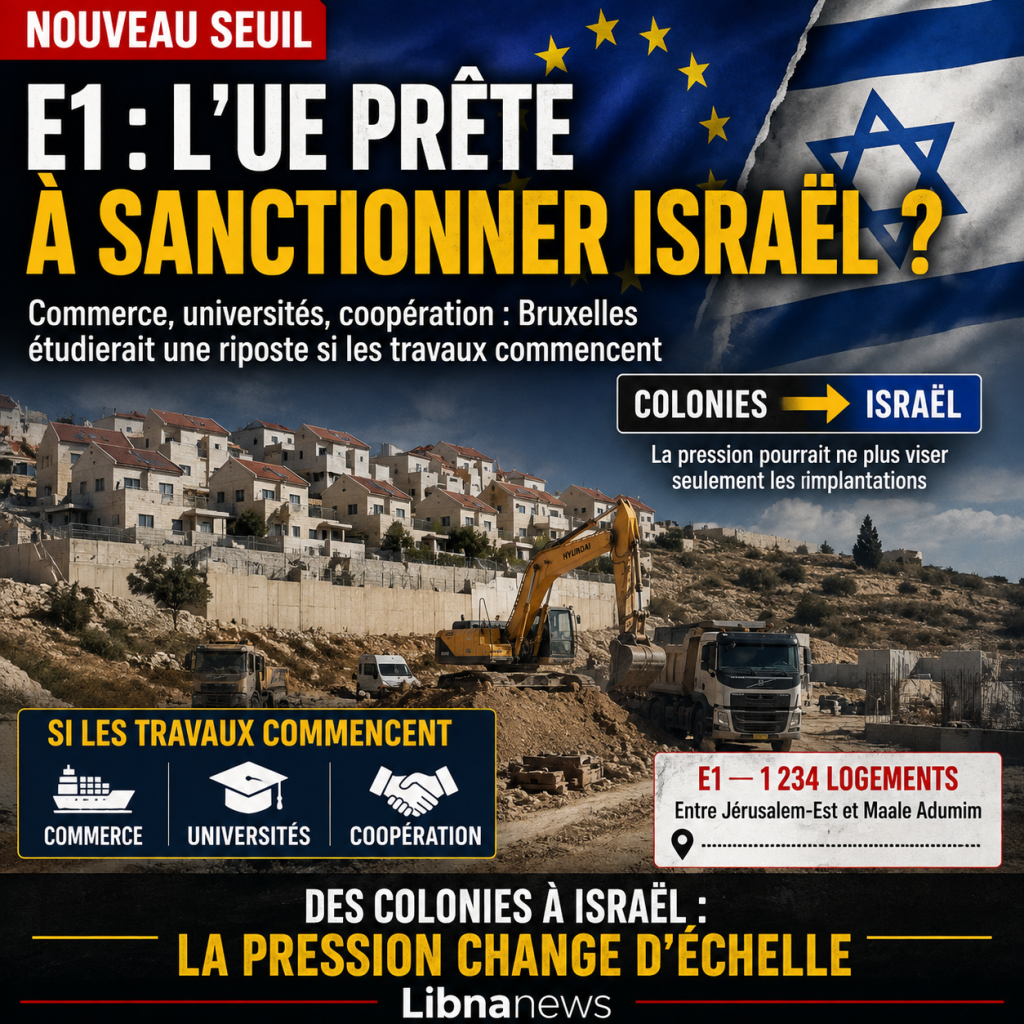
The European Union would have prepared a first set of sanctions against Israel that could be triggered if construction started in E1 area in the occupied West Bank. According to reports from the Israeli channel Channel 13, which quotes two Western diplomats, the measures envisaged would affect trade, academic relations and certain diplomatic and security cooperation. Their scope would be above all a major political change: Brussels would study measures aimed at Israel as a whole, not just settlements and economic activities directly related to them.
This threat remains conditional. On 21 August 2026, the European Union did not announce the formal adoption of this package or publicly confirm that it would automatically enter into force. The available information describes a mechanism prepared in the event of a change from tenders to actual construction. This distinction is essential. But it shows how far the crisis around E1 could now go: a project of 1,234 housing units east of Jerusalem threatens to move the European dispute with Benjamin Netanyahu’s government from diplomatic to economic and institutional relations.
E1 could change the scale of the European response
According to the information reported by Channel 13, the European Union has drawn up a list of measures that could be activated if Israel continues the E1 project in practice.
Among the options mentioned is a change in the labelling of Israeli products. The measure would no longer apply only to goods from the West Bank settlements, but to Israeli products more generally.
Other provisions would affect academic cooperation, while some diplomatic and security relations could be suspended or reduced.
However, a distinction should be maintained between administrative preparation and political decision-making. The measures are reported by an Israeli media on the basis of two Western diplomatic sources. Not all of them have been publicly detailed by the European institutions.
At this stage, therefore, there is no basis for presenting their adoption as acquired.
The mere fact that such a device is being studied nevertheless has an important scope. For years, European policy has sought to distinguish legally and economically the internationally recognized territory of Israel from settlements in the occupied Palestinian territories.
If general measures were applied to Israeli products or programmes of cooperation with the State of Israel, this separation would become less clear.
Why the distinction between Israel and settlements is essential
The European Union maintains important economic, scientific and institutional relations with Israel while considering settlements in the West Bank as illegal under international law.
This position led to the distinction between the two spaces.
A product from a colony is not politically treated in the same way as a product manufactured in Tel Aviv or Haifa. Similarly, agreements with Israel are not expected to have an automatic effect in the occupied territories.
This distinction allows Europeans to maintain a close relationship with Israel while refusing to recognize its sovereignty over settlements.
The device reported by Channel 13 could alter this logic.
If the E1 response involves products originating from Israel as a whole, Israeli universities or State cooperation programmes, the cost would no longer be limited to actors directly located in the West Bank.
The sanction would then seek to make the Israeli Government bear a more general price for a policy in the occupied territories.
This change would be much more politically difficult for Israel to accept. It would also be so for some EU Member States, which support the European opposition to colonization but remain reluctant to take general measures against the Israeli state.
Tenders turned an old threat into a concrete calendar
The current pressure is due to a new administrative step.
Israel issued on Tuesday a tender for seven residential complexes representing 1,234 housing units in zone E1. They belong to a broader programme of approximately 3,400 dwellings approved in August 2025.
Construction has therefore not yet begun. But the project is no longer simply a plan debated by the authorities.
The opening of tenders allows companies to position themselves to carry out the work. It thus brings E1 closer to its materialization on the ground.
It is precisely at this stage that several European countries have decided to raise the tone.
France, Germany, Italy and the United Kingdom called the publication of « unacceptable » tenders on Thursday. They called on the Israeli government to immediately withdraw its plans and halt the expansion of settlements in the West Bank.
Their warning is no longer addressed solely to the Netanyahu government. The four countries asked companies not to participate in tenders, citing the legal and reputational risks associated with possible involvement in serious violations of international law.
This approach seeks to act even before the construction sites are opened.
Why E1 triggers such a strong reaction
The number of dwellings is not sufficient to explain this mobilization.
Zone E1 is located east of Jerusalem, between the city and Maale Adumim. Its position gives it far greater strategic importance than its approximately 12 square kilometres.
The construction of a continuous Israeli assembly in this space would strengthen the connection between Jerusalem and Maale Adumim. At the same time, it would complicate Palestinian territorial continuity between the northern and southern parts of the West Bank and would increase the separation of East Jerusalem from its Palestinian environment.
For this reason, the project remained frozen for long periods despite its seniority.
US and European pressure had helped to prevent its complete development. Several Western governments considered E1 as one of the lines not to be crossed if a two-state solution were to remain territorially feasible.
The problem is both physical and diplomatic.
A Palestinian State does not depend solely on an international recognition or a border drawn on a map. It must have sufficient continuity to enable the movement of its population, the functioning of its economy and the administration of its territory.
E1 is precisely in one of the most sensitive parts of this geography.
Pressure extends beyond four countries
The international response has also expanded since the first declarations.
In addition to the French, German, Italian and British positions, the positions of other European and Western governments have been added. In particular, Belgium has qualified unacceptable tenders, while the Netherlands, Norway and Canada have joined the project’s condemnations.
This extension counts for the European Union.
A major European sanction does not depend solely on the Commission or the European External Action Service. Depending on its legal nature, it may require political agreement between Member States, and European divisions on Israel have regularly limited the scope of joint measures.
The real test is therefore not only whether European officials have prepared options. It involves determining whether the Twenty-Seven can agree to use them.
Germany is in particular a key player. Berlin maintains a special relationship with Israel and has traditionally been more cautious than some European partners when it comes to measures that could directly affect the Israeli state.
The fact that Germany participated in the conviction of E1 is politically significant. However, this does not mean that it would automatically approve each of the sanctions reported.
London is already starting to increase pressure
The United Kingdom, which no longer belongs to the European Union, acts in parallel.
London summoned the Israeli affairs officer and requested the withdrawal of the tender. The British government has also announced that it is preparing further measures against those involved in the expansion of settlements.
This is helping to boost Western pressure without creating a uniform European policy.
It also reveals a gradual strategy.
In the first phase, governments politically condemn the decision. In a second, they warn companies that could participate in tenders. A third could directly target individuals, institutions or economic relationships associated with the continuation of the project.
The package allocated to the European Union would represent a fourth, much more sensitive step: to impose certain consequences on the relationship with Israel itself.
Smotrich and Ben Gvir reject pressure
The Israeli government, for its part, is responding by challenging the very principle of this foreign intervention.
Foreign Minister Gideon Sa He invoked the right of Jews to live throughout the « Earth of Israel » in response to requests to stop construction in the West Bank.
Finance Minister Bezalel Smotrich also defends the project. As a central figure in the movement for settlement expansion, it presents the development of this area as both historical and security considerations.
Itamar Ben Gvir also rejects foreign pressure on Israeli policy in the West Bank.
These reactions show why the European threat may not be sufficient to cause a setback.
For European governments, E1 is an infringement of the possibility of a viable future Palestinian state. For part of the Israeli coalition, building in the West Bank is, on the contrary, a matter of historical law and political objective.
The conflict therefore does not concern solely the economic cost of a decision. It concerns two incompatible conceptions of the future of the territory.
Sanctioning Israel would be a political problem for Europe
The European difficulty begins here.
Sanctions are effective when changing the calculation of their target. Brussels should therefore impose a sufficiently high cost for the Israeli government to consider suspending E1.
But the greater this cost, the more difficult it becomes to reach agreement between Member States.
A reduction in university cooperation may affect research programmes and institutions that have no direct responsibility for settlement decisions. A general trade restriction would affect businesses and workers within Israel. A suspension of security cooperation could also affect European interests.
This is the classic dilemma of sanctions: to target broadly enough to exert real pressure without producing political effects contrary to the desired objective.
A measure limited to those directly involved in E1 would be easier to defend, but its enforcement power would remain reduced. A measure affecting all economic relations with Israel would be much more powerful, but also much more difficult to adopt.
General labelling would be a particularly strong signal
Among the measures reported, the labelling measure deserves special attention.
The European Union has for a long time stressed the distinction between products originating in Israel and those originating in settlements. This policy materially reflects its legal position: the territories occupied since 1967 are not considered to be part of Israeli sovereign territory.
Extending a specific labelling requirement to Israeli products in general would therefore change the nature of the signal sent.
The measure would no longer simply aim to allow the consumer to distinguish the origin of a product from a colony. It would make trade relations with Israel an instrument of political pressure.
The details will, however, be decisive. As at 21 August, the information available does not clarify the exact legal form of any labelling, its scope or the products concerned.
To present this measure as already adopted would therefore be premature.
A threat to prevent bulldozers from arriving
The timetable also explains why Europeans make their warnings public before work begins.
Once housing is built and inhabited, going back becomes politically and materially much more difficult.
The cost of administrative suspension is low compared to the cost of future dismantling. Governments opposed to E1 therefore seek to intervene in the gap between the tender and the construction site.
The threat of sanctions has a preventive function in this context.
She told Israel that the diplomatic cost could increase at the very moment when the project would leave the administrative domain and become a physical reality.
At the same time, it sends a message to companies which may participate in the project. The risk is no longer just that of public criticism: economic measures could change the very conditions in which they work with Europe.
E1 becomes a credibility test for the European Union
The case finally puts Brussels before its own statements.
The European Union has long maintained that colonization is contrary to international law and that a two-State solution requires a viable Palestinian territory. E1 is precisely presented by Europeans as a project likely to seriously undermine this viability.
If the work starts without any further response, the gap between the European legal position and its political translation will appear more clearly.
On the other hand, triggering general sanctions against Israel would make the Union pass a threshold it has long avoided.
That is why the central question is no longer just whether Brussels condemns E1. This position is established. It consists of determining how far Europeans are prepared to go to prevent its construction.
As at 21 August, the response to two decisions remains suspended. The first belongs to the Israeli government: to transform the tenders into construction projects. The second will belong to the Europeans if the work begins: to maintain the historical distinction between Israel and the settlements or to accept, for the first time in this matter, that the continuation of E1 has a cost for the relationship with Israel as a whole.




