

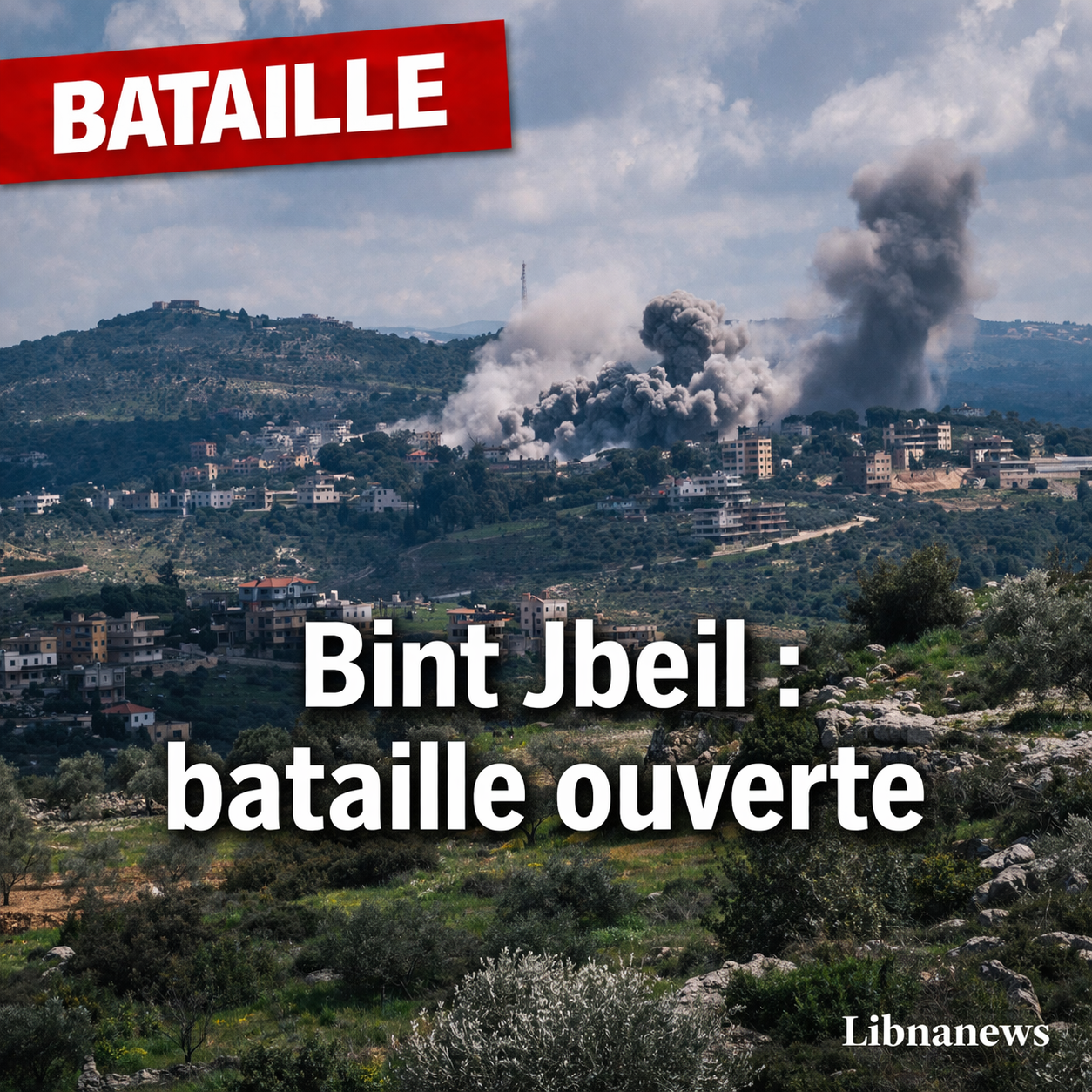
In Bint Jbeil, Israeli images give the impression of a city already fallen. Yet, as the information overlaps, another reading is required: the Israeli army has advanced well, it visibly controls certain symbolic points, but the battle does not yet appear to be over. And beyond this highly memory-filled city, it is the entire front of southern Lebanon that remains in motion, under strike, under artillery and under ground pressure, while Israel has made it one of its main maps in the framework of the Israeli-Lebanon negotiations.
Why Bint Jbeil blurs readings
The Israeli story changed its tone very quickly in Bint Jbeil. In less than twenty-four hours, he moved from the announcement of an encirclement and a land assault to the staging of more spectacular signs of domination: the taking of the stadium where Hassan Nasrallah had spoken in 2000 on the « spider web », the dissemination of a photo showing a commander of the Givati Brigade in the city, and then an announcement about the capture of three Hezbollah fighters. Taken together, these elements give the image of a fallen city or about to be. But at a time when the Washington talks are opening, this image remains more political than militaryly stabilized. The Israeli formulations themselves show this: the army did not say that it had completed the complete capture of the city, but hoped for « total operational control » in the coming days.
This is where confusion arises. A city actually taken does not, in principle, continue to produce such clear evidence of open battle. But several signals go in the opposite direction. A news agency reported on Monday that the assault had just begun after the city was encircled. Another described fierce fighting, with Israeli forces appearing to surround Bint Jbeil while Hezbollah fired rockets and shells in an attempt to repel them. A Hezbollah official even said that « the battle is not over » and that a significant number of fighters remain besieged in the city. This contradiction between images of Israeli penetration and persistent signs of resistance explains why the strongest formula this Tuesday is not « Bint Jbeil is taken », but « Bint Jbeil is disputed, with a strong Israeli advance ». This is an inference from consistent sources, not a formal confirmation of an independent party.
The past night further reinforces this caution. Israeli media reported on Tuesday that ten Israeli soldiers had been injured in a confrontation in Bint Jbeil, three of them seriously. The same sequence was relayed to Lebanon from Israeli sources. Again, the signal is clear: an army can enter a city, control certain symbolic points and, despite everything, suffer heavy losses, which is precisely the sign of an unstabilised combat environment. If the urban heart were fully neutralized, we would rather expect a story of raking and consolidation. The fact that combats of sufficient intensity to injure ten soldiers were still reported in the aftermath of the Israeli announcement of encirclement shows that the battle did not go from the offensive stage to the administrative stage.
Another element is the same: access even to the sector remains severely degraded. A news agency reported that it was not possible to access the village of Sultaniyah, Bint Jbeil district, to bury a Red Cross volunteer killed the day before, due to intense fighting. This logistical detail is actually an important military marker. When an area is described as too dangerous or too inaccessible for such essential movements, this means that the ground right-of-way remains contested or at least unstable. In addition, the International Committee of the Red Cross has publicly expressed its deep concern after successive attacks on medical personnel in South Lebanon. Again, it is not a post-battle decor, but an environment where the forehead still moves.
What Israel shows, what Hezbollah challenges
The interference also comes from the way each camp communicates. Israel shows what it controls: a stadium, crossing points, forward command images, weapons seizures and the alleged capture of combatants. Hezbollah, on the other hand, insists on what it still challenges: direct clashes, salves fired at Israeli positions around the city and the ability to inflict losses in the close combat. A media close to Hezbollah relayed on Monday and Tuesday demands for fire on groups of Israeli soldiers near the Moussa Abbas complex and east of Bint Jbeil, as well as on vehicles at Ain Ebel. These claims come from one stakeholder and must be read as such. But, in conjunction with the Israeli casualties and the descriptions of news agencies, they are sufficient to show that the city has not entered an undeniable phase of total control.
In reality, Bint Jbeil is in a classic grey area of urban battles. An army can occupy axes, circle, dominate high points or symbolic buildings, while encountering persistent resistance in other streets, other neighbourhoods or on the immediate periphery. That’s probably what’s happening here. The Israeli army has made clear progress and has sought to give this progression a strong psychological dimension, by seizing a site associated with one of Hezbollah’s founding stories. But as long as it speaks of a control to be obtained « in the days », as long as Israeli sources themselves report many wounded in the city and as long as Lebanese and international sources still speak of ongoing fighting, the expression « take of Bint Jbeil » remains premature.
This battle also counts more than the only fate of a border town. Bint Jbeil has strategic value, because it commands a set of villages in the southern central sector and weighs in the Israeli logic of creating a security band. But it also has a disproportionate symbolic value. It is the city of the 2000 speech, the one of the war of 2006, where Hezbollah long wanted to embody victorious resistance against Israeli incursions. For Israel, showing, photographing, capturing fighters or raising evidence of a sustainable presence is therefore worth more than just tactical success. This makes it possible to send a message to Hezbollah, Israeli opinion and Lebanon as negotiations indirectly linked to the future of the South open in Washington.
The front of South Lebanon is not limited to Bint Jbeil
The key point, however, is that communication on Bint Jbeil should not mask the real state of the front in South Lebanon. This is not a city, even though this city is now focusing attention. Since Tuesday’s early hours, Israeli strikes have spread over a much wider arc, from the coast of Tyre to the interior of Bint Jbeil district through Nabatiyah. A media near Hezbollah reported shelling of Tibnin, with extensive damage near the government hospital, as well as on Shabriha, Shehabiyah, Jabal al-Batm, Mansouri and Baflay. The same media then reported strikes on Deir Antar, Qlaileh, the surrounding areas of Ain Baal and Aytit, al-Housh in Tyre, Qalaway and Bourj Qalaway in Bint Jbeil district, as well as a drone attack on the Msayleh road.
The dispatches of the Lebanese National Agency describe the same expansion of the battlefield. They report, according to the hours, a strike on Arnoun, raids at dawn on Tibnin, Chabriha and Chehabiyé, artillery bombardment on Kafra and Yater in Bint Jbeil District and on the outskirts of Yanuh in Tyre District. Another dispatch reported a provisional count of four deaths and eight injuries in Tyre and its periphery, with one death and three injuries in Shabriha, one death and three injuries in Aitit, one death and two injuries in Qlaileh, and a fourth death recorded in another part of the area. Although these assessments may still evolve, they show that Israeli military pressure is not only on the line of land contact with Bint Jbeil, but on the whole of the South.
In other words, the South Lebanese front operates at two speeds. On one side, a high-intensity land battle is waged in and around Bint Jbeil, with an Israeli objective of urban control and consolidation of defensive depth. On the other hand, a campaign of airstrikes, drones and artillery continues to hammer larger communities, including areas far from the main urban combat. This coupling is not insignificant. It allows Israel to weigh simultaneously on the fighters present in the central sector of the front and on the logistics, human and psychological environment of South Lebanon. This also means that a possible « take » of Bint Jbeil, if later confirmed, would not mark the end of the battle in the South. It would only be a step.
An active front line
Hezbollah is precisely trying to prevent this linear reading. In his press releases issued by a media outlet close to the movement, he claims to have targeted Israeli soldiers east of Bint Jbeil, hit a Hummer vehicle in Ain Ebel and a logistics vehicle in Kiryat Shmona, and then shot down a Hermes 450 drone over Siddiqin. Again, these announcements are the communication of a committed actor, and they are not worth independent verification. But they reflect a clear will: to show that, even under pressure on Bint Jbeil, the front remains broad, mobile and capable of producing tactical blows both on the Lebanese side of the border and against Israeli positions north of Israel. It is this ability to maintain several points of friction that complicates the transformation of an Israeli local advance into a clear and immediately legible victory.
On the Israeli side, neither is the picture of a pacified front. A news agency reported Monday that the army claimed to have intercepted more than ten drones and rockets fired from Lebanon since the morning, while a Hizbullah rocket struck Nahariya and slightly injured a woman. On Tuesday, Israeli media also confirmed the death of an Israeli reservist in southern Lebanon in a separate incident, as well as the injuries of several other soldiers. These elements matter, because they recall that Israeli air superiority and ground progression do not nullify Hezbollah’s persistent nuisance capacity. Israel’s northern front remains exposed to fire, while the units engaged in Lebanon continue to pay a human cost.
That is why the most just formula for describing South Lebanon on Tuesday is neither that of an Israeli breakthrough nor that of a status quo. The ground shows something else: a real Israeli thrust, especially around Bint Jbeil, combined with a still tangible Hezbollah capacity to slow down, bleed and complicate this advance. It’s not the same thing. A thrust can change the position map, the depth of the military presence and the local power ratio. But it is not enough to produce a simple picture of a collapsed front. As long as the urban clashes continue, Israeli soldiers are injured in the city and the strikes multiply over a large southern arc, the front remains open, nervous and moving. This reading is a synthesis based on consistent sources, more than a single proclamation.
A local battle that already weighs on the political sequence
The political sequence further reinforces this impression. The Washington talks are opening up precisely as Israel tries to impose a new hierarchy of facts on the ground. The city of Bint Jbeil, by its symbolic weight, became a strategic narrative instrument. If Israel can say that it has fallen, or almost, it arrives at the table with an additional argument: that of a border band already partially reshaped by force. Conversely, if the city continues to absorb fighting, loss and resistance, Hezbollah can argue that no security scheme can be imposed without major cost. This local battle thus becomes a test of credibility for both sides, even beyond its own geographical value.
In Lebanese circles, this ambiguity also feeds a darker reading. To say too quickly that Bint Jbeil is taken would be to validate the Israeli account of a rapid recomposition of the South. To deny any Israeli advance would be to ignore concrete indications: encirclement, penetration, visible presence of Israeli officers in the city, taking a highly symbolic site and repeated announcements over the coming days. The right analytical distance is therefore to distinguish between entry, point control of certain sites and complete control of an urban space. This last step is not demonstrated at this stage. The fact that an Israeli official is still talking about complete control « in the days » is itself an implicit admission that this goal is not yet fully achieved.
This blur is also consistent with the very nature of the war in South Lebanon since the beginning of March. The lines move, but rarely in a clean way. Localities change status faster in narratives than in the field. A road can be under fire, a neighbourhood penetrated, a symbolic building occupied, an artillery axis installed, without it meaning that an entire city is neutralized. This is particularly true in Bint Jbeil, where the urban topography, the military memory of the place and the defensive preparation accumulated by Hezbollah make any instant verdict suspicious. What we see today is less an unquestionably conquered city than a confrontation in which Israel seeks to convert a tactical advance into a political fact, even before the last fighting is silent.
The rest of the South confirms this logic. Hits on Tibnin, Deir Antar, Qlaileh, Aitit, Chabriha, Kafra, Yater, Arnoun or on the outskirts of Tyre do not look like finishing operations after a local victory. On the contrary, they draw a broader crushing campaign, designed to keep pressure on several sectors at once. As long as this pressure is so dispersed, any reading strictly centered on Bint Jbeil misses part of the picture. The front in South Lebanon is not a linear front with a single key city. It is a set of punched pockets, crossed by the same logic: pushing to the ground where it is possible, hitting from the air where it allows to disorganize, and preventing the opponent from turning a local battle into a story of stabilized resistance.
At this stage, therefore, the most rigorous formulation remains as follows: Bint Jbeil is not clearly « taken » in the sense of a complete, undisputed and consolidated mastery, but it is well at the centre of a major Israeli advance that has already produced visible and symbolic gains. At the same time, the South Lebanese front remains very active on a wide arc, from Tyre to Bint Jbeil district, with deadly strikes, artillery bombardments and clashes still dense enough to change the situation from hour to hour. In this war, the map changes quickly, but words often change even faster than the map. In Bint Jbeil, it is precisely this gap between narrative and real control that needs to be monitored in the next few hours.




