

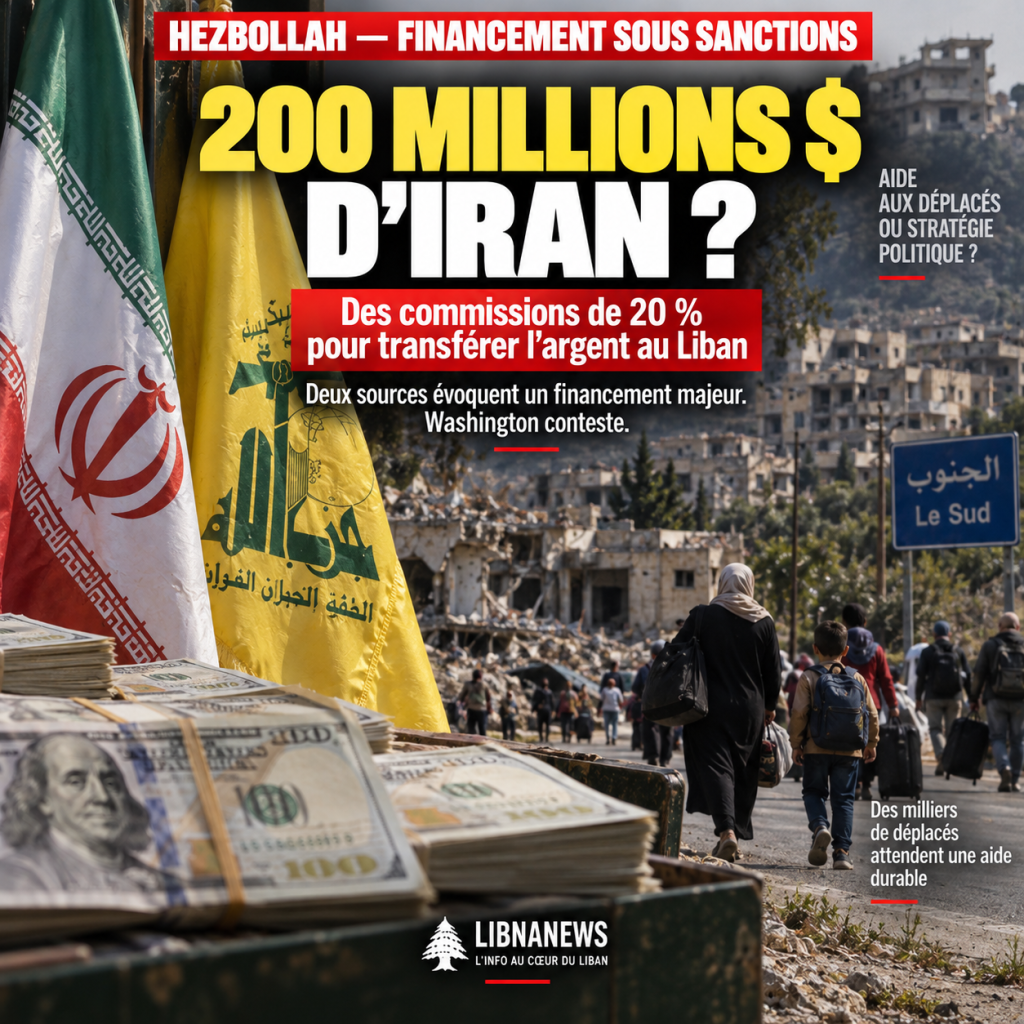
Two sources advance $200 million transfer
Two sources submitted as informed claim that Hezbollah received $200 million from Tehran in September 2026. The money was reportedly destined to support Lebanese displaced by the war with Israel. The information, released on 8 October, concerns a financial operation of considerable magnitude in the context of reinforced sanctions and increasing restrictions on the movement of funds. However, it does not constitute a bank confirmation of the transfer. Neither the list of senders, nor the list of beneficiaries, nor the documents for tracking payments are published. Both testimonies describe an alleged transaction, without providing verifiable accounting of the money actually received and distributed.
Hezbollah’s reaction confirms part of the context, but not the whole story. A party official states that a sum of money could be raised and that a distribution plan must be announced within the following days. It does not specify the exact amount or source of resources. This silence does not constitute confirmation of the $200 million allocated to Iran. Nor does it allow for the exclusion of several financings from different sources. The requested Iranian authorities did not provide, in the reported evidence, a response to confirm the operation. This difference between information obtained from anonymous sources and a limited recognition of the party must remain at the centre of the investigation: the existence of an aid programme does not alone demonstrate the origin of the funding.
Commissions announced at 20%: what the figure reveals and what it does not prove
The most singular detail concerns the remuneration of intermediaries. The information published refers to a 20 per cent commission to send funds to Lebanon, four times the standard level. If this proportion applied to the totality of a gross transfer of $200 million, it would amount to $40 million in costs, leaving theoretically $160 million available after remuneration of intermediaries. This is a conditional calculation, not an amount of commission actually documented. There is no evidence that the $200 million represents a gross sum, a net amount received by the party or several transactions subject to different tariffs. Neither does the publication provide contracts or statements confirming that the rate has been applied consistently.
However, the figure illustrates an identifiable economic phenomenon: when a financial circuit becomes more risky, actors willing to participate may require higher remuneration. Sanctions, transaction monitoring and fear of measures against intermediaries contribute to increasing the alleged cost of the transfer. But this general observation does not allow the money journey to be reconstructed. The information examined does not specify the countries of transit, the establishments that may be requested, or the share of cash payments. Any detailed description of a particular network would therefore be speculative. The real documentary education is more limited, but important: the sources advance an exceptionally high cost, which could reduce the resources finally destined for families if the commission is taken from the announced envelope.
Penalties complicate the circulation of money without establishing its route
The alleged transfer occurs as the United States strengthens measures against Tehran and the financial channels associated with its allies. The reported increase in fees is presented as a consequence of these obstacles. However, it would be misleading to deduce from this data the existence of a precisely identified route. The available information does not describe any judicial records related to the transaction, any seizure of the amounts involved and any documentation to establish the process. Nor is it clear whether the intermediaries would have been paid for simple transport, currency conversion, local liquidity provision or a combination of services. These distinctions are decisive for understanding the real cost of a financial transaction.
The issue goes beyond the question of the amount transferred. Funding for a sanctioned organization may encounter obstacles even when its announced use is humanitarian. The stated destination of the funds does not guarantee that all intermediaries can treat them without regulatory risk. Conversely, the reference to assistance to internally displaced persons does not lead to the conclusion that resources are used for military expenditure. In order to establish the actual nature of the payments, documentation should be available showing the receipt of the funds, their allocation and the expenses incurred. At this stage, public information does not provide this chain of evidence. They highlight the difficulty of separating funding announcements and independent job verification in an organization with political, social and military structures.
Displaced people at the centre of a battle of social legitimacy
The announced use of funds concerns Lebanese displaced by the clashes with Israel in 2026. This destination is politically significant. In areas affected by destruction, assistance to families is not limited to a one-time payment. It can cover housing, food, health, transport and, in the longer term, housing rehabilitation. Hezbollah presents its assistance as a response to the needs of the people who have borne the consequences of the war. The ability to quickly distribute resources thus becomes part of its relationship with the inhabitants, especially when public mechanisms are deemed insufficient or late.
However, the information available does not give the number of families to benefit from the announced programme, the average amount of aid or the selection criteria. No detailed payment schedule is presented in the sections examined. It is therefore impossible to calculate the amount each household would receive or to measure the actual coverage of needs. An announced $200 million envelope may seem massive, but its effect depends on the number of beneficiaries and the nature of the expenses covered. Emergency assistance should also be distinguished from destruction-related compensation, two policies whose costs and procedures differ. Without these data, the announcement remains an indication of presumed financial capacity rather than a controllable social balance sheet.
The American denial opens a major contradiction
The information on the $200 million generated an American reaction challenging the story of an Iranian transfer of this magnitude. This challenge does not in itself resolve the question: it creates a contradiction between the anonymous sources behind the information and the position expressed by Washington. Both versions are not based on publicly available documents for independent comparison. It would therefore be incorrect to present the payment as definitively established, but equally excessive to consider that the only denial is sufficient to prove its non-existence. Caution requires maintaining the three levels of reporting: the assertion of sources, Hezbollah’s recognition of unspecified resources, and American protest.
This divergence is not secondary. The source of the funds directly influences the political interpretation of the aid. A confirmed Iranian transfer would show that Tehran retains a significant capacity to finance its ally despite the sanctions. Funding from another source would lead to a different reading of the resources available. The question of the amount is also crucial: an amount announced does not necessarily correspond to immediately usable liquidity. The most useful documents would be receipts, distribution records and proof of expenditure. None of these elements appear in the information used. The file must therefore remain presented as a disputed disclosure, not as a closed accounting.
Financial aid in the context of losses and reconstruction
The announcement comes after clashes that caused displacement and extensive damage in the South. Assistance needs may last well beyond the acute phase of fighting. Families who cannot return to their homes must continue to finance their accommodation and current expenses, while damaged villages require rehabilitation. The reconstruction schedule also depends on the security situation, the withdrawal of Israeli forces and access to the affected areas. Financial aid cannot therefore be assessed independently of the physical obstacles to the return of the inhabitants.
Hezbollah is not the only actor concerned with these needs. The State, local authorities and humanitarian agencies also have responsibilities, but the documents examined do not allow a precise comparison of their budgets and results with those of the party. Any claim that one scheme would cover more families than another would require consistent data on beneficiaries and payments. The issue at stake in the announcement of the $200 million lies in a very concrete question: what sums actually come to the displaced, when and for what expenses? Without this information, the overall amount remains more visible than the social effect of the transaction.
Social financing and political capacity: two issues not to be confused
The resources allocated to Hezbollah are given special attention because the party retains a central military and political role in Lebanon. The possible existence of significant Iranian aid could fuel the debate on its financial autonomy and relations between Tehran and its regional allies. However, it does not allow, without further evidence, the determination of the party’s military budget. The funds pledged for internally displaced persons should not automatically be treated as weapons expenditure. It would be equally imprudent to assume that their declared destination has been verified. A serious investigation must maintain the separation between the alleged origin of the money, its announced allocation and its actual use.
This distinction is important in the context of the Hezbollah arms negotiations. The government of Nawaf Salam defends the monopoly of force by the institutions, while the party refuses disarmament imposed under foreign pressure. The financial file does not resolve this constitutional disagreement. It shows, however, that the influence of an organisation is not solely based on its arsenal: it also depends on its ability to support its close populations. If the aid programme is actually implemented, its political importance will be measured over time, through payments, regularity and actual beneficiaries. At this stage, these results are not documented.
Audits that are still missing on the 200 million
Four questions remain unanswered in the information of 8 October 2026. Does the amount of $200 million correspond to an amount promised, transferred or actually received? Do 20% commissions concern all funds or only some operations? Which agency is responsible for distributing money, according to what criteria and with what controls? Finally, how many households have already received assistance and for what amount? The available sources do not fully answer any of these questions. Their absence prohibits turning the figure announced into a balance sheet of financing or proof of a particular circuit.
However, information has a precise journalistic significance. It reveals the assertion of major Iranian financing, the exceptional cost attributed to intermediaries, partial recognition of resources by Hezbollah and an American challenge. These elements make up a sensitive but still open file. Follow-up to the announcement should focus on the actual distribution arrangements rather than the repetition of the initial amount. A published aid plan, identifiable payments and a breakdown of costs would help to measure what IDPs actually received. Until these elements are available, the $200 million remains an amount reported by anonymous sources, whose source, final cost and use are not fully established.





Comments