

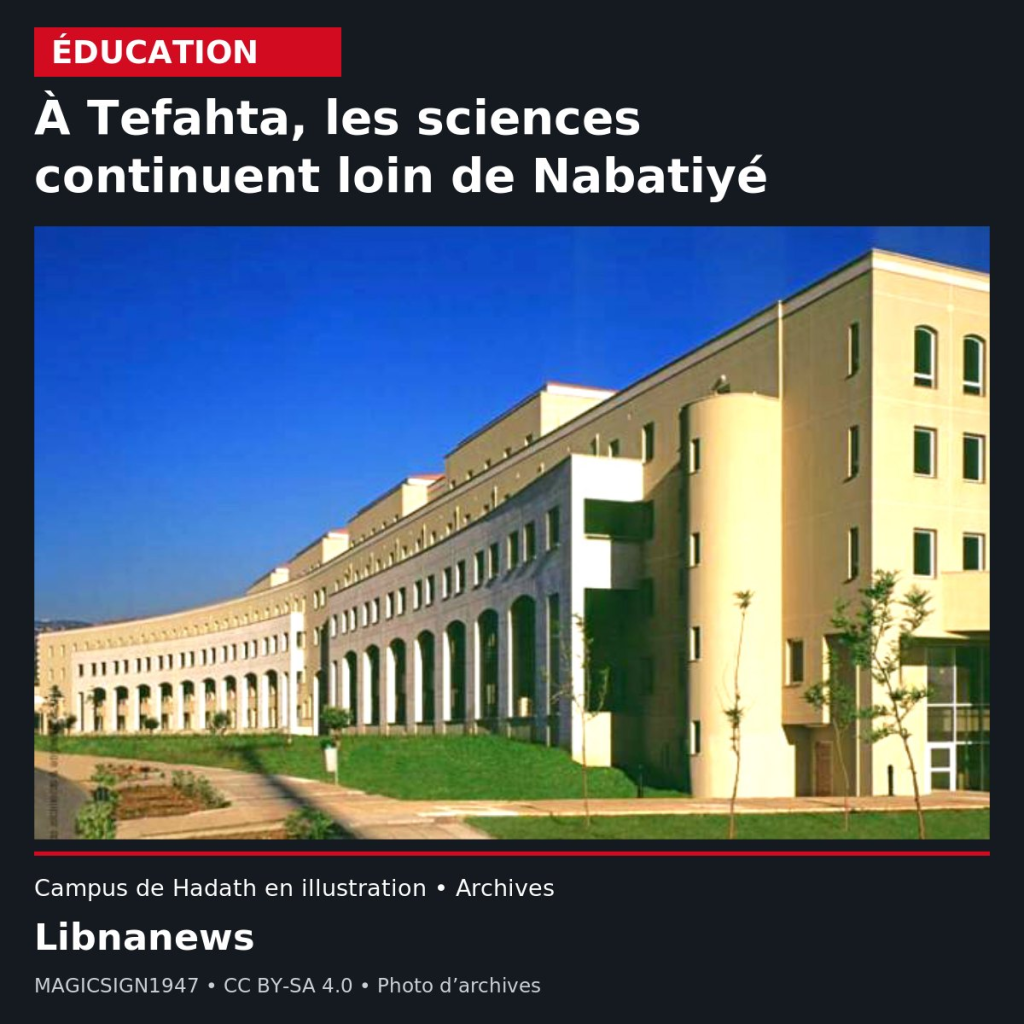
In Tefahta, the Lebanese University changed its address to maintain its courses in the South. Branch V of the Faculty of Science temporarily left the university district of Nabatiyah. It occupies a building that the municipality originally intended for a public high school. The academic year 2026-2027 began there in the face-to-face, as confirmed by the institution in its official announcements.
This move should allow studies to continue despite the risks to the origin site. It does not mean closure of the branch or permanent transfer. The question of returning to Nabatiyah remains distinct from the organization of teachings in the replacement premises.
In Tefahta, a municipal science building
The head of the branch, Wassim Abdallah, explained that the decision had to be taken before the start of the academic year. Waiting for an improvement in security conditions would have left the students uncertain when they resumed their studies. The choice of a provisional site therefore meets a requirement of continuity.
According to his account, the municipality made the building available to the faculty free of charge. The South Council provided rehabilitation and equipment. These two interventions made it possible to welcome an academic institution into premises for another educational use.
The building offers a concrete solution to an immediate difficulty. However, its provision does not in itself indicate the length of time the faculty will occupy. No schedule for returning to the university district of Nabatiyah is announced in the available items.
900 administrative entries announced
The director reports 900 students registered administratively. This number provides information on the records registered with the branch. It does not constitute a count of the daily presence in the rooms, nor a balance sheet of students who have completed their year.
An official announcement by the Lebanese University had set the opening of on-site registrations on 22 September 2026 in the new Tefahta building. Students were invited to complete their online process and then present the necessary materials to the faculty. The institution then confirmed the start of the face-to-face lessons.
The distinction between enrolment and attendance is important in an inappropriate faculty. The administrative organisation can be ensured while students’ journeys remain subject to traffic and safety constraints. However, no absence rates are provided: it would be unwarranted to deduct a group dropout.
Routes and landmarks to rebuild
Roua Qanso, a master’s student in biology, describes the changes imposed by the move. His journey to the faculty must now pass through Doueyr, Charqiyah and Kauthariyet al-Sayyad before reaching Tefahta. It evokes a place smaller than that of Nabatiyah, but which she considers safer.
His appreciation combines two realities of student life: attachment to the old rooms and their environment, and the relief of being able to study in conditions felt less threatening. This testimony does not measure the safety of all movements. It shows what campus change represents at the scale of an individual journey.
For scientific training, continuity is not limited to opening a classroom. Practical work and access to equipment are part of the curriculum. Public information confirms the layout of the site, without detailing the capacity of each laboratory or all the equipment transferred. They therefore do not permit any interruption of the practical work or complete equivalence of the installations.
Maintaining the presentiel in Tefahta is the element acquired. The continuation will depend on the operational conditions of the site and the evolution of security in Nabatiyah. For students, the immediate priority remains to be able to complete their training without a building displacement becoming a break-up.





Comments