

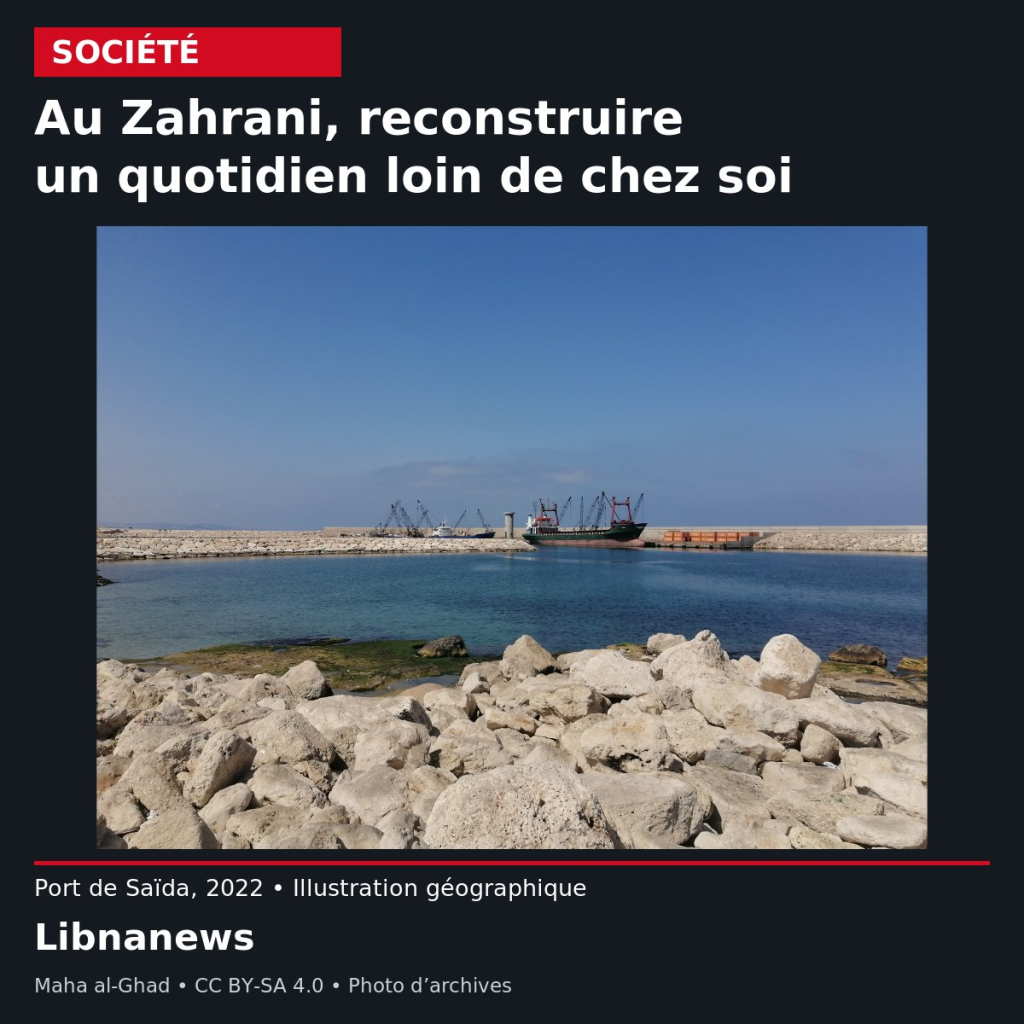
On the Zahrani coast, waiting for the return took the form of new addresses, reopened shops and daily trips to reorganize. Approximately 10,000 internally displaced persons live in 18 localities in the southern region, according to local estimates reported in early November. They have moved closer to their villages without necessarily being able to return.
The trip is no longer about finding a roof for a few days. As it continues, families seek income, municipalities adjust their services and ties to places of origin are reconstructed remotely. The installation remains experienced as provisional, even when it calls for decisions that engage the daily.
Zahrani coast attracts displaced families
The proximity of the coastal motorway, family relations and relatively lower rents than in cities and their suburbs explain part of this concentration. Some households have moved away from their first destination to the South. However, they do not return to their own home.
In Sarafand, there are approximately 800 displaced families, or 3,600 people, in the city council. This local count is not mechanically added to the estimated 10,000 people in the region: Sarafand belongs precisely to this set. The numbers describe a situation reported at the beginning of November, which could evolve with new movements.
Mayor Ali Haidar Khalifeh underlines the role of services, shops and the coastal situation in the reception. The municipality also has an ancient experience of hosting families from border villages. The links created in previous wars sometimes facilitate the search for housing, not enough to solve current needs.
Rent and employment burden on municipalities
The arrival of additional families increases the demand for housing. Local officials describe difficulties in finding available apartments and seek to contain rents. The municipality of Sarafand also requested that displaced persons be taken into account in access to employment opportunities.
At the level of the Union of Zahrani Coastal Municipalities, its President Ali Matar refers to cooperation with humanitarian associations and organizations. The interventions concern assistance to accommodation centres, approaches to municipalities and finding solutions when reception is prolonged.
Approximately 800 people remain in three accommodation centres in the area, according to the same situation. This number corresponds to a particular form of reception, not all of the displaced. A large proportion of families live in rented housing or are housed by relatives. Adding these figures without knowing the overlap would distort the assessment of needs.
Reopening a business without clearing the lost village
In Sarafand, Mohammad al-Sayyed and his son chose to resume activity after the loss of their home and source of income. They opened a shoe shop on the axis between Sarafand and Aaqbiyah. The sign takes the name of their business of Bint Jbeil, to which they added that of the city.
The gesture makes it possible to identify know-how and previous activity. It also retains a reference to the place left. In Erzai, a sign of falafels bears the name of Aitah al-Sha`b. In these examples, the economic recovery is accompanied by a way to keep the village visible in the reception area.
These openings do not demonstrate that the losses are offset. A new store must find its customers and cover its expenses in a still unstable situation. Rather, they show attempts to get out of the aid dependency alone, without any certainty as to the length of the trip.
Nine dwellings and one library destroyed
Tarek Mezrani’s journey reveals another dimension of this inner exile. Originally from Houla, he said he had changed housing nine times in three years, between several towns and villages. His settlement in Zrariyé took him back to a place where he had taught, but this time as a displaced person.
He describes the destruction of his library of 5,000 books and the heritage he had gathered around the rural history of Houla. Photographs and documents kept in his archives remain among the traces of this work. The loss thus concerns as much a living space as a set of cultural and personal landmarks.
The familiarity of Zrariyé and the relationships he finds there make this stage different from the previous ones. They do not end waiting for the return. On the Zahrani coast, the initiatives of families and municipalities organize a possible life away from the villages of origin, without turning their absence into a final choice.





Comments