

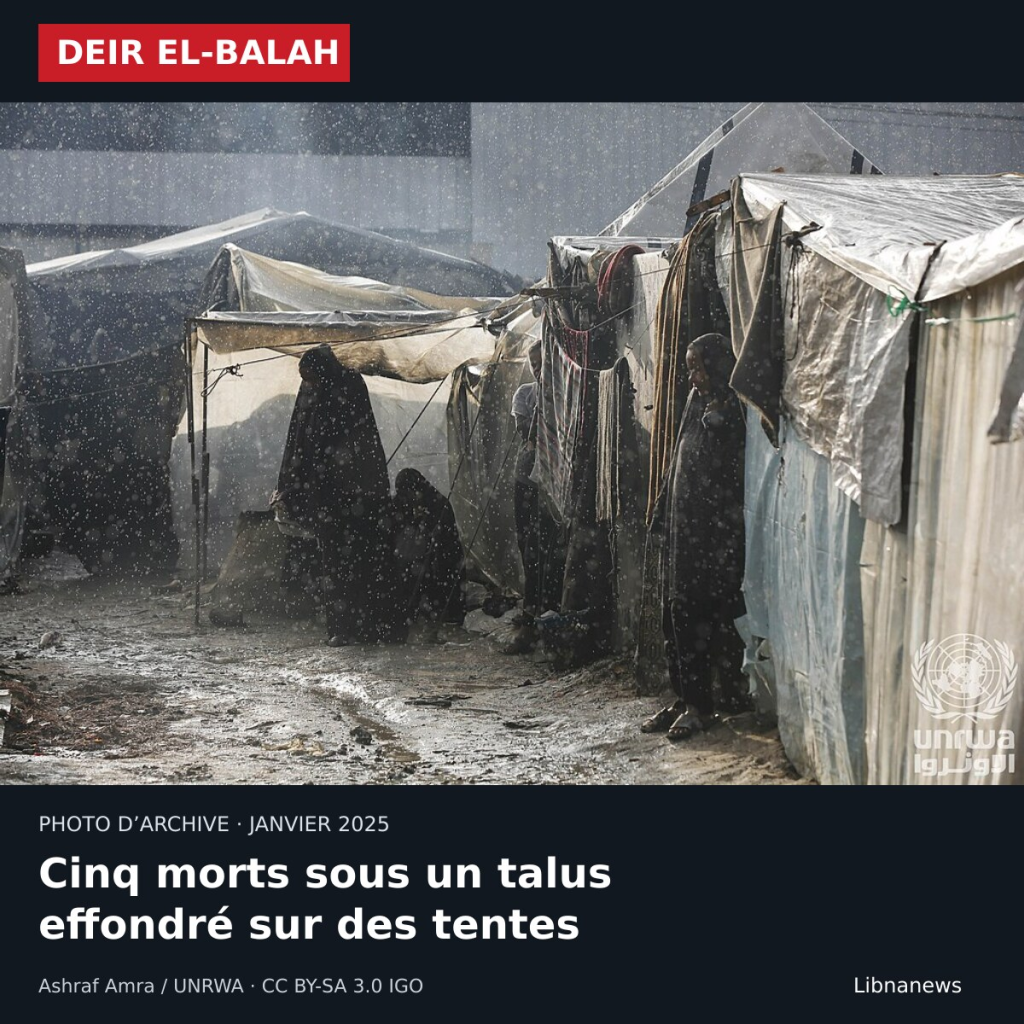
Three children and two women died Sunday, November 8, 2026 in the collapse of a mass of sand on displaced tents in Deir al-Balah, in the central Gaza Strip, according to Palestinian Civil Defence. The tragedy comes as the rains expose families living in precarious shelters to the risk of flooding, as well as burial.
The collapse occurred in the area of Hawouz al-Baraka, south of the city. The first on-site accounts describe tents occupied by two displaced families from Jabalia al-Balad, north of the enclave. They also reported six injuries. This figure remains provisional: the Civil Defence communiqué consulted for this article confirms the five deaths, without providing a detailed assessment of the injured.
A danger related to tent placement
In its press release broadcast on Sunday evening, the Civil Defence warns that installations close to slopes and sandy or earthy heights pose a danger, especially with the return of rain. She called on families to move their tents away from those lands and called on the agencies concerned to provide safe places and shelters.
The available information describes a collapse of land on makeshift dwellings. They do not make it possible to present this event as a strike or to attribute the precise cause to geotechnical expertise. Rain is the context of relief, which warns about soil instability; a detailed technical survey is not available at this stage.
The distinction is important to understand the immediate threat. A tent can partially protect from precipitation without providing resistance to a sand mass. Therefore, security also depends on the terrain chosen and what overlooks it. However, the lack of alternative shelters, documented by humanitarian organizations, is a challenge for travel instructions.
Housing needs far greater than stocks
The latest status report of the United Nations Office for the Coordination of Humanitarian Affairs, dated 5 November, indicates this shortage. As at 1 November, the identified needs were approximately 121,000 tents and 561,000 tarpaulins. Available stocks were only 2,800 tents and 76,000 tarpaulins. These data describe the humanitarian situation prior to the tragedy; They do not constitute a count of the affected families in Deir al-Balah on Sunday.
Humanitarian teams also reported difficulties in financing, supply and entry of supplies. Some shipments were likely to occur in the second half of the winter. Installations to evacuate rainwater and wastewater were already experiencing operational problems, compounded by difficulties in accessing the necessary parts and consumables.
Shelter, not just replace canvases
The collapse of Deir al-Balah adds a fatal risk to the damage caused by the weather. The distribution of tents remains essential, but it must be accompanied by an examination of the locations, the distance from the slopes and the development of the land where possible.
Civil Defence calls for support for relief teams and accommodation solutions to prevent new victims. His warning is about the other sites exposed: to identify the dangerous areas and offer a solution of withdrawal to families before another rain event, rather than waiting for another collapse.





Comments