

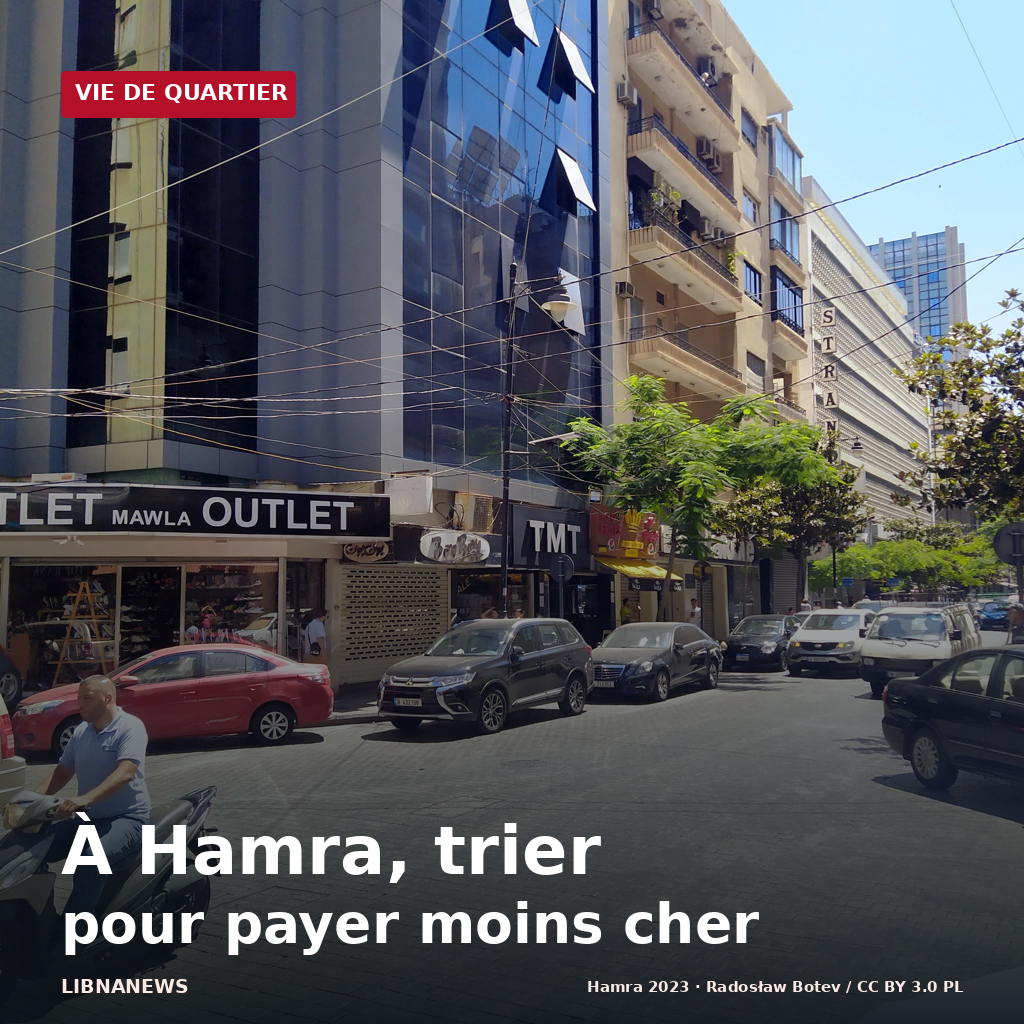
In Hamra, Beirut, paper, plastic or metal can be placed sorted and points for use at the EcoHub grocery store. The Ahla Fawda association, which manages the venue, also brought together a frying shop and a playground. The scheme provides an outlet for neighbourhood sorting and helps to reduce the price of some current purchases.
The principle is neither a single bottle order nor a free distribution of foodstuffs. Hamra EcoHub receives several families of materials. At its collection counter, Eco-Bank allocates points in exchange for sorted materials. These points are used in the context of the local scheme: they are not money and are not intended to be spent in local shops.
From the bag of recyclables to the shopping basket
Ahla Fawda cites paper, plastic and metal among the materials deposited. The first gesture is therefore made at home: to separate the materials before bringing them instead of arriving with a mixed garbage bag. The association does not detail a material scale on its public presentation. It is necessary to check with the EcoHub what it resumes, when and under what conditions, especially before bringing a large volume.
At the grocery store in the centre, called Dekkene, the association states that the points give access to food, hygiene and maintenance at half price. This mechanism does not transform each deposit into a free basket. A distinction must be made between the points obtained, the money remaining to be paid and the products actually available. The presentation of the programme makes it impossible to quantify what a household could save from a given bag.
Ahla Fawda posted 3,475 purchases from the Dekkene in its 2025 balance sheet. This number refers to purchases, not separate individuals or families. The association also states that it collected 76,725 kilos of recyclable material that year. This total is shown in its general balance sheet: it cannot be attributed to the grocery store alone or deducted from the value of the rebates granted.
A friperie and a playground in the same center
The site, opened in June 2023, is not limited to collection. The Souk El Khalanj, partner of the centre, offers used clothing at low prices. Its operator, the Lebanese social enterprise FabricAID, states that it sorts and cleans items collected before they are released. The purchase of used clothing and the deposit of paper or metal remain two different approaches: the association does not say that the same points apply to all the shops on the site.
It is also possible to search for used books and toys from the partner We Deserve Better. For children, the CatalyticAction association and the neighbourhood initiative of the American University of Beirut participated in the creation of a playground. CatalyticAction’s balance sheet shows in particular plastic boxes integrated into the structure. The re-use is visible, while at collection, the public does not necessarily see what becomes of each material after it is at the counter.
What the device changes, and what it does not regulate
At the launch, the association already presented the centre as a collection place and workshops. The switch to a reduced-price grocery store makes the interest of the deposit more concrete: points have immediate use for ordinary purchases. Another logic of re-use is the fripery. Wearing a garment longer avoids destroying it to recover fibers; it is not necessary to manufacture a new material to put the coin back into circulation.
A neighbourhood centre does not replace municipal collection or a sector capable of treating all the waste in a city. Its service is more precise: to offer the inhabitants a place to deliver separate materials, with a counterpart whose rules are local. Before moving, you can ask Ahla Fawda what deposits are accepted and when. The association indicates for its reception the building Youssef Assaf, at 180 Hamra Street, in Ras Beirut, and the number 01 355 211. This address is the one published on its contact page; access to the collection point should be confirmed with the team.





Comments