

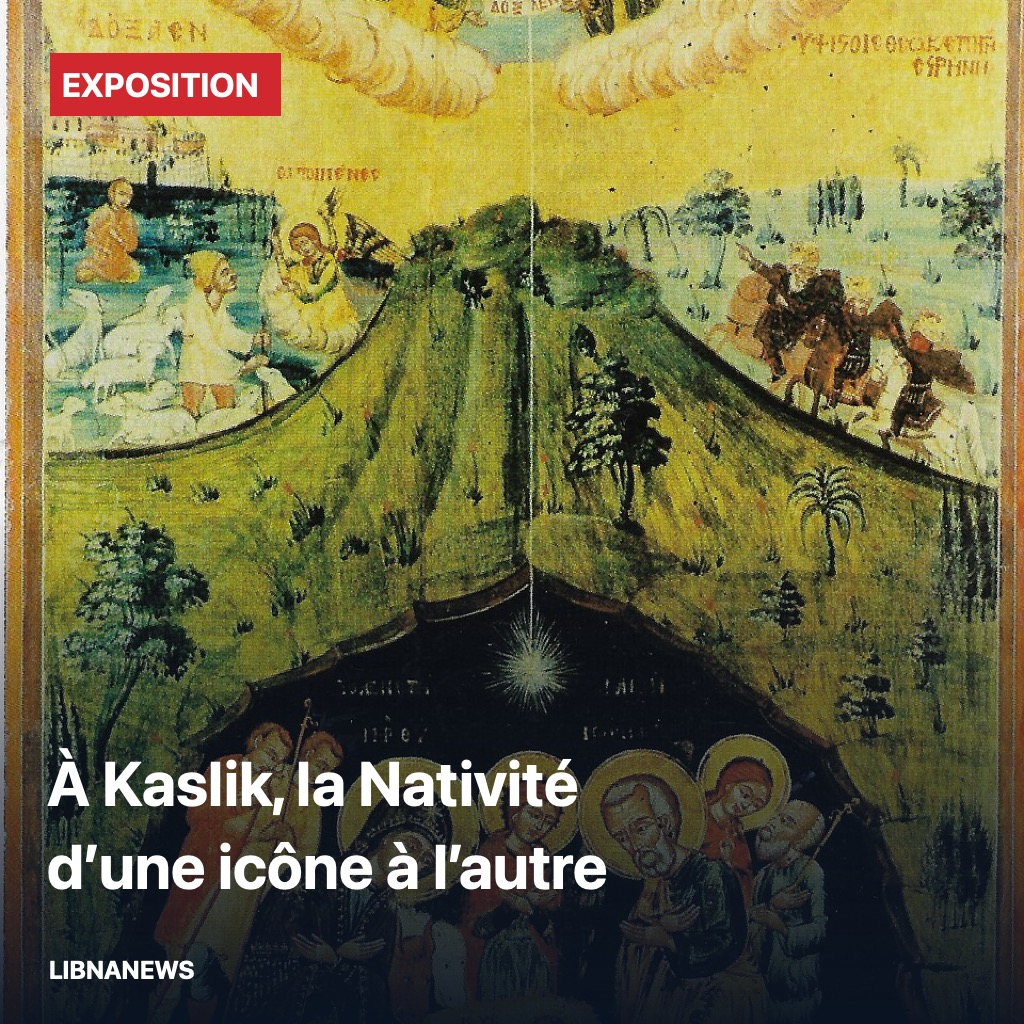
The Museum of the Holy Spirit University of Kaslik presents until January 15 an exhibition dedicated to the way artists represented the birth and early years of Christ. Title The Naticity and Beyond: A Story in Images, the route brings together religious icons and paintings from the 18th to the 20th century. A guided tour is planned on December 1, after an illustrated presentation of art history.
Opened on November 24 on the Kaslik campus, the exhibition does not stop at the crèche scene. It brings together works that take as a subject the birth or the episodes that surround it. Presenting together religious icons and paintings makes it possible to observe how the same narrative is transmitted without its representation remaining identical from one century to the next.
In an icon, the story does not always fit into a single scene
A representation of the Nativity does not necessarily place all its characters at the same time. An icon preserved at the Byzantine and Christian Museum of Athens, dated from the first half of the 15th century, gives an example: besides the central scene, it shows on the left the horse-mages and, on the right, a young shepherd who plays the flute. This example outside the exhibition helps to understand why you should also look at the edges of the image. The painter does not always treat the narrative as the view of a single moment.
The place of the figures, the direction of their gazes or the gesture of Mary give other points of comparison. According to traditions and works, the viewer does not enter the scene in the same detail. The juxtaposition offered to Kaslik makes it possible to follow these variations through the works rather than looking for an image which is supposed to summarize the whole Christian tradition.
Icons in Kaslik Museum collections
The museum is presented as a place of conservation and study whose collections include, alongside icons, paintings, archaeological objects, textiles and sculptures. Archaeological collections come mainly from Lebanon and cover a period from prehistoric to modern times. The Christmas exhibition holds a closer set, over three centuries. It is not confused with the entire collection of icons, nor with a panorama of all sacred art preserved in Lebanon.
The icon that illustrates this article belongs to another set: it is an 18th-century Nativity on wood preserved by the Greek-Catholic Melkite archearchy of Beirut and Byblos. It is reproduced here as an example of sacred art preserved in Lebanon. It must not be taken as one of the pieces hung in Kaslik.
A guided tour on Tuesday 1 December
On Tuesday, December 1, from 6 p.m. to 8 p.m., the museum hosts an evening entitled The Naticity Through Masterpieces. The program first announces an illustrated presentation of Nativity interpretations, then a guided tour of the exhibition, and finally a reception. This time range concerns the evening, not the usual hours of the museum.
For regular visits, the USEK announces an opening from Monday to Friday, from 9 a.m. to 4 p.m., until Friday, January 15, 2027. The museum does not open public holidays or during university closures. The evening of December 1st is held at the museum on Kaslik campus.





Comments