


The decline in artificial intelligence values, part of Asia, accelerated at Wall Street on Wednesday 25 November. On the American morning, Nasdaq Composite lost more than 4%, while investors found ECP inflation at 3.8%, fourteen U.S. tariff projects, and oil again rising. Dell results provide a measure of server demand. The session raises another question: at what cost can this request be financed, delivered and converted into profits?
Technological values cause the decline, not all actions at the same rate
At 0953 hours in New York (1453 hours UTC), the Nasdaq Composite lost 4.15 per cent at 22,747.61 points, compared with 2.86% for the S&P 500 and 1.99% for the Dow Jones, according to a market statement in session. Another observation at 1027 indicated a decrease of about 4.1% in Nasdaq and 2.7% in S&P 500. These figures are not closures. The difference between the two surveys describes the movement during the morning, not a contradiction in the calculation of the indices.
The composition of the indices helps explain the uneven extent of the decline. The Nasdaq Composite includes many technology companies, including groups that are heavily capitalized in the index. The S&P 500 covers more sectors, but is also capitalized. The Dow Jones contains only thirty values and weighs them according to the price of their shares, according to a different method. The American morning differences do not therefore indicate how many companies lose money or how much their securities have declined on average.
The contrast was already visible the day before. On November 24, S&P 500 had declined by about 0.5% and Nasdaq Composite by almost 1.5%, while Dow Jones had increased by about 0.8%. The S&P 500 index with equal weight had even gained 0.53%, according to the Saxo survey. This was not an increase in the market within the meaning of the main US index, but it showed that the decline in large capitalisations co-existed with gains on other securities. On Wednesday, the Dow’s decline is less accurate than the previous day’s rotation: the pressure extends to an indicator that does not concentrate the same companies in the same proportions.
The calendar adds a reason not to extrapolate each movement to the whole week. The New York Stock Exchange closes Thursday, November 26 for Thanksgiving and interrupts the regular session at 1 p.m. New York time, Friday, 27. During these atypical sessions, lower liquidity may amplify a purchase or sale order. This possibility does not prove that Wednesday’s volatility is due to the holiday. In particular, it indicates why a quotation noted before closing should not be presented as the final balance sheet of the day.
Asia and Europe: two different exhibitions at the same channel
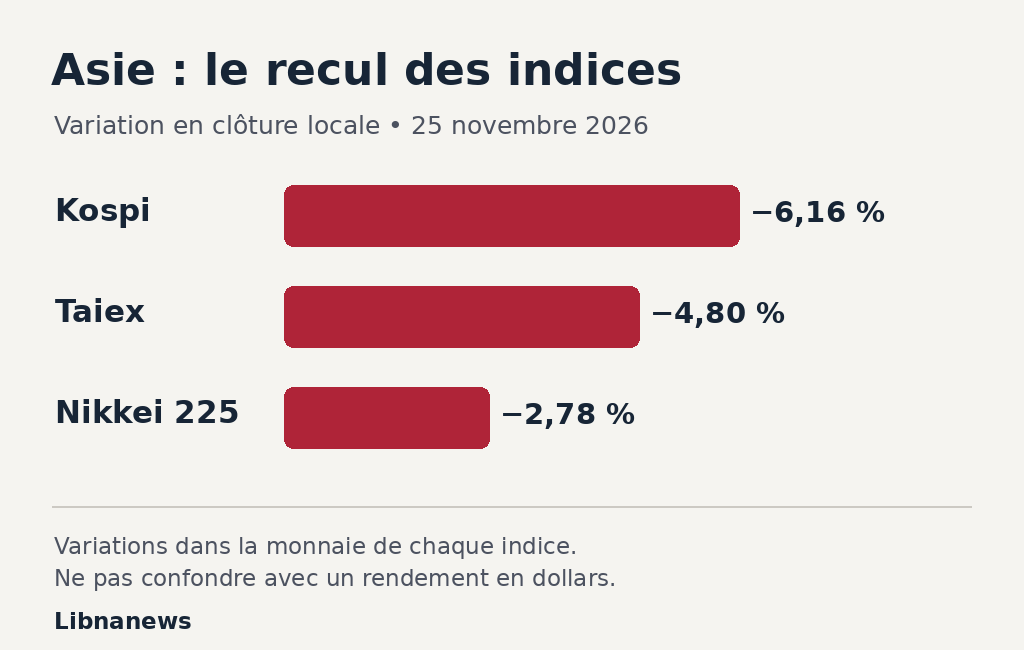
At the Asian closure, South Korean Kospi lost 6.16%, Taiwanese Taiex 4.80% and Japanese Nikkei 225 2.78%. The three percentage points are measured in the currencies and on the local schedules of their respective indices. They do not give the return in dollars of a foreign investor: this would require adding the effect of currencies at the same time. On the other hand, they show that the decline was not limited to US platforms and manufacturers listed in New York.
Companies exposed to AI do not occupy the same place in the production chain of one stock exchange to another. Chip designers market architectures or accelerators; founders manufacture components; Memory producers equip them; machinery suppliers sell or maintain the tools necessary for manufacturing. A review of the application does not have the same effect on a company that is already shipping products and on another whose customers may delay the opening of a new line. The extent of the fall in Seoul and Taipei is compatible with the high exposure of these places to semiconductors; it does not alone measure the amount of investments carried forward.
In Europe, the same theme met with a different sectoral composition. At 1:02 p.m. UTC, CAC 40 was up 0.53%, DAX was down 0.28% and STOXX Europe 600 was down 0.20%, depending on the ratings released at that time. This intraday survey, taken prior to the publication of the ECP, is not a closing statement: Tuesday’s European figures, including a STOXX 600 around 632.75 points, should not be substituted. The mid-day contrast remains useful: an index of luxury or consumer groups can better resist than a basket more exposed to industrial or technological equipment, without all groups in the same country being housed in the same sign.
In France, INSEE measured household confidence at 82 in November, compared with 81 in October after revision. The long-term average is 100. This rebound does not mean that household opinion is normalized or that purchases have increased by 1%. It is a synthetic indicator of opinion. A stock market increase in consumer values is not enough to inform about the basket of a French household: many listed companies make a significant share of their sales outside France. This is another reason why the trajectory of a national index is not confused with that of domestic demand.
In Washington, inflation and growth do not tell the same period
The price index for personal consumption expenditures, the ECP, grew 3.8% year-on-year in October, after 3.7% in September, according to the Bureau of Economic Analysis. Without food and energy, it increases by 3.3% over one year. The monthly change is 0.3% for both series. The ECP should not be confused with the ICC: they do not observe exactly the same expenses and do not give the same weight to the same products. The overall ECP index is the measure used by the Federal Reserve for its 2% inflation target.
The statistical office also revised the real GDP of the third quarter to an annualized increase of 4.3 per cent, compared with 3.4 per cent in the first estimate. This represents about 1.1% between the second and third quarters, not a 4.3% increase over the previous summer. Revised GDP ends in September. Real household expenditure fell slightly in October despite increases in nominal expenditure. At the same time, there was sustained activity in the third quarter, persistent inflation and less dynamic household purchases at the beginning of the following quarter.
For the Federal Reserve, the effects of these figures are not symmetrical. Higher underlying inflation makes it more expensive to wager a quick return to the target. An economy that continued to grow at a robust pace in the third quarter may seem able to absorb a more restrictive policy. But the October consumption indicator asks whether this capacity is continuing. The outcome of the ECP may change the price of rate-related contracts; it shall not take the place of a decision of the Monetary Policy Committee. Wednesday’s reaction must be read as a revision of the scenarios, not as the announcement of an official increase.
Nor is it contradictory to see investors anticipating a short-term increase and, at the same time, looking for longer government bonds. A 10-year maturity incorporates both the long-term key rate expectations and the remuneration required to immobilize funds. A sharp decline in stocks can stimulate demand for bonds, even when the market is more likely to tighten at the next meeting. Thus, a 10-year one-time rating does not measure the cost of all corporate debts or the likelihood of a single Fed decision.
Dell sells servers: the manufacturer’s book is not the customer’s income
In its results deposited with the SEC, Dell announces 22 billion dollars of quarterly turnover for its servers optimized for the AI, 60.2 billion new orders in business and an AI-related order book of 132.3 billion at the end of the quarter. The three amounts do not add up. The turnover describes what Dell was able to recognize during the quarter; new orders are the flow recorded during this period; the book is the ordered work stock that remains to be executed on a given date. Shipments from previous orders may increase turnover without being part of the new orders for the quarter.
The manufacturer says it examines the quality of its customers and their access to finance, land and electricity. This precision illuminates a particularity of the sector. A client may want several thousand servers without having all the conditions to put them into service from the moment of signature. It is necessary to finance the equipment, connect the data centre, have the electrical power expected and coordinate the delivery schedule. The manufacturer may have prepared its equipment while the ignition is delayed. Conversely, a ready infrastructure can wait for components whose production has fallen behind. The order book does not, therefore, provide information on the quarter in which the whole will be operational.
Another figure published by Dell is that the group has announced $10.8 billion in cash generated by its operations since the beginning of its fiscal year. This amount covers all its activities, from personal computers to storage solutions and servers. Dell does not break down this number by server type. The carnet is therefore not comparable to this cash flow: in order to estimate the profitability of the AI equipment, one would have to isolate their component costs, their margins and when customers pay. Quarterly accounts measure the rate of growth of deliveries, but do not provide all these data by product.
The same expense is read differently on each side of the transaction. For Dell, a server delivered and accepted can become a sale. For the centre operator, the equipment increases capital assets and then has to be profitable: through capacity leases, services billed to customers or internal gains that reduce costs. Before such revenues or savings arise, the operator shall bear the cost of capital, maintenance, cooling and electricity. The most important risk is not always the complete cancellation of a project: a delay in commissioning may be sufficient to increase its costs by delaying the receipt of its first income.
It is then understood how a company can publish a dramatic increase in sales and see its title decline with the rest of the sector. Results confirm past sales; the price incorporates margins, financing conditions and expected revenues over several years. If investors feel that project performance is more uncertain, they may agree to pay less for every dollar of anticipated profit, even without challenging sales already recorded. It does not follow from this movement that all Dell’s customers would be in difficulty or that companies already using their computing capabilities would face the same constraints as those still under construction.
U.S. rights are in the draft state, exchange rate is already reacting
The US Trade Representative presented projects targeting fourteen economies following surveys of industrial overcapacity. For the European Union, the draft provides for a level of 15% after taking into account the ordinary rights and rights already applied under Section 301, according to the terms of the text. For some Chinese products, the proposed rate may be as high as 20%, with lower rates or exemptions in the annexes. The total number of cases investigated is not the number of projects announced on Wednesday: there is a need to distinguish between the savings studied and those covered by the fourteen texts submitted for consultation.
Comments may be filed until 5 January and hearings must begin on 25 January. The publication of the proposals therefore does not constitute an invoice to be paid today in customs or an effective date. For an exporting company, the immediate risk is that it will not be able to determine with certainty the price at which its goods will be sold upon arrival in the United States. It may clarify with its customers the allocation of any additional costs; it cannot calculate a reliable single rate without the product code, origin, annexes, duties already due and terms of the contract.
Not all the effects go through an equivalent increase in the selling price. The importer may absorb part of the duty by reducing its margin or negotiate a price decrease with the supplier; in other cases, the additional cost is passed on to the buyer. When an input enters a product manufactured in the United States, the cost may also rise for an American producer who is not directly competing with the imported good. This is why revisions of profits may vary within the same sector. A company with production capacity on both sides of the Atlantic does not face the same constraints as a company exporting from a single site.
The European Central Bank published on Wednesday a reference rate of $1.0935 for one euro, compared to 1.0963 the previous day, a decrease of about 0.26% of the euro according to this series. It also posted 174.22 yen and 0.83730 pound sterling for one euro. The courses are based on a consultation at the beginning of the European afternoon and published at around 4 p.m. in Frankfurt, i.e. 3 p.m. UTC. These are statistical references, not executable prices; the market price has changed since their fixation. On the scale of an invoice, the exchange rate to be used is also that provided for in the contract or that applied through the intermediary, not automatically the ECB rate of the day.
Oil rises as US stocks increase
At 1448 UTC, the January Brent contract traded at $93.06 per barrel, an increase of 1.82 per cent, and the West Texas Intermediate contract at $82.97, an increase of 1.12 per cent, depending on the prices recorded in the session. Both prices relate to futures contracts, not cash delivery to any port. The climb followed in particular a Houthis claim against the Saudi refinery in Ras Tanura. The Riyadh-led coalition announced that it had intercepted four drones in the area, without injury according to an initial assessment. No interruption of production is established by these declarations.
Later, the weekly Energy Information Administration survey showed an increase of 1.1 million barrels of U.S. commercial crude oil stocks in the week ended November 20, to 418.9 million barrels, excluding strategic reserves. The figure describes stocks in the United States over a period prior to the session. It does not measure the volumes available in Gulf terminals or the cost of marine insurance. An increase in US stocks and an increase in Brent can therefore occur on the same day if operators simultaneously review the prospects for availability or transport in other markets.
For Lebanon, the short-term issue is the full cost of actually imported products. When fuel is paid in dollars, the price of the barrel counts, but also the price of the refined product, freight, insurance, contract fixing dates and conversion terms. An intraday increase in the Brent makes it impossible to predict the next Lebanese grid or to say that it will rise as much. Instead, it provides an indicator of one of the components of the invoice, then compared to the official rates and actual prices of the available cargo.
The mechanism of the day: the cost of waiting for a profit
At 1415 UTC, gold in cash was yielding about 2 per cent at $3,483.59 per ounce. Metal does not pay any interest. When bond investments provide higher expected earnings after inflation, it becomes more costly, in income that is renounced, to hold an asset that does not pay coupons. This mechanism helps to understand why gold can drop one day of stock decline. However, it does not dissociate the effect of the dollar, liquidity requirements or sales related to existing positions. The quoted course is a sessional observation, not a long-term value estimate.
The same reasoning makes it possible to read a value for growth. One hundred dollars received in five years is now worth about 78 dollars if the rate at which the payment is updated is 5 per cent, and about 71 dollars if the rate increases to 7 per cent. This is an arithmetic example: none of these rates is a rating of the session. The farther the payment is, the more sensitive its present value is to a rate differential. If the payment itself becomes less likely or later, the value decreases further. These are two separate revisions, one on the price of waiting, the other on the amount and timing of profits.
In the case of the AI, this distinction calls for separate attention to deliveries, electrical connections and payment of services by end users. An increasing notebook provides information on projects undertaken; deliveries and revenue recognition are what suppliers may have invoiced; the cash flows of their clients provide information on the ability to continue purchasing. On Wednesday, investors revised their price for future revenues while new figures showed a real demand for equipment. Both findings are compatible. The next evidence will come from accounts, turnaround times, and orders actually turned into sales, not just from the first hour at Wall Street.





Comments