

A falcinal ibis that stops in the Bekaa has nothing to say. What Chadi Saad filmed near the marshes of Ammiq was much more: an adult feeding a young in shallow water. The Society for the Protection of Nature in Lebanon (SPNL) published the observation on 28 June 2025. She documented a behavior rarely observed in the country, but did not locate the nest.
The scene that the passage alone does not explain
Chadi Saad, who runs the Hammana Raptors Observatory for SPNL, was in Western Bekaa for a field trip. The scene he filmed differs from a simple counting of passing birds. It shows that an adult and a young person were together near the marsh and that the former fed the latter on the spot. A bird seen in flight, even identified without hesitation, would have learned nothing of that kind about its use of the site.
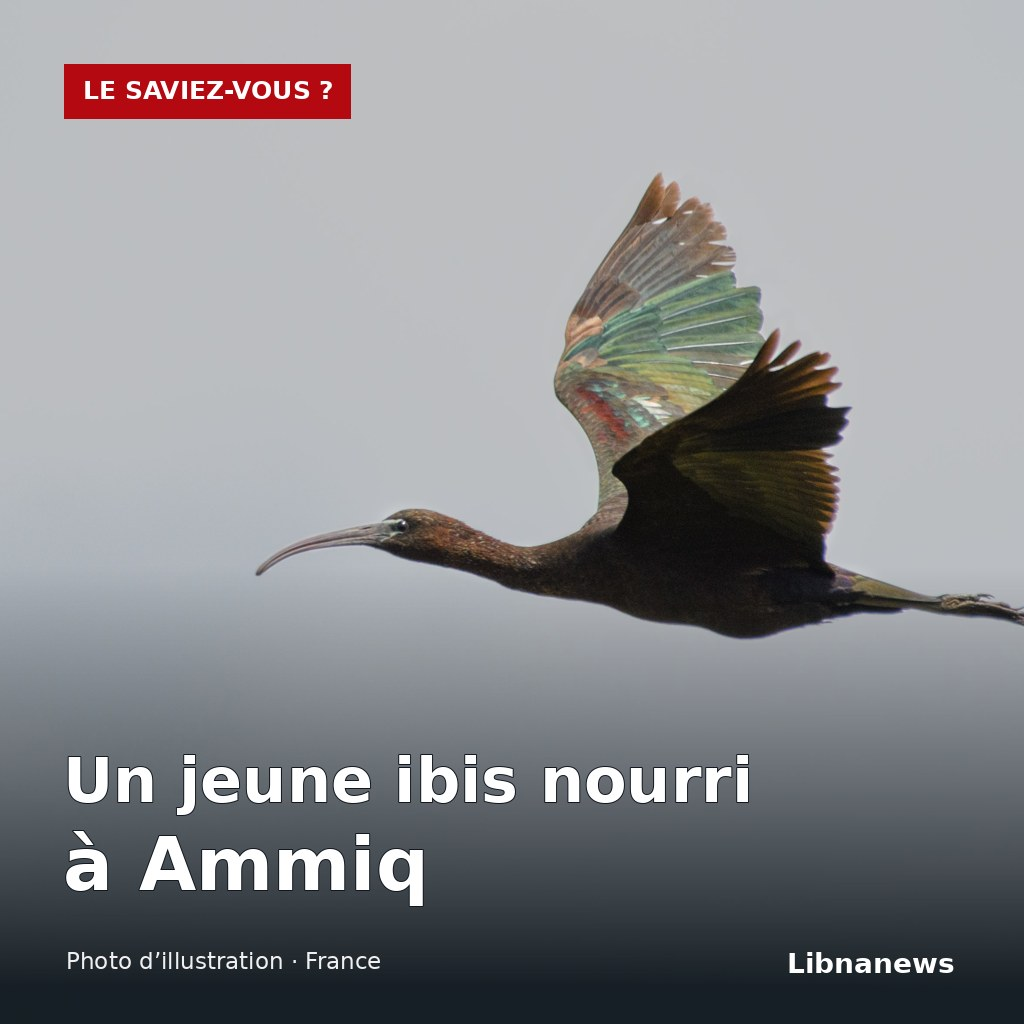
The falcinella is recognized by its long beak and curved downwards. In low water, it searches the vase rather than pursuing its prey on the surface. Its dark plumage may seem almost uniform at a distance. When the light hangs the feathers, they take green and coppery reflections. The species is widely distributed throughout the world, but SPNL indicates that in Lebanon the observations remain uncommon and concern mainly birds of passage.
A young nurse doesn’t tell where the nest is
The distinction counts. The observation is compatible with nesting in the vicinity, but it is not sufficient to establish that the young was born in Ammiq. The SPNL does not report nests, eggs or colonies in its report. The adult and the young were also able to win the marsh after leaving another site. The sequence therefore documents a feeding site and raises a question which the following observations will have to decide. It does not justify announcing a first confirmed reproduction in Lebanon.
What the marshes offer birds
In western Bekaa, at the foot of Baruk, Ammiq brings together reeds, open water areas and wet meadows. The site has been listed under the Ramsar Convention on Wetlands since 1999. The rain and snow falling on the heights of the Baruk feed the system through sources. The extent of the water varies with the seasons. The conservation of the marsh is therefore not only due to what is happening within its limits: it also depends on the water reaching it from the heights.
For a migratory bird, a marsh can be used as a stopover and pantry. The scene filmed in 2025 shows that a single site can also allow an adult to continue feeding a young person. It is already a valuable observation, even if the birthplace of this young ibis remains unknown.
Photo of illustration: falcinelle ibis in flight in the marshes of Hiers-Brouage (France), 8 June 2026; it does not show the observation of Ammiq. TRinaud / Wikimedia Commons,CC BY 4.0. Framed and titrated image.





Comments