

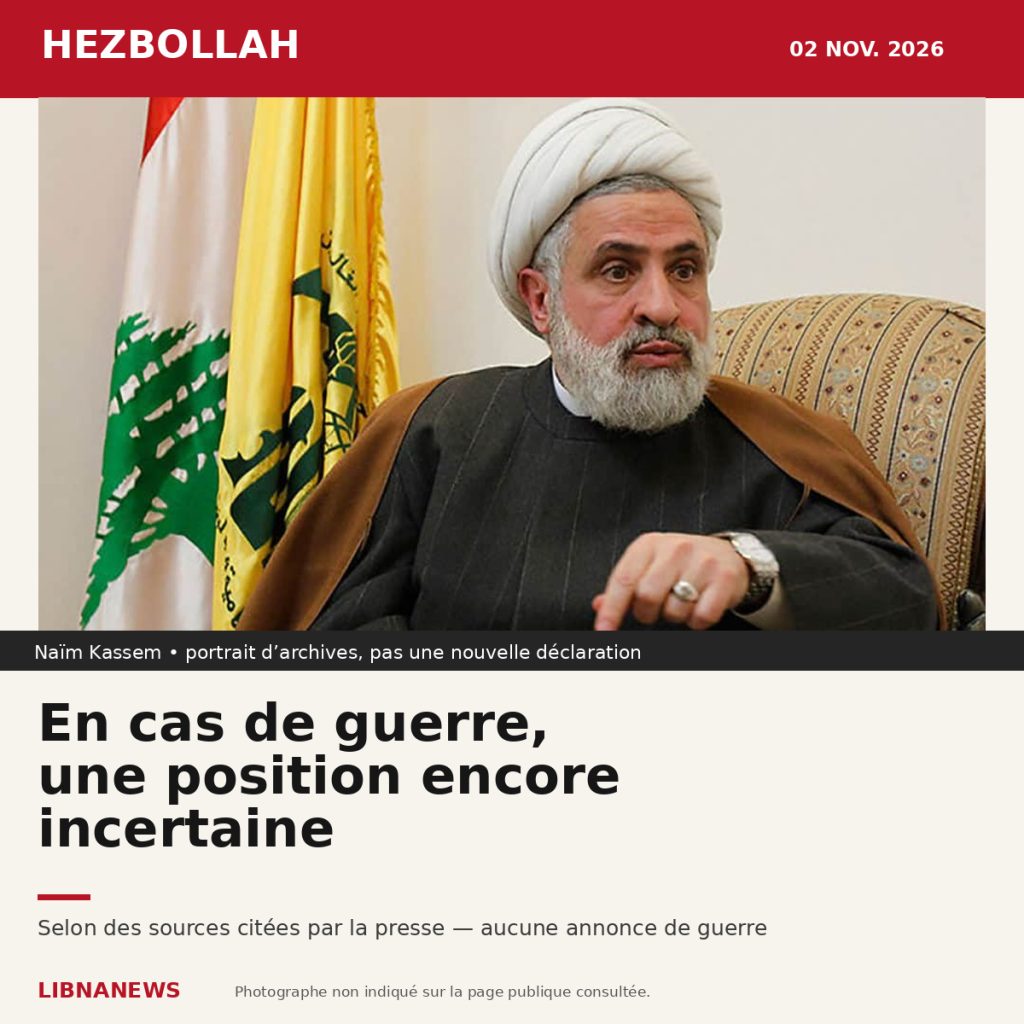
Hezbollah gave no clear commitment to its conduct in the event of a further attack on Iran, according to follow-up sources cited by Al Akhbar on 2 November 2026. The daily reports that the movement keeps its position open and refuses, at this stage, to provide intermediaries with an answer to determine their behaviour. It is neither a promise to stay away, nor an announcement of war.
The story is based on unnamed sources. It does not constitute an official statement by Hezbollah or a public statement by its secretary-general, Naïm Kassem. The formula reported by the newspaper is precise: the party would have made no clear commitment, « not in one direction or the other ».
Do not stop its position before a possible attack
According to Al Akhbar’s interlocutors, contacts conducted by local, French, Qatari or other intermediaries did not get the desired answer. Hezbollah would prefer not to decide before knowing the nature of a possible attack. He would not allow such exchanges to limit his freedom of decision in advance.
The daily also reports a question attributed to the movement: are contacts aimed at preventing war or obtaining a position that could reassure Israel? This distinction forms the narrative of the newspaper. In the first case, mediation would seek to prevent escalation; in the second, it would collect guarantees even before military choices were known.
This lack of commitment leaves many possibilities open. It does not predict an intervention, its possible timing or form. It means, in the information published by Al Akhbar, that mediators do not have a clear assurance of Hizbullah’s non-participation.
What the messages received by Berri report
Ad Diyar of 2 November 2026 refers, for his part, to reassuring messages arrived at Nabih Berri. Official Lebanese sources cited by the daily newspaper believe that they may be the result of warnings sent to Lebanon. But the passage does not specify who sent these messages or what they contain exactly.
This information is therefore not sufficient to establish that Hezbollah would have guaranteed its non-intervention. It does not necessarily contradict Al Akhbar’s account of a specific commitment. Both newspapers describe contacts whose interlocutors, scope and degree of formalization are not identical in their texts.
Ad Diyar adds that Hezbollah remains ready for all eventualities, while still considering the choice of war by Washington unlikely. According to daily sources, the movement mainly interprets escalation as a pressure to obtain Iranian concessions. This assessment does not replace a formal decision on what he would do in the event of an attack.
Warnings that seek a prior response
The debate is based on Israeli threats against Lebanon. Ad Diyar reports warnings received through several official and unofficial channels. Their message would be that an involvement of Hezbollah would lead to destruction that neither the party nor the state could contain.
Al Akhbar puts contacts in this context of pressure. In particular, military scenarios taken from the Israeli press seek to deter intervention. However, they are still reported assumptions, not evidence that an announced campaign is already underway.
Indirect discussions between Washington and Tehran continue in parallel. In this context, the position left open by Hezbollah, as described by Al Akhbar, maintains uncertainty for mediators: obtaining exchanges does not mean obtaining a guarantee. None of the narratives cited in this report allow the movement’s participation in a new war or its exclusion to be presented as acquired.
Sources
Al Akhbar, 2 November 2026, page 2; Ad Diyar, November 2, 2026, pages 1 and 4.





Comments