

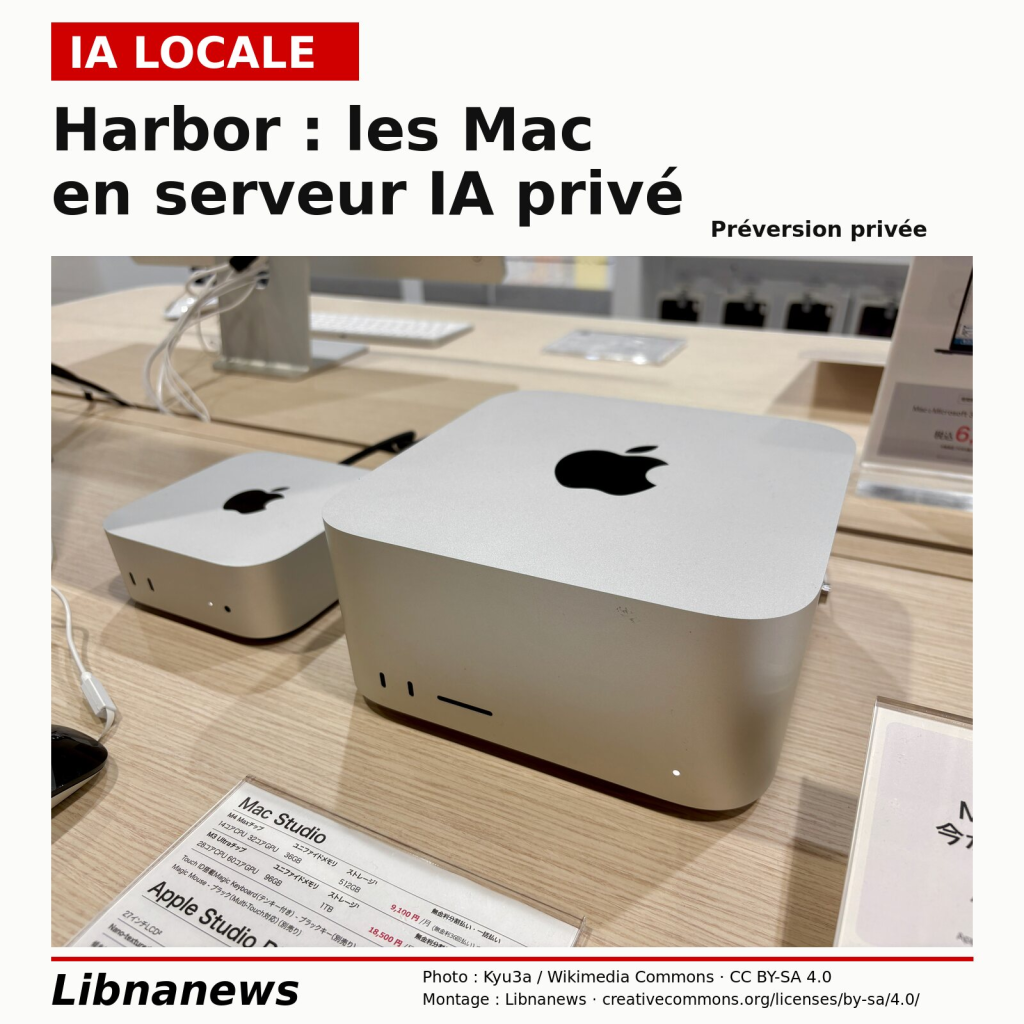
Claris, the Apple subsidiary known for FileMaker, is preparing Harbor, an application designed to transform Macs into a private artificial intelligence server. The project, identified in the specialized press on 10 November 2026, has an official presentation. It remains in private preversion, without public launch date or advertised rate.
The principle is to run models on user computers, rather than on remote infrastructure. Several machines could work together when a model exceeds the capabilities of a single Mac. Harbor’s challenge is to make this facility more accessible, with a management interface and less technical manipulation.
Harbor, a preversion confirmed by Claris
The official page of Claris, consulted on November 11, explicitly presents Harbor as a « private preversion. » It describes a service running on Macs equipped with Apple chips. The grouping of several computers is based on Thunderbolt 5, to mobilize their memory for larger models.
This presentation therefore goes beyond a mere rumor. However, it is not a general availability. The proposed form provides information on the project. It does not provide access to a public download. In particular, it asks for the company’s name, without establishing future commercial conditions.
An App Store sheet, reported by the American specialist press, briefly circulated before its withdrawal. This withdrawal alone does not lead to a finding of annulment. Claris’ presentation remains accessible.
A tool to exploit existing models
The description of the application relayed by the press provides for the search, download and loading of models from the same interface. It also announces a detection of the Macs connected by Thunderbolt 5, to form a calculation group without complex manual configuration.
Harbor aims at inference: using a model already trained to produce a response. The project does not correspond to the announcement of a new language model designed by Apple. The models concerned are called « open weights », because their parameters can be downloaded. Their capacity and conditions of use depend on the model chosen.
The sheet evokes two possible benefits of grouping: running a model too large for a single machine and processing more simultaneous requests. These objectives remain announced capabilities. No Harbor test consulted for this article allows to encrypt winnings in real use.
Thunderbolt 5: a technical base already available
The project is part of a technical development already documented by Apple. Since macOS 26.2, Apple smart Macs with Thunderbolt 5 can use the RDMA on this link. This direct access to remote memory reduces the interventions of the processor and the system during exchanges between computers.
However, the documentation distinguishes this capacity from the simple connection of a cable. RDMA provides rapid data transport. Software still has to distribute the work, coordinate the machines and assemble the results. The shape of the USB-C connector also does not guarantee Thunderbolt 5.
Apple is currently describing an activation of RDMA from the macOS recovery environment. The promise of simplified installation of Harbor must therefore be specified by its final documentation. It cannot be said that all the necessary steps will disappear, nor deduce the complete list of compatible Macs from this presentation alone.
Gathering memory does not remove constraints
On an Apple chip Mac, unified memory allows the processor and the graphics circuit to use shared space. MLX, the computing library developed by Apple, operates this organization to avoid certain data transfers between these components.
Between several computers, the situation differs: the data go through a physical link. In its technical presentation of WWDC 2026, Apple explains how MLX and the JACCL communications library coordinate distributed calculations. The topology of connections influences their effectiveness. This documentation sheds light on the possibilities of the platform, without establishing Harbor’s exact internal architecture.
The size of the model, the available memory, the length of the exchanges and the number of users will weigh on the result. A larger accumulated memory capacity does not guarantee proportional acceleration. The time before the first response, the speed of generation and the behaviour under several queries will have to be measured separately.
Confidentiality to be assessed throughout the chain
Claris highlights maintaining data and queries about the user’s hardware. This approach can reduce transmissions to a remote inference provider. It does not exempt from examining applications that will connect to the server and the rights granted to their users.
It is also necessary to distinguish local execution from the initial download. A tool can calculate its off-line responses while using the Internet to recover templates or updates. The documentation of LM Studio, another local AI software, shows precisely this separation. It provides a point of comparison, not a description of Harbor’s operation.
For professional deployment, the expected information will include authentication, logs, network access and conversation retention. The local character of the calculation is not sufficient to establish the safety of the whole. These elements should be checked in the accessible product.
An existing market, conditions still expected
Harbor arrives on an already occupied land. The free Exo project connects several devices to distribute models and offers group management of machines. It uses MLX and supports RDMA on Thunderbolt 5. LM Studio, for its part, can serve models locally or on a local network.
Claris also has an experience with AI Model Server, integrated into its FileMaker environment. Its documentation recommends that memory be preferred and that a machine be reserved for this service. These indications concern this existing product: they do not constitute Harbor’s official material requirements.
Finally, the announced lack of billing of the calculation for use does not mean that the software will be free. Equipment, electricity and administration retain a cost. The price of Harbor, the supported models and the conditions for access to a public version remain to be seen.





Comments