

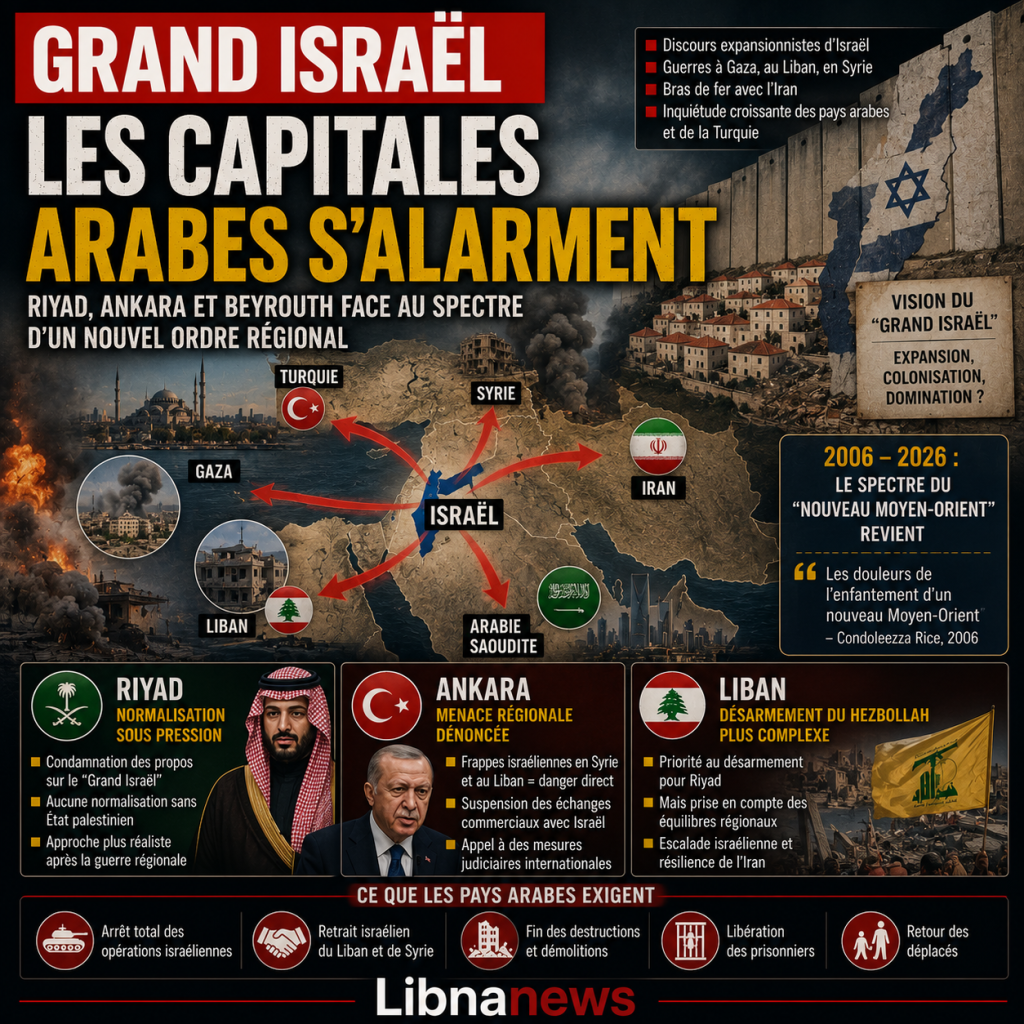
Tension beyond Gaza and Lebanon
Tensions between Israel, Turkey and several Arab countries are taking on a new dimension as the discourses on « Great Israel » are mixed up in the ongoing wars in Gaza, Lebanon, Syria and around Iran. The controversy is no longer limited to the usual statements about settlement in the West Bank. It now affects the perception in Arab capitals and Ankara of a broader Israeli project, based on military superiority, the widening of control zones and the gradual normalization of strikes beyond recognized borders.
Saudi Arabia is following this development with special attention. Riyadh had already condemned Benjamin Netanyahu’s words on a vision of « Great Israel » as a dangerous challenge to international law and Palestinian rights. Several Arab and Islamic countries then issued a joint statement denouncing these statements as a direct threat to Arab national security, State sovereignty and regional stability. This collective reaction shows that the debate has gone beyond the Palestinian framework.
Turkey is also adopting an increasingly hard line. President Recep Tayyip Erdogan claimed that Israeli attacks against Syria and Lebanon had reached a level that also threatened Turkish security. Ankara accuses Israel of seeking to destabilize neighbouring areas, from the Eastern Mediterranean to the Levant, and of transforming its military operations into regional doctrine. Turkey had already suspended its trade with Israel and called for international judicial measures.
The return of an ancient fear
The term « Great Israel » does not always refer to a clear official agenda. It circulates in political, religious, militant or media discourses. But in the current context, it is received in Arab countries as a symptom of expansionist drift. The comments of Israeli officials on the West Bank, Gaza, Lebanon or Syria give this concern a concrete resonance. Arab capitals are no longer content to see verbal provocation. They read a possible orientation of the regional balance of power.
The Saudi reaction is explained by this reading. Riyadh remains committed to a political solution including a Palestinian state. The kingdom still links all normalization with Israel to guarantees on the Palestinian question. The statements on « Great Israel », the expansion of settlements, projects in E1 zone and statements by Israeli ministers opposed to a Palestinian state make this equation almost impossible. They also expose Saudi Arabia to internal, Arab and Islamic pressure if it appeared to be lenient in the face of a discourse perceived as annexationist.
The United Arab Emirates, Jordan, Egypt, Qatar and other Arab countries follow the same sequence with their own constraints. Some have signed agreements with Israel. Others maintain security or diplomatic channels. But everyone knows that Israeli expansionist rhetoric touches a red line. It is not just threatening the Palestinians. It raises the question of the sovereignty of neighbouring States, the stability of borders and the possibility of regional peace based on something other than military domination.
Saudi Arabia between firmness and realism
According to informed sources quoted in the Lebanese press, the Saudi position towards Hezbollah and its weapons was, before the American-Israeli war against Iran, marked by a clear firmness. Riyadh rejected any compromise formula and criticized the Lebanese Army Commander, General Rodolphe Haykal, for failing to implement government decisions related to arms control. The disarmament of Hezbollah remained an unambiguous priority.
The regional war changed this approach without changing the final objective. The same sources indicate that the Saudi side is now talking about a more realistic approach to case management. Hezbollah disarmament remains high on the agenda, but Riyadh would take more account of the balances created by the war, Iran’s resilience and the rise of Israeli aggression. This slide does not mean Saudi support for Hezbollah. Rather, it reflects a reassessment of the timing, means and political cost of direct confrontation.
Two factors would explain this change. The first is Iran’s resilience. The war did not reduce Tehran to the weakened role that some hoped for. On the contrary, it has shown its ability to stand in a regional confrontation, to impose Lebanon as a negotiating issue and to retain a power of military nuisance. The second factor is the Israeli escalation. The strikes in Lebanon, threats against Syria, speeches about colonization and references to « Great Israel » are worrying Arab capitals who do not want Israel to transform military superiority into a redesigned regional map.
For Riyadh, this dual evolution creates a difficulty. Too much pressure on Hezbollah, at a time when Israel is multiplying strikes in Lebanon, could be interpreted as alignment with Israeli objectives. Too much flexibility towards Hezbollah would weaken the Saudi line over Lebanese state sovereignty and the arms monopoly. The so-called realistic approach is therefore to maintain the objective of disarmament, while avoiding making it an immediate injunction that ignores the war, Iran’s place and the radicalization of Israeli discourse.
Ankara sees a direct threat
Turkey expresses its concerns more prominently. Erdogan accuses Israel of threatening not only Gaza and Lebanon, but also Syria, the Eastern Mediterranean and Turkish interests. For Ankara, Israeli operations across Palestinian borders confirm a projection strategy that can eventually cross the areas of Turkish influence. Syria is the most visible point of friction here. Turkey maintains important security, military and political interests.
Turkish concern also goes beyond Syria. Ankara looks at the eastern Mediterranean, Cyprus, energy routes and naval balances. Any extension of the Israeli military presence or any doctrine of regional preventive strike may be interpreted as an indirect threat to Turkey. Erdogan therefore presents Israeli operations as a global danger, not just as an Arab-Israeli dispute. This formulation aims to internationalize the problem and mobilize countries that fear a lasting destabilization of the Levant.
Verbal tensions between Ankara and Tel Aviv have also increased. Turkish officials accuse Netanyahu of diverting attention from charges against Israel in Gaza and Lebanon. Israeli officials respond by denouncing Turkish positions and Ankara’s ties with Palestinian movements. The bilateral relationship, already weakened from Gaza, is now part of a policy of political confrontation. Turkey is no longer merely defending the Palestinians. It presents itself as a state threatened by a regional Israeli trajectory.
The « New Middle East » 2006
The current crisis reactivates an ancient vocabulary. In 2006, during the war between Israel and Hezbollah, US Secretary of State Condoleezza Rice spoke of « the pains of the birth of a new Middle East ». That formula had been very badly received in Lebanon and in the Arab world. It gave the impression that the destruction of Lebanon was accepted as a necessary step towards a regional order desired by Washington and Tel Aviv.
Behind this expression was a strategic vision. The « new Middle East » should weaken armed actors hostile to Israel, reduce Iranian influence, strengthen the Arab allies of the United States and pave the way for wider normalization. In this reading, Lebanon was a key theatre. Hezbollah was to be broken militarily or politically. The defeat of the Lebanese resistance was to open a new regional phase. The 2006 war did not produce this result. Instead, it strengthened the political weight of Hezbollah in Lebanon and increased the caution of several Arab regimes.
Twenty years later, the vocabulary has changed, but concerns remain close. The Arab countries are seeing a reappearance of a logic of regional recomposition by force. The « new Middle East » is no longer solely driven by American discourse. It manifests itself in the repetition of strikes, the fragmentation of Palestinian spaces, the incursions into Lebanon and Syria, the settlement projects and the Israeli debates on extended sovereignty. The Arab capitals see it as a precedent: if a power can impose a new map by war, no border seems completely protected.
Arab countries face an unstable equation
Arab countries face a difficult equation. They want to contain Iran and limit the influence of its allies, including Hezbollah. They also want to prevent Israel from turning this confrontation into unlimited regional domination. This double requirement creates contradictions. For years, several capitals have seen the weakening of Hezbollah as an objective compatible with their interests. But when the Israeli offensive is accompanied by destruction in Lebanon, threats to Syria and discourse on « Great Israel », the calculation changes.
Saudi Arabia illustrates this tension. Riyadh is not close to Hezbollah. The kingdom does not renounce the idea that non-state weapons weaken Lebanon and create an Iranian lever. But it now seems to take into account another danger: that of an Israeli seeking, under the guise of security, to change territorial balances in a lasting way. From this perspective, the question is no longer just how to reduce Iranian influence. It also becomes aware of how to prevent Israel from using the war against Iran and its allies to impose its own regional architecture.
Egypt and Jordan have a similar reading, even if they express it differently. They have peace treaties with Israel, but they are concerned about any plans for Palestinian displacement, de facto annexation or redefinition of borders. The speech on « Great Israel » directly affects these two countries, as it reactivates the fear of population transfer and a challenge to the balances resulting from the Arab-Israeli wars. Their condemnation of Netanyahu’s words is part of this concern.
Arab standardization under pressure
The speech of « Great Israel » also weakens normalization agreements. The Abraham Accords were based on the idea that Israel’s regional integration could generate economic, technological and security benefits. That logic, however, required that the Palestinian question should remain contained and that the region should not be drawn into a series of wars. The war in Gaza, operations in Lebanon, tensions with Iran and annexationist statements have eroded this political base.
For countries that have normalized their relations with Israel, the cost of image increases. It becomes more difficult to justify open ties with an Israeli government whose ministers reject a Palestinian state and undertake settlement projects. For countries that have not standardized, particularly Saudi Arabia, the move towards an agreement seems to be delayed. Riyadh cannot sign a historic normalization when Arab opinion sees images of destruction in Gaza, Lebanon and the West Bank, and hears of « Great Israel ».
The Palestinian question therefore regains a central role. It is no longer just a moral or historical record. It’s back to being a strategic lock. Saudi officials reiterated that no normalization would be possible without a credible Palestinian state perspective. However, projects such as E1, Smotrich’s comments and statements on the vision of « Great Israel » close precisely this horizon. The link between colonization and normalization then becomes direct.
Lebanon as a regional test
Lebanon has become a test for this new phase. Israel claims to want to neutralize Hezbollah. The United States is seeking an arrangement that avoids a wider regional war. Iran wants to keep Lebanon in the field of the regional agreement. Arab countries want to limit Hezbollah, but do not want an unlimited Israeli destruction of Lebanon. This superimposition makes the Lebanese crisis wider than a border conflict.
The Saudi position reported by the Lebanese press shows this displacement. Prior to the war, Riyadh was said to have placed priority on firmness against Hezbollah’s weapons. After the American-Israeli war against Iran and the rise of « Great Israel » rhetoric, the kingdom would speak more of realism. This word doesn’t fix anything, but it signals a change of method. It recognizes that the disarmament of Hezbollah cannot be treated as a mere administrative request to the Lebanese army, especially when the Israeli army continues to strike Lebanese territory.
General Rodolphe Haykal finds himself, in this reading, at the heart of a contradictory expectation. Some foreign partners want the army to implement government decisions on weapons. But the army cannot become the instrument of an agenda perceived as serving Israeli strikes. It must maintain its cohesion, avoid internal confrontation and maintain its national legitimacy. The realism mentioned by Saudi sources is also due to this constraint: no lasting Lebanese policy can be imposed by an external injunction under Israeli bombardment.
A region between two feared hegemonies
The crisis reveals a deeper concern in the Arab world: that of being caught between two power projects. On one side, Iran built an armed alliance network, from Lebanon to Yemen, through Iraq and Syria. On the other hand, Israel affirms an increasingly offensive military superiority, with attacks on several theatres and widespread sovereignty rhetoric among some officials. The Arab countries seek to avoid being the confrontational terrain of these two logics.
Saudi Arabia, the Emirates, Egypt and Jordan want a stable regional order. They do not want Iranian domination by interposed militias or Israeli domination by strikes and annexations. This position is difficult to hold because crises advance faster than diplomatic frameworks. Every strike in Lebanon, every Yemeni drone, every Iranian missile, every colony project and every statement on « Great Israel » reduces the space for compromise.
Turkey, for its part, sees itself as a regional power capable of challenging this dynamic. It refuses the idea of an order dictated by Israel and supported by the United States. It also seeks to preserve its interests in Syria, the Mediterranean and the Muslim world. His opposition to Israel is therefore both ideological, diplomatic and strategic. It gives Ankara a special role in challenging the « new Middle East » that some actors would like to impose.
A speech with consequences
The words about « Great Israel » are not just words. They produce diplomatic effects. They bring together Arab countries that do not always have the same positions. They give Saudi Arabia a motive to harden its public line against Israel. They reinforce Turkey’s denunciation of a regional threat. They complicate standardization. They reduce the margin of Arab Governments wishing to cooperate with Israel while preserving their internal legitimacy.
They also affect the Lebanese case. The more expansionist Israel appears, the less the demand for the immediate disarmament of Hezbollah seems politically simple. Hezbollah’s opponents can continue to criticize its weapons. But they have to answer a question that many Lebanese ask: how can we disarm under the strikes of a state whose leaders speak of territorial extension or regional domination? This issue does not justify the permanent militarization of Lebanon. It only complicates simplistic solutions.
The result is a more suspicious region. Arab capitals no longer readily believe in the promises of stability linked to Israel’s integration. They observe the wars, destructions, settlement projects and statements of Israeli ministers. They also re-evaluate the role of Iran, which has not been weakened as much as hoped and which now uses Lebanon as a lever in discussions with Washington. Between these two forces, Arab space seeks a line of defence of its sovereignty.
The next few weeks will say whether this concern translates into concrete decisions. Saudi Arabia can maintain its demand for Hezbollah disarmament while refusing to formulate it as a concession to Israel. Turkey can increase its diplomatic pressure against Tel Aviv. Arab countries can further coordinate their positions on « Great Israel », the West Bank and Lebanon. The debate on the new Middle East, born in the Lebanese ruins of 2006, thus returns in another form, as the ruins spread again.




