

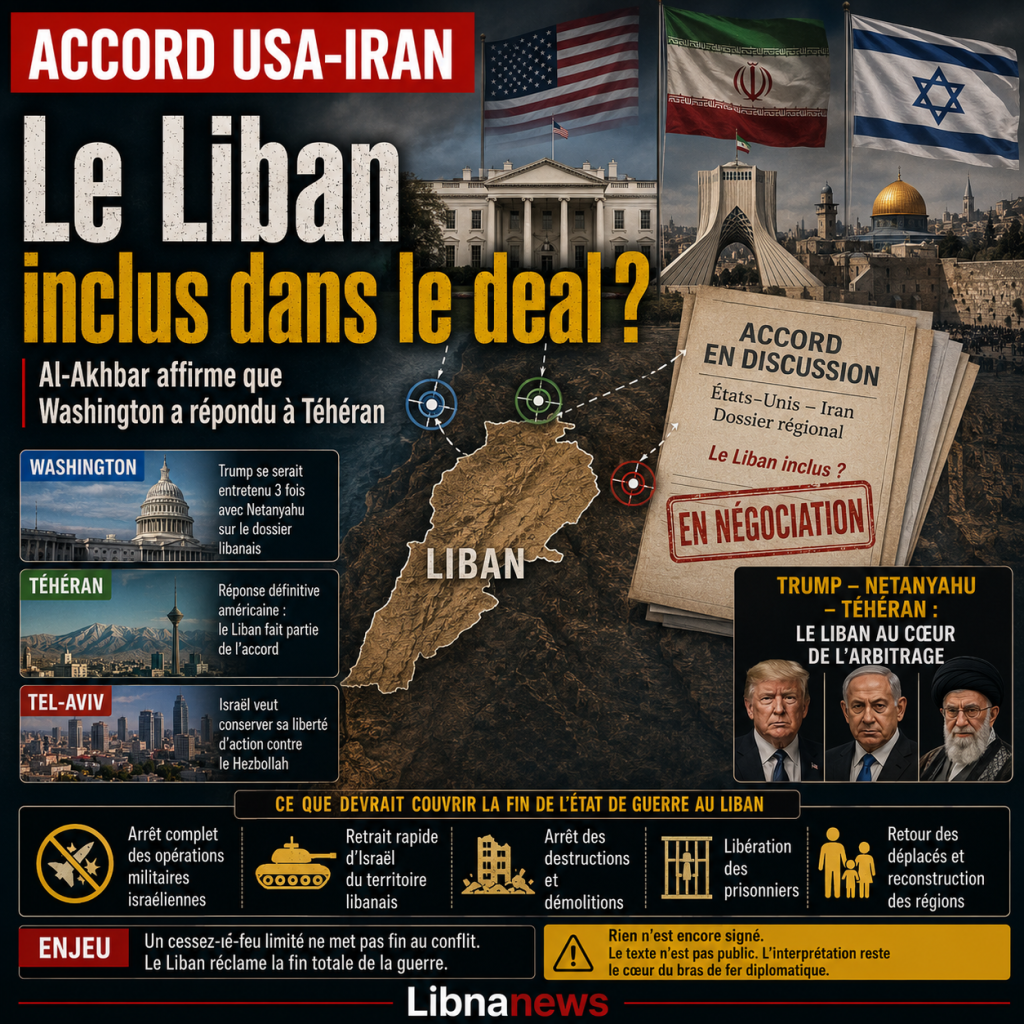
The question of whether Lebanon is included in the draft agreement between the United States and Iran has again become central after new information published byAl-Akhbar. The Lebanese daily claims that Tehran received a definitive reply from Washington confirming that the Lebanese file is part of the agreement under discussion. This version contradicts the dominant reading relayed in recent days by several Western media and by officials close to Israel, according to which the truce between Washington and Tehran would not cover the Lebanese front.
According toAl-Akhbarthe inclusion of Lebanon would not be limited to a vague formula of de-escalation. The newspaper states that the issue is the end of the state of war in Lebanon, not a simple ceasefire. This distinction is important. A ceasefire can freeze fire without settling occupation, destruction, prisoners, return of displaced persons and reconstruction. The end of the state of war would imply, in this reading, the complete cessation of all Israeli military operations, the planning of a rapid withdrawal from Lebanon, the cessation of destruction and demolition, and the release of prisoners.
The same article reports that Donald Trump met with Israeli Prime Minister Benjamin Netanyahu three times about Lebanon. This detail, if confirmed, shows that the Lebanese case would not only be a secondary consequence of the American-Iranian dialogue. It would form part of the arbitration between Washington, Tel Aviv and Tehran. Israel, for its part, has so far sought to preserve its freedom of action against Hezbollah, even when the United States was pushing for a pause on the Iranian front.
The thesis of Al-Akhbar
Al-Akhbarpresents the case as a turning point. The newspaper writes that Trump announced an agreement with Iran to end the war, before the opening of more technical negotiations on the nuclear issue. He also states that in Tehran, officials speak for the first time about significant progress, on the grounds that the United States would have accepted the project transmitted by Iran. Iranian prudence remains, but the tone of daily life is different from that of previous days.
On the Lebanese side, the wording is even more precise. AfterAl-AkhbarIran would have received a definitive response from the United States that Lebanon is included in the agreement. The newspaper links this inclusion to a broader understanding of the ceasefire. It would not only be a matter of stopping fire temporarily, but of recognizing that the war on Lebanese territory must cease as a state of affairs. This reading gives Lebanon a place for direct negotiation, even if Beirut is not formally party to the discussions between Washington and Tehran.
The article also reports that Trump spoke three times with Netanyahu about the Lebanese case. This is an indication of a number of information published in recent days on tensions between Washington and Tel Aviv. The United States wants a de-escalation with Iran. Israel wants to avoid a US-Iranian agreement requiring it to reduce its operations in Lebanon. The conflict therefore concerns the geographical scope of the truce: does it cover only Iran, or does it also include the allied fronts in Tehran, particularly Lebanon?
The d-versionAl-Akhbargives a clear answer. She claims that Lebanon is included. But it must be distinguished from official public confirmation. Neither Washington nor Tehran, at the time of the available information, published a full text of the agreement. Several media reports indicate that the document remains subject to final validation. The debate therefore concerns the interpretation of a text under negotiation, messages sent between capitals and guarantees that may be given behind the scenes.
More conservative Western versions
The Western media have, in recent days, presented a more uncertain picture. A news agency reported that Iran was seeking to retain Lebanon as a lever in discussions with Washington. According to this reading, Tehran wants to link the fate of the Lebanese front to the great regional bargaining, while Beirut tries to maintain a national negotiating path with Israel, under American sponsorship. The same dispatch also quotes President Joseph Aoun, who claims that the future of Lebanon lies with the Lebanese, neither Iran nor Israel.
This reading does not deny that Lebanon is weighing on the agreement. Rather, it indicates that Lebanon has become one of the friction points. For this agency, Tehran makes the ceasefire in Lebanon a condition for a broader arrangement, while Washington and Israel seek to avoid Iran speaking on behalf of Beirut. The difference withAl-Akhbarthe level of certainty.Al-Akhbarstates that Washington replied that Lebanon is included. The Western narratives further describe an arm where this inclusion is precisely contested.
Another American media reported that the memorandum of understanding between the United States and Iran provided for a 60-day ceasefire, including in Lebanon. This information partially compares Western reading to that ofAl-Akhbar. But the same media said that the text still required final validation and that the Iranian decision was not completely stopped. He also stressed the provisional nature of the memorandum, which would pave the way for more detailed nuclear negotiations, without resolving all the issues.
The British press also reported that Trump claims to be close to an agreement, while Iran points out that it has not reached a final conclusion. The Iranian Ministry of Foreign Affairs indicated that much of the text was finalized, but that the Tehran red lines remained. This caution makes the case more complex. An agreement can be almost ready, and yet remain politically fragile if the parties do not agree on the interpretation of its Lebanese clauses.
Cease fire or end of war
The central point is the difference between ceasefire and the end of the state of war. A ceasefire can be partial, temporary and conditional. It can apply to some shots and not others. He can protect Beirut while leaving South Lebanon under pressure. It may require Hezbollah to cease operations, while allowing Israel to retain a right to strike. This is precisely what several Lebanese officials have been denouncing for weeks.
The end of the state of war would have a different scope. It would entail a complete cessation of military operations, the Israeli withdrawal from Lebanese territory, the cessation of destruction, the cessation of demolitions, the release of prisoners and the return of displaced persons. It would transform the discussion into a broader political and security settlement. It would also oblige Israel to renounce the idea of a continuous war in Lebanon on the pretext of fighting against Hezbollah.
According to the reading reported byAl-AkhbarIran would have obtained recognition for this approach. Lebanon would therefore not be included as a mere humanitarian annex or as a temporary calm variable. It would be included as a theatre whose war must stop fully. This is crucial for Beirut. A ceasefire that leaves villages destroyed, prisoners in detention, displaced persons without return and the Israeli army in position does not end the problem. He freezes it.
The Israeli position remains opposed to this reading. Netanyahu and his government want to maintain freedom of action in Lebanon. They claim to be targeting Hezbollah, not the Lebanese state. They refuse that the truce with Iran restricts their right to strike against positions they present as threatening. This position allows Israel to accept a pause on the Iranian front while continuing the war in Lebanon. It is at the heart of the current disagreement.
Lebanon taken between readings
For Lebanon, the stake is both vital and risky. If Lebanon is included in the U.S.-Iranian agreement, it can pave the way for a complete cessation of hostilities, Israeli withdrawal and the return of displaced persons. But this can also give Iran a central role in defining the fate of Lebanon. Beirut is therefore looking for a delicate line: to benefit from Iranian pressure on Washington to stop the strikes, without letting Tehran speak instead of the Lebanese state.
President Joseph Aoun has repeatedly stated that Lebanon must decide its future. Prime Minister Nawaf Salam also insisted that no one negotiates for Lebanon outside the Lebanese state. These statements are aimed at preserving Beirut’s institutional sovereignty. But they do not change one fact: Lebanon’s ability to impose only the cessation of Israeli strikes remains limited.
In this context, Lebanon’s inclusion in a broader agreement can be seen in two ways. The first is positive: it gives the Lebanese case a regional weight, obliges Washington to deal with the war in Lebanon and puts Israel under pressure. The second is more worrying: it turns Lebanon into a negotiating map between Iran and the United States. Both readings may coexist. The same mechanism can lead to de-escalation and reduce the margin of Lebanese sovereignty.
The difference will depend on the final text and its application. If the agreement clearly mentions the cessation of Israeli operations, withdrawal, return of internally displaced persons and prisoners, Lebanon will have a stronger basis. If the agreement is content with a vague extension of the ceasefire, Israel will be able to continue its operations by claiming that they are not part of the Iranian front. The debate on words thus becomes a debate on lives, villages and sovereignty.
Why Israel Resistant
Israel resists the complete inclusion of Lebanon because it would limit its military margin. Since the beginning of the war, the Netanyahu government has sought to impose a new reality on southern Lebanon. It wants to move Hezbollah away from the border, obtain guarantees on disarmament or withdrawal of its combatants, and maintain the possibility of striking if these guarantees are not respected. A clause requiring total cessation of operations would remove part of this leverage.
Netanyahu must also respond to a very sensitive Israeli opinion on the northern front. The people evacuated from Galilee ask for a safe return. Right-wing parties want a hard line against Hezbollah. The most radical ministers reject any truce that would leave the Shiite movement armed. In this climate, accepting that Washington and Tehran impose an end of war on Lebanon can appear as a major political setback.
That’s why the phone calls between Trump and Netanyahu, reported byAl-Akhbarare important. They suggest that the US President had to deal directly with the head of the Israeli government to define Lebanon’s place in the agreement. If these exchanges have taken place on three occasions, they confirm that the Lebanese question is not secondary. It is sensitive enough to require personal arbitration between the two leaders.
Washington, for its part, has an interest in including Lebanon if this inclusion facilitates the agreement with Iran. Trump wants to avoid a resumption of the regional war. He wants to reopen the Strait of Ormuz, reduce the pressure on markets and achieve a diplomatic victory. Iran made it clear, however, that the continuation of Israeli strikes in Lebanon could lead to the failure of any de-escalation. For Washington, Lebanon is therefore becoming a price to be paid to stabilize the Iranian case.
The question of prisoners and destruction
Information reported byAl-Akhbaralso refers to the cessation of destruction and demolition, as well as the release of prisoners. These two points extend the file. They move the discussion from the mere cessation of fire to the concrete consequences of war. The destruction in South Lebanon is not just about military objectives. They affect villages, houses, roads, infrastructure and livelihoods. The cessation of demolitions would be a minimum condition for the return of the inhabitants.
The issue of prisoners was also sensitive. Lebanon regularly calls for the release of persons detained by Israel. In any lasting settlement, this issue returns as a confidence-building measure. Its inclusion in the elements reported byAl-Akhbarindicates that the proposed agreement would cover not only weapons, but also humanitarian and political dimensions.
Planning for Israel’s rapid withdrawal from Lebanon is the third central element. Without withdrawal, the ceasefire would remain unfinished. The Israeli presence on part of Lebanese territory would feed the justification for Hezbollah’s weapons and prevent the normal return of the displaced. It would also maintain permanent tension with the Lebanese army and the inhabitants of the border areas.
These three elements form a coherent architecture: cessation of operations, cessation of destruction, withdrawal, release of prisoners, return of displaced persons. It is this architecture that would allow us to talk about an end to the state of war. Without it, Lebanon would remain in an amputated ceasefire, with a war suspended but not over.
A text yet to be confirmed
However, caution is still needed. InformationAl-Akhbarare precise, but they do not replace the publication of an official text. The United States has not published a comprehensive document confirming all these clauses. Iran did not announce full final approval. Israel claims not to be a party to the memorandum with Iran and continues to want to preserve its security requirements. Western media reports progress, but also uncertainties and risks of failure.
The initial question therefore calls for a nuanced answer. Lebanon seems to be at the heart of the agreement under discussion. Several sources, including Western sources, indicate that the ceasefire or its extension would include Lebanon.Al-Akhbargoes further, saying that Washington has given Iran a definitive response and that the agreement is about the end of the state of war in Lebanon. But until the text is signed, published and implemented, this inclusion remains a diplomatic issue.
For Beirut, the priority will be to transform this possible inclusion into written and verifiable guarantees. Lebanon cannot simply be mentioned in a regional agreement. He must obtain an effective halt to strikes, a withdrawal schedule, the protection of civilians, the return of internally displaced persons and a procedure on prisoners. It must also preserve its ability to speak on its behalf, so that the agreement is not only an exchange between Washington, Tehran and Tel Aviv on its territory.
The next few days will tell if the informationAl-Akhbarannounces a turning point or a new battle of interpretation. If Washington confirms that Lebanon is included in the end of the war, Israel will have to choose between accepting an American constraint or pursuing a war that threatens the agreement with Iran. If the White House returns to a closer reading, Lebanon will remain the weak point of de-escalation, the one where war can continue even as the major capitals announce peace.




