

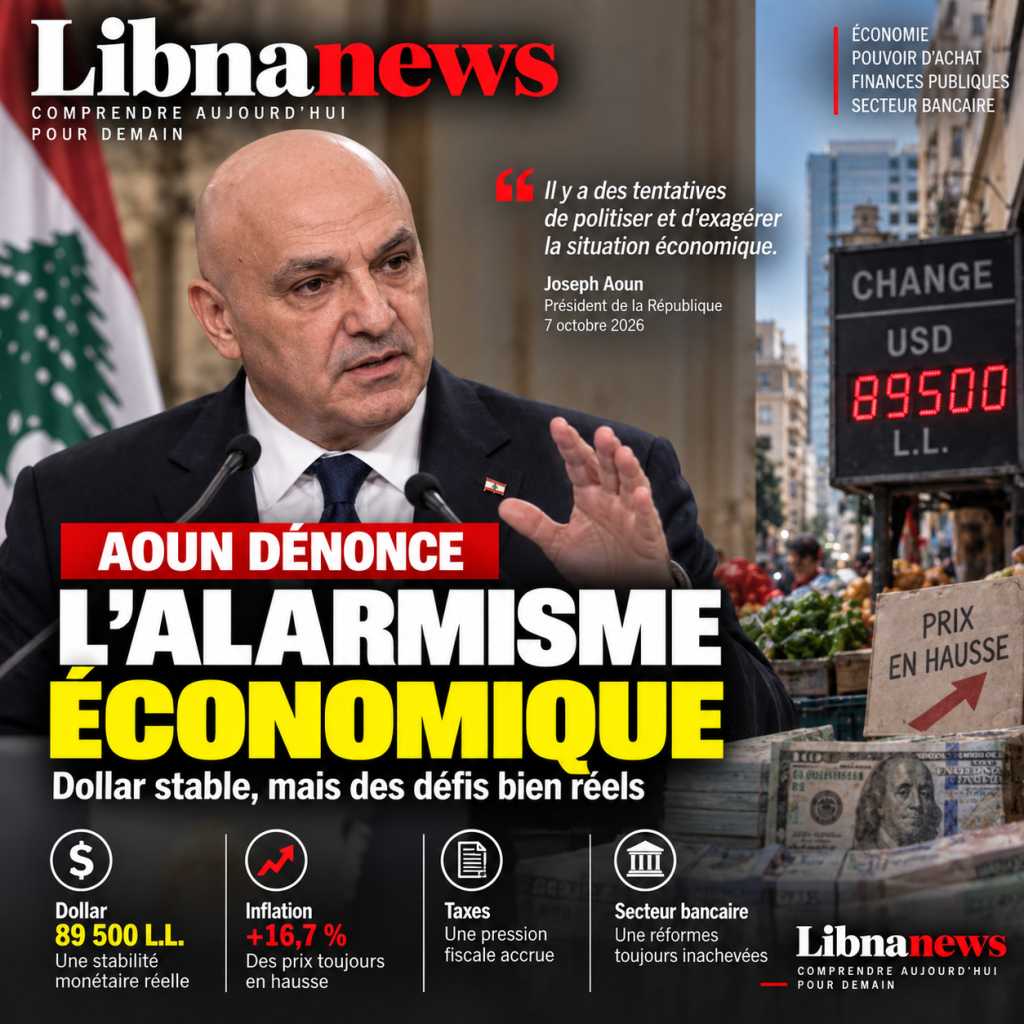
President Joseph Aoun denounced on Wednesday 7 October 2026 attempts to « politicize » and « exaggerate » Lebanon’s economic situation, notably through fears of an increase in the dollar and a new crisis comparable to that of 2019. The Head of State can rely on real monetary stability, with the dollar remaining around £89,500. But its warning comes in an economy still facing high inflation despite its dollarization, increased tax pressure, financial difficulties of the state and still incomplete banking restructuring. All these elements distinguish alarmist rumours from well-founded economic concerns.
President Joseph Aoun warned Wednesday against what he considers to be a political instrumentalisation of the economic situation. In particular, he mentioned discussions about a possible raise in the dollar and comparisons with the crisis triggered in 2019. According to him, these speeches are aimed at creating confusion and marginalizing efforts to put Lebanon back on the path of recovery.
Aoun called for cooperation in the face of economic difficulties, recalling that they do not concern Lebanon alone. He also highlighted measures taken by the Bank of Lebanon and the Ministry of Finance to maintain monetary stability. Finally, the President felt that decades of corruption and mismanagement could not be eliminated quickly, while ensuring that the authorities were working to combat corruption, develop digital administration and improve the functioning of public institutions.
Aoun defends the stability of the dollar
The main argument behind presidential discourse is exchange rate stability. After several years of collapse of the pound, the dollar has been evolving for a long time around £89,500. Lebanon is therefore not currently experiencing the monetary spiral that had marked the early years of the crisis, when the depreciation of the currency was fuelling price increases and loss of confidence almost daily.
The rumours of an imminent new surge in the dollar without concrete elements can have consequences in this context. The monetary trauma remains profound. A sudden increase in the demand for currencies caused by fear can create additional market tension and fuel the expectations that the authorities are trying to avoid.
Joseph Aoun’s call not to turn every concern into an announcement of a new collapse comparable to 2019 is therefore based on a real difference between the two periods. The Bank of Lebanon has more control over liquidity in books and the foreign exchange market is not experiencing the disorderly movements observed during the most acute years of the crisis at this stage.
But the problem begins when the stability of the dollar implicitly becomes synonymous with economic stability. Both realities no longer coincide in Lebanon.
High inflation despite dollarization
The Lebanese economy has been heavily dollarized since the collapse of the pound. Much of the price, rent, services and transactions are now directly expressed in dollars or closely indexed to the US currency. This has reduced one of the main sources of price instability: daily changes in the exchange rate.
Yet inflation remains high. According to the latest available official data, consumer prices rose by16.66 % over one year in august 2026. For its part, the World Bank forecasts average inflation of around17.5% over the whole year 2026.
This phenomenon is particularly important to appreciate the President’s comments. An inflation close to 17% in an already largely dollarized economy cannot be explained by a further fall in the pound. It reflects other tensions: rising costs, war-related disturbances, energy, transportation, imports and price increases for some locally produced services.
For households, the difference is important but the result remains concrete. The dollar can remain at £89,500 while a basket of goods and services continues to cost more. A household whose income in dollars or converted pounds does not increase at the same rate therefore loses purchasing power despite monetary stability.
This is one of the limits of Joseph Aoun’s reassuring speech. Rumours about an explosion of the dollar can be unfounded without cost-of-living concerns.
Taxes also fuel economic malaise
The President also called for Lebanese difficulties to be placed in a complicated global economic environment. But part of the pressure on households comes directly from the financial needs of the Lebanese State. It has been trying for several years to rebuild its revenue after the collapse of tax collection and the real value of levies during the crisis.
This restoration of revenue requires a reassessment of taxes, duties, administrative fees and public tariffs. The Government has also envisaged an increase in VAT from 11% to 12% in order to finance, inter alia, the additional expenditure related to public sector remuneration and pensions.
For the State, these measures respond to a real constraint. Public servants have lost much of their purchasing power since 2019, governments lack resources and public services need to be funded. The war added considerable needs for reconstruction, assistance to displaced populations and rehabilitation of infrastructure.
For households and businesses, however, these levies represent an additional burden. A policy aimed at restoring public finances can therefore be economically necessary while increasing the perception of rising costs of living in the short term.
This fact makes the general accusation of « exaggeration » difficult. Part of the discontent is not based on rumours about the dollar, but on actually higher spending.
The state itself remains financially constrained
Joseph Aoun admits that decades of corruption and mismanagement cannot be eliminated quickly. This is probably the most important point of his diagnosis, as the state itself remains one of the most fragile players in the economy.
Lebanon has been in default on its sovereign debt since 2020. It does not have normal access to international markets to finance its needs. The public debt remains considered unsustainable and its restructuring is not completed. Under these circumstances, any sustained increase in expenditure must be offset by new revenue, external assistance or savings elsewhere in the budget.
War has further complicated this equation. The country must rebuild housing and infrastructure, support the affected regions and finance public institutions, while the economy was once again heavily affected by hostilities. The World Bank forecasts a significant contraction in activity in 2026.
The fiscal prudence advocated by the government and international institutions avoids further financial flight. However, it means that the State has little means to alleviate the difficulties encountered by households.
The crisis of 2019 is not yet resolved
Another difficulty is the comparison used by Joseph Aoun with 2019. Lebanon is certainly not confronted today with the same mechanism of monetary collapse. But the crisis started in 2019 has never been completely resolved.
The banking system continues to be thoroughly restructured, without any further definitive distribution of accumulated losses. Depositors continue to suffer the consequences of the collapse, while the issue of deposit return remains linked to the treatment of losses by the Bank of Lebanon and commercial banks.
The country still does not have a full programme with the International Monetary Fund, more than four years after the preliminary agreement concluded in April 2022. The IMF continues to call for credible restructuring of the banking sector, a distribution of losses in line with the creditor hierarchy, a deposit strategy and a framework for making public debt sustainable.
This situation makes the presidential formula on the risk of a crisis « similar to 2019 » paradoxical. There is no need for an identical new crisis to begin, as several essential components of the one in 2019 remain unresolved.
Banks remain a major player in blocking
The banking sector is one of the main areas of confrontation around these reforms. Since the beginning of the crisis, the Association of Banks of Lebanon and several institutions have challenged plans to allocate losses that could impose a significant contribution to banks and their shareholders.
The banks highlight the responsibility of the State and the Bank of Lebanon in accumulating losses and defend mechanisms to further mobilize public resources or assets to repay depositors. On the contrary, the IMF insists that the losses should first be borne by shareholders and lower-ranking creditors before they are transferred to depositors.
This conflict has contributed to slowing down financial restructuring. However, it would be incorrect to attribute only banks the failure to conclude a programme with the IMF so far. The Government, Parliament, the Bank of Lebanon and the various political forces have also been involved in several years of disagreement and delays.
But the banking sector’s resistance to the allocation of losses is a central element of the case. They show above all that the main financial problem inherited from 2019 remains open while the President calls not to dramatize the current situation.
Distinguish rumors of real difficulties
Joseph Aoun’s warning therefore contains two messages that should be distinguished. The first concerns monetary rumours. In the absence of evidence showing an imminent increase in the dollar, announcing the certain return of a collapse comparable to that of 2019 can effectively fuel unnecessary fear and speculation.
The second message is more problematic if it is to extend this criticism to all economic concerns. Inflation is close to 17%, the government’s fiscal difficulties, fiscal pressure, weak banking, deposit records and the persistent lack of agreement with the IMF are measurable economic realities.
Thus, the Lebanon of 2026 presents a paradox that cannot be grasped by the exchange rate alone. The currency is stable, but prices are rising. The State is improving its revenue, but must increase certain levies to finance its needs. The banking system works partially, but its restructuring remains incomplete. The authorities are talking about recovery, but the war has again severely affected activity.
By calling not to « exaggerate » the situation, Joseph Aoun seeks to protect difficult monetary stability and avoid a new crisis of confidence. However, his speech will be confronted with the data of the coming months: price developments, fiscal pressure, the ability of the state to finance its bonds and, above all, advanced banking issues with the IMF. It is on these results, more than on maintaining the dollar at its current level alone, that the reality of the economic recovery invoked by the President can be measured.





Comments