

On Tuesday, November 10, 2026, Benjamin Netanyahu’s office defended the entry of humanitarian equipment to prepare Gaza for the winter. N12 presents this statement as an indirect confirmation of a relaxation, after a call by Donald Trump. But the volumes put forward resume an Israeli balance sheet already announced. On the ground, humanitarian assessments continue to describe destroyed shelters, depleted stocks and equipment blocked outside the enclave.
What Channel 12 reports precisely
In a published on november 10 at 10:30 p.m. and updated on november 11 at 1:45 a.mN12 explains that the English press release from the Prime Minister’s office suggests that Israel is enabling the implementation of the winter programme. The channel is bringing this announcement closer to a telephone interview during which Trump allegedly asked Netanyahu to move forward in the implementation of his Gaza plan.
This content of the appeal, held Thursday, November 5, is attributed by N12 to two informed sources. It is therefore not a public statement by the US President. The chain also reports on the preparation of a mechanism for the entry of dual-use, civilian and military equipment, while avoiding their direct surrender to Hamas.
A statement that also defends the Israeli record
The statement by the Prime Minister’s Office, reproduced by Zman Israel, highlights more than 91,000 tents, more than 8,200 trucks of tarpaulins, blankets, clothing and other supplies, as well as 12 trucks pumping wastewater. It also mentions network repairs and fuel for pumping facilities.
Netanyahu claims to be working with the United States and the Peace Council. He maintains, however, that reconstruction must be preceded by the disarmament of Hamas and the demilitarization of Gaza. His office accused the movement of diverting humanitarian equipment for military purposes. These accusations are those of the Israeli government; the release does not provide an independent verification of the alleged diversions.
The figures do not prove a new delivery after the call
The Israeli army was already presenting, in a of 6 novembera total of over 85,000 tents and 8,000 trucks since the beginning of the programme. It distinguished approved requests from equipment actually transported, citing logistical and budgetary difficulties for some of the cargoes.
The balance sheet of 91,000 tents and 8,200 trucks was then claimed by the army and COGAT on 9 November, according to their report from the Times of Israel. Its recovery the next day does not allow to measure a supplement entered as a result of American pressure. No independent count consulted links a particular delivery to this telephone exchange.
Peace Council public pressure documented
On 9 November, the Peace Council, chaired by Trump, called on Israel to immediately authorize and facilitate the necessary supplies for shelter, water, sanitation and drainage. It considered that the measures envisaged were insufficient after the floods. He also called on Hamas to disarm and renounce power.
This communiqué, already processed by Libnanewsestablishes public pressure. The response of the Netanyahu office represents the new development. The scope and modalities of any further opening remain to be assessed on the basis of concrete authorisations and actual passages.
Thousands of families remain at risk
The oCHA balance sheet adopted on 8 November and published on 9 November described the consequences of the rains that began on 6 November: more than 26,000 households sought assistance for shelter or damaged property. Partners report over 6,000 destroyed family shelters and 17,400 damaged. These assessments are preliminary.
Humanitarian supplies of tents, tarpaulins, blankets and clothing in Gaza were almost exhausted. Outside, more than 150,000 tents purchased by humanitarian partners and States are ready to be shipped, including approximately 117,000 from the Egyptian Relief Committee in Al-Arich. Their availability outside Gaza does not mean that they crossed the entry points.
OCHA calls for Israeli permits and funding for shelters, as well as pumps, engine oils, spare parts and heavy equipment. Water that accumulates between tents makes sanitation inseparable from cold protection.
Needs were already exceeding the means before the rains
The oCHA report of 5 November estimated the remaining needs for approximately 121,000 tents, 561,000 tarpaulins, 57,000 emergency shelter kits and 1.7 million mattresses as at 1 November. It reported a funding shortfall of $186.5 million for winter needs estimated at $267.9 million.
These requirements are not confused with the Israeli cumulation of entries or with the number of tents available abroad: the dates, perimeters and function of the indicators differ. A tent entered several weeks earlier may have been distributed, worn or destroyed.
OCHA also warned that the suspension announced on 1 November of humanitarian and commercial shipments from Egypt, with certain exceptions, threatened food supply. If it persisted, free food production and distribution could increase from about 600,000 to 330,000 per day. This was a projected risk, not an already measured decline.
Sustainable shelters and networks to be repaired
The Norwegian Refugee Council alerted as early as 5 October the consequences of restrictions on wood, cement, plate and other materials necessary for repair. The organization described a cycle of replacement of tents and tarpaulins that deteriorated in a few months because of the lack of more resistant shelters.
Its estimate at that time placed about 950,000 people in medium- or high-risk flood sites. Lack of space to move families, drainage needs and inadequate heavy equipment made preparations difficult. This earlier warning shows that the winter response is not limited to counting tents.
In order to assess the follow-up to the press release of 10 November, the decisive indicators will be the volumes actually entered, their distribution to families and the return to service of water and sanitation equipment. Political declarations and cumulative balance sheets alone do not allow us to know how many households now have safe shelter.
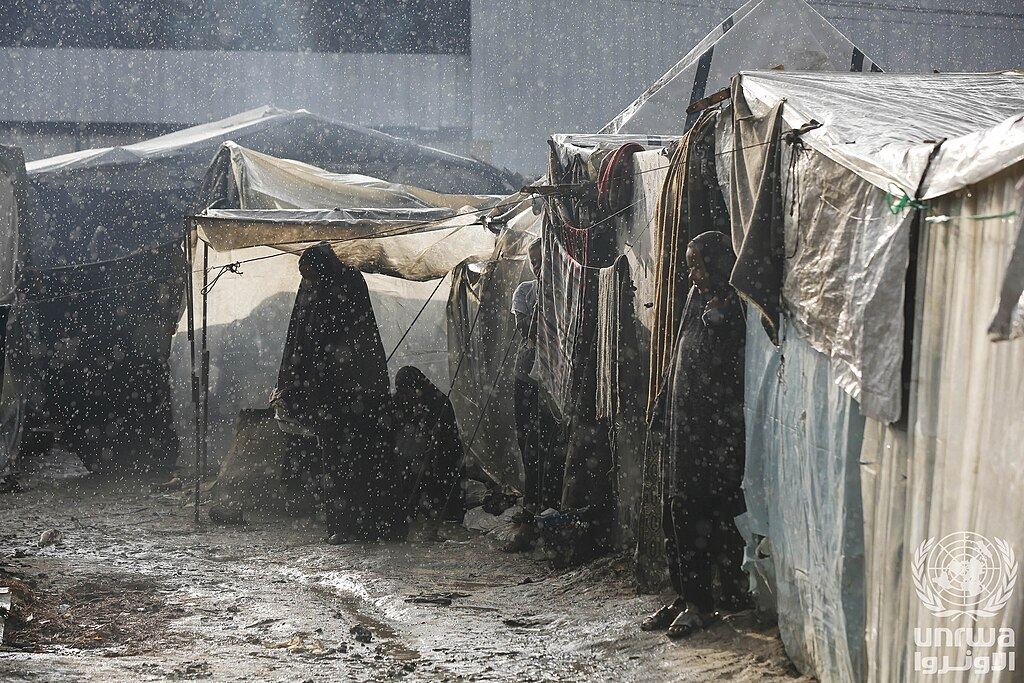
Photo of illustration: tents of displaced people in the rain in Deir al-Balah, 23 January 2025. This archive does not show the floods of November 2026. Ashraf Amra / UNRWA, CC BY-SA 3.0 IGO. Whole photograph, without retouching the scene. Source, credit and licence.






Comments