

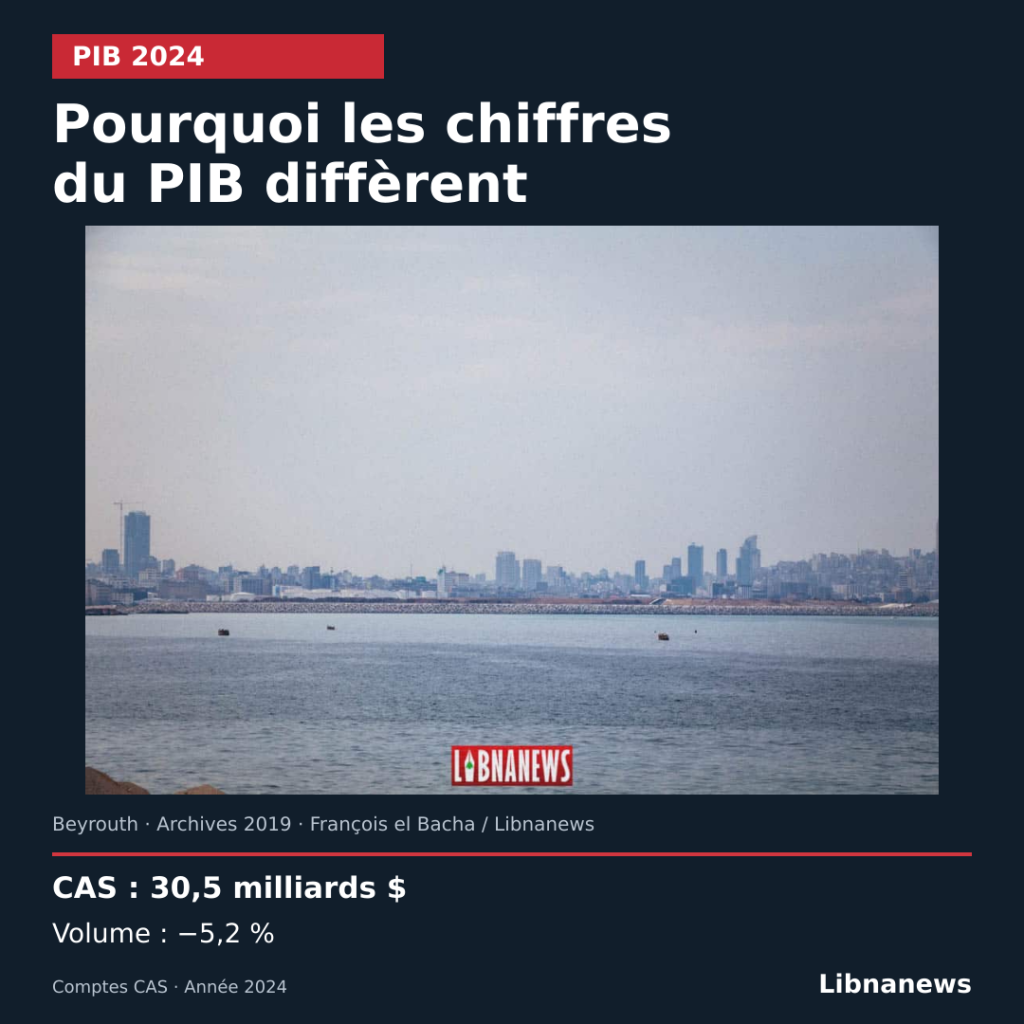
Lebanese GDP in 2024 is estimated at $30.5 billion in the accounts of the Central Statistical Office (CAS), with a 5.2% decrease in volume. The Bank of Lebanon’s December 2025 macroeconomic review, however, retained $27.7 billion and a contraction of 6.4 per cent for the same year. These figures belong to different statistical exercises. Comparing them requires checking their origin, method and version of previous years.
The gap also concerns archives. On August 6, 2025, Libnanews reported an estimate of $32.8 billion, accompanied by a real decrease of 7%. The now available CAS folder does not include these values. It also revises the period 2020-2023. To read the economic trajectory, therefore, a coherent series is needed, rather than juxtapose the figures of successive publications.
Lebanese GDP in 2024: three estimates to be distinguished
In its main table, the CAS estimates gross domestic product at £2,728,402 billion in 2024. The amount reached $2,257,806 billion in 2023. This represents a nominal increase of 20.8%, calculated in the same currency unit. This increase does not reflect an equivalent increase in production. The GDP deflator increased by 27.4%, while the volume contracted by 5.2%.
The Bank of Lebanon presents another set in its December 2025 review. Its comparison table for 2024 shows nominal GDP of $27.7 billion and real growth of -6.4 per cent. It explicitly distinguishes its estimates from those of CAS, the World Bank and the International Monetary Fund. The CAS box for 2024 is still marked as unavailable.
| Publication and status | Nominal GDP 2024 | Real change 2024 |
|---|---|---|
| Estimated by Libnanews on August 6, 2025 | $32.8 billion | -7.0 per cent |
| BDL estimate, December 2025 review | $27.7 billion | -6.4 per cent |
| CAS Accounts 2024, revised series consulted November 10, 2026 | $30.5 billion | -5.2 per cent |
The table returns published values at different times. It does not measure a growth between these publications, nor does it measure a wealth supplement that appeared after their circulation. The $2.8 billion between the last two evaluations is for the same economic year. The documents consulted do not provide a transition table for assigning each dollar of this difference to a specific correction.
Revised accounts, not a simple monetary conversion
The CAS states that the 2020–2023 revisions are the result of new data provided by several institutions. It also mentions important methodological improvements, particularly for real estate activity. A revision therefore changes the levels and sometimes the growth rates of previous years. It changes the basis on which the following year is compared.
Real estate illustrates this development. The previous method implied a fixed annual increase of 0.5 per cent in the housing stock. The new methodology uses household surveys, distinguishes between owner-occupied and rented dwellings, and then mobilizes building permits for annual estimates. Another change concerns the deflator of non-housing real estate services.
These changes relate to the measurement of a service produced each year. They do not consist of adding to GDP the value of all apartments. The CAS does not, in the main report, isolate the quantitative contribution of each improvement to the total revision. Presenting real estate as the only explanation for the gap between institutions would therefore go beyond what documents establish.
The BDL presents its own statistical limits
The preface of the December 2025 review explains the use of internal estimates. At the time of preparation of this document, the major national accounts aggregates had not been formally updated beyond 2023. The central bank used its composite activity indicator and various indirect indicators to assess the economic situation.
The CAS describes a production-based approach to national accounts. It measures the added value of resident producers. The expenditure approach then presents consumption, capital formation and external trade. Two organizations can work on the same economy with different information, schedules and tools.
It would be wrong to transform the reference date of a review into a certain date of all its data. Similarly, the directory « 2024/10 » in the address of the CAS file does not prove its date of publication. The document consulted presents many accounts for 2024 and earlier revisions. His computer path does not allow us to say that they were already available in October 2024.
Price, dollars and volumes answer three questions
GDP in current books measures a value at year’s prices. The volume series seeks to neutralise price developments. The dollar conversion adds a third transaction: the application of an exchange rate. These three readings are not interchangeable, especially after a monetary crisis.
For 2024, the CAS uses a weighted average annual rate of £89,474.5 per dollar. For 2023, it retained 87,043.2 pounds. Its table reached $30.5 billion in 2024, compared to $25.9 billion in 2023, with rounded dollar amounts. The nominal increase in foreign exchange thus coexists with a real decline in activity.
The long-term comparison provides another benchmark. By volume, the 2024 level represents about 69% of the 2019 level. The nominal GDP in dollars represents approximately 57% of the $53.3 billion posted in 2019. The first report provides information on price-adjusted production. The second also depends on relative prices and monetary conversion.
Economic ratios must follow the same version
A revision of GDP mechanically affects the indicators expressed as a percentage of this total. Debt, government revenue, credit or external deficit may have a different ratio without changing their amount. Retrieve a numerator of a publication and divide it by a GDP derived from another request, therefore a verification of the scope and period.
The same caution applies to forecasts. The 2024 CAS accounts do not provide a 2026 growth measure. They provide a revised historical basis. The next useful comparison will focus on accounts with compatible definitions, and detailed explanations that will accompany any further revision.





Comments