

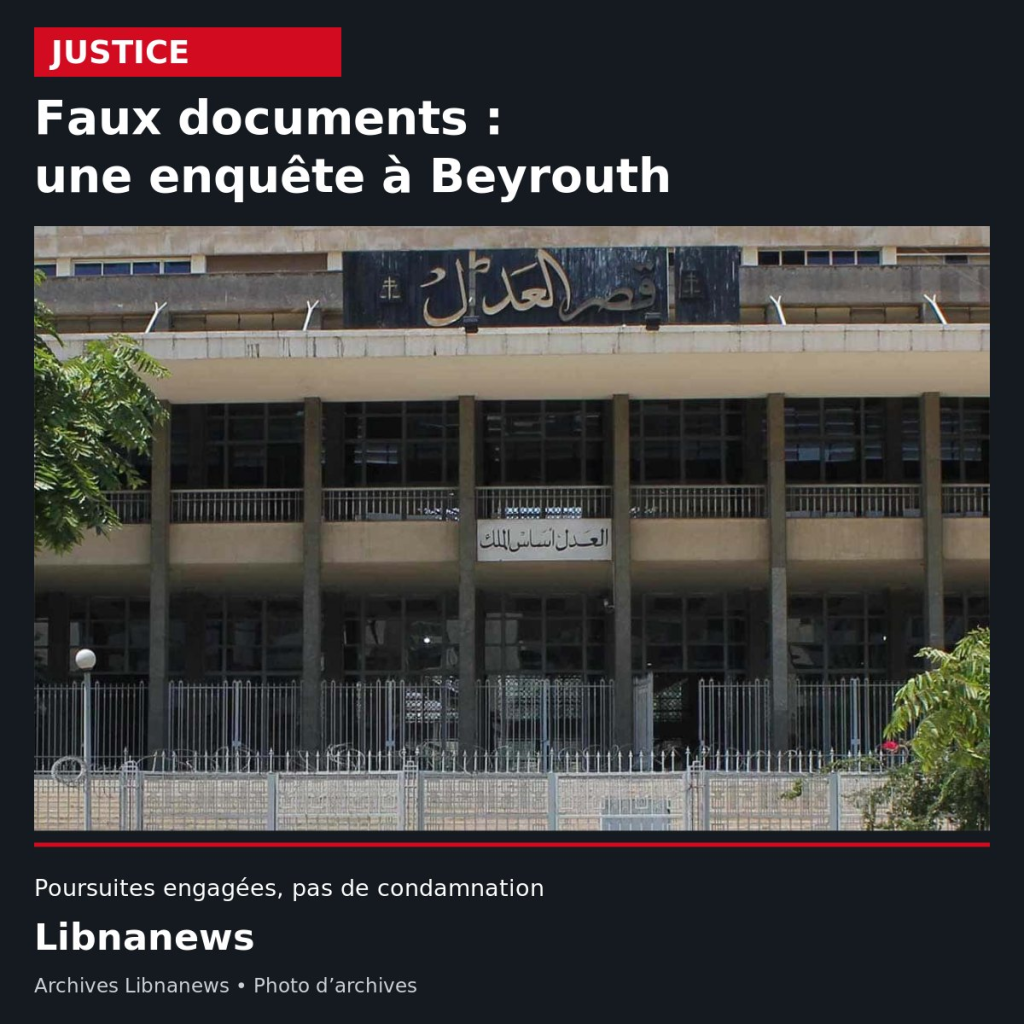
A complaint filed by a banking institution led to an investigation into alleged falsified documents used by banks, businesses and other institutions in Beirut. According to the judicial information released on 6 November, the investigations were conducted by the Beirut Judicial Brigade under the supervision of the Attorney General of Appeal Raja Hamouche.
Magistrate Marie Rady has initiated proceedings, including the establishment of an association to commit crimes, the falsification of official and private documents and the use of forgery. These prosecutions open a judicial stage. They do not constitute a conviction of the persons involved.
A bank complaint giving rise to the file
The complainant institution reportedly identified the use by companies of certificates issued to it without having been regularly issued. The investigators then examined the documents, their source and those involved in their preparation or transmission.
Certificates relating to company capital are included in the documents indicated. According to the version of the investigation, some of them reported a capital increase that did not correspond to the actual situation. This charge must remain distinguished from a final judicial finding on each of the companies concerned.
The file would not be limited to bank coins. Public information also refers to evidence relating to social security and educational institutions. The diversity of the alleged documents requires verification of each origin rather than a single process.
Deemed roles to be clarified
The survey accounts describe an organization that combines the production of documents and the search for clients by intermediaries. The alleged existence of this division of labour does not make it possible to assign the same role to all persons prosecuted.
The exact number of documents and scope of operations remain to be determined. The figures distributed are not uniform. They do not allow for a consolidated total of bank notes, other evidence or persons involved. A document seized, a transaction and a client do not represent the same unit.
The investigation will also have to distinguish between the persons who allegedly manufactured the forgeries, those who would have transmitted them and those who would have used them knowingly. The presence of an irregular document in a file is not sufficient, without other elements, to demonstrate the intention of all stakeholders.
Check a document with its issuer
This case highlights the difference between the appearance of a certificate and the confirmation of its authenticity. A header, a reproduced signature or a stamp may give an impression of regularity. The inspection with the body presented as an issuer makes it possible to examine whether the part actually corresponds to its records.
Traceability of transmissions is another issue. Identifying the person who submitted a document, the date of receipt and the checks performed helps to reconstruct the course of a disputed document. These elements do not replace the investigation but give it points of comparison.
The available information does not establish an overall amount of losses for banks. A document bearing the name of an institution does not prove that the institution paid money or suffered financial damage of the same kind as the other bodies mentioned. The consequences must be examined separately.
Prosecutions remain open
The case continues before the courts to clarify the responsibilities and scope of the alleged acts. The published material does not include full judicial documents or detailed observations of the persons involved. Their guilt cannot be deduced from the only qualifications at the stage of prosecution.
The next useful steps will be communicable court decisions and the results of documentary audits. They will make it possible to distinguish the documents actually falsified from the initial suspicions, then the individual responsibilities of a general presentation of the alleged network.





Comments